Showing posts with label Asia. Show all posts

Sunday, January 31, 2021

Massive power outage in Pakistan plunges whole country into darkness

Euronews 10/01/2021 

A major technical fault in Pakistan's power generation and distribution system caused a massive power outage that plunged the country into darkness overnight, the energy minister said.

The blackout affected all the country's major cities on Saturday, including its capital Islamabad, its major economic hub Karachi, and the second-largest city, Lahore.

Hours after the late outage, Energy Minister Omar Ayub Khan said on Twitter that power was being restored in phases, starting with Islamabad. He said later on Sunday that power had been brought back to much of the country.

Saturday, November 30, 2019

Why Asia is facing a food problem?


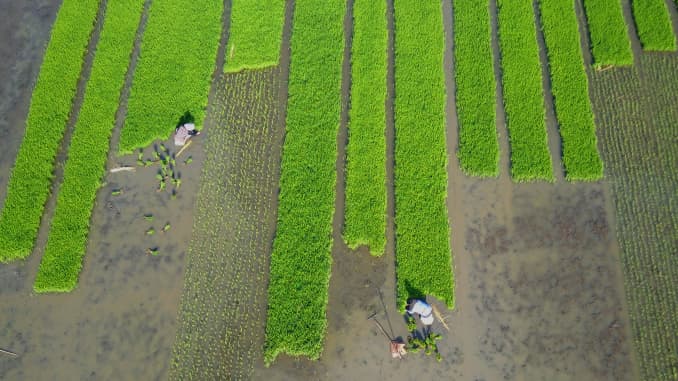
GP: TOPSHOT-CHINA-AGRICULTURE-RICE 191122

NBC   Nov 27 2019
Asia is “unable to feed itself” — and needs to invest another $800 billion in the next 10 years to produce more food and meet the region’s needs, according to a report.

The population in Asia is growing, and consumers are demanding safer, healthier, and more sustainable food.

 Food spending will more than double — from $4 trillion in 2019 to over $8 trillion by 2030, said the Asia Food Challenge Report which was released last week.

“If this investment does not materialise, we believe the industry will struggle to keep up with demand, resulting in poorer food outcomes for Asia’s population,” according to the authors of the report which was compiled by PwC, Rabobank, and Singapore investment firm Temasek.

Why Asia is facing a food problem

“Asia is unable to feed itself, relying on imports flowing through long supply chains from the Americas, Europe and Africa,” according to the report that was released Nov. 20.

That’s consistent with research from a 2018 United Nations Conference on Trade and Development report. “In general, countries in Latin America, East Africa and South Asia are net food exporters, while most of the rest of Asia and Africa remain net food importers,” the Key Statistics and Trends in International Trade report said.

Saturday, August 31, 2019

Philippines declares epidemic after more than 600 die from dengue fever


There have been more than 146,062 cases of dengue recorded between January and June 20, according to the country's health department. The department said that the number of recorded cases is 98 percent higher than the same period in 2018.
Health Secretary Francisco Duque said it was important for local areas to access national funds to treat the outbreak and provide a "localized response" in a Tuesday news release. During the week of July 14 to July 20, the country documented 10,502 cases, 71 percent higher than the same period in 2018.
The Western Visayas area of the country was hit hardest, with more than 23,000 documented cases. There were also large outbreaks in Calabarzon, the Zamboanga Peninsula and Northern Mindanao.
The Health Department said Tuesday it is launching a program aimed at destroying mosquito breeding sites.

Saturday, September 30, 2017

Japan considers killing cash by launching own cryptocurrency


Japan considers killing cash by launching own cryptocurrency

27 Sep, 2017 
Authorities in Japan are considering starting a digital currency to be called the J-Coin. By doing so, Tokyo will reduce cash circulation in the country.  
"The project is in the early stages, and we have just held study meetings with other institutions," a spokesperson for Japanese bank Mizuho Financial Group told CNBC on Wednesday.
"This will be pegged with Japanese Yen, and hopefully used to make payments and transfers through a mobile phone app," the bank said.
According to a report by the Financial Times, a consortium of Japanese banks are working on the project, and they are interested in launching the J-Coin before the Tokyo Olympics in 2020.
The project has the support of the central bank and regulators. The J-Coin will allow Japanese consumers to pay for goods and services with their smartphones.
The government's goal is to cut dependence on cash, which represents 70 percent of all transactions by value in Japan. The J-Coin will be exchanged at a one-to-one rate with the yen.
Banks behind the project intend to counter the growing e-payments services of international tech giants like Apple or Alibaba.
Japan is one of the first countries to begin to recognize cryptocurrency as a legal method of payment. The country passed legislation into law, effective April 1, categorizing digital currency as a kind of prepaid payment instrument.        RT

Thursday, May 18, 2017

The One Belt-One Road initiative may shift the global balance of power once and for all

Adam Garrie
World leaders, including Russia’s President Putin have been attending meetings in Beijing as part of the ‘One Belt–One Road’ initiatives launched by China in 2013.
The ambitious project aims to set up transport and trade corridors that will help connect East-Asia, Eurasia and Europe, using both rail and maritime links.
China’s goals represent the most ambitious project to re-define the logistical and financial nature of world-trade since the creation of the World Trade Organisation (WTO) in 1995.
Chinese President Xi Jinping opened the meetings saying,
“Spanning thousands of miles and years, the ancient silk routes embody the spirit of peace and cooperation, openness and inclusiveness, mutual learning and mutual benefit.
The Silk Road spirit has become a great heritage of human civilisation”.
Russia is keenly interested in using this project to facilitate energy trade between Russia and its eastern partners including China, Mongolia, Japan and Korea.
President Putin called One Belt-One Road, named for China’s ancient silk road, a “Civilization project for the future”.
He went on to state,
“We cannot resolve modern challenges by using old approaches. We need new ideas. We need to abandon all stereotypes.
We should set a role model for the global community of how we can work together, develop together, based on equality and respect for national sovereignty based on international law and the United Nations principles”.
Turkey’s President Erdogan meanwhile said that the project would “pave the way in a new era”.
The projects logistics are immense and any project of this size will not come to fruition in a day. This is especially true as the countries leading the project seek cooperation and consent. Intimation and domination, hallmarks of western economic imperialism, are off the table.
President Xi made this abundantly clear. The Chinese President said,
“We have no intentions to meddle in the internal affairs of other countries via bringing our social system and the development model, or by imposing our will (on other states)”.
However, the political implications are clear. While the leaders of China, Russia, India, Turkey, Pakistan, Philippines, Indonesia,Vietnam, Myanmar and others gathered in Beijing, the leaders of the United States and Europe’s largest economies were notably absent. Instead, these countries sent minor officials.          More