Showing posts with label History. Show all posts

Sunday, January 31, 2021

The St. bartholomew massacre

St. Bartholomew's Day massacre - Wikipedia
THE NAME FRANCE IS DERIVED FROM THE FRANKISH WORD FRANK (GER. FREI) WHICH MEANS FREE AS IN: "THEREFORE IF THE SON MAKES YOU FREE, YOU SHALL BE FREE INDEED (ST. JOHN 7:36).

Here is an English language quote based on a true history of France entitled Franco-Gallia by a Massacre survivor named François Hotman:

Gaul returned to a tradition of more freedom with the arrival of the Franks. They were originally a Germanic tribe living on the coasts of northern Europe, between the Rhine and the Elbe. Their very name reflects their love of freedom, as frank means "free" in German. The Franks were originally a fairly small band, but other Germanic peoples entering Gaul adopted their name out of admiration for their leading role in overthrowing the tyranny of the Romans. (Kingdon, Myths About the St. Bartholomew's Day Massacre, p. 143).

The old Frankish language was replaced by the French language which is a Romance language derived from Latin with only a few Frankish words remaining to remind the French of the liberty-loving Franks.

The French Christians were given the derogatory name "Huguenot" by the Jesuits. Unlike the word "Protestant," which came from the corrupt Latin Vulgate Version, the origin of that word is still obscure.

Satan is the same in every country, so Empress Tzu Hsi engineered a Chinese St. Bartholomew's Day Massacre in 1900.

On August 15, 1534, Ignatius Loyola and 6 of his companions founded the Jesuit order on a hilltop outside Paris. The deadly 6 founders were: Ignatius Loyola, Francis Xavier, Alfonso Salmeron, Diego Laínez, Nicolás Bobadilla, Peter Faber, and Simão Rodrigues. Francis Borgia, the grandson of Pope Alexander VI, and the éminence grise behind the new order–was not present at that time. 

On August 15, 1534, the Jesuit order was founded on a hilltop outside Paris called Montmartre. It was originally a Druid shrine where human sacrifices were made to Esus.

A basilica to the Sacred Heart of Jesus now dominates Montmartre.

The original French name of the Jesuits was la Sociéte des Pères du Sacré-Coeur de Jésus.

In 1540, Pope Paul III officially recognized the "new" Militia of Zeus and Minerva....In reality, the Jesuits were just warmed-over or incognito Franciscans....They were the shock troops or special forces of the Counter-Reformation. They were excused from chanting the Psalms; they did not have to wear the round tonsure, they were allowed to wear civilian clothes, and their general was elected for life. 

The planning for the Massacre began immediately after the founding of the Jesuits. The glorious Reformation, begun in Germany on October 31, 1517, had spread to France–and was joyfully received. A great change had come over the people as industry and learning began to flourish, and so rapidly did the Truth spread that over a third of the French population of 20,000,000 embraced the Reformed Christian Faith.

True Christianity was also making progress at the highest echelon of French society. In 1521, Anne Boleyn—the future queen of Englandreturned from a 5-year-stay at the French Court . . . burning with zeal to rescue her nation from Papal darkness. 

Walsingham "hid" in the British embassy and escaped the Massacre. He was not even FIRED for incompetence . . . but was promoted to become the queen's Secretary of State in 1573....That was an incredible failure of intelligence for the legendary British Secret Service!!

The Massacre happened at a time of great friendship and ecumenical goodwill between the French Christians and the Vatican. The French Christians were derisively called "Huguenots" by the Latin

Alarmingly for the Jesuits, the French Christians ignored the Bull of Borgia granting the entire New World to Spain. In 1562, Jean Ribault led a colonizing expedition to South Carolina . . . which was brutally wiped out by the Spanish. 

Catherine married Henry II of France in 1533. For the first 10 years of their marriage she produced no children. In desperation, she entered into a pact with Lucifer himself, and eventually produced 10 "children." One of her daughters, Elizabeth, married Philip II of Spain. 

Charles was the eldest son of King Francis II (1544–1560), who suffered an untimely death in a jousting tournament. Charles was only 10-years-old at that time, so his mother Catherine became Regent, and de-facto ruler of the country. Unlike England, French Salic law prohibited females from inheriting the throne, otherwise Catherine would have joined Elizabeth of England and Mary Queen of Scots as an independent sovereign.

The lure to get the admiral to Paris was the wedding of King Henry III of Navarre to Marguerite de Valois. Marguerite was the daughter of King Henry II of France and Catherine de' Medici.

Admiral Coligny was without doubt the most famous man in France, and a leader in the French effort to plant the New Israel in the New World. The 1562 colony that was founded by Jean Ribault in South Carolina was wiped out by the Spanish Inquisition. 

On the morning of Friday, August 22, Admiral Coligny was walking back from the Louvre after a meeting with King Charles. The admiral was near home when suddenly he bent down to tie his shoelace. At that moment a shot rang out, wounding . . . but not killing the admiral:

On the morning of Friday, 22 August, the government recess for the marriage celebrations being now over, Admiral Gaspard de Coligny left his lodgings on the rue de Béthizy–today No. 144 rue de Rivoli–for a council meeting that was to start at nine o'clock. He had wished to press for French military intervention in Flanders, but to his frustration he found Anjou presiding over the meeting as the King had risen late. Anjou left the meeting early and when matters had been concluded the Admiral came across the King on his way with Téligny and the Duke of Guise to play a game of tennis. Charles begged Coligny to join him for a game but the Admiral refused. They parted at around eleven o'clock and Coligny left the Louvre for his short walk home, reading a document while he did so. As he approached the window at which Maurevert was hiding a binding on one of his shoes came loose and he bent down to fix it. Just as he did so, a shot rang out. The bullet broke his left arm and almost tore the index finger off his right hand. Had he not bent over at the critical moment he would have been mortally wounded. (Frieda, Catherine de Medici, p. 259).

 Charles de Louviers, seignor de Maurevert, lay in wait for days to kill Admiral Coligny . . . but in the end his attempt ended in failure

Catherine didn't care if her son was killed in the "assassination" attempt because she was the real ruler of France. This false flag operation was similar to the Gunpowder Plot in England....Our Great JEHOVAH brought their wicked council to nothing:

JEHOVAH brings the counsel of the nations to nothing. He makes the plans of the peoples of no effect
(Psalm 33:10).

In preparation for the Massacre, friendly diplomatic relations also began between long-time rivals England and France. The Treaty of Blois was signed on April 19, 1572, between Queen Elizabeth and Catherine de' Medici. Based on the terms of the treaty, France and England relinquished their historic rivalry and established an alliance against Spain:

In June, the Queen Mother sent to London, as ambassador extraordinary, the Duke of Montmorency, with powers to ratify the Treaty of Blois and formally offer Alencon as a husband for the Queen. Elizabeth was a gracious hostess, entertaining the embassy lavishly and investing the Duke with the Order of the Garter, but she was noncommittal about the marriage proposal, citing her reservations about Alencon's age and appearance. When Montmorency left, she promised that she would consider the matter and give King Charles her answer within a month. She then told Burghley to instruct Walshingham to submit a full report. (Weir, The Life of Queen Elizabeth I, p. 285).

Sir "Francis" Walshingham was the queen's "spymaster" and eyes and ears throughout Europe.

To distinguish between the murderers and the French Christians, a white cross was sown on their hats.

It is true that England and France were always bitter enemies . . . but that was Papal England and Papal France!!           

 References
Algrant, Christine Pevitt. Madame de Pompadour, Mistress of France. Grove Press, New York. 2002.
Bernier, Olivier. Louis the Beloved. The Life of Louis XV. Doubleday & Co., Garden City, New York, 1984.
Crowdy, Terry. The Enemy Within: A History of Spies, Spymasters and Espionage. Osprey Publishing, Oxford, UK, 2006.
Erickson, Carolly, The First Elizabeth. St. Martin's Press, New York, 1983.
Frieda, Leonie. Catherine de Medici: Renaissance Queen of France. HarperCollins Publishers, New York, 2003.
Hotman, François. Franco-Gallia: or, an Account of the Ancient Free State of France. Tim. Goodwin, London, 1711.
Haynes, Alan. Walshingham: Elizabethan Spymaster and Statesman. Sutton Publishing, Gloustershire, UK, 2007.
Kingdon, Robert M. Myth's About the St. Bartholomew's Day Massacre, Harvard University Press, Cambridge, MASS, 1988.
Lever, Evelyne. Madame de Pompadour. A Life. Farrar, Straus and Giroux, New York, 2000.
Nicolini, G.B. History of the Jesuits. George Bell & Sons, London & New York, 1893.
Noguerès, Henry. The Massacre of Saint Bartholomew. The Macmillan Company, New York, 1959.
Smith, H.C. The Bonapartes. The History of a Dynasty. Hambledon & London, London & New York, 2000.
Somerset, Anne, Elizabeth I. St. Martin's Griffin, New York, 1991.
Weir, Alison. The Life of Queen Elizabeth I. Ballantine Books, New York, 1998.

         Reformation

The horrible St. Bartholomew's Day Massacre

August 24, 1572, was the date of the infamous Jesuit engineered St. Bartholomew's Day Massacre. On that day, over 400 years ago, began one of the most horrifying holocausts in history.

The Massacre began with the brutal murder of Admiral Coligny . . . in his bedroom.

Henry, Duke of Guise
(1550–1588).
 

At 2 A.M., on the morning of August 24, Henry, duke of Guise, led about 300 soldiers to the home of Admiral Coligny.

The murders entered his house by force and found the admiral by his bedside praying.

The admiral was brutally stabbed to death and his body thrown out the window.

 
The brutal murder of
Admiral Coligny.

When Catherine de Medici heard news of his death, she ordered the big bell of St. Germain L'Auxerrous to be rung. That was the agreed on signal for the Massacre to begin. Soon other church bells throughout the city began to ring and the deadly holocaust commenced.

The Church of Saint-Germain L'Auxerrois.
 

The signal for the Massacre to begin was the ringing of the bell of Saint-Germain L'Auxerrois.

The Cardinal de Lorraine was in Rome at that time, but thousands of Certificates of Indulgences (certificat d'indulgence), were preprinted with his signature.

The priests and friars used these licenses to kill to encourage the murderers and absolve them in advance!!


The Cardinal de Lorraine (1524–1574).
The Cardinal de Lorraine
(1524–1574).

If the murderers happened to be killed in the carnage, the priests and friars assured them that their Certificates would cause the doors of Paradise to open wide for them.

Catherine de' Medici exults over the dead bodies of the Huguenots.
Catherine de' Medici rejoiced over the
dead bodies of the
French Christians.


The St. Bartholomew's Day Massacre was one of the greatest crimes in the history of the world.

Total victims numbered over 100,000 Christians throughout France.

When confronted with the choice of the mass or death, very few choose the mass.


Blood flowed like a river in the streets of Paris.
The Catholics were acting like Muslims
during the Massacre!

When dawn broke on the morning of August 24, such a sight of carnage had never been seen in the entire history of the world. Paris was a literal Dante's Inferno slaughterhouse....Men, women, and children were stripped naked and their bodies horribly mutilated.

Catherine de' Medici came out to gloat over and inspect the bodies of the slain. She wondered if the bodies of the Christians were normal because they could not be seduced by her courtesans.

After the brutal murder of Admiral Coligny, his head was cut off, and taken to the royal palace as a trophy for the king and queen mother. It was later embalmed and sent to Rome as a "present" for Pope Gregory XIII.

King Philip II (1527-1598).
King from 1554 to 1598.


King Philip II of Spain financed the Massacre with New World gold and silver.

When news of the Massacre reached him, he "laughed for the first time on record."

Jesuit general Francis Borgia was the overall coordinator of the Massacre.


Francis Borgia (1510–1572).
Jesuit general from 1565 to 1572.

Beginning in Paris, the Massacre spread rapidly to all the cities, towns, and villages....The streets were awash with blood and the rivers were filled with dead bodies. Men, women, and children were all consumed by the murderous conflagration. Total victims exceeded 100,000. Not until the atomic bombing of Hiroshima were so many people killed in so short a time.

Queen Elizabeth heard the news on September 3:

By 22 August, the Queen had arrived at Kenilworth to be entertained by Leicester, who had arranged all kinds of 'princely sports.' But on 3 September, while she was out hunting one day, a messenger arrived with a dispatch from Walsingham in Paris that caused her to burst into tears, cancel all further entertainments and send de la Mole back to France. A Spanish agent in London informed Alva that she had 'sent all her musicians and minstrels home, and there are no more of the dances, farces and entertainments with which they have been amusing themselves lately, as they have some less agreeable things to think about.' (Weir, The Life of Queen Elizabeth I, p. 287).

Queen Elizabeth put on a good act of "grieving," while Mary Queen of Scots stayed up all night celebrating. Pope Gregory XIII was beside himself with joy.

Pope Gregory XIII (1502-1585).
Pope Gregory XIII (1502–1585).
Pope from1572 to 1585.


Pope Gregory XIII was delirious with joy when he heard of the Massacre.

The Gregorian calendarnow universally usedis named after him!


The Massacre Medal of Pope Gregory XIII.

 
After the Massacre, Pope Gregory celebrated a Te Deum mass. Italian artist Giorgio Vasari painted 3 frescoes which still hang in the Sala Regia Palace next to the Cistine Chapel. A commemorate medal was struck with Gregory's portrait and on the obverse a chastising angel, sword in hand, and the legend UGONOTTORUM STRAGES ("Massacre of the Huguenots"). Pope Gregory designated September 11 as a joint holiday (Feast of the unholy Rosary) to celebrate the Battle of Lepanto and the St. Bartholomew's Day Massacre!!
The Massacre was a staggering blow to France from which it never fully recovered. Most of the Christians were artisans and belonged to the middle class. Many of them found a refuge in Germany, Switzerland, England, and Ireland and those countries benefited greatly by their industry and maritime skills.        
 
References
Algrant, Christine Pevitt. Madame de Pompadour, Mistress of France. Grove Press, New York. 2002.
Bernier, Olivier. Louis the Beloved. The Life of Louis XV. Doubleday & Co., Garden City, New York, 1984.
Crowdy, Terry. The Enemy Within: A History of Spies, Spymasters and Espionage. Osprey Publishing, Oxford, UK, 2006.
Erickson, Carolly, The First Elizabeth. St. Martin's Press, New York, 1983.
Frieda, Leonie. Catherine de Medici: Renaissance Queen of France. HarperCollins Publishers, New York, 2003.
Hotman, François. Franco-Gallia: or, an Account of the Ancient Free State of France. Tim. Goodwin, London, 1711.
Haynes, Alan. Walshingham: Elizabethan Spymaster and Statesman. Sutton Publishing, Gloustershire, UK, 2007.
Kingdon, Robert M. Myth's About the St. Bartholomew's Day Massacre, Harvard University Press, Cambridge, MASS, 1988.
Lever, Evelyne. Madame de Pompadour. A Life. Farrar, Straus and Giroux, New York, 2000.
Nicolini, G.B. History of the Jesuits. George Bell & Sons, London & New York, 1893.
Noguerès, Henry. The Massacre of Saint Bartholomew. The Macmillan Company, New York, 1959.
Smith, H.C. The Bonapartes. The History of a Dynasty. Hambledon & London, London & New York, 2000.
Somerset, Anne, Elizabeth I. St. Martin's Griffin, New York, 1991.
Weir, Alison. The Life of Queen Elizabeth I. Ballantine Books, New York, 1998.
 

Holocaust Timeline

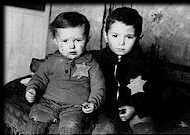
Emanuel and Avram Rosenthal, killed at Majdanek

January 30, 1933 - Adolf Hitler is appointed Chancellor of Germany a nation with a Jewish population of 566,000.

February 22, 1933 - 40,000 SA and SS men are sworn in as auxiliary police.

February 27, 1933 - Nazis burn Reichstag building to create crisis atmosphere.

February 28, 1933 - Emergency powers granted to Hitler as a result of the Reichstag fire.

March 22, 1933 - Nazis open Dachau concentration camp near Munich, to be followed by Buchenwald near Weimar in central Germany, Sachsenhausen near Berlin in northern Germany, and Ravensbrück for women.

March 24, 1933 - German Parliament passes Enabling Act giving Hitler dictatorial powers.

See also: The History Place - Rise of Hitler

April 1, 1933 - Nazis stage boycott of Jewish shops and businesses.

April 11, 1933 - Nazis issue a Decree defining a non-Aryan as "anyone descended from non-Aryan, especially Jewish, parents or grandparents. One parent or grandparent classifies the descendant as non-Aryan...especially if one parent or grandparent was of the Jewish faith."

April 26, 1933 - The Gestapo is born, created by Hermann Göring in the German state of Prussia.

May 10, 1933 - Burning of books in Berlin and throughout Germany.

July 14, 1933 - Nazi Party is declared the only legal party in Germany; Also, Nazis pass Law to strip Jewish immigrants from Poland of their German citizenship.

In July - Nazis pass law allowing for forced sterilization of those found by a Hereditary Health Court to have genetic defects.

In September - Nazis establish Reich Chamber of Culture, then exclude Jews from the Arts.

September 29, 1933 - Nazis prohibit Jews from owning land.

October 4, 1933 - Jews are prohibited from being newspaper editors.

November 24, 1933 - Nazis pass a Law against Habitual and Dangerous Criminals, which allows beggars, the homeless, alcoholics and the unemployed to be sent to concentration camps.

 More...

Saturday, October 31, 2020

Codeword Barbelon

Download [PDF] Codeword Barb�l�n - 666 - Danger in the Vatican: The  Sons of Loyola and Their Plans for World Domination... (BK 1) [Illustrated]  (Paperback) (Codeword Barbelon) By - P.D. Stuart *Full Pages* - dayw6dw78wa

This book contains some very startling facts.   Who is really in Charge? New book exposes the secret societies and political forces behind the New World Order…. "Men occasionally stumble over the Truth, but most pick themselves up and hurry on as if nothing had happened.” (Sir Winston Churchill) 

Synopsis:
Utilizing records inaccessible to or overlooked by other writers, P.D. Stuart’s book puts the spotlight on the power about which President Woodrow Wilson once said, “the few who are aware of it, dare not speak above their breath when they speak in condemnation of it.” A work of great insight and moral courage Codeword Barbêlôn exposes, in unequivocal terms, the secret connections, oaths and codewords of the powers that be…. 

"Good historians," wrote Horace Walpole, "are the most scarce of all writers, and no wonder! A good style is not very common; thorough information is still rare; and if these meet, what a chance that impartiality should be added to them!" P.D. Stuart's work possesses all of these qualities. Consisting of 48 chapters, and hundreds of footnotes and references, Codeword Barbêlôn covers a vast period of history, from the second and third centuries to the present day. Spatially, the work spans three continents, and focuses on Europe and North America and the hidden influence of secret societies on that continent. Indeed, reading Codeword Barbêlôn, one cannot help but feel as if he were travelling in H. G. Wells' time machine, finding himself sometimes at the City of Rome in the 16th Century, at other times in Bavarian Germany in the 18th Century, yet at other times in the political intrigues of North America in the 19th, 20th and 21st Centuries. 

In doing so Codeword Barbêlôn uncovers a plot so sinister, that in the words of ex-FBI Director and founder, J. Edgar Hoover: "The individual... coming face-to-face with a conspiracy so monstrous... cannot believe it exists...." Some of it is unsettling, disquieting, and often downright scary. 

Codeword Barbêlôn is a `tough book': direct, honest, and thought provoking, with no compromise, no apologies, and no vagaries; it spares no characters—all are lashed without ceremony. It "connects the dots" completely, thoroughly, and intelligently. An instance of high scholarship and intelligence, this book recounts the little known history of the religious and political Illuminati, and reveals how knowledge of this secret organization was transmitted to America; and importantly how it has ruled the world from that country ever since. Rarely does one source "connect the dots" as completely, thoroughly, and intelligently as does this one! It gives us a stunningly plausible picture of the global religious and political landscape of the 21st century. This extraordinary project is the literary equivalent of turning over a flat rock. This book sounds a clear warning…. a gripping tell-all book, as unforgettable as it is daring. A controversial and hard-hitting exposé of the powers that be. To borrow the words of Henry Lincoln, “Something extraordinary is waiting to be found….”       Google Books

Friday, February 28, 2020

Vatican set to open Pope Pius XII's secret WWII archives

Fox. February 20
The Vatican is set to open the secret archives of Pope Pius XII, the World War II-era pope whose record during the Holocaust has come under intense scrutiny.
The archive will be opened on March 2.

Some Jewish groups and historians have said Pius, who was pope from 1939-1958, stayed silent during the Holocaust and didn’t do enough to save lives. His defenders at the Vatican and beyond say he used quiet diplomacy and encouraged convents and other religious institutes to hide Jews.

Saturday, November 30, 2019

The Pilgrims Journey


Secular evidence of Jesus existence


Image result for jesus old"
Bible History    November 2019
The first historical evidence for the life of Jesus, mentioned outside of the Bible, comes from a Jewish historian by the name of Josephus.

Josephus was born in 37 A.D., just a few years after the crucifixion of the Lord Jesus Christ. He was the son of a priest named Matthias and at the age of 19 he became a Pharisee in Jerusalem. Later in his life he was appointed a commander in Galilee during the Jewish revolt against Rome.
      
After surrendering to the Romans, he was taken before the Roman Commander Vespasian and prophesied that God had shown him in a dream that Vespasian and his son Titus would soon become Emperor's of Rome. Shortly afterwards the dream became reality and Josephus became a member of Vespasian's household. During his stay in Rome he wrote two works dealing with Jewish history.
       
In his work entitled Jewish Antiquities, which was written between 70 and 100 A.D., he mentions Jesus the Messiah.

Josephus is quoted below by Eusebius, an early Christian Bishop, in 324 A.D.:
       
"It was during this timeframe that Jesus lived, a wise man, if anyone could really call him a man. For he did many deeds that were out of the ordinary and was an instructor of those who accept the truth. Many of the Jews and Greeks put their trust in him. He being the Messiah. When our chief leaders accused him, Pilate condemned him to the cross, but his original disciples continued to follow him; for he had appeared before them on the third day alive again, as the prophets of God had spoken of these and countless other marvelous things about him. And the tribe of Christians, who had been named after him, remains to this present day."
      A later Arabic manuscript written by a tenth-century Melkite historian named Agapius also quotes from the same passage of Josephus as follows:
      "During this time there was a wise man named Jesus, and his actions were good, and he was known to be holy. Many people among the Jews and from other nations became his followers. He was condemned to be crucified and to die by the order of Pilate. But those who had become his disciples did not stray from his teaching. They proclaimed that he had appeared to them three days after his crucifixion and that he was restored to life. Thus, he may have been the Christ, of whom wondrous things have been spoken of through the prophets. And the Christians, who were known by his name, have remained to this very day."

     
 These statements confirm the following Christian truths found in the Bible:

1) Jesus was the Messiah spoken of by the prophets.  
2) He performed miracles.
3) He was crucified under Pontius Pilate
4) He arose from the dead three days later and appeared to his disciples.

Jesus Christ was not just another man, He was God in human flesh. There is no greater truth than knowing Jesus Christ as your Lord and Savior.    

Sources:
1) Josephus The Essential Writings, Author: Paul L. Maier, ISBN 0-8254-2964-1
Pg.10-11 (Josephus background), Pg.264-265 (Jesus history).

2) Antiquities of the Jews - The Historian Flavius Josephus.
Book 18 Chapter 3 (Josephus's account of Jesus in history showing Jesus was real).          

Friday, March 16, 2018

Dormant volcanos in United States

Image result for georgia mountains
USGS 
June 20, 1857 Pigeon Mountain volcano, Georgia  The New York Times
A writer in the Sentinel states that a volcano has lately made its appearance in Pigeon mountain, about ten miles from Augusta. On the 24th, ult., the mountain was violently agitated, and the citizens in the vicinity were aroused and terribly frightened by the commotion. When observing the mountain they were more than ever terrified, for a brilliant light was plainly seen issuing from the summit. The atmosphere soon became strongly impregnated with a disagreeable sulphuric odor. On the following day a thick torrent of smoke and ashes ascended from where this light was previously seen. No blaze has yet been seen to issue from the crater. It had continued up to the 29th ultimo about as above described, emitting smoke and ashes without intermission. The crater is thought to be about 100 yards in diameter. No one has yet ventured near enough to ascertain anything of its general depth. 

Several springs in the vicinity have totally disappeared. Many of the citizens are very much alarmed, and some even are moving out of the valley, through anticipation and fear of a violent eruption. The writer states that the principle of a volcano has for many years been germinating in Pigeon mountain. About ten miles south from where the present appeared, is the crater of an extinguished volcano, which appears to have been in an active state at no very distant period. 

March 18, 1874 ... (March 17) Bald Mountain, North Carolina  The New York Times
KNOXVILLE, Tenn., March 17. -- We have no positive information of the volcanic disturbance reported from Raleigh. It is reported from Ashville as being between that place and Old Fort, and not at the Bald Mountains. The rumbling sounds have been heard and tremors felt frequently during the last two or three weeks for some distance in that vicinity.  

THE REPORTS CONFIRMED.
RALEIGH, N.C., March 17. -- Passengers from the west on this morning's train confirm the reports of the rumbling noises and the general upheaving of the Bald Mountain in Western Carolina. People living on and near the mountain are moving out, and a volcanic eruption is momentarily expected.

Tuesday, October 31, 2017

500 years ago today: The birth of Protestantism


Martin Luther

WND   October 31, 2017
On Oct. 31, 1517, an Augustinian monk named Martin Luther posted 95 debate questions on the door of Wittenberg Church, which began the movement known as “the Reformation.”
In 1521, 34-year-old Martin Luther was summoned to stand trial before the most powerful man in the world, 21-year-old Holy Roman Emperor Charles V. Charles V of Spain’s empire spanned nearly two million square miles across Europe, the Netherlands, the Far East, North and South America and the Caribbean.
The Philippine Islands were named after his son, King Philip II of Spain. The sun never set on the Spanish Empire.
At the Diet of Worms, Charles V initially dismissed Luther’s theses as “an argument between monks” and simply declared Martin Luther an outlaw. Martin Luther was hid by Frederick of Saxony in the Wartburg Castle, where he translated the New Testament into German. Charles V’s unruly troops sacked Rome and imprisoned Pope Clement VII for six months.
​This was the same Pope that refused to annul the marriage of Henry VIII and Charles’s aunt Catherine of Aragon, leading Henry break away from Rome and start the Church of England. (Catherine had been married for six months to Henry’s older brother Arthur before he died in 1502.)
Charles V oversaw the Spanish colonization of the Americas, and began the Counter-Reformation. He eventually responded to the pleadings of the priest Bartolomé de Las Casas and outlawed the enslavement of native Americans.
Gold from the New World was used by Spain to push back the Muslim Ottoman Empire’s invasion of Europe. Sultan Suleiman the Magnificent’s Ottoman fleet dominated the Mediterranean Sea, the Red Sea and the Persian Gulf. Suleiman conquered into Christian Hungary, Christian Serbia and Christian Austria, in addition to controlling the Middle East and North Africa. In 1529, 35-year-old Suleiman the Magnificent sent 100,000 Muslim Turks to surround Vienna, Austria.
Martin Luther wrote: “The Turk is the rod of the wrath of the Lord our God. … If the Turk’s god, the devil, is not beaten first, there is reason to fear that the Turk will not be so easy to beat. … Christian weapons and power must do it. …”
Martin Luther continued: “(The fight against the Turks) must begin with repentance, and we must reform our lives, or we shall fight in vain. (The Church should) drive men to repentance by showing our great and numberless sins and our ingratitude, by which we have earned God’s wrath and disfavor, so that He justly gives us into the hands of the devil and the Turk.”
In an attempt to unite the Holy Roman Empire against the Ottoman Muslims, Charles V agreed to a truce recognizing the Protestants, as Eric W. Gritisch wrote in “Martin – God’s Court Jester: Luther in Retrospect” (Philadelphia: Fortress, 1983, p. 69-70): “Afraid of losing the much-needed support of the German princes for the struggle against the Turkish threat from the south, Emperor Charles V agreed to a truce between Protestant and Catholic territories in Nuremberg in 1532. … Thus the Lutheran movement was, for the first time, officially tolerated and could enjoy a place in the political sun of the Holy Roman Empire.”
As the Islamic threat intensified, reformer John Calvin wrote to Philip Melanthon in 154 (“Selected Works of John Calvin: Tracts & Letters,” I: 373): “I hear of the sad condition of your Germany! … The Turk again prepares to wage war with a larger force. Who will stand up to oppose his marching throughout the length and breadth of the land, at his mere will and pleasure?”
Followers of the reformers who “protested” certain doctrines, were generally referred to as “Protestants.” Some Protestants refused to help Charles V who was defending Europe from the Muslim invasion. Finally, Charles V made a treaty with the German Lutheran Princes by signing the Peace of Augsburg, September 25, 1555, ceasing the religious struggle between Lutherans and Catholics.
A line in the treaty, “cuius regio, eius religio,” allowed each king to decide what was to be believed in his kingdom.
A month later, Oct. 25, 1555, suffering from severe gout, Charles V abdicated his throne and lived the rest of his life secluded in the monastery of Yuste, leaving his son Philip II to rule.
As different kings in Europe chose different denominations for their kingdoms, millions migrated from one country to another simply for conscience sake. Many of these Christian religious refugees fled Europe to settle colonies in America.
New York University Professor Emeritus Patricia Bonomi, in her article “The Middle Colonies as the Birthplace of American Religious Pluralism” wrote: “The colonists were about 98 percent Protestant.”
Of the 56 signers of the Declaration, most were Protestant, with the notable exception of Catholic Charles Carroll of Maryland.
British Statesman Edmund Burke addressed Parliament, 1775: “All Protestantism … is a sort of dissent. But the religion most prevalent in our Northern Colonies is a refinement on the principle of resistance; it is the dissidence of dissent, and the protestantism of the Protestant religion.”
Samuel Adams stated when he signed the Declaration of Independence: “This day, I trust, the reign of political protestantism will commence.”
Martin Luther, who died in 1546, wrote: “I am much afraid that schools will prove to be the great gates of hell unless they diligently labor in explaining the Holy Scriptures, engraving them in the hearts of youth.”

Friday, August 4, 2017

John Wycliffe, the medieval reformer


John Wycliffe

 "Trust wholly in Christ; rely altogether on his sufferings; beware of seeking to be justified in any other way than by his righteousness."
John Wycliffe left quite an impression on the church: 43 years after his death, officials dug up his body, burned his remains, and threw the ashes into the river Swift. Still, they couldn't get rid of him. Wycliffe's teachings, though suppressed, continued to spread. As a later chronicler observed, "Thus the brook hath conveyed his ashes into Avon; Avon into Severn; Severn into the narrow seas; and they into the main ocean. And thus the ashes of Wycliffe are the emblem of his doctrine which now is dispersed the world over."

Timeline

1302
Unam Sanctam proclaims papal supremacy
1309
Papacy begins "Babylonian" exile in Avignon
1321
Dante completes Divine Comedy
1330
John Wycliffe born
1384
John Wycliffe dies
1415
Jan Hus burned at stake

"Master of errors"

Wycliffe had been born in the hinterlands, on a sheep farm 200 miles from London. He left for Oxford University in 1346, but because of periodic eruptions of the Black Death, he was not able to earn his doctorate until 1372. Nonetheless, by then he was already considered Oxford's leading philosopher and theologian.
In 1374 he became rector of the parish in Lutterworth, but a year later he was disappointed to learn he was not granted a position at Lincoln nor the bishopric of Worcester—setbacks that some have seized upon as motives for his subsequent attacks on the papacy.
In the meantime, Rome had demanded financial support from England, a nation struggling to raise money to resist a possible French attack. Wycliffe advised his local lord, John of Gaunt, to tell Parliament not to comply. He argued that the church was already too wealthy and that Christ called his disciples to poverty, not wealth. If anyone should keep such taxes, it should be local English authorities.
Such opinions got Wycliffe into trouble, and he was brought to London to answer charges of heresy. The hearing had hardly gotten underway when recriminations on both sides filled the air. Soon they erupted into an open brawl, ending the meeting. Three months later, Pope Gregory XI issued five bulls (church edicts) against Wycliffe, in which Wycliffe was accused on 18 counts and was called "the master of errors."
At a subsequent hearing before the archbishop at Lambeth Palace, Wycliffe replied, "I am ready to defend my convictions even unto death…. I have followed the Sacred Scriptures and the holy doctors." He went on to say that the pope and the church were second in authority to Scripture.
This didn't sit well with Rome, but because of Wycliffe's popularity in England and a subsequent split in the papacy (the Great Schism of 1378, when rival popes were elected), Wycliffe was put under "house arrest" and left to pastor his Lutterworth parish.

Disputing the church

He deepened his study of Scripture and wrote more about his conflicts with official church teaching. He wrote against the doctrine of transubstantiation: "The bread while becoming by virtue of Christ's words the body of Christ does not cease to be bread."
He challenged indulgences: "It is plain to me that our prelates in granting indulgences do commonly blaspheme the wisdom of God."
He repudiated the confessional: "Private confession … was not ordered by Christ and was not used by the apostles."
He reiterated the biblical teaching on faith: "Trust wholly in Christ; rely altogether on his sufferings; beware of seeking to be justified in any other way than by his righteousness."
Believing that every Christian should have access to Scripture (only Latin translations were available at the time), he began translating the Bible into English, with the help of his good friend John Purvey.
The church bitterly opposed it: "By this translation, the Scriptures have become vulgar, and they are more available to lay, and even to women who can read, than they were to learned scholars, who have a high intelligence. So the pearl of the gospel is scattered and trodden underfoot by swine."
Wycliffe replied, "Englishmen learn Christ's law best in English. Moses heard God's law in his own tongue; so did Christ's apostles."
Wycliffe died before the translation was complete (and before authorities could convict him of heresy); his friend Purvey is considered responsible for the version of the "Wycliffe" Bible we have today. Though Wycliffe's followers (who came to be called "Lollards"—referring to the region of their original strength) were driven underground, they remained a persistent irritant to English Catholic authorities until the English Reformation made their views the norm.        Christianity Today

Monday, July 31, 2017

Who is the last world power? Is it the bankers, secret societies, Islam or the United States?

Who is the last world power? Is it the bankers, secret societies, Islam or the United States? What is historicism, preteretism and futurism? Who is the Antichrist? This is study that will look at and will attempt to answer these questions using current affairs, history and prophecy and the book of Daniel will be the foundation off this study.

Wednesday, January 25, 2017

Pioneers and the changing of the fundamental beliefs

George R. Knight is professor of church history at the Theological Seminary, Andrews University, Berrien Springs, Michigan.
Most of the founders of Seventh-day Adventism would not be able to join the church today if they had to subscribe to the denomination's Fundamental Beliefs. 1

More specifically, most would not be able to agree to belief number 2, which deals with the doctrine of the Trinity. For Joseph Bates the Trinity was an unscriptural doctrine, for James White it was that "old Trinitarian absurdity," and for M. E. Cornell it was a fruit of the great apostasy, along with such false doctrines as Sunday-keeping and the immortality of the soul.2

In like manner, most of the founders of Seventh-day Adventism would have trouble with fundamental belief number 4, which holds that Jesus is both eternal and truly God. For J. N. Andrews "the Son of God ... had God for His Father, and did, at some point in the eternity of the past, have beginning of days." And E. J. Waggoner, of Minneapolis 1888 fame, penned in 1890 that "there was a time when Christ proceeded forth and came from God,... but that time was so far back in the days of eternity that to finite comprehension it is practically without beginning." 3

Neither could most of the leading Adventists have agreed with fundamental belief number 5, which implies the personhood of the Holy Spirit. Uriah Smith, for example, not only was anti- Trinitarian and semi-Arian, like so many of his colleagues, but also like them pictured the Holy Spirit as "that divine, mysterious emanation through which They [the Father and the Son] carry forward their great and infinite work." On another occasion, Smith pictured the Holy Spirit as a "divine influence" and not a "person like the Father and the Son." 4

Such misconceptions during the 1890s a decade in which the work of the Holy Spirit and the indwelling power of Christ were being emphasized by such writers as Ellen White, E. J. Waggoner, and W. W. Prescott helped pave the way for the pantheism that Waggoner and J. H. Kellogg taught around the turn of the century. Those misconceptions also probably helped set some Adventists up for the holy flesh heresy by the end of the 1890s.

1 The fundamental beliefs of Seventh-day Adventists may be found in the annual Seventh-day Adventist Yearbook and in the denomination's Church Manual.

2 Joseph Bates, The Autobiography of Elder Joseph Bates (Battle Creek, Mich.: Seventh-day Adventist Pub. Assn., 1868), pp. 204, 205; James White, "The Faith of Jesus," Review and Herald,
August 5,1852, p. 52; M. E. Cornell, Facts for the Times (Battle Creek, Mich.: M. E. Cornell, 1858),
p. 76. See also Erwin Roy Gane, "The Arian or Anti-Trinitarian Views Presented in Seventh-day Adventist Literature and the Ellen G. White Answer" (M.A. thesis, Andrews University, 1963); Russell Holt, "The Doctrine of the Trinity in the Seventh-day Adventist Denomination: Its Rejection
and Acceptance" (Term paper, Andrews University, 1969). 

3 J. N. Andrews, "Melchizedec," Review and Herald, September 7,1869, p. 84; E. J. Waggoner, Christ and His Righteousness (Oakland, Calif.:Pacific Press Pub. Assn., 1890), pp. 21, 22; see also pp. 9, 19, 20.

4 Uriah Smith, "The Spirit of Prophecy and Our Relation to It," General Conference Daily Bulletin, 1891, p. 146; Uriah Smith, "In the Question Chair," Review and Herald, October 28,1890, p. 664.

5 See George R. Knight, Angry Saints: Tensions and Possibilities in the Adventist Struggle Over Righteousness by Faith (Washington, D.C.: Review and Herald Pub. Assn., 1989), pp. 76,77; Richard W.Schwarz, John Harvey Kellogg, M.D. (Nashville: Southern Pub. Assn., 1970), pp. 184-186; Richard W. Schwarz, Light Bearers to the Remnant (Mountain View, Calif.: Pacific Press Pub. Assn., 1979), pp. 446-448.                    Ministry Magazine

Wednesday, January 11, 2017

Romanism is now regarded by Protestants with far greater favor than in former years.

Romanism is now regarded by Protestants with far greater favor than in former years. In those countries where Catholicism is not in the ascendancy, and the papists are taking a conciliatory course in order to gain influence, there is an increasing indifference concerning the doctrines that separate the reformed churches from the papal hierarchy; the opinion is gaining ground that, after all, we do not differ so widely upon vital points as has been supposed, and that a little concession on our part will bring us into a better understanding with Rome. The time was when Protestants placed a high value upon the liberty of conscience which had been so dearly purchased. They taught their children to abhor popery and held that to seek harmony with Rome would be disloyalty to God. But how widely different are the sentiments now expressed!

The defenders of the papacy declare that the church has been maligned, and the Protestant world are inclined to accept the statement. Many urge that it is unjust to judge the church of today by the abominations and absurdities that marked her reign during the centuries of ignorance and darkness. They excuse her horrible cruelty as the result of the barbarism of the times and plead that the influence of modern civilization has changed her sentiments...

The papal church will never relinquish her claim to infallibility. All that she has done in her persecution of those who reject her dogmas she holds to be right; and would she not repeat the same acts, should the opportunity be presented? Let the restraints now imposed by secular governments be removed and Rome be reinstated in her former power, and there would speedily be a revival of her tyranny and persecution.    GC pp. 563,564

Tuesday, December 6, 2016

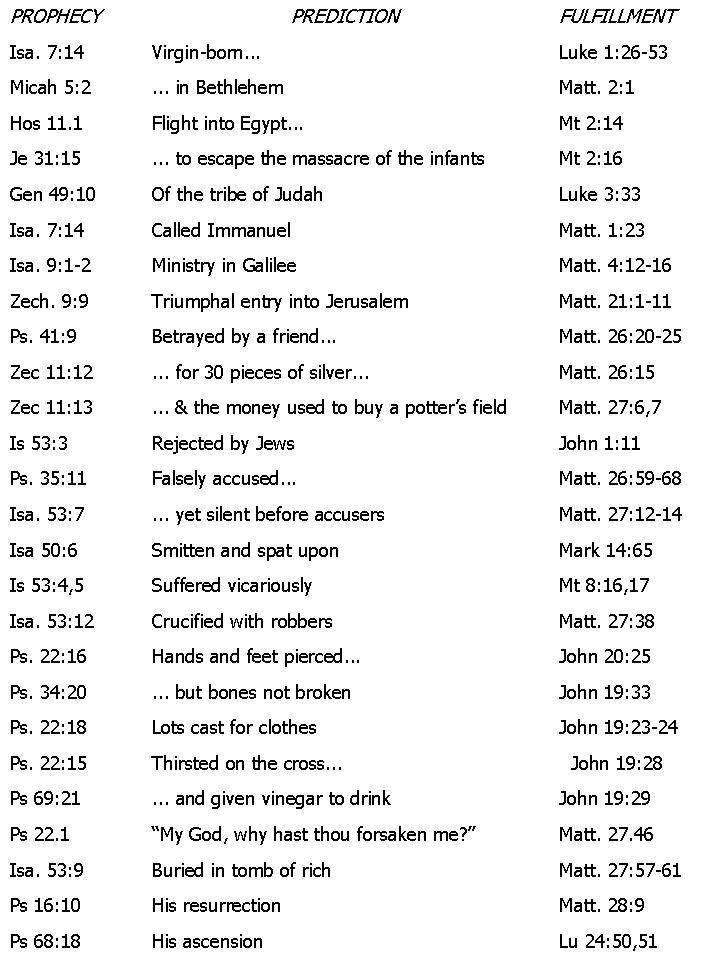
Fulfilled prophecies of Jesus as the Messiah

https://comingworldwar3.files.wordpress.com/2010/07/messianic-prophecies-fulfilled-jesus-is-the-messiah-11.jpg
Note: Probability of One man fulfilling all these prophecies is 1 in 10157 from “Evidence that Demands a Verdict” by Josh McDowell, page 167

Thursday, December 1, 2016

Was LeRoy Froom A Freemason?

Image result for Leroy froom wiki
Although William Miller was a Mason, few SDA’s have every heard this historic fact.  It is another example of how church history has not been fully explained or honestly addressed by the Adventists.  Here is a long known source:
"It was here [Poultney, Vermont] that Miller became a member of the Masonic fraternity, in which his perseverance, if nothing else, was manifested; for he advanced to the highest degree which the lodges in the country, or in any in that region, could confer."

Sylvester Bliss, Memoirs of William Miller, pages 21-22 (1853)


"At the age of 23, in 1803, he married Lucy Smith and they set up housekeeping in Poultney, Vermont. There was a large library in this town and Miller spent much time there. His ability to write verse made him popular at public occasions. He joined the Literary Society and also became a Mason."
LeRoy Froom, The Prophetic Faith of Our Fathers, vol. 4, page 456.


SDA’s Anti-Mason

By the time the SDA’s had become organized, most Christian denominations were anti-Mason, and so too were the Adventists. Their views were normative for that period.


In 1859, the Review and Herald published an article titled, “Is Freemasonry Compatible with present Truth?”  The answer was no. Listen to the author, J H Waggoner, the father of EJ Waggoner of 1888 fame, make this point:
“The boasted universality of masonry makes it necessary to exclude the name of Christ from prayers, otherwise they would be fitted only for a class, and hence be local and not general.  He who joins in a prayer where the name of Christ is intentionally omitted to gratify another who denies Christ, certainly compromises his christianity, and “has denied the faith.”  This should lead every Christian to avoid such a connection.
J. H. W. Review and Herald, September 15, 1859.


Ellen White also makes it clear:
"Those who stand under the blood-stained banner of Prince Immanuel cannot be united with the Free Masons or with any secret organization. The seal of the living God will not be placed upon anyone who maintains such a connection after the light of truth has shone upon his pathway." Letter 21, 1893.


Conclusion
It is very unlikely that Froom would be a Mason.  However, more research needs to be done before this issue can be fully resolved . The SDA’s were clearly anti-Mason, and Froom had to have known this fact.  However, considering that William Miller, the Father of the Advent Movement, was a Mason, what would it matter if Froom has some association with the Masons?  Perhaps someone, who was a Mason, gave him these grave sites?  


The problem with Froom is not that he was a Mason, (if he was), but that he did not understand the Gospel.  While Froom was one of the most published and dogmatic of the 20th century SDA theologians, his understanding of the Gospel was very poor. Moreover, his official history of 1888, entitled “Movement of Destiny,” is a very dishonest and harmful apologetic that helped pave the way for the tragedy of Glacier View.  
 

So Froom is part of the problem and one reason why the SDA’s are so confused about both theology and church history.            All Experts