Showing posts with label Financial Markets. Show all posts

Sunday, January 31, 2021

The Stock Market, Fatally Wounded by the Truth, Will Stumble and Crash

Charles Hugh January 30, 2021

It didn't have to be this way, but this is the reality we must now face: truth is fatal to fraud, and our entire financial-political system is a fraud.

The stock market has just been punctured by the thin blades of truth. It is fatally wounded but nobody dares notice. The wounds are barely visible, but the internal damage is mortal. The stock market is already stumbling and will soon crash.

The banquet's participants ignore the faltering market because the rules are we never reveal the truth, or acknowledge it, or discuss it, no matter how obvious, because truth is fatal to fraud. So the stock market's vital signs are in freefall but the conversation remains upbeat and light: stimulus, rapid growth in the second half, etc., all the patter of a carefully constructed illusion that fraud is forever as long as the truth never comes out.

Alas, the truth has emerged from the shadows, despite the silence of the insiders and the financial media. Here are the truths that have emerged like karmic genies:

1. The stock market is nothing but one giant fraud. The entire market is corrupt and rigged from the ground up. The fraud is systemic, designed into every tendril of the market. It was a useful deception to blame it all on "bad players," but now the truth has been revealed: the market is nothing but a rigged game enriching insiders.

2. The Fed is a fraud. All the Federal Reserve has accomplished in 13 years of goosing the stock market is unprecedented wealth and income inequality as the fraud of the Fed has boosted the fraud of the market, which has fatally undermined America's social and economic orders. Please read this short paragraph and let it sink in. Monopoly Versus Democracy (Foreign Affairs):

Ten percent of Americans now control 97 percent of all capital income in the country. Nearly half of the new income generated since the global financial crisis of 2008 has gone to the wealthiest one percent of U.S. citizens. The richest three Americans collectively have more wealth than the poorest 160 million Americans.

Wednesday, September 30, 2020

Paper bank notes are being upgraded for a digital future around the world

Market Watch Sept. 21, 2019

The Federal Reserve has never been more famous than it is today. It drew praise, and ire, for its handling of the financial crisis a decade ago, and the extraordinary measures it took subsequently to stimulate the U.S. economy have made it an important driver of financial markets. Meanwhile, President Trump has made its chairman, Jerome Powell, a household name by frequently criticizing the central bank’s policies on Twitter and to the press.

A movement, meanwhile, has been brewing among economists, financial-services professionals and central bankers to encourage a rethinking of the technology of currency — those paper notes we carry in our wallets — with an eye toward issuing a digital currency. Some argue that could give central banks the tools necessary to break free of chronic disinflation and persistently low or negative interest rates, while providing Americans a risk-free means to transact in a world where digital commerce constitutes a growing share of the economy. 

“The debate isn’t about whether we need [a digital currency],” Michael Bordo, an economist at Rutgers University and a fellow at the Hoover Institution, the public-policy think tank at Stanford University, told MarketWatch. “It’s about how you do it.”

Tuesday, October 29, 2019

Stock Market Crash Near? Nobel Laureate Sees 'Bubbles Everywhere'

Investors   10/25/2019
When Nobel Laureate and "Irrational Exuberance" author Robert Shiller says he sees bubbles in the financial markets — you'd better listen up. He literally wrote the book on stock market crashes and bubbles after all.

"I see bubbles everywhere," Shiller, economics professor at Yale University and author of just-published "Narrative Economics" told investors gathered in Los Angeles on Oct. 23. "There's no place to go. You just have to ride it out. You invest even though you expect the price to decline." Shiller famously predicted the 2000 stock market crash and the 2007 crash of the housing market.

The timing of Shiller's ominous warning comes at a scary time. This is the month of the 90th anniversary of Black Monday. That day on Oct. 28, 1929, the Dow Jones Industrial Average fell 13%. That still stands as the second-worst drop in history and, combined with the pounding the stock market took in early days of the depression, took 25 years for investors to recover from.

Shiller sees bubbles in the stock market, bond market and the housing market. "You get ... in a situation where you know it's going to decline, but you still saved enough to hold you over; you have no choice."

Friday, August 2, 2019

Starvation to the poorer classes will result in a civil war

Image result for covetousness
There are men in the church and in the world who have educated themselves to practice fraud, and for this they will be brought into judgment.... Men have chosen to stand, not under the blood-stained banner of Prince Immanuel, but under the rebel flag to do the works of a rebellious prince. They may have sold their souls for money. They may have taken their Lord's money to purchase wheat and the facilities whereby poor men live, that they may extort from the Lord's creatures the highest prices. They make for themselves princely fortunes.  

But for all this the Lord says He will bring them into judgment. In God's sight such a man has made himself an outcast. He has sold his soul for that which he may lose at any time. He has worshiped an idol; covetousness was his sin, and the means needed to bless humanity has become to him the greatest curse.—Letter 89, 1898, pp. 9, 10. (To J. E. White, October 30, 1898.)  

God does not design that men shall appropriate all that the earth produces for their own selfish purposes. He calls upon them to bring their tithes and offerings into His storehouse, that there may be meat in His house.  

In India, China, Russia, and the cities of America, thousands of men and women are dying of starvation. The monied men, because they have the power, control the market. They purchase at low rates all they can obtain, and then sell at greatly increased prices. This means starvation to the poorer classes, and will result in a civil war. There will be a time of trouble such as never was since there was a nation. “And at that time shall Michael stand up, the great prince which standeth for the children of thy people: and there shall be a time of trouble such as never was since there was a nation, even to that same time; and at that time thy people shall be delivered, everyone that shall be found written in the book.... Many shall be purified, and made white, and tried; but the wicked shall do wickedly, and none of the wicked shall understand, but the wise shall understand.”         5MR 305

Monday, July 29, 2019

A Bank With 49 Trillion Dollars In Exposure To Derivatives Is Melting Down Right In Front Of Our Eyes


TECB
Could it be possible that we are on the verge of the next “Lehman Brothers moment”?  Deutsche Bank is the most important bank in all of Europe, it has 49 trillion dollars in exposure to derivatives, and most of the largest “too big to fail banks” in the United States have very deep financial connections to the bank.  In other words, the global financial system simply cannot afford for Deutsche Bank to fail, and right now it is literally melting down right in front of our eyes.  For years I have been warning that this day would come, and even though it has been hit by scandal after scandal, somehow Deutsche Bank was able to survive until now.  But after what we have witnessed in recent days, many now believe that the end is near for Deutsche Bank.  On July 7th, they really shook up investors all over the globe when they laid off 18,000 employees and announced that they would be completely exiting their global equities trading business…
It takes a lot to rattle Wall Street.
But Deutsche Bank managed to. The beleaguered German giant announced on July 7 that it is laying off 18,000 employees—roughly one-fifth of its global workforce—and pursuing a vast restructuring plan that most notably includes shutting down its global equities trading business.
Though Deutsche’s Bloody Sunday seemed to come out of the blue, it’s actually the culmination of a years-long—some would say decades-long—descent into unprofitability and scandal for the bank, which in the early 1990s set out to make itself into a universal banking powerhouse to rival the behemoths of Wall Street.
These moves may delay Deutsche Bank’s inexorable march into oblivion, but not by much.
And as Deutsche Bank collapses, it could take a whole lot of others down with it at the same time.  According to Wall Street On Parade, the bank had 49 trillion dollars in exposure to derivatives as of the end of last year…
During 2018, the serially troubled Deutsche Bank – which still has a vast derivatives footprint in the U.S. as counterparty to some of the largest banks on Wall Street – trimmed its exposure to derivatives from a notional €48.266 trillion to a notional €43.459 trillion (49 trillion U.S. dollars) according to its 2018 annual report. A derivatives book of $49 trillion notional puts Deutsche Bank in the same league as the bank holding companies of U.S. juggernauts JPMorgan Chase, Citigroup and Goldman Sachs, which logged in at $48 trillion, $47 trillion and $42 trillion, respectively, at the end of December 2018 according to the Office of the Comptroller of the Currency (OCC). (See Table 2 in the Appendix at this link.)
Yes, the actual credit risk to Deutsche Bank is much, much lower than the notional value of its derivatives contracts, but we are still talking about an obscene amount of exposure.
And this is especially true when we consider the state of Deutsche Bank’s balance sheet.  According to Nasdaq.com, as of the end of last year the bank had total assets of 1.541 trillion dollars and total liabilities of 1.469 trillion dollars.
In other words, there wasn’t much equity there at the end of December, and things have deteriorated rapidly since that time.  In fact, it is being reported that a billion dollars a day is being pulled out of the bank at this point.
I know that most Americans don’t really care if Deutsche Bank lives or dies, but as the New York Post has pointed out, the failure of Deutsche Bank could quickly become a major crisis for the entire global financial system…

Sunday, March 31, 2019

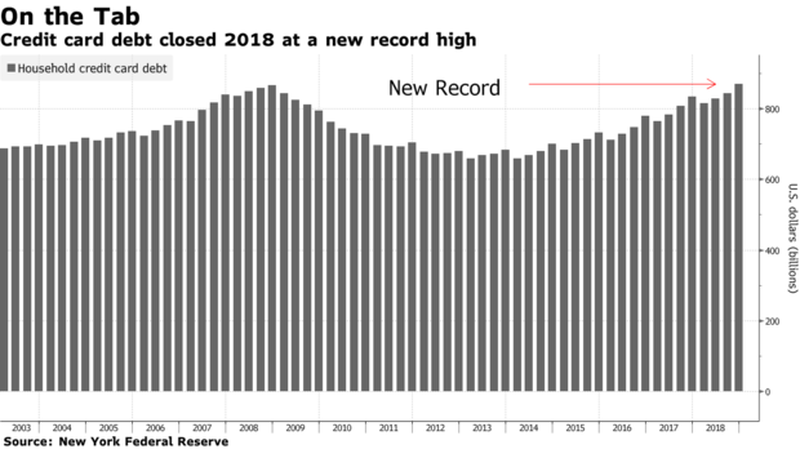
70% Of Consumers With Credit Cards Say They Can't Pay It Off This Year

Zerohedge 03/29/2019
Zerohedge readers who follow our monthly consumer credit updates already knew, aggregate household debt balances jumped in 4Q18. As of late December, total household indebtedness was at a staggering $13.54 trillion, $32 billion higher than 3Q18.
More troubling is that 37 million Americans had a 90-day delinquent strike added to their credit report last quarter, an increase of two million from the fourth quarter of 2017. These 37 million delinquent accounts held roughly $68 billion in debt, or roughly the market cap of BlackRock, Inc.
* * *
New evidence this week points to a further deterioration in consumer creditworthiness.
To understand the American credit card debt crisis, real estate data company Clever surveyed 1,000 credit card users earlier this month.
Using Consumer Financial Protection credit card complaint data and other forms of consumer metrics, the company was able to gain tremendous insight into the average American’s purchasing habits, dependence on credit cards, and feelings about their debt situation.
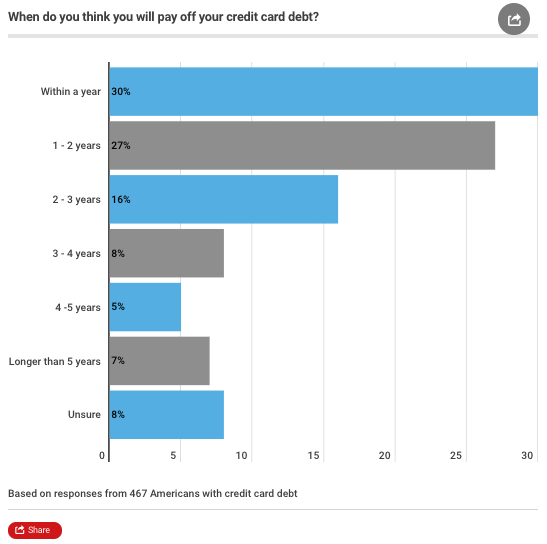
The survey found that 47% of Americans have a monthly balance on their credit card. About 30% of respondents with credit card debt believe they'll extinguish the debt this year, leading many of the respondents stuck in an endless debt cycle.
Fifty-six percent of the respondents say they've had credit card debt for more than a year. About 20% estimate their debt will be paid off by 2022, while 8% were unsure about a timeline.
“It’s a big issue,” Ted Rossman, credit industry expert for CreditCards.com, tells CNBC. With credit card APR soaring to about 17.64%, a new high, the interest accrued on monthly balances can quickly add up and trap unsuspecting consumers with insurmountable debt.

Saturday, January 20, 2018

Stock market optimism from pros reaches highest level in nearly 32 years


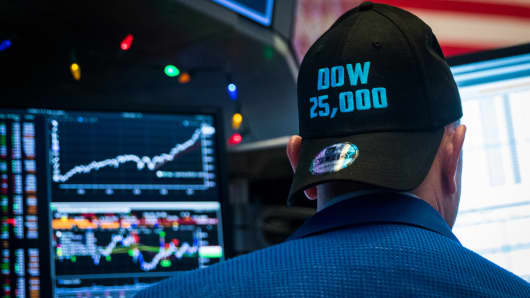
A trader wears a DOW 24,000 hat as he works on the floor of the New York Stock Exchange, (NYSE) as the Dow Jones Industrial Average crosses 25,000 on Jan. 4ht, 2018 for the first time.

CNBC  Wed, 17 Jan 2018
Stock market optimism among professional investors just keeps on surging, and is now at the highest levels since before the crash of 1987.
Bullishness, or the belief that the market is heading higher, is now at 66.7 percent in the latest Investors Intelligence survey, a widely followed gauge of sentiment among investment newsletter authors.
That's the highest level since early April 1986 — a potential warning sign that the rush into equities is getting overdone. After all, a year after the bulls had reached this level came the infamous Black Monday crash that sent the Dow Jones industrials down nearly 22 percent in a single day.

Wednesday, October 4, 2017

The Globalists Are Systematically Destroying America’s Middle Class


By Michael Snyder, on October 1st, 2017 
When people are dependent on the government they are much easier to control.  We are often told that we are not “compassionate” when we object to the endless expansion of government social programs, but that is not how the debate should be framed.  In America today, well over 100 million people receive money from the federal government each month, and the number of Americans that are truly financially independent is continually shrinking.  In fact, only 25 percent of all Americans have more than $10,000 in savings right now according to one survey.  If we eventually get to the point where virtually all of us are dependent on the government for our continued existence, that would give the globalists a very powerful tool of control.  In the end, they want as many of us dependent on the government as possible, because those that are dependent on the government are a lot less likely to fight against their agenda.
Back in 1992, the bottom 90 percent of American income earners brought in more than 60 percent of the country’s income.  But last year that figure slipped to just 49.7 percent.  The wealth of our society is increasingly being concentrated at the very top, and the middle class is steadily being eroded.  Surveys have found that somewhere around two-thirds of the country is living paycheck to paycheck at least part of the time, and so living on the edge has become a way of life for most Americans.
Earlier today, I came across a Business Insider article that was bemoaning the fact that the U.S. economy seems to be rather directionless at this point…
  • We do not have a real plan for health care, and costs continue to gobble up American wages.
  • We do not have a plan for dealing with globalization and economic change, but that change continues to shape our economy.
  • We don’t have a plan to update our decrepit infrastructure.
  • The one plan we did have — the Federal Reserve’s post-financial crisis program — is about to be unwound, marking the end of the last clear, executable plan to bolster America’s economy.
Ultimately, the truth is that we don’t actually need some sort of “central plan” for our economy.  We are supposed to be a free market system that is not guided and directed by central planners, but many Americans don’t even understand the benefits of free market capitalism anymore.
However, that Business Insider article did make a great point about globalization.   Most people don’t realize that our economy is slowly but surely being integrated into a global economic system.   This is really bad for American workers, because now they are being merged into a global labor pool in which they must compete directly for jobs with workers in other countries where it is legal to pay slave labor wages.
Even down in Mexico, many autoworkers are only making $2.25 an hour…
Most of the workers at the new Audi factory in the state of Puebla, inaugurated in 2016 and assembling the Audi Q4 SUV, which carries a sticker price in the US of over $40,000 for base versions, make $2.25 an hour, according to the Union.
Volkswagen, which owns Audi, started building Beetles in Puebla in 1967 and has since created a vast manufacturing empire in Mexico, with vehicles built for consumers in Mexico, the US, Canada, and Latin American markets.
Volkswagen, Ford, GM, or any of the global automakers, which can manufacture just about anywhere in the world, always search for cheap labor to maximize the bottom line.
Would you want to work for $2.25 an hour?
Over time, millions of good paying jobs have been leaving high wage countries and have been going to low wage countries.  The United States has lost more than 70,000 manufacturing facilities since China joined the WTO, and this is one of the biggest factors that has eroded the middle class.
In a desperate attempt to maintain our standard of living, we have gone into increasing amounts of debt.  Of course our federal government is now 20 trillion dollars in debt, but on an individual level we are doing the same thing.  Today, American consumers are over 12 trillion dollars in debt, and it gets worse with each passing day.
The borrower is the servant of the lender, and most Americans have become debt slaves at this point.  This is something that Paul Craig Roberts commented on recently…
Americans carry on by accumulating debt and becoming debt slaves. Many can only make the minimum payment on their credit card and thus accumulate debt. The Federal Reserve’s policy has exploded the prices of financial assets. The result is that the bulk of the population lacks discretionary income, and those with financial assets are wealthy until values adjust to reality.
As an economist I cannot identify in history any economy whose affairs have been so badly managed and prospects so severely damaged as the economy of the United States of America. In the short/intermediate run policies that damage the prospects for the American work force benefit what is called the One Percent as jobs offshoring reduces corporate costs and financialization transfers remaining discretionary income in interest and fees to the financial sector. But as consumer discretionary incomes disappear and debt burdens rise, aggregate demand falters, and there is nothing left to drive the economy.
This debt-based system continuously funnels wealth toward the very top of the pyramid, because it is the people at the very top that hold all of the debts.
Each year it gets worse, and most Americans would be absolutely stunned to hear that the top one percent now control 38.6 percent of all wealth in the United States…
The richest 1% of families controlled a record-high 38.6% of the country’s wealth in 2016, according to a Federal Reserve report published on Wednesday.
That’s nearly twice as much as the bottom 90%, which has seen its slice of the pie continue to shrink.
The bottom 90% of families now hold just 22.8% of the wealth, down from about one-third in 1989 when the Fed started tracking this measure.
So how do we fix this?
Well, the truth is that we need to go back to a non-debt based system that does not funnel all of the wealth to the very top of the pyramid.  Unfortunately, most Americans don’t even realize that our current debt-based system is fundamentally flawed, and it will probably take an unprecedented crisis in order to wake people up enough to take action.         Economic Collapse

Monday, July 31, 2017

One mystery trader has made an extremely large bet that the stock market is going to crash by October


By Michael Snyder, on July 23rd, 2017 
One mystery trader has made an extremely large bet that the stock market is going to crash by October, and if he is right he could potentially make up to 262 million dollars on the deal.  Fortunes were made and lost during the great financial crisis of 2008, and the same thing will happen again the next time we see a major stock market crash.  But will that stock market crash take place before 2017 is over?  Without a doubt, we are in the midst of one of the largest stock market bubbles in U.S. history, and many prominent investors are loudly warning of an imminent stock market collapse.  It doesn’t take a genius to see that this stock market bubble is going to end very badly just like all of the other stock market bubbles throughout history have, but if you could know the precise timing that it will end you could set yourself up financially for the rest of your life.
I want to be very clear about the fact that I do not know what will or will not happen by the end of October.  But one mystery investor is extremely convinced that market volatility is going to increase over the next few months, and if he is correct he will make an astounding amount of money.  According to Business Insider, the following is how the trade was set up…
  • To fund it, the investor sold 262,000 VIX puts expiring in October, with a strike price of 12.
  • The trader then used those proceeds to buy a VIX 1×2 call spread, which involves buying 262,000 October contracts with a strike price of 15 and selling 524,000 October contracts with a strike price of 25.
  • For reference, bullish call spreads are used when a moderate rise in the underlying asset is expected. Traders buy call options at a specific strike price while selling the same number of calls of the same asset and expiration date at a higher strike.
  • In a perfect scenario, where the VIX hits but doesn’t exceed 25 before October expiration, the trader would see a whopping $262 million payout.
I will be watching to see what happens.  If this mystery investor is correct, it will essentially be like winning the lottery.
But just because he has made this wager does not mean that he has some special knowledge about what is going to happen.
For example, just look at what Ruffer LLP has been doing.  They are a $20 billion investment fund based in London, and they have been betting tens of millions of dollars on a stock market crash which has failed to materialize so far.  But even though they have lost so much money already, they continue to make extremely large bearish bets…                  More

Wednesday, April 26, 2017

Over a third of Europeans would be happy to abandon cash and rely on electronic payments if they could


1 in 3 Europeans ready to dump cash ahead of digital future

26 Apr, 2017
Over a third of Europeans would be happy to abandon cash and rely on electronic payments if they could, according to a study by ING bank released on Wednesday.

The survey of almost 15,000 respondents showed that over half used less cash over the last year, with 78 percent wanting to use less cash in the next 12 month.

The study covered respondents from 13 European countries and revealed that in many places where cash is most used, people are among the keenest to get rid of it.

With the rapid development of cashless payment systems such as contactless cards and mobile-phone digital wallets as well as the expansion of digital currencies, the future of physical money has come under the spotlight. The increasing interest of central banks in new cashless schemes has promoted the trend.

“A cashless society is not only possible but could be accepted by at least part of the population in many European nations,” said the researchers led by senior economist Ian Bright as quoted by Bloomberg.

The economist stressed that there’s a “gulf” between those changing payment methods and those who are still sticking with cash.

According to the survey, 82 percent of respondents, who said that they did not use less cash over the previous year, also stated that they don’t plan to reduce usage in the next.     RT

Tuesday, December 8, 2015

Financial Markets Crashed, Including the Dollar. What Happened?

dollars-money-economy-crisis
So what exactly happened last Thursday?  The markets (including the dollar) crashed …and this was not supposed to happen? 
It’s actually quite easy to understand if you see what they did was “only a test” …   Do you understand what I mean when I say a “test”?  
I will explain shortly but first, the Fed came out with piggybacked governors talking about a rate hike.  Hilarious on the face of it if you just look at the U.S. economic implosion going on. 
But let’s assume this is reality, the Fed really wants to hike rates (they do not “want to”,  they HAVE to).  For the sake of saving face and retaining any credibility they absolutely MUST raise interest rates after seven years …how do they do this? 
Please read this piece by E.D. Skyrm,  just a .25% rate raise in rates will require the equivalent of up to $800 billion of collateral necessitated to being pulled.  Did you get that?  $800 billion???  A huge number and enough to tank the whole system …unless someone is willing to replace it. 
For starters you must understand if the Fed does tighten and collateral is withdrawn from the system, because everything is now so levered …”collateral” from somewhere else must be added. That “somewhere” was supposed to be Europe.  Mario Draghi tried to push the EU governing council into further QE, in essence the German hawks refused and instead want to let some air out of the current bubbles.  Europe was supposed to carry the baton of QE, they instead dropped it.  
Mario Draghi tried to fix it on Friday with his “whatever it takes” statement.  I see a problem with this and it has to do with collateral, or the lack of.  You see, Europe is experiencing the same limits the Fed ran into during its last round of QE, not enough unencumbered collateral left to purchase.  Another way to say this would be …”there is just not enough debt outstanding”.  I know it sounds crazy because the underlying financial and economic problems have arisen BECAUSE there is too much debt …but, there is not enough to accommodate the needs for more QE.
What happened on Thursday was a “test of wills” between the Fed and the Bundesbank, the Fed clearly lost even though Friday was a giant reversal from Thursday.  I say this because Mario Draghi can say whatever he likes, his mouth will not create the collateral necessary to substitute for any tightening by the Fed.  He can say what he pleases but the governing council of the EU (run by hawkish Germans) will not reach for the QE baton.  Mr. Draghi can now only jawbone and try to mold appearances.
So where does this leave the Fed and their quarter point rate increase?  I would say they have already seen the future and … IT WAS THURSDAY!  If they decide to hike rates and the EU does not pick up the collateral slack, I believe we will not see the markets stay open for more than a week or so.  I say this because in essence the Fed will be issuing a margin call into a system already lacking for liquidity.  As I’ve said before, they originally treated a “solvency” problem with more liquidity and it has now morphed into a far bigger solvency problem.  Only this time as liquidity is also lacking, they do not have the tools (collateral) to create the needed additional liquidity.
The Fed has truly painted themselves into a corner of their own making.  I am shocked they have been so vocal and vehement they were going to raise rates.  Did they not have a deal already in place with the ECB or were they double crossed?  On the one hand if they do not hike rates, their credibility is toast.  On the other hand if they do raise rates they will smoke the financial markets faster than you can call your broker with a sell order.  I can only think the Fed somehow believed they had a deal with the ECB?  Even the BIS has warned the Fed about raising rates, is the Fed just not listening to the rest of the world?  Whether they see it or not, they have created a currency crisis with the dollar being the central character.   
The way I see this, the U.S. now has very big problems on the credibility front.  You can add to the above monetary fix we are in with a multitude of other U.S. “pictures” just not adding up.  U.S. “policy” is now being found out geopolitically thanks to Mr. Putin dropping a few “truth bombs”.  The domestic economy is already in recession and Christmas (the politically correct term is now “holiday”) sales will be a disaster.
“Truth” is beginning to slip out from behind several different curtains.  I hate to say it but a giant false flag will have to come out very soon in order to keep cover and divert attention from the truth.  I do not see any other options left, the reality MUST remain hidden or attention diverted, …or the unravelling comes. Standing watch,
Bill Holter, Holter-Sinclair collaboration, Comments welcome  bholter@hotmail.com   Global Research