Showing posts with label Falsehood. Show all posts

Friday, February 28, 2020

There is no union between the Prince of light and the prince of darkness

The apostles encountered those in the church who professed godliness while they were secretly cherishing iniquity. Ananias and Sapphira acted the part of deceivers, pretending to make an entire sacrifice for God, when they were covetously withholding a portion for themselves. The Spirit of truth revealed to the apostles the real character of these pretenders, and the judgments of God rid the church of this foul blot upon its purity. This signal evidence of the discerning Spirit of Christ in the church was a terror to hypocrites and evildoers. They could not long remain in connection with those who were, in habit and disposition, constant representatives of Christ; and as trials and persecution came upon His followers, those only who were willing to forsake all for the truth's sake desired to become His disciples. Thus, as long as persecution continued, the church remained comparatively pure. But as it ceased, converts were added who were less sincere and devoted, and the way was open for Satan to obtain a foothold.  

But there is no union between the Prince of light and the prince of darkness, and there can be no union between their followers. When Christians consented to unite with those who were but half converted from paganism, they entered upon a path which led further and further from the truth. Satan exulted that he had succeeded in deceiving so large a number of the followers of Christ. He then brought his power to bear more fully upon these, and inspired them to persecute those who remained true to God. None understood so well how to oppose the true Christian faith as did those who had once been its defenders; and these apostate Christians, uniting with their half-pagan companions, directed their warfare against the most essential features of the doctrines of Christ.  

It required a desperate struggle for those who would be faithful to stand firm against the deceptions and abominations which were disguised in sacerdotal garments and introduced into the church. The Bible was not accepted as the standard of faith. The doctrine of religious freedom was termed heresy, and its upholders were hated and proscribed.  

After a long and severe conflict, the faithful few decided to dissolve all union with the apostate church if she still refused to free herself from falsehood and idolatry. They saw that separation was an absolute necessity if they would obey the word of God. They dared not tolerate errors fatal to their own souls, and set an example which would imperil the faith of their children and children's children. To secure peace and unity they were ready to make any concession consistent with fidelity to God; but they felt that even peace would be too dearly purchased at the sacrifice of principle. If unity could be secured only by the compromise of truth and righteousness, then let there be difference, and even war.  

Well would it be for the church and the world if the principles that actuated those steadfast souls were revived in the hearts of God's professed people.     Great Controversy pp. 44,45

Monday, November 14, 2016

Young Adventists Speak: Pacific Union College Students Discuss the U.S. Election

6 November 2016 | Alexander Carpenter

Continuing our Young Adventists Speak series Pacific Union College students discuss the US election, who they are voting for, and what issues matter to them. Directed and edited by Ben Josse. Thanks to faculty members Rajeev Sigamoney and Tim de la Torre.                               More

Saturday, November 7, 2015

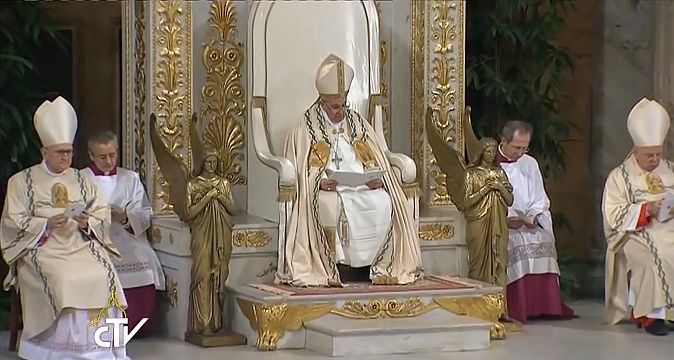
Why Pope Francis Won't sell the Treasures of the Church

.-

In a new interview ranging from fame to finances to his childhood dreams, Pope Francis explained that despite his strong concern for the poor, he will not sell the “riches of the Church.”
Asked whether he has ever felt pressure to sell “the treasures of the Church,” the Pope responded, “This is an easy question. They are not the treasures of the Church, (but) the treasures of humanity.”
“For example, if tomorrow I say that Michelangelo's Pieta is going to be auctioned, it can't be done, because it's not the property of the Church. It's inside a Church, but it belongs to humanity,” he said, explaining that this is true “for all the treasures of the Church.”
The Pope’s comments came in an interview with a Dutch newspaper “Straatnieuws.” The paper’s most unique quality: it is published by the homeless of the Dutch city Utrecht.
The interview was conducted Oct. 27 at the Pope’s Vatican residence and published Nov. 6.  
Questions were conducted by a homeless street newspaper vendor named Marc. Vatican journalist Stijn Fens and the former spokesman of the Dutch Bishops’ Conference, Jan-Willem Wits were also present for the interview, as well as the paper’s editor, Frank Dries.
Among the topics discussed by the Pope were the dangers of corruption, his childhood dream profession, the Vatican’s finances, and his personal commitment to fight poverty.
In his answers to some of the tough questions, Francis did not hesitate to wade into sensitive topics. One of them was whether or not he is worried that his frequent pleas for solidarity in defense of the poor are being politically exploited, as well as how the Church can talk about the issue in an influential way while staying outside the political spectrum.
The Pope underlined two temptations in this area, the first being hypocrisy.
“If a believer speaks about poverty or the homeless and leads the life of a pharaoh – this cannot be done,” he said. “The Church must speak the truth and also with witness: the witness of poverty.”
He also pointed to the dangers surrounding government agreements. While agreements with secular governments can be made, “they must be clear agreements, transparent agreements.”
As an example, Francis pointed to the Vatican’s management of the Apostolic Palace. The Vatican is in charge of handling the finances, but “the accounts are all controlled, to avoid corruption, (because) there is always the temptation of corruption in public life – both political and religious.”
Discussing the perception that the Vatican is rich, the Holy Father acknowledged that if one makes a catalogue of all the goods of the Church, it might seem like “the Church is very rich.”
However, many of the Church’s “riches” are actually treasures that belong to humanity, he explained.
He added that while these items are for the enjoyment of all, there are some things that he does sell, such as many of the elaborate gifts he has received. Among them are motorcycles and cars that have either been given away or sold through an auction.
Proceeds of the sales then go to the Papal Almoner, Archbishop Konrad Krajewski, and are used for the needs of the poor.
And while the Church does have a lot in real estate, he continued, the money is used “to maintain the structures of the Church and to maintain the many works the Church does in needy countries: hospitals, schools.”
As an example, the Pope explained that just the day before, he had asked that 50,000 euros be sent to the Democratic Republic of the Congo to build three schools, because “education is important for children.”
He also pointed to the 1929 Lateran Concordat that recognized the sovereignty of the Holy See. When the Italian government at the time offered the Church a large park in Rome, Pope Pius XI “said no.”
Instead, Pius XI told them, “I want only half of a square kilometer to guarantee the independence of the Church,” Francis observed, explaining that “this principle still stands.”
Catholic News Agency