Showing posts with label False Peace. Show all posts

Wednesday, September 30, 2020

All eyes might be on the Temple Mount after the UAE-Israel deal

JPost SEPTEMBER 26, 2020 

When he dedicated the Temple he built on Mount Moriah, King Solomon prayed that God’s house would be a center of prayer for all the peoples of the world.

Now, in the wake of the recent Abraham Accords – the normalization agreement entered into by Israel, the United Arab Emirates and Bahrain – the possibility exists that Solomon’s aspiration could be recreated.

Part of the avowed rationale for the accords was to create enhanced access for all Muslims to worship at al-Aqsa Mosque. This was lofty, with humanitarian intent, and a realpolitik gesture designed to discredit both the reflex accusation that Jews were somehow attacking al-Aqsa and were “Judaizing Jerusalem.”

How might this Solomonic vision occur? Quite simply by having various Emirs and Imams from the Gulf countries come to the Temple Mount to pray. Well, a bit more than that.
It would be one thing, not terribly noteworthy, for these leaders to make a ceremonial appearance at al-Aqsa. That, of course, would be a validation and proof of the benefits accruing to Muslims for entering into the accords.
However, imagine now if those same leaders were to stand on the open spaces of the Temple Mount, alongside Jewish leaders, religious and political, to pray together.

Wednesday, January 29, 2020

Trump and Francis bulding the one world religion

NTEB  January 25, 2020
VP Mike Pence arrived at the Vatican for what was billed as a 'meet and greet', then stunned everyone by turning into a high-level, closed-door meeting on something so sensitive that neither party was willing to discuss it. And within mere hours of that bombshell, President Trump announced he was finally ready to reveal his 'Deal Of The Century' Middle East Peace Plan, and asked Benjamin Netanyahu to fly to Washington this coming Tuesday, for a meeting on that very subject. Do you see where all this is heading? Trump has the relationship with Israel, Pope Francis has the relationship with the Muslims, put the two together and....peace in the Middle East?

Suddenly, everything begins to makes sense. From one side, I have been watching Donald Trump over the past three and a half years, the man that God placed in power of the world’s strongest and most-prosperous nation, doing amazing things for the nation of Israel. The thing he wants most to do in Israel is his ‘Deal Of The Century‘ Middle East Peace Plan, headed up by his Jewish son in law, Jared Kushner.

“Wherefore hear the word of the LORD, ye scornful men, that rule this people which is in Jerusalem. Because ye have said, We have made a covenant with death, and with hell are we at agreement; when the overflowing scourge shall pass through, it shall not come unto us: for we have made lies our refuge, and under falsehood have we hid ourselves: Therefore thus saith the Lord GOD, Behold, I lay in Zion for a foundation a stone, a tried stone, a precious corner stone, a sure foundation: he that believeth shall not make haste.” Isaiah 28:14-16 (KJB)

On the other side, I have been watching Pope Francis over the past 7 years, weaving and scheming to build the One World Religion of Chrislam. In 2019, things came to a head as Chrislam, otherwise known as the Abrahamic Faiths Initiative, was finally formalized. The peace covenant document known as ‘Human Fraternity For World Peace‘ was signed by Pope Francis and Sheikh Ahmed al-Tayeb, and sealed by kissing each other on the mouth. Chrislam.

For quite awhile, I viewed both these paradigms as something happening separately from each other, until today. The thing that always nagged at me in the back of my mind was how to combine the two and keep all parties happy at the same time. It was seemingly impossible. Then last week, U.S. Ambassador to the Holy See, Callista Gingrich, held a meeting at her office at the Vatican and declared to Pope Francis that the United States is “fully committed to working with you to advance our shared goals of mutual respect, religious freedom, and peaceful coexistence” in regards to the Abrahamic Faiths Initiative, otherwise known as Chrislam.

Do you see where all this is heading? Trump has the relationship with Israel, Pope Francis has the relationship with the Muslims, put the two together and….peace in the Middle East? Sure seems like it to me. The missing ingredient that no other political leader has had in the past 70 years is Chrislam. Rick Warren started it, handed the baton with full evangelical support to Pope Francis, the pope then signed a covenant with Islam, and the Trump administration has thrown in their full support in the same week as announcing they are finally ready with the Peace Plan. Across the board you have complete and total harmony, everyone gets something, everyone is happy.

Tuesday, April 30, 2019

I shall never tire of repeating this: peace is possible

Zenit  April 11, 2019
‘I think constantly of these suffering souls and I pray that the fires of war will finally die down … I shall never tire of repeating this: peace is possible’ 
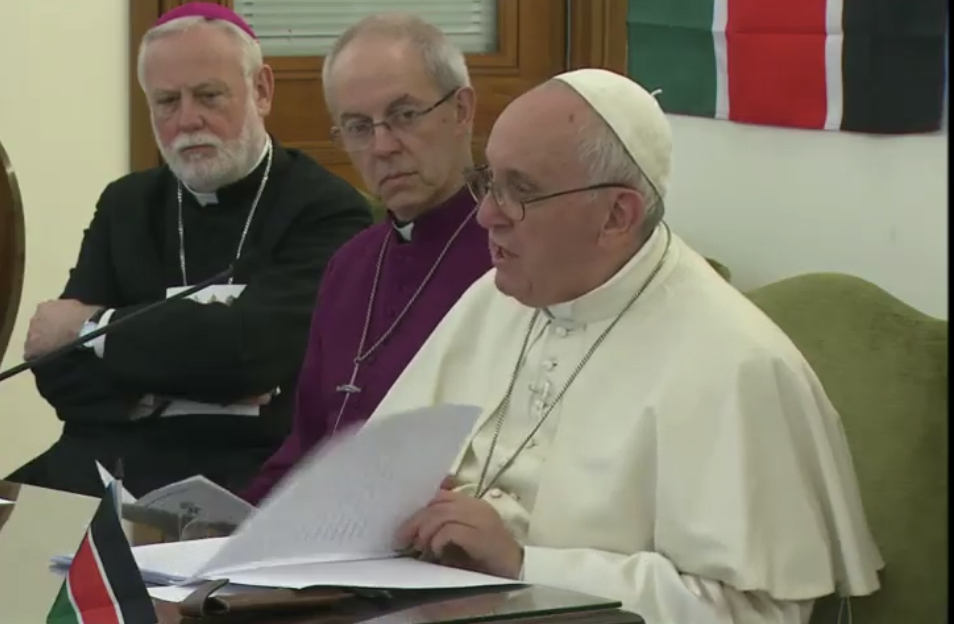
Pope Francis addressed top South Sudanese civil and church authorities today, April 11, urging them to overcome what divides them, reminding that peace is possible and expressing his desire to visit the country.
His remarks came at the end of their two-day spiritual retreat in the Vatican, proposed and organized by Archbishop of Canterbury, Justin Welby, which brought together those who will lead as president and vice-president of the country following a peace accord signed last September, and Church representatives, both Catholic and Protestant leaders.
In his address, Pope Francis stressed: “I urge you, then, to seek what unites you, beginning with the fact that you belong to one and the same people, and to overcome all that divides you.”
“People are wearied, exhausted by past conflicts: remember that with war, all is lost! Your people today are yearning for a better future, which can only come about through reconciliation and peace.”
The Pope has on various conditions expressed his desire to visit the civil-war struck nation, along with Archbishop of Canterbury, Justin Welby, who presented the proposal to organize this retreat and has led it.

Friday, August 31, 2018

Adventists leaders sounding like Rome

Adventist Jul 10, 2018
Seventh-day Adventist religious liberty leaders were invited by the Colombian government to help celebrate the country’s third annual National Religious Freedom Day, held July 4. During a morning meeting at Casa La Giralda, headquarters of Colombia’s Ministry of the Interior, Dr. Ganoune Diop, director of Public Affairs and Religious Liberty for the Adventist world church, addressed more than 100 religious and political leaders who had gathered to mark the occasion. 

“You have the opportunity to make a historic contribution to peace by recognizing human dignity as the essential foundation for building a peaceful coexistence,” Dr. Diop told the group, which included Evangelicals, Protestants, Catholics, Muslims, Jews, Buddhists, and representatives of other faiths. 

Monday, June 25, 2018

Jews, Christians Pray for the Peace of Jerusalem

CBN 06-08-2018
JERUSALEM, Israel – Hundreds of Christians from around the world gathered in Jerusalem this week, together with Israeli Knesset members and Jewish leaders, to pray for the peace of Jerusalem at the Jerusalem Prayer Breakfast.

"I think about the fact that God is joining Jews and Christians together for such an event.  This is a wonder.  This is such a wonder happening in our day and age," said Sharon Daugherty, founding pastor of the Victory Christian Center.

"We are in the last days.  And we recognize that God is moving by his Holy Spirit around the world but particularly here in Israel," Daugherty told CBN News.

This is the second year that the gathering has taken place. Knesset Member Robert Ilatov initiated the breakfast that's co-chaired by former US Congresswoman Michele Bachmann. It's part of a global movement to encourage Jews and Christians to pray for the peace of Jerusalem.  This year representatives from 70 nations came up to Jerusalem. Some noted that there were 70 nations in Israel's 70th year.

Thursday, March 29, 2018

A politically diverse group of over 80 prominent evangelical leaders unite to pray for peace in the Korean Peninsula

Christian Post Mar 28, 2018
A politically diverse group of over 80 prominent evangelical leaders, spanning from former Southern Baptist Convention presidents Ronnie Floyd and Jack Graham to Sojourners founder Jim Wallis, have signed a joint statement calling for united prayer for peace in the Korean Peninsula.

"As American Christians with diverse approaches to force and nonviolence and yet all committed to pursuing peaceful relations among people and nations, we unite in prayer for permanent peace on the Korean Peninsula," the statement released Tuesday reads. "We do this mindful of the millions of lives, including more than 230,000 Americans, that would be threatened by an escalation of conflict there."

Thursday, May 25, 2017

Trump and Pope set aside rude comments

VATICAN CITY — Handshakes, gifts, friendly small talk and big hopes for peace. Setting aside past differences and rude comments aside, President Donald Trump and Pope Francis put a determinedly positive face on their first meeting Wednesday at the Vatican.
The two global leaders, vastly different in temperament and views of the world, talked seriously and extensively in a 30-minute private meeting about terrorism, the radicalization of young people, immigration and climate change, officials said. Details were not revealed.
But all was upbeat in public, peace the overarching theme.
Francis gave Trump a medal featuring an olive branch.
“We can use peace,” said the president, acknowledging the symbolism.
He gave the pope a custom-bound, first-edition set of Martin Luther King Jr.’s works, an engraved stone from the King Memorial in Washington and a bronze sculpture of a flowering lotus titled “Rising Above.”
“I think you’ll enjoy them. I hope you do,” Trump said.
The pope’s other gifts could be taken as offering a more pointed message, though Francis is known to give them to other visitors, too.
He gave Trump three bound papal documents that he has written that to some degree define his papacy and priorities. One focuses on the environment, demanding an end to a “structurally perverse” economic system that has turned Earth into an “immense pile of filth.” He frames climate change as an urgent moral crisis and blames global warming on an unfair, fossil fuel-based industrial model that harms the poor the most.
Trump has expressed skepticism about global warming and possible causes, and he has promised changes to spur more coal and oil production in the U.S.
The president is midway through a grueling nine-day, maiden international journey which has included Middle East stops in the cradles of Islam and Judaism. In Saudi Arabia, he addressed dozens of Arab leaders and urged them to fight extremists at home and isolate Iran, which he depicted as a menace to the region. In Israel, Trump reaffirmed his commitment to strong ties with the longtime U.S. ally and urged Israelis and the Palestinians to work harder toward peace.   Washington Post

Thursday, May 4, 2017

Lady of Fatima is coming to the United Nations


.- One day before the May 13 celebration marking the 100th anniversary of the Fatima apparitions, a statue of Our Lady of Fatima will be visiting the United Nations.
May 12 will mark the second time this particular statue has been to the United Nations, the first being in 1952.
Among the presenters at the May 12 United Nations event is Johnnette Benkovic, founder and president of EWTN’s Women of Grace.
“As she [Our Lady] came to the world through her apparitions to the shepherd children, the 100th anniversary of which will be celebrated the following day, she ‘comes again’ to remind the people of the world that the message is the same – that peace and hope and solidarity are possible through Heaven’s plan,” Benkovic told CNA.
On May 13, 1917, three shepherd children named Lucia, Jacinta, and Francisco saw a vision of Our Lady of Fatima who was dressed in white and holding a rosary. These apparitions lasted through October of the same year, and brought messages of prayer, repentance, and reparation.
The apparitions were declared of “supernatural character” by the Catholic Church in 1930, and a shrine was erected near the original apparition site in Fatima. Since then, thousands of pilgrims have made their prayerful journeys to Fatima, including three popes: Pope Paul VI, Pope John Paul II, and Pope Benedict XVI.  
During Pope Francis’ upcoming anniversary pilgrimage to Fatima, he will canonize two of the Fatima visionaries, Francisco and Jacinta Marto, on May 13.       CNA

Tuesday, March 28, 2017

Pope urges leaders to return to roots


Pope Francis speaks during the European Union summit at the Vatican March 24 (CNS photo/L'Osservatore Romano via Reuters).

Gerard O'Connell March 24, 2017
“What hope is there for the Europe of today and tomorrow?” Pope Francis asked when he addressed the leaders of 27 European Union countries this evening in the Sala Regia (Royal Hall) of the Vatican’s Apostolic Palace, on the eve of the 60th anniversary of the signing of the Treaty of Rome, March 25, 1957, that created the European Economic Community, the forerunner of today’s European Union.
He said the answer to that question is to be found in “the pillars” with which the union’s founding fathers—the leaders of Belgium, France, Germany, Holland, Italy and Luxembourg—had laid 60 years ago, namely: “the centrality of man, concrete solidarity, openness to the world, the pursuit of peace and development, openness to the future.”   
Francis believes in the E.U., and sees its importance not only for the peoples of this continent but also for peace and development in the world, but he is convinced it must be reformed. He made this clear today, and advocated that on the path to reform E.U.’s leaders should revisit the origins of the union in 1957 when its founding fathers signed the Treaty “after the dark years and bloodshed of the Second World War” because they “had faith in the possibility of a better future.”
He recalled that from the outset, the founding fathers understood that the Treaty would remain a dead letter unless they had “spirit and life” and so they agreed that “the first element of European vitality must be solidarity.” Francis emphasized that this spirit of solidarity “remains as necessary as ever today, in the face of centrifugal impulses and the temptation to reduce the founding ideals of the Union to productive, economic and financial needs.”
 

Wednesday, January 11, 2017

Pope calls for unity in Europe


Image result for vatican
Ben Rosen January 9, 2017
In 1957, six European nations agreed on a single economic market that laid the groundwork for the European Union, bringing together a continent that in the previous decade had been shattered by total war.
On Monday, some sixty years after those six countries signed Treaty of Rome, Pope Francis reminded diplomats of the agreement’s importance as he called for a new European humanism.
“Europe as a whole is experiencing a decisive moment in its history, one in which it is called to rediscover its proper identity. This requires recovering its roots in order to shape its future,” said the pope in the annual papal “state of the world” address. 
“In response to currents of divisiveness, it is all the more urgent to update the idea of Europe, so as to give birth to a new humanism based on the capacity to integrate, dialogue and generate that made the Old Continent great,” he said.
Pope France’s annual foreign policy speech comes, as he noted in his address, at a time when Europe is in the midst of a migrant crisis, the threat of religious-inspired violence, and a shakeup through Brexit. The pope’s speech represents another effort on his part to urge peace and reconciliation in Europe and abroad.    
The process of European unification "continues to be a unique opportunity for stability, peace and solidarity between peoples," he said. "On this occasion, I can only reaffirm the interest and concern of the Holy See for Europe and its future, conscious that the values that were the inspiration and basis of that project, which this year celebrates its 60th anniversary, are values common to the entire continent and transcend the borders of the European Union itself."
The pope’s call for unity in Europe comes just months before Britain is expect to begin the formal process of withdrawing from the EU. Britain’s Prime Minister Theresa May has said she will invoke Article 50 of the Lisbon Treaty by the end of March.
Speaking in front of diplomats from 180 countries in the Vatican on Monday, the pope also denounced “fundamentalists-inspired terrorism” in 2016, listing attacks by Islamist militants in Europe, Africa, Asia, and the United States.
He called such violence “homicidal madness, which misuses God’s name in order to disseminate death, in a play for domination and power,” and urged religious and political leaders to play their part in stopping it. The pope said such violence is “spiritual poverty” often borne out of material poverty. He said religious leaders should preach God’s message of love and peace and political leaders should ensure economic opportunities for young people.
In addition to safety, “government leaders are also responsible for ensuring that conditions do not exist that can serve as fertile terrain for the spread of forms of fundamentalism.”
Pope Francis’s speech is in line with his past remarks on Islamic extremism, nuclear weapons, and even the proliferation of fake news. Last month, the pope said that both the creation and spread of fake news is a sin, urging the media to do its part to stop it.
"The communications media have a very great responsibility. Nowadays they have in their hands the possibility and the capacity to form opinion: they can form a good or a bad opinion," the pope said in an interview with Belgian Catholic weekly, Tertio. He added, "Disinformation is probably the greatest damage that the media can do, as opinion is guided in one direction, neglecting the other part of the truth."
This warning wasn’t directed at just the media, but also those who post or repost harmful stories through social media.      Yahoo News

Saturday, September 17, 2016

Leaders of the world’s main religions praying for peace and to renew their commitment to work together for peace.


At the height of the Cold War, on Oct. 27, 1986, Pope John Paul II invited the leaders of the world’s main religions to Assisi for “a day of prayer and fasting for peace.” Thirty years later, there is an even greater need to pray for peace because, as Pope Francis says, “a third world war is being fought piecemeal,” and blind violence and hatred are spreading across the globe.
It is therefore significant that leaders of the different religions have agreed to come together again in Assisi on Sept. 20 to pray for peace and to renew their commitment to work together for peace. They do so as bitter conflicts are being fought not only in countries that hit the headlines, like Syria and Libya, but also in others that get little media attention, like Yemen and Sudan; these conflicts are causing a refugee crisis of a dimension not seen since World War II, involving some 60 million people.
Convened under the banner “Thirst for Peace: Religions and Cultures in Dialogue,” this three-day event (Sept. 18 to 20) is organized by the Sant’Egidio Community, together with the Franciscan Families and the Diocese of Assisi. It brings together leading representatives from Judaism, Christianity, Islam, Buddhism, Hinduism, Sikhism and traditional religions. They will participate in roundtable discussions regarding peace on the first two days, and on the third they will pray for it.
Pope Francis will come for that final day and join Ecumenical Patriarch Bartholomew; the archbishop of Canterbury, Justin Welby; the Syro-Orthodox patriarch of Antioch, Efrem II; the Israeli chief rabbi of Tel Aviv, Meir Lau; and the head of Japan’s Tendai Buddhism. There will also be a strong Muslim representation from 17 Islamic states, including Ahmad Muhammad Al-Tayyeb, the Grand Iman of Al-Azhar, the most authoritative Sunni Muslim center in the world.
On that day, Christians will pray at the tomb of St. Francis, while members of other religions will pray at other sites across the town. In the afternoon, they will come together in a powerful witness to the world of their joint commitment to peace.
As in Assisi in 1986, this event will highlight the vital contributions all religions are called upon to make for the promotion, building and safeguarding of peace. Cardinal Francis Arinze of Nigeria, former president of the Pontifical Council for Interreligious Dialogue, highlighted this call in his book Religions for Peace (Doubleday), published soon after the attack on the twin towers of the World Trade Center, by drawing attention to the fact that all religions “with admirable unanimity, teach the Golden Rule: Love your neighbor as yourself.” “This,” he underlined, “is a key foundation for peace.”
Introducing that book, the French cardinal Paul Poupard affirmed that “each of us is either a peace maker or a peace breaker.” But, he added, “fanatics and fundamentalists have no doubt given religion a bad name. Politicians, having their own hidden agendas, at times exploit religion to fan the flames of intolerance and hatred. Such unwholesome propaganda can only boomerang, causing a spiraling effect of violence.”
His words have found strong verification since then not only in Afghanistan, Iraq, Syria, Libya, Yemen, Nigeria, Ethiopia and South Sudan but also in European countries and even the United States, where Islamophobia is being stoked and exploited by politicians in an anti-immigrant key.
The origin of much of the violence, though not all of it, in recent years can be traced back to March 19, 2003, when, rejecting appeals from people across the globe, including John Paul II, President George W. Bush, supported by Prime Minister Tony Blair of Britain, launched the war on Iraq. Immediately after handing over the pope’s appeal to the president on March 5, 2003, Cardinal Pio Laghi, speaking to the press in the name of the Holy See, warned that such a war would bring “grave consequences,” including “the suffering of the people of Iraq and those involved in the military operation, a further instability in the region and a new gulf between Islam and Christianity.” Prophetic words! The world is still reaping the bitter fruits of that war.
Pope Francis is well aware of all this, and by coming to Assisi he is affirming yet again the urgent need for all religions to work together for peace through dialogue and to reject the use of God’s name to justify violence.                        America Magazine

Tuesday, July 12, 2016

The SDA Church in North America issues a statement on shooting deaths


The Seventh-day Adventist Church in North America issues a statement on shooting deaths in Louisiana, Minnesota, and Texas

July 08, 2016 | Silver Spring, Maryland, United States

Daniel R. Jackson and G. Alexander Bryant, the president and executive secretary of the Seventh-day Adventist Church in North America, issued the following joint statement on July 8, 2016. The statement is in response to this week’s shooting deaths in Baton Rouge, Louisiana, Falcon Heights, Minnesota, and Dallas, Texas:  


“We are heartbroken and disturbed by the tragic and brutal shooting deaths of Alton Sterling, Philando Castile, and five Dallas police officers.*  We extend our deepest condolences and prayers for the seven people killed this week, the seven officers and two civilians wounded in Dallas, their families, loved ones, and friends. We also pray for the communities of Baton Rouge, Falcon Heights, and Dallas, and the heartache they are experiencing as a result of this tragedy.
“This week has been an extremely difficult week as we wrestle with the senseless loss of life. It is past time for our society to engage in open, honest, civil, and constructive conversation about the rights and equality of every member of our community. Having an open discussion means talking about difficult topics in a productive manner.   However, we must move beyond the talking stage and begin to actually develop practical ways of dealing with racial intolerance in all of its forms — whether subtle or overt.
“This week we continue the struggle with what it means to fear for your life because of the color of your skin. We struggle with the pain that the African-American community feels. Last night we struggled seeing a hate so evil, so intense, that it led to the murder of those who were attempting to protect the right of American citizens to peacefully protest. 
“We were deeply troubled by the shooting deaths of two African-American men by police officers this week. This brings the total number of blacks shot to death by police in the United States to 123 so far in 2016, according to press reports. We are equally troubled that five Dallas police officers were killed by a gunman filled with hate who, in his words, wanted to “kill white people and especially white police.”
“Let us be clear: the violent death of any human being is wrong. The deaths of these seven people in these three events are equally tragic and agonizing for God. While so many in our country are angry and frightened, hate and revenge are never the answer. 
“We find wisdom and comfort in the life of Jesus. Human experience illustrates that hatred breeds more hatred. Jesus lived a life that demonstrated love in the face of hatred, and peace in the place of anger. Evil cannot be eliminated with evil; it must be overwhelmed with peace, love, and goodness. We know that there is growing anger, frustration, and alienation throughout our division. These emotions are accompanied by a growing distrust and fear. 
“How will we personally and corporately respond? We believe that . . . 
·      Now is the time to listen, to hear, and to understand the cry of those living in fear.
·      Now is the time for the men and women of the North American Division to stand up and link arms together, in peace and love, to say “NO” to racial inequality; and demonstrate that love is stronger than hate.
·      Now is the time for our local congregations, for our state and regional conferences, for our educational and medical institutions to pray together, to engage in creative thinking together, and then to work together to strengthen what we have in common and bring the hope and healing compassion of Jesus to our communities. 
 “We pray for peace and compassion to guide our way forward as we acknowledge and seek to heal the hurt and fear that pervades this country. We pray, once again, for the day when all of God’s children, of all races, treat each other with love and respect rather than bias and hate. 
“There is neither Jew nor Greek, neither slave nor free, nor is there male and female, for you are all one in Christ Jesus” (Gal. 3:28, NIV).       Adventist News

Note:
"For when they shall say, Peace and safety; then sudden destruction cometh upon them, as travail upon a woman with child; and they shall not escape." 1 Thessalonians 5:3