Showing posts with label NWO. Show all posts

Wednesday, March 31, 2021

Technology and media entities join forces to create standards group aimed at building trust in online content

Microsoft February 22, 2021

SAN JOSE, Calif., and REDMOND, Wash. — Feb. 22, 2021 — A group of influential technology and media companies has partnered to form the Coalition for Content Provenance and Authenticity (C2PA), a Joint Development Foundation project established to address the prevalence of disinformation, misinformation and online content fraud through developing technical standards for certifying the source and history or provenance of media content.  Founding members Adobe, Arm, BBC, Intel, Microsoft and Truepic seek to establish a standardized provenance solution with the goal of combating misleading content.

C2PA member organizations will work together to develop content provenance specifications for common asset types and formats to enable publishers, creators and consumers to trace the origin and evolution of a piece of media, including images, videos, audio and documents. These technical specifications will include defining what information is associated with each type of asset, how that information is presented and stored, and how evidence of tampering can be identified.

The C2PA’s open standard will give platforms a method to preserve and read provenance-based digital content. Because an open standard can be adopted by any online platform, it is critical to scaling trust across the internet. In addition to the inclusion of varied media types at scale, C2PA is driving an end-to-end provenance experience from the capturing device to the information consumer. Collaboration with chipmakers, news organizations, and software and platform companies is critical to facilitate a comprehensive provenance standard and drive broad adoption across the content ecosystem.

Saturday, October 31, 2020

Codeword Barbelon

Download [PDF] Codeword Barb�l�n - 666 - Danger in the Vatican: The  Sons of Loyola and Their Plans for World Domination... (BK 1) [Illustrated]  (Paperback) (Codeword Barbelon) By - P.D. Stuart *Full Pages* - dayw6dw78wa

This book contains some very startling facts.   Who is really in Charge? New book exposes the secret societies and political forces behind the New World Order…. "Men occasionally stumble over the Truth, but most pick themselves up and hurry on as if nothing had happened.” (Sir Winston Churchill) 

Synopsis:
Utilizing records inaccessible to or overlooked by other writers, P.D. Stuart’s book puts the spotlight on the power about which President Woodrow Wilson once said, “the few who are aware of it, dare not speak above their breath when they speak in condemnation of it.” A work of great insight and moral courage Codeword Barbêlôn exposes, in unequivocal terms, the secret connections, oaths and codewords of the powers that be…. 

"Good historians," wrote Horace Walpole, "are the most scarce of all writers, and no wonder! A good style is not very common; thorough information is still rare; and if these meet, what a chance that impartiality should be added to them!" P.D. Stuart's work possesses all of these qualities. Consisting of 48 chapters, and hundreds of footnotes and references, Codeword Barbêlôn covers a vast period of history, from the second and third centuries to the present day. Spatially, the work spans three continents, and focuses on Europe and North America and the hidden influence of secret societies on that continent. Indeed, reading Codeword Barbêlôn, one cannot help but feel as if he were travelling in H. G. Wells' time machine, finding himself sometimes at the City of Rome in the 16th Century, at other times in Bavarian Germany in the 18th Century, yet at other times in the political intrigues of North America in the 19th, 20th and 21st Centuries. 

In doing so Codeword Barbêlôn uncovers a plot so sinister, that in the words of ex-FBI Director and founder, J. Edgar Hoover: "The individual... coming face-to-face with a conspiracy so monstrous... cannot believe it exists...." Some of it is unsettling, disquieting, and often downright scary. 

Codeword Barbêlôn is a `tough book': direct, honest, and thought provoking, with no compromise, no apologies, and no vagaries; it spares no characters—all are lashed without ceremony. It "connects the dots" completely, thoroughly, and intelligently. An instance of high scholarship and intelligence, this book recounts the little known history of the religious and political Illuminati, and reveals how knowledge of this secret organization was transmitted to America; and importantly how it has ruled the world from that country ever since. Rarely does one source "connect the dots" as completely, thoroughly, and intelligently as does this one! It gives us a stunningly plausible picture of the global religious and political landscape of the 21st century. This extraordinary project is the literary equivalent of turning over a flat rock. This book sounds a clear warning…. a gripping tell-all book, as unforgettable as it is daring. A controversial and hard-hitting exposé of the powers that be. To borrow the words of Henry Lincoln, “Something extraordinary is waiting to be found….”       Google Books

Wednesday, September 30, 2020

Paper bank notes are being upgraded for a digital future around the world

Market Watch Sept. 21, 2019

The Federal Reserve has never been more famous than it is today. It drew praise, and ire, for its handling of the financial crisis a decade ago, and the extraordinary measures it took subsequently to stimulate the U.S. economy have made it an important driver of financial markets. Meanwhile, President Trump has made its chairman, Jerome Powell, a household name by frequently criticizing the central bank’s policies on Twitter and to the press.

A movement, meanwhile, has been brewing among economists, financial-services professionals and central bankers to encourage a rethinking of the technology of currency — those paper notes we carry in our wallets — with an eye toward issuing a digital currency. Some argue that could give central banks the tools necessary to break free of chronic disinflation and persistently low or negative interest rates, while providing Americans a risk-free means to transact in a world where digital commerce constitutes a growing share of the economy. 

“The debate isn’t about whether we need [a digital currency],” Michael Bordo, an economist at Rutgers University and a fellow at the Hoover Institution, the public-policy think tank at Stanford University, told MarketWatch. “It’s about how you do it.”

The European Union is planning to establish an EU-wide digital ID system

Biometric Update Sep 10, 2020

The European Union is planning to establish an EU-wide digital ID system, with a proposal due by the middle of 2021, and leaders will seek to fund it with resources from its economic recovery fund, according to Euractiv.

EU leaders will request the European Commission to develop the service to support continued integration of digital services and economies in the region. EU rules have evolved over the past several years to make national digital identity systems more interoperable through eIDAS regulation.

Leaders are expected to call for “EU-wide secure public electronic identification (e-ID) to provide people with control over their online identity and data as well as to enable access to cross-border digital services,” a draft document seen by Euractiv reads.

EC Vice-President for Digital Margarethe Vestager launched public consultations over the summer to consider revisions to eIDAS. That consultation closes on October 2. The Commission is also expected to publish its Digital Services Act by the end of the year, which will include some details on how the EU will extend its digital identification framework.

Tuesday, December 31, 2019

Internet founder launches contract to end online abuse

SCMP   Nov, 2019
Tim Berners-Lee pictured at a data privacy conference at the European Parliament last year. Photo: AP
World Wide Web inventor Tim Berners-Lee on Monday unveiled a “Contract for the Web” to halt “misuse” by governments, companies and individuals, bringing several capital cities and tech titans like Google aboard.
“If we don’t act now – and act together – to prevent the web being misused by those who want to exploit, divide and undermine, we are at risk of squandering” its potential for good, Berners-Lee said in a statement from his World Wide Web Foundation.
Credited with laying the groundwork for the web – the universe of multimedia web pages accessible via the internet – in 1989, the computer scientist has been developing the so-called Contract for the Web since last year.
His unveiling of the final document on Monday comes as government, business and civil society leaders gather in Berlin for the four-day UN Internet Governance Forum.

Monday, November 18, 2019

The Royal Bank of Scotland will open Britain’s first cashless bank

The Royal Bank of Scotland will open what is believed to be Britain’s first cashless bank branch next month in as the move towards online banking continues at pace.

The bank is to open at 49 Bishopsgate, London on November 20, replacing the branch at 62-63 Threadneedle Street, London, which is being closed on December 20.

The “digital bank” will remove the frontline cashier services in the store and will not have an ATM fitted, meaning customers will not be able to pay in and take cash out.

Instead, the branch will be used for other banking needs, including appointments to open Isas and other savings accounts as well as applying for mortgages.

Video banking, where people can book appointments to talk to bankers via video chat will be available, as well as staff to assist with online banking and “presentation space” for anyone to attend sessions on protecting against scammers and managing their finances.

Saturday, March 9, 2019

Danish government wants to allow petrol stations, stores to refuse cash

The Local27 February 2019
The government is considering giving stores and gas stations the option of becoming cash-free as a measure against crime.
Lawmakers are to consider easing current rules which make it compulsory for the vast majority of stores to accept cash payments, DR reports.
Suggested changes to the rules would allow businesses such as petrol stations, convenience stores and clothing shops to choose to only accept card and online forms of payment.
Such a measure would provide additional security for stores, Business Minister Rasmus Jarlov said.
“Fewer people use cash today, so we think there should be a balance between the difficulty and security risks placed on business owners and the benefits of accepting cash,” Jarlov told DR.
A 2017 law enabled certain types of store to apply for dispensation to be cash-free between 10pm and 6am.

Monday, March 4, 2019

Mercedes-Benz Stadium will become the first professional stadium to become cash free

Mercedes-Benz Stadium in Atlanta will become the first professional stadium to become cash free.
NBC  March 4, 2019
Arthur Blank hopes to revolutionize the stadium experience yet again. AMB Group, which owns Mercedes-Benz Stadium in Atlanta, announced Monday it will become the first pro sports stadium to implement a completely cashless model.

This will apply to all sporting events and nearly every concert, effective Sunday, March 10.

Mercedes-Benz Stadium is home to the NFL's Atlanta Falcons and Major League Soccer's Atlanta United and was the home for Super Bowl LIII last month.

Whether fans are buying a $1.50 hot dog, purchasing merchandise or even a game ticket — cash will no longer be accepted. The goal is to dramatically speed up transactions to keep fans from spending unnecessary time waiting in lines.

Friday, August 31, 2018

Chase ATMs go cardless

Fox  August 02, 2018
Forgot your bank card? No worries. Chase has you covered.
The New York City-based bank announced that it has expanded its cardless access to nearly all of its 16,000 ATMs nationwide.
The new technology will allow customers to get cash through their phone’s mobile wallet without needing a physical debit card or an access code for authentication.
Users can simple “tap” their smartphone on the ATM to “easily and securely access money on the go.”
“Cardless no longer means cashless,” Sol Gindi, chief administrative officer of consumer banking at Chase, said in a statement. “As more of our customers are using digital wallets to pay, we’re pleased to be able to provide them with the same experience at the ATM.”

Monday, June 25, 2018

America’s Drive for World Domination

Global Reasearch June 08, 2018
The world is riven with class conflicts in Latin America, political conflicts between the Anglo-Americans and Russians, and economic conflicts between Washington against Europe and Asia.
The conflicts have called into question the capacity of ruling elites to promote growth, to secure international stability and to foster global as co-operation.
To understand the underlying source of conflicts it is essential to identify and unmask the underlying political and economic interests which spread and deepen class, regional and global confrontations.

Saturday, September 30, 2017

Japan considers killing cash by launching own cryptocurrency


Japan considers killing cash by launching own cryptocurrency

27 Sep, 2017 
Authorities in Japan are considering starting a digital currency to be called the J-Coin. By doing so, Tokyo will reduce cash circulation in the country.  
"The project is in the early stages, and we have just held study meetings with other institutions," a spokesperson for Japanese bank Mizuho Financial Group told CNBC on Wednesday.
"This will be pegged with Japanese Yen, and hopefully used to make payments and transfers through a mobile phone app," the bank said.
According to a report by the Financial Times, a consortium of Japanese banks are working on the project, and they are interested in launching the J-Coin before the Tokyo Olympics in 2020.
The project has the support of the central bank and regulators. The J-Coin will allow Japanese consumers to pay for goods and services with their smartphones.
The government's goal is to cut dependence on cash, which represents 70 percent of all transactions by value in Japan. The J-Coin will be exchanged at a one-to-one rate with the yen.
Banks behind the project intend to counter the growing e-payments services of international tech giants like Apple or Alibaba.
Japan is one of the first countries to begin to recognize cryptocurrency as a legal method of payment. The country passed legislation into law, effective April 1, categorizing digital currency as a kind of prepaid payment instrument.        RT

Tuesday, July 25, 2017

Visa Now Paying Businesses to go cashless

According to the most recent data, Visa — which is mostly owned by banks–accounts for over 50 percent of all credit card transactions and 70 percent of all debit card transactions in the world. Hundreds of billions in transactions process through Visa’s databases every year and this number continues to grow.
Despite their overwhelming increase in market share, cards issued, and overall total volume, Visa has made a recent move that shows they intend to completely snub out their most unaccountable, untraceable, and most liberty-associated competitor and means of payment–cash.
In a news release, ostensibly written as an attempt to “help small businesses,” Visa announced that they are launching “a major effort to encourage businesses to go cashless. Aiming to create a culture where cash is no longer king, the program will give merchants increased ability to accept all forms of global digital payments.”
“At Visa, we believe you can be everywhere you want to be, and that it should be easy to pay and be paid in more ways than ever — whether it’s a phone, card, wearable or other device,” Jack Forestell, Visa’s head of global merchant solutions, said in a statement. “We have an incredible opportunity to educate merchants and consumers alike on the effectiveness of going cashless.”
Laughably, Visa claims that companies who stop accepting cash — a major form of payment for people around the globe — that they could increase profits.
Apparently, they want business owners to forget that they take upwards of five percent of every single transaction.
“The important thing to realize is that going with ‘fast and easy’ is not always the best and most cost effective,” Marco Carabjo, a credit expert, wrote in a 2013 U.S. Small Business Administration blog post.
“Typical merchant account companies can charge up to 5 percent of everything a company earns with prices consisting of merchant processing costs, gateway fees, interchange costs, Visa, MasterCard, American Express charges, statement fees and so on.”
Outside of the obvious reason of convincing businesses to go cashless so they can tax their sales into oblivion by creating a monopoly on accepting payments, the implications for control and surveillance are far more insidious.
Visa — just like government — wants to monitor your spending habits and use that data to exploit humanity. This is why governments and banks across the world have almost simultaneously launched a war on cash.
Earlier this year, the European Commission proposed enforcing “restrictions on payments in cash” under an all-too-familiar premise — terrorism.
“Payments in cash are widely used in the financing of terrorist activities,” the Commission’s proposal states. “In this context, the relevance of potential upper limits to cash payments could also be explored. Several Member States have in place prohibitions for cash payments above a specific threshold.”              The free thought project

Tuesday, May 30, 2017

Facebook founder Mark Zuckerberg stated his belief that the world is in need of a “global superstructure"

In an article titled “Can Facebook Fix It’s Own Worst Bug?” author Farhad Manjoo poses the question, “Mark Zuckerberg now acknowledges the dangerous side of the social revolution he helped start. But is the most powerful tool for connection in human history capable of adapting to the world it created?”
The author met with Zuckerberg to discuss Facebook and the many issues that the company faces. At one point, Zuckerberg discussed the need for the development of social infrastructure in order for humanity to “get to the next level.”
“There’s a social infrastructure that needs to get built for modern problems in order for humanity to get to the next level,” he stated. “Having more people oriented not just toward short-term things but toward building the long-term social infrastructure that needs to get built across all these things in order to enable people to come together is going to be a really important thing over the next decades.”
Zuckerberg highlighted Facebook’s “safety check” feature which allows users to publicly acknowledge that they’re safe during dangerous events. Zuckerberg later expanded on this, describing a “global superstructure to advance humanity.” Zuckerberg stated, “we’re getting to a point where the biggest opportunities I think in the world … problems like preventing pandemics from spreading or ending terrorism, all these things, they require a level of coordination and connection that I don’t think can only be solved by the current systems that we have.”
The author of the article states, “What’s needed, he argues, is some global superstructure to advance humanity.”
Manjoo goes on to describe Zuckerberg’s idea as not a particularly controversial one, but his position as unelected CEO of a company and not an elected government official makes his proposal troubling. “This is not an especially controversial idea,” the author writes, “Zuckerberg is arguing for a kind of digital-era version of the global institution-building that the Western world engaged in after World War II. But because he is a chief executive and not an elected president, there is something frightening about his project.”
The author argues that Zuckerberg is purposefully positioning himself as a key figure in the future: “He is positioning Facebook — and, considering that he commands absolute voting control of the company, he is positioning himself — as a critical enabler of the next generation of human society. A minor problem with his mission is that it drips with megalomania, albeit of a particularly sincere sort.”
Manjoo notes that Zuckerberg acts in quite a casual manner about his plans to transition from the current infrastructure of the world into his newest vision. “Zuckerberg is often blasé about the messiness of the transition between the world we’re in and the one he wants to create through software,” he notes. “Building new ‘social infrastructure’ usually involves tearing older infrastructure down. If you manage the demolition poorly, you might undermine what comes next. In the case of the shattering media landscape, Zuckerberg seems finally to have at least noticed this problem and may yet come up with fixes for it. But in the meantime, Facebook rushes headlong into murky new areas, uncovering new dystopian possibilities at every turn.”
Given Facebook’s recent decision to hire partisan left-leaning fact checkers such as ABC News, Snopes, Politifact, and even the George Soros-funded Correctiv to police “fake news” on their platform, many would question the type of  “global superstructure” that Mark Zuckerberg wishes to architect.      Breitbart

Thursday, May 18, 2017

The One Belt-One Road initiative may shift the global balance of power once and for all

Adam Garrie
World leaders, including Russia’s President Putin have been attending meetings in Beijing as part of the ‘One Belt–One Road’ initiatives launched by China in 2013.
The ambitious project aims to set up transport and trade corridors that will help connect East-Asia, Eurasia and Europe, using both rail and maritime links.
China’s goals represent the most ambitious project to re-define the logistical and financial nature of world-trade since the creation of the World Trade Organisation (WTO) in 1995.
Chinese President Xi Jinping opened the meetings saying,
“Spanning thousands of miles and years, the ancient silk routes embody the spirit of peace and cooperation, openness and inclusiveness, mutual learning and mutual benefit.
The Silk Road spirit has become a great heritage of human civilisation”.
Russia is keenly interested in using this project to facilitate energy trade between Russia and its eastern partners including China, Mongolia, Japan and Korea.
President Putin called One Belt-One Road, named for China’s ancient silk road, a “Civilization project for the future”.
He went on to state,
“We cannot resolve modern challenges by using old approaches. We need new ideas. We need to abandon all stereotypes.
We should set a role model for the global community of how we can work together, develop together, based on equality and respect for national sovereignty based on international law and the United Nations principles”.
Turkey’s President Erdogan meanwhile said that the project would “pave the way in a new era”.
The projects logistics are immense and any project of this size will not come to fruition in a day. This is especially true as the countries leading the project seek cooperation and consent. Intimation and domination, hallmarks of western economic imperialism, are off the table.
President Xi made this abundantly clear. The Chinese President said,
“We have no intentions to meddle in the internal affairs of other countries via bringing our social system and the development model, or by imposing our will (on other states)”.
However, the political implications are clear. While the leaders of China, Russia, India, Turkey, Pakistan, Philippines, Indonesia,Vietnam, Myanmar and others gathered in Beijing, the leaders of the United States and Europe’s largest economies were notably absent. Instead, these countries sent minor officials.          More

Wednesday, January 11, 2017

The rise of the cashless society

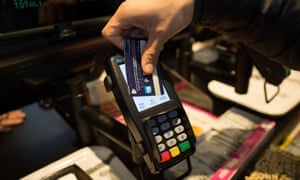
A customer uses a credit card to make a contactless payment.
Adam Forrest Monday 9 January, 2017
Scrolling through my online bank statements at Christmas, I was surprised to find I had not removed cash from an ATM for well over four months. Thanks to the ubiquity of electronic payment systems, it has become increasingly easy to glide around London to a chorus of approving bleeps.
As more shops and transport networks adapt to contactless card and touch-and-go mobile technology, many major cities around the world are in the process of relegating cash to second-class status. Some London shops and cafes are now, like the capital’s buses, simply refusing to handle notes or coins.
Could we see a whole city go cash-free? From Seoul to Bergamo, cities big and small are at the forefront of a global drive to go digital. Many of us are happy to tap cards or phones to hop on a bus, buy a coffee or pay for groceries, but it raises the prospect of a time we no longer carry any cash at all.
No spare change for the busker at the station, the person sleeping rough in need of a hot drink, the market trader, the donation box. Although even on-street charity fundraisers are now broaching the world of contactless payments, what might the rise of the cashless city mean for street vendors, small merchants and the poorest inhabitants?
Some experts now fear a two-tier urban realm in which those on the lowest incomes become disconnected from mainstream commercial life by their dependence on traditional forms of currency.
“The beauty of cash is that it’s a direct and simple transaction between all kinds of different people, no matter how rich or poor,” explains financial writer Dominic Frisby. “If you begin to insist on cashlessness, it does put pressure on you to be banked and signed up to financial system, and many of the poorest are likely to remain outside of that system. So there is this real danger of exclusion.”
Ajay Banga, Mastercard’s CEO, has spoken about the growing global risk of “creating islands, where the unbanked transact [only] with each other”.
In India, the question of how the poorest might connect with the digitised world of the middle-class consumer is now of central importance. In November, the prime minister Narendra Modi announced the removal of 500 and 1000 rupee notes from circulation. Part of a wider attempt to jolt the nation into joining the cashless revolution, Modi’s government believes restricting currency and pushing the take-up of electronic payment will help tackle corruption and regulate India’s untaxed, “black” economy.
Saurabh Shukla, the Delhi-based editor in chief at NewsMobile Asia, says he has seen many small “mom and pop” store owners introduce card readers and learn how to use Paytm, a mobile payment platform, over the past two months.
“They realise a big change is here and they are trying to adjust to electronic payment,” he explains. “But they still want to convert back to cash at the end of the working day or the working week. It will be a gradual adjustment. We might not be able to create a completely cashless India, but we can aim to create a low cash economy.”
Modi is encouraging state government to create “smart” cities by connecting their public services with the latest online technology. Officials are aiming to make the Chandigarh – famously designed by modernist architect Le Corbusier – India’s first cashless city by insisting all bills are paid electronically at government offices. And the government of Goa is attempting to turn its capital Panjim cash-free by offering discounts in digitally bought services like train tickets, and by setting up classrooms to teach small traders e-payment technology.
Yet huge queues remain outside banks as many Indians continue to demand cash. Some of the poorest street vendors cannot afford card readers, and have struggled to operate Paytm payment transfers on their mobile phones.
Aires Rodrigues, a human rights lawyer in Goa, says traders in Panjim are suffering. Rickshaw drivers and fish market sellers have been left with no way of accepting payment from middle-class customers now inclined to do everything digitally. “It’s senseless to try to make everyone go cashless,” says Rodrigues. “The government seems to have lost sight of the plight of the common man.”
If India’s urbanites are being forced to undergo digital shock therapy, city dwellers in much of Europe have been moving steadily away from cash. Consumers like convenience. Governments like the idea of tax transparency. And retailers like cutting down on the costs of cash handling.       The Guardian

Wednesday, December 7, 2016

Trump the showman


Trump doigt
By F. William Engdahl Global Research, November 30, 2016
The project called the Trump Presidency has just two months before its formal beginning. Yet already the hopes and fantasies of much of the world are making him into something and someone Donald Trump most definitely is not.
Donald Trump is yet another project of the same bo2ring old patriarchs who try again and again to create a one world order that they control absolutely, a New World Order that one close Trump backer once referred to as universal fascism.
Ignore the sometimes fine rhetoric in some of his speeches. Talk is cheap. If we consider rather the agenda that’s taking form even in these very early days of cabinet naming, we can see that Donald Trump is the same agenda of war and global empire as Obama, as Bush before him, as Bill Clinton and Clinton’s “tutor”, George H.W. Bush before him. There is no good side to what the world is about to experience with President Trump.
‘Ladies and gentlemen, It’s Showtime!’ Today we give you Donald Trump.
He will tell you just what many of you want to hear. Trump the showman will tell you he will make America great again; Trump will say he will ship at least 3 million illegals back across the Rio Grande; Trump will introduce a bill to declare the Muslim Brotherhood a terrorist organization; Trump will bring jobs back to America from China and other low wage countries; Trump will sit down with Putin and work out some kind of a deal to calm things down; Trump will scrap the Iran nuclear deal of Obama…
Often during this election campaign, which was more a Hollywood “D1” grade movie than any honest debate of policies and ideas candidate Trump made statements that resonated with the “silent majority” of not only so-called blue collar workers, but also the disenfranchised middle class whose earnings have been declining in real terms since the 1970’s. Trump, like an earlier actor-President named Ronald Reagan, has a talent to make himself sound sincere.                   Read more

Monday, October 31, 2016

The World Of Dialectics In The 2016 US Presidential Elections


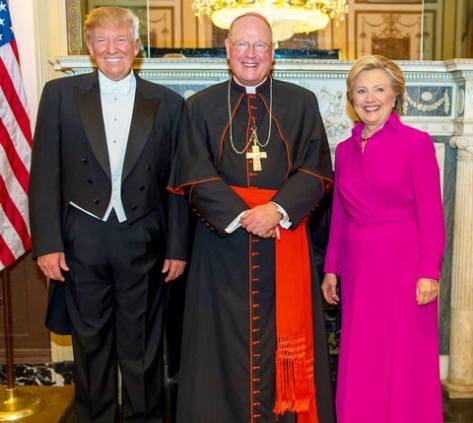
Image result for hillary and trump at the jesuit

ElectionOracle / US Presidential Election 2016 Oct 26, 2016 - 03:14 PM GMT By: Jeff_Berwick

We have been very, very suspicious of Donald Trump since he began his political run.
Many believed he was an outsider who was our “only hope” to tame the US federal government beast.  But it has become very clear he is not.
First, Wikileaks showed that Killary herself actually approved Trump to be her competitor. According to an email sent from an assistant at the Clinton campaign, Hillary was aware that Trump was going to run before the political process was fully underway.

Clinton advised the mainstream media to push his legitimacy as a “pied piper” candidate because she realized, after looking at the poll numbers, that she wouldn’t stand a chance at winning the presidency against any of the establishment republicans without making them “pied pipers” –  it just so happened that Donald was the easiest to play the role considering his long history of friendship with the Clintons.
In addition, the mainstream media was more than complicit in creating a narrative that the 2016 presidential elections were about Hillary Clinton vs Donald Trump from the get go.
But, barely reported in the media, was that after the 3rd presidential debate, Clinton and Trump went out for a night on the town together… and where they went is of great interest.

They went to an annual Jesuit function which is usually full of New World Order types.
THE JESUITS
One of the more interesting things that occurred right at the end of the Jubilee year in early October, was that the Jesuits installed a new Superior General, with the date to commence being actually at midnight on the end of Jubilee.
We found this interesting because there is plenty of evidence that the Jesuits are at least one major arm of what you can call the illuminati.
In fact, the Jesuits were founded in Spain by what various reports call  “crypto Jews” – those who are Jewish but pretending  to be Catholic. Certainly at that time in Spain it was safer not to be a Jew.
Even Wikipedia, which wouldn’t recognize a conspiracy if it were directly presented by its participants has this to say about the Jesuits:
… In the first 30 years of the existence of the Society of Jesus there were many Jesuit conversos (Catholic-convert Jews) including the second Father General Diego Lainez … The original founder Ignatius …  said that he,  “would take it as a special grace from our Lord to come from Jewish lineage.”
At the beginning of the Al Smith dinner party after Cardinal Dolan was introduced, a joke was even made by a speaker that “everyone in attendance is doing their part in supporting their charitable efforts and that it couldn’t be done without the support of many of the other devoted “Catholics” on stage like Henry Kissinger, Howard Rubenstein, and Mort Zuckerman” – all of whom are obviously Jewish so this remark was naturally met with a lot of laughter…
In fact, an extraordinary amount of controversy swirls around Jesuits. They are said to constitute the “Black Church” and thus adhere to the same Satanic religion as the world’s elite bankers supposedly hold.
The leader of the Jesuit order is commonly recognized in conspiratorial circles as the “Black Pope” whose signature staff is a crooked cross. Historically, the Jesuit Order has been seen as one that shirks no crime in expanding the power of the Church.
Lest this sound entirely outrageous, one must note that the Jesuits are, for instance, the inventors of concentration camps, which they established in Paraguay  in order to incarcerate and then torture the native indians of the area.
But the litany of attributed Jesuit evil is even darker than that according to those who believe in the order’s continued malicious pursuit. The supposed founder of the Bavarian-based Illuminati,  Adam Weishaupt, was a Jesuit.
In fact, the order is reputed to have been deeply involved in the Illuminati’s initial expansion, and chances are it is still deeply involved.
One more thing that highlights the evil of the Jesuits is their extreme oath of induction which all superiors must take in order to be elevated to the higher rungs of the organization. This is taken from the book Subterranean Rome by Carlos Didier, translated from the French, and published in New York in 1843 and reads in part,
“…promise and declare that I will, when opportunity present, make and wage relentless war, secretly or openly, against all heretics, Protestants and Liberals, as I am directed to do, to extirpate and exterminate them from the face of the whole earth; and that I will spare neither age, sex or condition; and that I will hang, waste, boil, flay, strangle and bury alive these infamous heretics, rip up the stomachs and wombs of their women and crush their infants’ heads against the walls, in order to annihilate forever their execrable race. That when the same cannot be done openly, I will secretly use the poisoned cup, the strangulating cord, the steel of the poniard or the leaden bullet, regardless of the honor, rank, dignity, or authority of the person or persons, whatever may be their condition in life, either public or private, as I at any time may be directed so to do by any agent of the Pope or Superior of the Brotherhood of the Holy Faith, of the Society of Jesus…”
One of the most poignant quotes regarding the malevolence of the Jesuits comes from Marquis de LaFayette 1757-1834; who was a French statesman and general who served in the American Continental Army under the command of General George Washington during the American Revolutionary War.
His quote is as follows:
“It is my opinion that if the liberties of this country – the United States of America – are destroyed, it will be by the subtlety of the Roman Catholic Jesuit priests, for they are the most crafty, dangerous enemies to civil and religious liberty. They have instigated MOST of the wars of Europe.”
THE BIG BASH
When evaluating Jesuit behavior and influence, please keep in mind that both Donald Trump and Hillary’s VP, Tim Kaine, are Jesuit educated. And it should be of GREAT interest, therefore, that practically on the eve of the US election, Donald Trump and Hillary Clinton partied the night away at a Jesuit function that included such prominent Jesuit-trained attendees as Henry Kissinger.
Not only did the two not look like sworn enemies… they looked like two star crossed lovers going to their first prom.
We have long held to our stance that Killary will be the next President of the US.  The amount of vote rigging, murders and shenanigans to even get her to where she is so far has been tremendous… and it won’t stop.
That said, if by some fluke, and the Diebold machines malfunction or people in the US wake up slightly and Donald Trump gets elected… it is pretty clear they are on the same team and, as we’ve said previously, nothing major will change.
So, if you were hoping that this election could change things in the US… get over that hope right now.  It might change things, but only for the much, much worse.
This charade is being played right in front of everyone’s eyes and most do not understand what is happening or why jokes like the “Catholic” joke is actually funny to these elite people.
They are laughing at the peasants stupidity and lack of understanding, not because the men mentioned are Jews… anyone with half a brain knows that.
But while they laugh, we’ll be laughing all the way to the bank ourselves. Just because these sick people are formulating diabolical plans to enslave humanity doesn’t mean we can’t profit from their planned chaos. It’s better than sitting back in ignorance and making nothing.
Our analysis of these elite’s occult timelines which began with the Shemitah and culminated with the Jubilee, have helped us to accumulate around a 200% collective return on our portfolio in the last year.
The groundwork for global governance has been laid, don’t let them blindside you as they attempt to carry out their nefarious plot.  Donald Trump even stated at the dinner, “We’ve got to come together, not only as a nation, but as a world community.”
Promotion of the globalist new world order.
They want to keep you ignorant and powerless because after all, knowledge is power.                             Market Oracle

Saturday, October 29, 2016

The Other Explanation for Venezuela’s Economic Crisis

By Peter Bolton, Research Fellow at the Council on Hemispheric Affairs
To download a PDF version of this article, click here.
Reports in the English-language press last week highlighted a series of small-scale street protests in Venezuela that bemoaned the scarcity of certain basic products, chronic shortages of medical supplies, and continued power and water outages throughout the country. According to Reuters, for instance, more than a thousand such protests occurred in January and February and, taken together, “show the depth of public anger” and “could become a catalyst for wider unrest.”[1] News accounts proclaiming Venezuela’s state of emergency are not new but in recent weeks have reached hysterical levels, with the Boston-based Global Post claiming that Venezuela’s economic situation is now “worse than 1960s Cuba.”[2]
The mainstream narrative explanation is that the crisis is the result of economic mismanagement and the ideological rigidity of the country’s “authoritarian” Chavista led-government. For instance, Andreas E. Feldmann, Federico Merke, and Oliver Stuenkel, writing for the Carnegie Endowment for International Peace, wrote last November that “Venezuela’s steep recession has been worsened by economic mismanagement leading to mounting inflation, a widening fiscal deficit, and growing shortages of essential goods including food, soap, and diapers.”[3] Similarly, Arlecchino Gomez at The Daily Signal, wrote, also last November, that Venezuela’s recession “was largely due to government incompetence and mismanagement.”[4]
The Workings of the “Free” Market
These sentiments are strongly predicated on the standard line of economic thought prevailing in the Western media and political class: that stringent price and currency controls are distorting the mechanisms of the “free” market and have led to stagnant production, soaring inflation and a burgeoning black market in U.S. dollars and consumer goods. The explicit or strongly implied conclusion is that the crisis proves beyond doubt that socialism “doesn’t work” and that the solution to Venezuela’s ills is a return with gusto to Chicago School economic policy and hence a restoration of the unimpeded mechanisms of the market. Making this point in Forbes magazine, Tim Walstall goes so far as to compare the situation in Venezuela with the collapse of the Soviet Union; he argues that the solution “is to do as Russia did at the end of their socialist nightmare… [and implement] an immediate move to full blown free marketry [sic].”[5] To achieve this, “regime change” is presented as an imperative prerequisite and the only viable way for things to improve. Michael Shifter, writing in Foreign Affairs, says that even though many on the Latin American left initially found Chavismo an “appealing alternative to market-based approaches,” these days “few dispute that it has failed.”[6]
The Alternative Thesis
Within Venezuela itself, however, this analysis is just one of two competing narratives, both of which are discussed and taken seriously in discussions of policy, governance, and economic dynamics. The economic mismanagement thesis is the natural position taken by the Venezuelan opposition and its allies. But the fact that it is practically the only narrative reported in the English-language press misrepresents the intricacies of Venezuela’s economic problems while revealing how Western media heavily favor the opposition’s analysis, often by its own admission. (Rory Carroll of The Guardian, for instance, boasted that he moved almost exclusively in opposition elite circles while based in Caracas as the paper’s Latin America editor.)
But there is another narrative, favored by the government and the pro-Chavista social movements and civil society sectors, which, it is important to stress, are independent of the government. This perspective can loosely be called the economic war thesis. It explains the crisis in terms of the economic and social dynamics at play outside policy and governmental action. It holds that business sectors friendly to the opposition are waging an aggressive and protracted campaign of economic sabotage to deliberately stir up social unrest to destabilize and discredit the governing Chavista bloc and in the ensuing chaos bring about an end to the PSUV government and the installation of a new one made up of opposition parties. The central pillars of the economic war thesis are that these hostile sectors have been engaging in acts such as hoarding and price speculation and have purposely generated scarcity in pursuit of calculated chaos.
Naturally, all of the allegations that make up this narrative are dismissed out of hand by the opposition, which argues that they amount to a desperate propaganda stunt to shift blame from the government’s own incompetence onto its political opponents. President Nicolás Maduro’s use of the term “bourgeois parasites” in particular has been seized on by opposition commentators to portray him as a hopeless buffoon desperately holding onto to power and flailingly seeking to prop up a failed political project. Friendly commentators in the Western press are equally disparaging, with the aforementioned Michael Shifter, for instance, claiming that these accusations “have no merit,” but do serve to “show that any semblance of cooperation between the executive and the assembly to alleviate the country’s economic collapse is, at least for now, far-fetched.”[7] Similarly, Jeffrey Taylor writes in Foreign Policy, “Maduro’s response [to shortages and currency crises] has been to blame everything on scheming “Yanquis,” Venezuela’s “far-right elite,” the “parasitic bourgeois,” and, of course, the opposition, “even though he has effectively neutralized its leadership.”[8]
But though more scholarly research is necessary for a detailed and considered analysis of the myriad factors contributing to Venezuela’s economic situation, it is worth giving the claims of Chavismo a fair hearing. A fuller picture shows that this alternate thesis should not be so glibly dismissed.
Take hoarding, for instance. Before Hugo Chávez was elected president in 1998, the economic levers of society were near-exclusively in the hands of a social elite of overwhelmingly light-skinned Venezuelans: the inhabitants of the wealthy neighborhoods of Venezuela’s urban centers and wealthy landowners of the campo. Not only were they in charge of importation, distribution and wholesaling of all manner of goods for the Venezuelan markets, but they also had a stranglehold over the state apparatus needed to profiteer from effective importation in the first place. A central goal of Chavismo was to wrest control of the economic levers from this elite and more evenly disperse it throughout society. The Chávez and Maduro administrations have sought to democratize economic decision-making and predicate it on serving the public interest rather than the pursuit of private profit.
Confronting Entrenched Privilege
Political psychology provides important insights into the socio-economic dynamics of Venezuelan society. In his book, Angry White Men, sociologist Michael Kimmel argues that much of white men’s rage in the United States is the result of privileges that were historically bestowed on them gradually becoming less automatic. As historically disadvantaged sectors gain more opportunities and influence, the change appears to the previously favored group as a great injustice.[9] The same dynamic is evident in Venezuela: an unaccountable elite of overwhelmingly white, Euro-descent Venezuelans hold positions of influence and has had control of many of the important economic decisions. In great part the Chavista movement was based on giving voice to the country’s poor majority, which incidentally is overwhelmingly black, brown, indigenous, and/or mixed race. Hugo Chávez was himself of mixed-race heritage, with European, native Venezuelan, and African ancestry. The mere idea that such a person (or mono, meaning monkey, as the opposition frequently called him) could be president and give voice to the dark-skinned chusma was seen as a veritable insult to the Venezuelan elite.
The Chávez and Maduro governments have attempted to transition Venezuela away from a society that has been not only inherently racist and classist, but also highly rigid, stratified and oligarchic. Problems inevitably arise because this elite already holds the reins and can aggressively resist a recalibration of economic and social power. In 1998, the highly corrupt business class controlled almost every economic structure imaginable from distribution of food and production of oil to systems for obtaining dollars and importing consumer goods. As James Petras and Henry Veitmeyer argue in their 2013 book What’s Left in Latin America? Regime Change in New Times, “The government’s socialist project depends on mass social organizations capable of advancing on the economic elite and cleaning the neighborhoods of rightwing thugs, gangsters and paramilitary agents of the Venezuelan oligarchs and [Colombia’s] Uribe regime.”[10] Since these are the people who were already in positions of economic power and influence when the Bolivarian process began, their ability to throw a wrench in the government’s efforts for reform has been formidable. Ryan Mallet-Outtrim, writing in Venezuela Analysis, points out that “Venezuela’s private sector has long attacked the socialist government.” So much so, he adds, “that for years Venezuelans have acknowledged that scarcity of basic consumer goods spikes around important elections, as businesses seek to pressure voters into turning against Chavismo.”[11]
Evidence of such efforts by pro-opposition sectors has not been lacking. Immediately following the opposition victory in the 2015 National Assembly elections, for instance, social media commentators indicated that staple goods miraculously began to reappear on shelves throughout the country.[12] Tellingly, some of the products had expiration dates that suggested that the problem was not with production but rather with distribution, which is largely controlled by the right-wing business elite. By creating this kind of scarcity, the elite were essentially trying to starve the public into rejecting the revolution, a tactic influenced by the United States’ economic blockade against Cuba.
When these dynamics are taken in the wider context of Venezuelan politics over the last two decades, they begin to seem less and less ridiculous and more and more plausible. Throughout the period of Chavismo there have been times when these aggressive tactics of economic sabotage have been too obvious to allow for the opposition’s usual equivocation. During the so-called oil strike, for example, opposition forces led by Venezuela’s largest business association, Fedecamaras, orchestrated a nationwide disruption of oil production in hopes that the ensuing economic chaos would destabilize the government and precipitate a coup.[13] Taken in the context of this history of instigated pandemonium, the economic war thesis emerges as at least equally worthy of consideration as its major competitor.
Internal and External Challenges to the Revolution
None of this is to say, of course, that there are no legitimate criticisms of the central government, far less that the opposition’s explanation for the economic crisis should be dismissed as casually as it dismisses the government’s. Yet there are mitigating factors that must be raised in the government’s defense. The Bolivarian process has attempted not just to pay the social debt that was owed the country’s poor majority, but also to radically transform society by offering an alterative development model to the neoliberal consensus of the 1980s and 1990s that plunged the entire region into disarray. The Chávez and Maduro administrations have attempted this task while facing constant hostility not only from an aggressive internal political opposition that has often resorted to violence, but also from the hemisphere’s hegemon, the United States. Washington, which almost instinctively has been opposed to Chavismo from day one, has consistently interfered in Venezuela’s internal affairs in the hope of crushing the Bolivarian process. From a Bush administration-backed[14] and CIA-aided[15] coup in 2002, in which then-President Chavez was nearly removed from power by force, to refusals to recognize Chavista electoral victories, threats of sanctions, and covert funding for opposition candidates, the United States had been determined to do everything possible to ensure that it would fail. The United States has viciously opposed anything that threatens the dominance of the unfettered neoliberal capitalist vision that it has sought to defend, and then spread, throughout the world. As William Camacaro and COHA Senior Research Fellow Fred Mills wrote early last year in Counterpunch, “A great deal hangs in the balance with regard to the feasibility of advancing a democratic socialist project while under the continuous attack of a U.S.-backed opposition, elements of which are bent on restoring the neoliberal regime.”[16]
The U.S. mainstream media, overwhelmingly owned by large corporations and loyal to their interests, naturally reflects and promulgates the ideological contours of this worldview. Herein lies the explanation for why the debate has been so narrow, so inordinately skewed toward the opposition’s account of the situation, and so disregarding of the complexities and subtleties of the discourse regarding the admittedly tragic and desperate circumstances in which the Venezuelan people find themselves.
By Peter Bolton, Research Fellow at the Council on Hemispheric Affairs
Please accept this document as a free contribution from COHA, but if re-posting, please afford authorial and institutional attribution. Exclusive rights can be negotiated. For additional news and analysis on Latin America, please go to: LatinNews.com and Rights Action.
Featured Photo: Venezuela Central Madeirense. Taken from Wikimedia.
[1] “Small Protests Proliferate in Simmering Venezuela,” The New York Times, accessed March 21, 2016, http://www.nytimes.com/reuters/2016/03/17/world/americas/17reuters-venezuela-politics-protests.html?ref=americas&_r=0.
[2] “Venezuelans in the US say their country is worse than 1960s Cuba,” Global Post, accessed March 21, 2016, http://www.globalpost.com/article/6749177/2016/03/21/venezuelans-us-say-their-country-worse-1960s-cuba.
[3] “Venezuela’s Political Crisis: Can Regional Actors Help?,” Carnegie Endowment for International Peace, accessed March 21, 2016, http://carnegieendowment.org/2015/11/30/venezuela-s-political-crisis-can-regional-actors-help/im9t.
[4] “Venezuela’s Economic Crisis,” The Daily Signal, accessed March 21, 2016, http://dailysignal.com/2015/11/09/venezuelas-economic-crisis/.
[5] “Venezuela’s Economic Catastrophe Isn’t About To Happen, It Has Happened,” Forbes, accessed March 21, 2016, http://www.forbes.com/sites/timworstall/2016/02/07/venezuelas-economic-catastrophe-isnt-about-to-happen-it-has-happened/#41880a0a5a1e.
[6] “Venezuela’s Meltdown Continues,” Foreign Affairs, accessed March 21, 2016, https://www.foreignaffairs.com/articles/venezuela/2016-03-10/venezuelas-meltdown-continues.
[7] Ibid.
[8] Venezuela’s Last Hope, Foreign Policy, accessed March 21, 2016, http://foreignpolicy.com/2015/06/10/venezuelas-last-hope-leopoldo-lopez-maduro/.
[9] Angry White Men: A Book Review, Huffington Post, accessed March 21, 2016, http://www.huffingtonpost.com/tristan-bridges/a-review-of-angry-white-m_b_4611216.html.
[10] James Petras and Henry Veitmeyer, What’s Left in Latin America?: Regime Change in New Times, Routledge (2016).
[11] How Bad is Venezuela’s Economic Situation?, Venezuela Analysis, accessed March 21, 2016, http://venezuelanalysis.com/analysis/11832.
[12] Basic Goods ‘Suspiciously’ Begin to Appear in Venezuela Stores, TeleSur, accessed March 21, 2016, http://www.telesurtv.net/english/news/Basic-Goods-Suspiciously-Begin-to-Appear-in-Venezuela-Stores–20151214-0018.html.
[13] “Venezuelan general strike extended,” BBC News, accessed March 21, 2016, http://news.bbc.co.uk/2/hi/americas/1918189.stm.
[14] Venezuela Coup Linked to Bush Team,” The Guardian, accessed March 22, 2016, http://www.theguardian.com/world/2002/apr/21/usa.venezuela.
[15] “The CIA Was Involved In the Coup Against Venezuela’s Chavez,” Venezuela Analysis, accessed March 22, 2016, http://venezuelanalysis.com/analysis/800.
[16] “Revolution, Counter Revolution and the Economic War in Venezuela,” Counterpunch, accessed March 21, 2016, http://www.counterpunch.org/2015/01/27/revolution-counter-revolution-and-the-economic-war-in-venezuela/.                                     COHA