Showing posts with label Theos. Show all posts

Sunday, January 19, 2020

Is God Plural in Greek?

In the Old Testament, the most common Hebrew word for “God” is “elohim”. (Strongs 0430 Myhla ‘elohiym el-o-heem’)
It is (sometimes) used as the plural form of the singular noun (strongs 0433) hwla ‘eloah.
Trinitarians commonly make the mistake of claiming that this plural appearance of the word is “proof” of their Trinitarian doctrine.
However this claim is seriously wrong! It is an abuse of the Hebrew Grammar. We must NOT ignore the fact that although “elohim” looks plural because of its suffix “IM”, it is most often singular in its own right. To distinguish between the singular and plural uses of “elohim” you have to be able to read Hebrew and know a little bit of Hebrew grammar. (or know someone who does!) When it is mean to be understood as singular, it is accompanied by SINGULAR verbs and pronouns. And when it is meant to be understood as plural it is accompanied by PLURAL verbs and pronouns. (Hebrew is a complicated language. There are a very few instances where this rule does not apply. However these relatively rare cases do not affect our main conclusions here)
When ELOHIM is used as a proper name, or when referring to Israel's ONE God, it is treated as a singular noun.

WHEN ELOHIM IS TRANSLATED INTO GREEK
It helps to look at how “elohim” is translated into the Greek language
The Greek language doesn’t have this same “singular/plural appearance” problem.
In the Septuagint version of the Old Testament, and the Greek New Testament, when OT references to “elohim” as the ONE God of Israel are translated into Greek the word "theos" is used. “Theos" is always a SINGULAR noun. You can’t ever mistake it for plural!!
When plural “elohim” meaning (idol) “gods” is translated into Greek the plural form "thea" or "theoi" is easy to distinguish. And when elohim refers to “goddess” or goddesses”, the singular is translated by “thea”. and the plural by “theai”.

LATIN
The same happens in the Latin translations. When “elohim” refers to plural (idol) “gods” (note the lower case)  the term “deus” (singular) or “dei” (plural) is used, When it means “goddesses, “dea” (singular) or “deai” (plural) is used, while for the Christian God the Latin uses simply “Deus” (singular).
From this it ought to be clear that when the OT Hebrew “elohim” refers to the ONE God of Israel, BOTH the Greek and the Latin recognise that it is a singular noun.
There is no possible justification for claiming that it supports the doctrine of the trinity.       Allon Maxwell

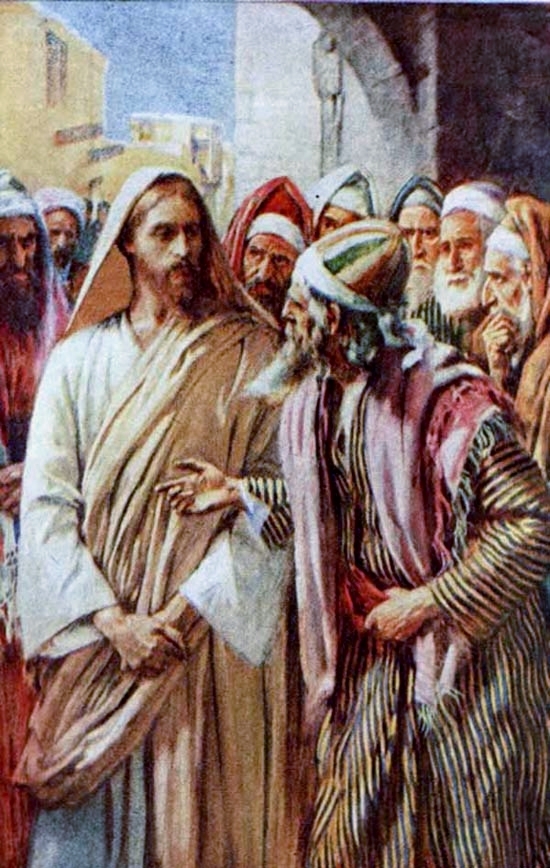
The Greatest Commandment


Image result for jesus and scribe
28And one of the scribes came, and having heard them reasoning together, and perceiving that he had answered them well, asked him, Which is the first commandment of all? 
29And Jesus answered him, The first of all the commandments is, Hear, O Israel; The Lord our God (Theos) is one Lord:  
30And thou shalt love the Lord thy God with all thy heart, and with all thy soul, and with all thy mind, and with all thy strength: this is the first commandment.  
31And the second is like, namely this, Thou shalt love thy neighbour as thyself. There is none other commandment greater than these.  
32And the scribe said unto him, Well, Master, thou hast said the truth: for there is one God; and there is none other but he:
33And to love him with all the heart, and with all the understanding, and with all the soul, and with all the strength, and to love his neighbour as himself, is more than all whole burnt offerings and sacrifices.  
34And when Jesus saw that he answered discreetly, he said unto him, Thou art not far from the kingdom of God. And no man after that durst ask him any question.        Mark 12:28-34
  

Now these are the commandments, the statutes, and the judgments, which the Lord your God commanded to teach you, that ye might do them in the land whither ye go to possess it:
That thou mightest fear the Lord thy God, to keep all his statutes and his commandments, which I command thee, thou, and thy son, and thy son's son, all the days of thy life; and that thy days may be prolonged.
Hear therefore, O Israel, and observe to do it; that it may be well with thee, and that ye may increase mightily, as the Lord God of thy fathers hath promised thee, in the land that floweth with milk and honey.
4 Hear, O Israel: The Lord our God (Elohim) is one Lord:
And thou shalt love the Lord thy God with all thine heart, and with all thy soul, and with all thy might.
And these words, which I command thee this day, shall be in thine heart:
And thou shalt teach them diligently unto thy children, and shalt talk of them when thou sittest in thine house, and when thou walkest by the way, and when thou liest down, and when thou risest up.     Deuteronomy 6:4


Theos : God, a god
Original Word: θεός, οῦ, ὁ
Part of Speech: Noun, Feminine; Noun, Masculine
Transliteration: theos
Phonetic Spelling: (theh'-os)
Definition: God, a god
Usage: (a) God, (b) a god, generally.

2316 theós (of unknown origin) – properly, God, the Creator and owner of all things (Jn 1:3; Gen 1 - 3).
[Long before the NT was written, 2316 (theós) referred to the supreme being who owns and sustains all things.]


Elohim, singular Eloah, (Hebrew: God), the God of Israel in the Old Testament. A plural of majesty, the term Elohim—though sometimes used for other deities, such as the Moabite god Chemosh, the Sidonian goddess Astarte, and also for other majestic beings such as angels, kings, judges (the Old Testament shofeṭim), and the Messiah—is usually employed in the Old Testament for the one and only God of Israel, whose personal name was revealed to Moses as YHWH, or Yahweh (q.v.). When referring to Yahweh, elohim very often is accompanied by the article ha-, to mean, in combination, “the God,” and sometimes with a further identification Elohim ḥayyim, meaning “the living God.”
Though Elohim is plural in form, it is understood in the singular sense. Thus, in Genesis the words, “In the beginning God (Elohim) created the heavens and the earth,” Elohim is monotheistic in connotation, though its grammatical structure seems polytheistic. The Israelites probably borrowed the Canaanite plural noun Elohim and made it singular in meaning in their cultic practices and theological reflections.   Encyclopaedia Britannica

Friday, January 17, 2020

Understanding the true meaning of the word "Elohim"


Related image
Some claim that because the word most often used for God in the Hebrew Bible is Elohim (plural for El), then God must be a trinity and hence Jesus must be God (Supreme). But this is just another deception or ignorance. The fact is that the word Elohim is used for the true God, false gods, supernatural spirits (angels) and even human leaders such as kings and judges. Thus the word Elohim can and is used to refer to a single person, and when it does, linguists call it a “plural intensive” or “plural of majesty” which denotes greatness. The Hebrew people pluralized nouns when they desired to express greatness or majesty as they did with God. So when Elohim is used of the one true God, it is called a “plural of majesty” which denotes the greatness of God, not number.

This was “only” done by the Hebrew people so in the Greek translation of the Hebrew Bible (the Septuagint, which Jesus and the apostles quoted) where Elohim refers to the true God, the word Theos is used which is not plural but singular. The same applies to the New Testament where Theos is the Greek equivalent to Elohim and once again it is not plural but singular. For example. Jesus quotes Deuteronomy 6:4 in Mark 12:29. The word Theos for God in this verse is singular, not plural. If Elohim was really a plurality of the one true God, then the New Testament writers would have used the plural of Theos also when referring to God. Instead they used the singular form every single time. And yet the plural form is used eight times in the New Testament referring to men or false gods. (John 10:34-35; Acts 7:40, Acts 14:11, Acts 19:26; 1 Corinthians 8:5; Galatians 4:8). I trust that no one will say that God is a Trinity in the Hebrew language while being one God in the Greek language.

Below are some dictionary definitions from scholars concerning the usage of Elohim as a “plural intensive,” or as many prefer, “plural of majesty” (a pluralis excellentice) or “plentitude of might.”

The Hebrew noun Elohim is plural but the verb is singular, a normal usage in the OT when reference is to the one true God. This use of the plural expresses intensification rather than number and has been called the plural of majesty, or of potentiality.” — New International Version Study Bible, Grand Rapids: Zondervan, 1985, p. 6

This word [elohim], which is generally viewed as the plural of eloah [Strong's #433], is found far more frequently in Scripture than either el or eloah for the true God. The plural ending is usually described as a plural of majesty and not intended as a true plural when used of God. This is seen in the fact that the noun elohim is consistently used with singular verb forms and with adjectives and pronouns in the singular.” — Theological Wordbook of the Old Testament, Vol. 1, 1980, p. 44

The plural form of Elohim has given rise to much discussion. The fanciful idea that it referred to the trinity of persons in the Godhead hardly finds now a supporter among scholars. It is either what grammarians call the plural of majesty, or it denotes the fullness of divine strength, the sum of the powers displayed by God. Jehovah denotes specifically the one true God, whose people the Jews were, and who made them the guardians of his truth.” — Smith's Bible Dictionary 1884 pp. 331-332

So why does the fanciful idea that Elohim refers to a trinity hardly find a supporter among scholars now? Because the truth is impossible to avoid and you would only end up looking very foolish and deceived if you use this to try and prove a lie. So when you hear the argument that Elohim means God must be a trinity, then understand that there is either deliberate deception or total ignorance and such a person cannot be trusted.

As for Genesis 1:26, the pronouns are plural in the Hebrew text so it is translated, “God said, let us make man in our image, after our likeness.” Trinitarians claim that since Elohim is plural, and the pronouns are plural, God must be more than one. But Elohim refers to the one true God which only leaves the question of who is “us” in this verse. Scripture does not leave us guessing.

Ephesians 3:9 says, “God, ... created all things by Jesus Christ:” God in this verse is obviously someone other than Jesus Christ, and Hebrews 1:2 and John 1:3 says God created all things by His Son. So who is speaking in Genesis 1:26 and who is He speaking to?

God the Father said to His Son, “let us make man in our image.” Christ is “the express image” of the Father, so anyone created in the Father's image is also created in His Son's image.

After the earth was created, and the beasts upon it, the Father and Son carried out their purpose, which was designed before the fall of Satan, to make man in their own image. They had wrought together in the creation of the earth and every living thing upon it. And now God says to his Son, “Let us make man in our image.” As Adam came forth from the hand of his Creator, he was of noble height, and of beautiful symmetry. He was more than twice as tall as men now living upon the earth, and was well proportioned. His features were perfect and beautiful. His complexion was neither white, nor sallow, but ruddy, glowing with the rich tint of health. Eve was not quite as tall as Adam. Her head reached a little above his shoulders. She, too, was noble—perfect in symmetry, and very beautiful. ” — 1SP p. 24