Showing posts with label Jerusalem. Show all posts

Friday, April 30, 2021

Russians rebuilding pagan Arch of Palmyra: Preparation for Messiah?


Israel365News   Apr 12, 2021

After six years of laying in ruin, the Russians have begun reconstructing the Triumphal Arch of Palmyra in Syria that served as a gateway to a major pagan temple to Ba’al. Rebuilding the arch is predicted in the Talmud as preceding the Messiah.

The Arch of Palmyra; Temple to Ba’al

The ruins of the ancient city of Palmyra located about 135 miles north of Damascus were a huge tourist attraction, drawing 105,000 visitors a year until the devastating civil war broke out in Syria in 2011. The temple and much of the site were destroyed by the Islamic State (ISIS) in 2015. The Monumental Arch, a centerpiece of the site that was mostly destroyed, was built during the reign of Roman Emperor Septimius Severus in about 200 CE. It is estimated that only 30-40% of the stones in the arch remain. 

Nazir Awad, director-general of the Syrian Antiquities and Museums Directorate, explained to Al-Ahed News that “meetings have taken place with Russian experts to discuss the work that will begin to restore and resurrect the Arch of Triumph. They are in the process of documenting and studying in order to outline the restoration work.”

“The necessary programs have been put in place to establish working groups concerned with documentation and preparation of documents as part of the restoration work and other teams to handle the rubble,” he added.

Awad points out that “the work did not actually start, but a working paper was drawn up from the Syrian side, with specific tasks prepared for teams, as this type of work follows global standards. The coronavirus is affecting the progress of the restoration work with the Association Stone Industry of Russia, and the Directorate is in contact with UNESCO and other institutions.”

Saturday, October 31, 2020

Turkish President Erdoğan has warned the world Jerusalem “belongs” to Turkey

turkey claims

Breitbart 4 Oct 2020

Erdogan made his public claim Thursday as he addressed Turkish lawmakers during a major policy speech in Ankara. He said:

In this city that we had to leave in tears during the First World War, it is still possible to come across traces of the Ottoman resistance. So Jerusalem is our city, a city from us. Our first qibla [direction of prayer in Islam] al-Aqsa and the Dome of the Rock in Jerusalem are the symbolic mosques of our faith. In addition, this city is home to the holy places of Christianity and Judaism.

As the Times of Israel reported, the Ottoman Empire ruled Jerusalem from 1516 to 1917. Modern Turkey, its successor state, has long claimed a connection to the holy city, regularly condemning Israel for alleged attemtps to “Judaize” it and the U.S. administration’s December 2017 recognition of it as Israel’s capital.

Turkey’s claim to ownership and an Islamic proprietary interest in the city defies thousands of years of accepted wisdom that confirms some of Judaism’s holiest sites are located in the West Bank and eastern Jerusalem.

These include the Temple Mount and Western Wall in Jerusalem; the Tomb of the Patriarchs and Matriarchs in Hebron; and Joseph’s Tomb in Nablus.

That did not stop Erdoğan during his lengthy speech to the Turkish parliament lamenting the fate of Jerusalem and Palestinians and reaffirming his embrace of Hamas, the Islamist group that controls the Gaza Strip, and is deemed a terrorist group by Israel, the E.U. and the U.S.

Wednesday, January 29, 2020

Trump and Francis bulding the one world religion

NTEB  January 25, 2020
VP Mike Pence arrived at the Vatican for what was billed as a 'meet and greet', then stunned everyone by turning into a high-level, closed-door meeting on something so sensitive that neither party was willing to discuss it. And within mere hours of that bombshell, President Trump announced he was finally ready to reveal his 'Deal Of The Century' Middle East Peace Plan, and asked Benjamin Netanyahu to fly to Washington this coming Tuesday, for a meeting on that very subject. Do you see where all this is heading? Trump has the relationship with Israel, Pope Francis has the relationship with the Muslims, put the two together and....peace in the Middle East?

Suddenly, everything begins to makes sense. From one side, I have been watching Donald Trump over the past three and a half years, the man that God placed in power of the world’s strongest and most-prosperous nation, doing amazing things for the nation of Israel. The thing he wants most to do in Israel is his ‘Deal Of The Century‘ Middle East Peace Plan, headed up by his Jewish son in law, Jared Kushner.

“Wherefore hear the word of the LORD, ye scornful men, that rule this people which is in Jerusalem. Because ye have said, We have made a covenant with death, and with hell are we at agreement; when the overflowing scourge shall pass through, it shall not come unto us: for we have made lies our refuge, and under falsehood have we hid ourselves: Therefore thus saith the Lord GOD, Behold, I lay in Zion for a foundation a stone, a tried stone, a precious corner stone, a sure foundation: he that believeth shall not make haste.” Isaiah 28:14-16 (KJB)

On the other side, I have been watching Pope Francis over the past 7 years, weaving and scheming to build the One World Religion of Chrislam. In 2019, things came to a head as Chrislam, otherwise known as the Abrahamic Faiths Initiative, was finally formalized. The peace covenant document known as ‘Human Fraternity For World Peace‘ was signed by Pope Francis and Sheikh Ahmed al-Tayeb, and sealed by kissing each other on the mouth. Chrislam.

For quite awhile, I viewed both these paradigms as something happening separately from each other, until today. The thing that always nagged at me in the back of my mind was how to combine the two and keep all parties happy at the same time. It was seemingly impossible. Then last week, U.S. Ambassador to the Holy See, Callista Gingrich, held a meeting at her office at the Vatican and declared to Pope Francis that the United States is “fully committed to working with you to advance our shared goals of mutual respect, religious freedom, and peaceful coexistence” in regards to the Abrahamic Faiths Initiative, otherwise known as Chrislam.

Do you see where all this is heading? Trump has the relationship with Israel, Pope Francis has the relationship with the Muslims, put the two together and….peace in the Middle East? Sure seems like it to me. The missing ingredient that no other political leader has had in the past 70 years is Chrislam. Rick Warren started it, handed the baton with full evangelical support to Pope Francis, the pope then signed a covenant with Islam, and the Trump administration has thrown in their full support in the same week as announcing they are finally ready with the Peace Plan. Across the board you have complete and total harmony, everyone gets something, everyone is happy.

Monday, June 25, 2018

Jews, Christians Pray for the Peace of Jerusalem

CBN 06-08-2018
JERUSALEM, Israel – Hundreds of Christians from around the world gathered in Jerusalem this week, together with Israeli Knesset members and Jewish leaders, to pray for the peace of Jerusalem at the Jerusalem Prayer Breakfast.

"I think about the fact that God is joining Jews and Christians together for such an event.  This is a wonder.  This is such a wonder happening in our day and age," said Sharon Daugherty, founding pastor of the Victory Christian Center.

"We are in the last days.  And we recognize that God is moving by his Holy Spirit around the world but particularly here in Israel," Daugherty told CBN News.

This is the second year that the gathering has taken place. Knesset Member Robert Ilatov initiated the breakfast that's co-chaired by former US Congresswoman Michele Bachmann. It's part of a global movement to encourage Jews and Christians to pray for the peace of Jerusalem.  This year representatives from 70 nations came up to Jerusalem. Some noted that there were 70 nations in Israel's 70th year.

Thursday, May 24, 2018

Half of evangelicals support Israel because they believe it is important for fulfilling end-times prophecy

WP  
Well before he was asked to offer a prayer at Monday’s ceremony marking the U.S. Embassy’s move from Tel Aviv to Jerusalem, earning the enmity of Mitt Romney, Pastor Robert Jeffress offered tangential insight into why he and many evangelicals think the move was so important.

“Jerusalem has been the object of the affection of both Jews and Christians down through history and the touchstone of prophecy,” Jeffress told CNN last year. “But, most importantly, God gave Jerusalem — and the rest of the Holy Land — to the Jewish people.”

The latter half of that quote hints at the deep religious meaning of the existence of Israel for Jeffress and other Christians. As University of North Texas professor Elizabeth Oldmixon told Vox last year, the issue of recognizing Jerusalem is inextricable from that belief.

“The tenet of Christian Zionism is that God’s promise of the Holy Land to the Jews is eternal. It’s not just something in antiquity,” Oldmixon said. “When we talk about the Holy Land, God’s promise of the Holy Land, we’re talking about real estate on both sides of the Jordan River. So the sense of a greater Israel and expansionism is really important to this community. Jerusalem is just central to that. It’s viewed as a historical and biblical capital.”

Wednesday, February 28, 2018

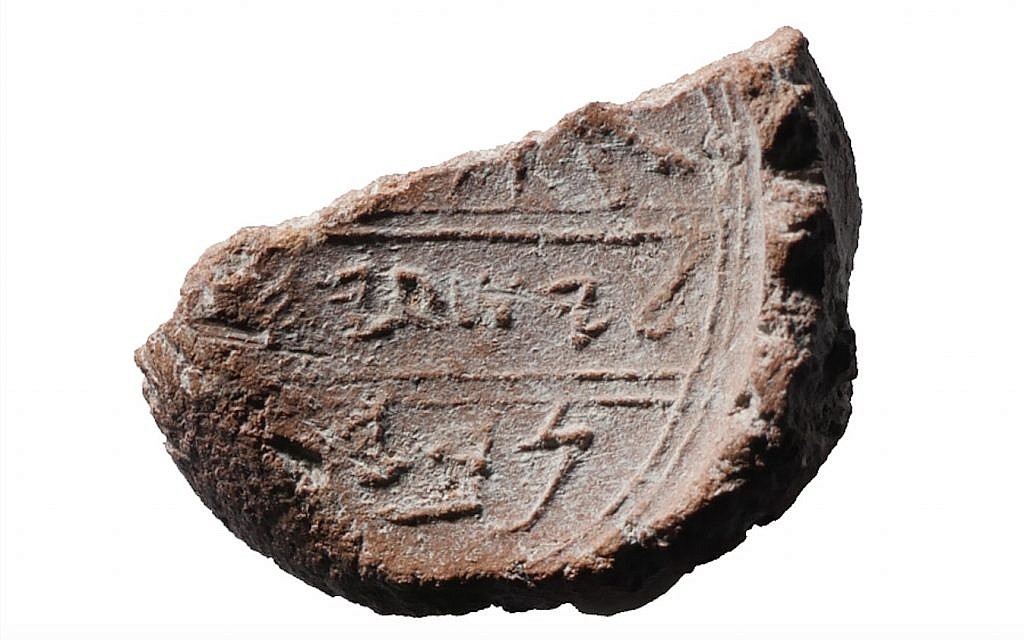
A 2,700-year-old clay seal impression found in Jerusalem which may have belonged to prophet Isaiah


Times of Israel   22 February 2018
The hand of the Prophet Isaiah himself may have created an 8th century BCE seal impression discovered in First Temple remains near Jerusalem’s Temple Mount, according to Hebrew University archaeologist Dr. Eilat Mazar.

“We appear to have discovered a seal impression, which may have belonged to the prophet Isaiah, in a scientific, archaeological excavation,” said Mazar this week in a press release announcing the breathtaking discovery.
Mazar’s team uncovered the minuscule bulla, or seal impression, during renewed excavations at the Ophel, located at the foot of the southern wall of the Temple Mount in Jerusalem. The discovery was published on Wednesday in an article, “Is This the Prophet Isaiah’s Signature?” as part of a massive March-June issue of the Biblical Archaeology Review dedicated to its recently retired founding editor, Hershel Shanks.

The clay impression is inscribed with letters and what appears to be a grazing doe, “a motif of blessing and protection found in Judah, particularly in Jerusalem,” according to the BAR article.

Tuesday, October 24, 2017

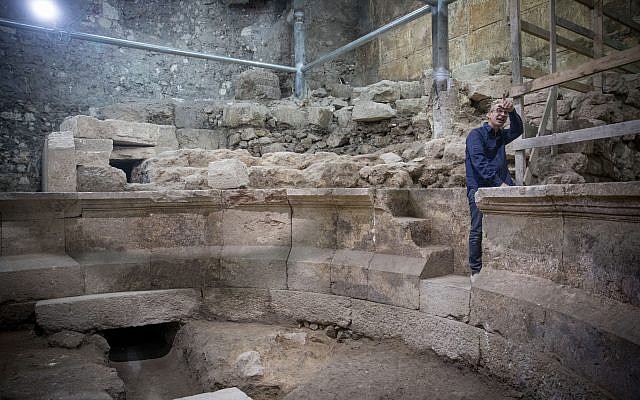
Massive section of Western Wall and Roman theater uncovered after 1,700 years


Times of Israel 16 October 2017,
Archaeologists are one step closer to solving the riddle of what took place in Jerusalem following the destruction of the city by Romans in 70 CE.

Israel Antiquity Authority archaeologists announced Monday that for the past two years they have been excavating and exposing a massive eight-meter deep section of Jerusalem’s Western Wall, unseen for 1,700 years.

And in the course of their work, which has been quietly proceeding directly beneath Wilson’s Arch — the area immediately adjacent to the men’s section of the Western Wall — they unexpectedly discovered a small Roman theater. The dig has not encroached under the Temple Mount.

During the two years of excavations, a new reinforced floor was constructed so as not to interrupt daily worship at Judaism’s holiest site for prayer.

The work is set to continue for another six months, and the expectation is that First Temple-era findings will be uncovered. When the work is completed, the site will be opened to the public.

Wednesday, August 30, 2017

Proof that the Burning of Jerusalem by the Babylonians was real

By Lulu Morris 03 August 2017
An excavation at The City of David in Jerusalem has unearthed an ancient biblical story.
 
Archaeologists at the site have exhumed burnt artefacts dated 2,600 years ago. The discovery of the artefacts solidifies the passage in the bible, where Jerusalem is burnt down by the Babylonians around 587 BC.

Researchers found burnt pieces of wood, grape seeds, burnt pottery and bone all concealed by layers of ash. The burning of Jerusalem was described in the Old Testament in the book of Jeremiah.

"Now on the seventh day of the fifth month, which was the nineteenth year of King Nebuchadnezzar, king of Babylon, Nebuzaradan the captain of the guard, a servant of the king of Babylon, came to Jerusalem. He burned the house of the Lord, the king's house, and all the houses of Jerusalem; even every great house he burned with fire."

The archaeologists from the Israel Antiquities Authority were looking under layers of rock in the eastern area of the City of David when they found the artefacts. Alongside the burnt remains found were storage jars, many bearing stamped handles and rosette seals. The seals were the driving evidence that led the researchers to date the artefacts at 2,600 years. Dr Joel Uziel, the leader of the excavation, explains

“These seals are characteristic of the end of the First Temple Period, [They] were used for the administrative system that developed towards the end of the Judean dynasty."
Find ing the burnt pottery and artefacts in the dig site corroborate Jeremiah’s testament, though perhaps not to the extent he described it, but Jerusalem was at one point, during 587BC burnt to the ground by Babylonian invaders 2,600 years ago.         National Geographic

Tuesday, April 25, 2017

Israel’s Supreme Court ruled that some businesses and supermarkets may remain open on Shabbat.

JERUSALEM (JTA) — Israel’s Supreme Court ruled that some businesses and supermarkets may remain open on Shabbat.

The decision issued Wednesday dealt with the operation of businesses in entertainment complexes including the Tel Aviv and Jaffa harbors along with the old train station, as well as the opening of supermarkets in some parts of the city.

Tel Aviv-Jaffa Mayor Ron Huldai said in response to the ruling, according to Ynet, “As I said four years ago, the city of Tel Aviv-Jaffa was free and will remain free.”

Haredi Orthodox lawmakers, including Interior Minister Aryeh Deri, called the ruling a “severe blow” to the sanctity of the Jewish Sabbath.

Retail businesses in Israel are not permitted to open on the Jewish Sabbath, which begins at sundown Friday and ends after sunset Saturday. Businesses that ignore the ban are levied modest fines.

In 2013, the Supreme Court ordered the Tel Aviv-Jaffa municipality to enforce the ban. At the time, the municipality had been working to find a way to allow a percentage of the city’s grocery stores to stay open on Saturdays, using an amendment to the existing law. The stores would have been spread throughout the city, with fewer open in areas that are more religious and more in secular areas.

However, the interior minister at the time, Gideon Saar, did not approve the amendment.       JTA

Wednesday, January 11, 2017

Ancient Roman theater found in northern Israel may have been used for religious ceremonies


An image of the excavation site

Daniel K. Eisenbud 10 January 2017
A Roman amphitheater discovered during an excavation by the University of Haifa at Hippos, a site overlooking the Sea of Galilee, may support the hypothesis that the facility was used for religious ceremonies instead of entertainment.

Hippos, which is situated on a prominent hill some two kilometers east of the Sea of Galilee within Sussita National Park, is operated by the Israel Nature and Parks Authority.  

According to the University of Haifa’s Dr. Michael Eisenberg, who heads the Hippos Excavations Project, the digs outside the city over the past few years “are falling into place like in a detective story.”

“First, we found a mask of Pan, then the monumental gate leading to what we began to assume was a large public compound, a sanctuary,” he said this week at an annual research conference at the school’s Zinman Institute of Archeology. “And now, this year, we find a public bathhouse and theater in the same location – both facilities that in the Roman period could be associated with the god of medicine Asclepius, or with gods of nature, such as Dionysus and Pan.”

During the Roman period, Hippos was an important city in the Golan Heights, and the area east of the Sea of Galilee, or Lake Kinneret. Over the past two years, researchers from the university’s Institute of Archeology have repeatedly been surprised by the unexpected findings uncovered outside the city’s walls.

However, one feature that was missing in the excavated city, until now, was the theater – a public building capable of accommodating thousands of people, which served as the venue for the popular public shows.     JPost

Saturday, October 29, 2016

Ancient Roman Battlefield Uncovered in Jerusalem

Ancient Roman Battlefield Uncovered in Jerusalem

By |

Archaeologists say they've found evidence of a battlefield from the Roman emperor Titus' siege of Jerusalem in A.D. 70.
Recent excavations revealed a section of the so-called "Third Wall" of Jerusalem that Titus' army breached on its way to conquering the city, according to the Israel Antiquities Authority (IAA).
Outside the wall, the archaeologists found that the ground was littered with large ballista stones (stones used as projectiles with a type of crossbow) and sling stones, suggesting that this area had been under heavy fire from Roman siege engines. [See Photos of the Ancient Roman Battlefield]
These archaeological remains were unearthed last winter at the site where the campus of the Bezalel Academy of Arts and Design is to be built, in an area of the city that is known today as the Russian Compound, IAA officials said.
"This is a fascinating testimony of the intensive bombardment by the Roman army, led by Titus, on their way to conquering the city and destroying the Second Temple," the excavation directors, Rina Avner and Kfir Arbib, said in a statement from the IAA. "The bombardment was intended to attack the sentries guarding the wall and provide cover for the Roman forces so they could approach the wall with battering rams and thereby breach the city's defenses."
An eyewitness to the war, historian Flavius Josephus, wrote the seminal account of the Roman siege of Jerusalem, which included key details about the Third Wall.
Josephus said the wall was built to protect a neighborhood called Beit Zeita, which was built outside the city's boundaries at the time. The construction was started by Agrippa I, King of Judea, and was finished two decades later to help fortify the city as Jewish rebels prepared to revolt against Rome in A.D. 66.
Ultimately, the uprising against Rome was unsuccessful, and in A.D. 70, the Romans took back Jerusalem and destroyed much of the city, including the Second Temple.
The newly uncovered section of the wall is 6.2 feet (1.9 meters) wide. Pottery discovered at the site suggests that this battlefield dates back to Roman times, the archaeologists said. They also discovered the remains of a watchtower along the wall.
The new findings could help settle some debate about the exact location of the Third Wall, which has been going on ever since archaeologist Edward Robinson claimed to have found a portion of the wall in 1838. The discoveries will be presented next week at the New Studies in the Archaeology of Jerusalem and its Region conference.

Saturday, September 17, 2016

Archaeologists found evidence where David Battled Goliath


Image result for The site's casemate walls are reminiscent of the type of urban planning found only in Judah and Transjordan

Posted on September 9, 2016 By Maayan Jaffe-Hoffman/JNS.org

Archaeologists believe they have found evidence of King David’s footprints in a mysterious two-gated city from 3,000 years ago, mentioned in the Bible’s story of David and Goliath

The site is known by its modern name, Khirbet Qeiyafa, in Israel’s Elah Valley.Eviden

After nearly seven years of excavations, the public can now explore the archaeological findings of Qeiyafa through “In the Valley of David and Goliath,” a new Bible Lands Museum exhibition that opened earlier this week in Jerusalem. The Qeiyafa findings have sparked debate and intrigued historians and archaeologists since they were first revealed.


The city was discovered between Sokho and Azekah, on the border between the Philistines and the Judeans, in the place where David and Goliath battled. It’s mentioned in the Torah in 1 Samuel 17: 1-2.

Carbon-14 dating of some 28 charred olive pits found during excavations date the city as existing around the end of the 11th century BCE, until the early 10th century, in the days of Saul and David.
“No one can argue with this data,” said Prof. Yosef Garfinkel, Yigal Yadin Chair of Archeology at the Institute of Archeology at Hebrew University of Jerusalem. He, along with Sa’ar Ganor from the Israel Antiquities Authority and Prof. Michal Hazel of Southern Adventist University of Tennessee, led the excavations.

Among the site’s highlights are its two gates: the western gate, which faced Philistia, and the southern gate, which faced Judah. Having two gates for a relatively small city of 5.7 acres is unusual, according to Bible Lands curator Yehuda Kaplan. Gates are the weakest part of any city. The two gates are what led excavators to identify the site with Sha’arayim (Hebrew for “two gates”), a city mentioned in the David and Goliath story in the Book of Samuel, which reads, “…And the slain Philistines lay along the way of Sha’arayim, as far as Gath and Ekron.” (1 Samuel 17:52) It’s also in Judges 16:5 and in Jeremiah 17:19-20.

The gates were corroborated by additional evidence of Jewish activity at Qeiyafa, including thousands of sheep, goat, cow and fish bones, and the absence of non-kosher pig bones, Kaplan said.
Evidence of cultic activity throughout the city was also unearthed, as well as two inscriptions written in the Canaanite script. One was incised on a jar and contains the Hebrew name Eshbaal, son of Beda. The second was inscribed on a pottery shard with only a few identifiable words, including “king” and “judge.” Many of the letters seem to reflect Hebraic writing.  Garfinkel suggests this is the earliest writing documentation of the Hebrew language discovered to date.

Among the pottery on the site, less than 2 percent was typical Philistine pottery. Kaplan said if the community had been Philistine, a minimum of 20 percent of Philistine design should have been found. Of the 24 weapons and tools discovered, 67 percent were made from iron and 33 percent from bronze. Use of iron during this period by other sites in Judah, such as Arad and Beersheva, helped archeologists identify Qeiyafa as a Judean site.                 


Finally, casemate walls - two thinner, parallel walls with empty space in between and a belt of houses abutting the casemates, incorporating them as part of the construction - are reminiscent of the type of urban planning found only in Judah and Transjordan.

Garfinkel explained that before the period of King David, people lived in small farming communities. Around 11th BCE, these agrarian communities became urban societies.

“In this, the biblical tradition has historic memory,” Garfinkel said. “If we ask, ‘Where is archaeology starting to support biblical tradition, Khirbet Qeiyafa is the beginning.” 

There’s only one other archaeological reference to King David found in Israel, the Aramaic inscription from the mid-9th century BCE found at Tel Dan. This inscription, on display as part of the new exhibit, is attributed to Hazel, king of Damascus, who boasts about killing a king of Israel and a king of Judah, the latter of which is referred to in the inscription as “King of the House of David.”

While the site stirs the biblical imagination, it also serves a political role. 

Biblical Minimalists, a band of biblical scholars and archaeologists trying to eradicate the connection of the Jewish people to the land of Israel by claiming there’s not reliable evidence for what had happened in ancient Israel, can be negated by some of Qeiyafa’s findings. Within 10 days of his publishing the first paper on Qeiyafa, another article claimed the site as Palestinian, Garfinkel said.

“This happens a lot,” said Jacob L. Wright, associate professor of Hebrew Bible at Emory University in Atlanta. “In no other area of the world do you have such a connection to biblical imagination.”

Wright said there’s likely a middle ground. While he believes Garfinkel has placed Qeiyafa in the right time period and that it’s likely a Judean community, experts aren’t certain that King David had anything to do directly with the site. 

“One has to separate the bible and archaeology,” Wright said. “The minimalists want to deny the state of Judah and Israel; they are politically driven and have a loose agenda. … But it does not help when the maximalists try to connect everything they find on the ground with Jesus or King David.”

Bible Lands’ Kaplan is confident in the exhibit and the story it’s telling of Qeiyafa.

“Everything you touch at Khirbet Qeiyafa brings you to this biblical period,” he said.                     Jewish News Service

Wednesday, March 9, 2016

2,500-year-old seal from First Temple period unearthed in Jerusalem


Who was Elihana bat Gael? An exceptional woman during Jerusalem’s First Temple period some 2,500 years ago, according to the Antiquities Authority.

A rare seal bearing her name was recently unearthed in a large ancient building during excavations carried out in the Givati parking lot at the City of David in the Jerusalem Walls National Park, the authority announced on Monday.

Inscribed in ancient Hebrew letters on the seal, made of semiprecious stone, appears the mirror-writing of “to Elihana bat Gael,” along with the name of her father.


Another seal, belonging to a man named “Sa’aryahu ben Shabenyahu,” was found nearby.

The second seal was also in mirror-writing, and bears the inscription “to Sa’aryahu ben Shabenyahu.” The name Sa’aryahu appears on a sherd from Arad, and apparently means “The Lord, which was revealed in a storm” (Job 38).

“Finding seals that bear names from the time of the First Temple is hardly a commonplace occurrence, and finding a seal that belonged to a woman is an even rarer phenomenon,” the authority said.

Indeed, according to the authority’s excavation directors, “The owner of the seal was notable compared to other women of the First Temple period: She had legal status, which allowed her to conduct business and possess property.”

The rare bounty was discovered inside a structure built of well-preserved ashlars following nine years of excavation at the site outside the Old City’s walls by the authority, in cooperation with the Israel Nature and Parks Authority and the City of David Foundation.

The authority’s excavation directors, Dr. Doron Ben- Ami, Yana Tchekhanovets and Salome Cohen, said they believe the ancient building once served as an administrative center.

“Personal seals, such as those of Elihana and Sa’aryahu, were used for signing documents, and were frequently inlaid as part of a ring that was worn by the owner,” the archeologists said in a joint statement.

“In antiquity, they designated the identity, genealogy and status of the owner of the seal.”

According to Dr. Haggai Misgav of the Hebrew University in Jerusalem, seals that belonged to women represent a very small proportion of all the seals that have been discovered to date.

“This is because of the generally inferior economic status of women, apart from extraordinary instances such as this,” Misgav said. “Indeed, the name Elihana does not appear in the Bible, and there is no other information regarding the identity of the woman, but the fact that she possessed a seal demonstrates her high social status.”

Most of the women’s seals known from this period, Misgav said, bear the names of their fathers, rather than that of their husbands.

“Here, as in other cases, this might indicate the relatively elevated status of Elihana, which depended on her original family, and not on her husband’s family,” the researcher stated. “It seems that Elihana maintained her right to property and financial independence even after her marriage, and, therefore, her father’s name was retained. However, we do not have sufficient information about the law in Judah during this period.”

He said the name Eliha is known from a contemporary Ammonite seal, and is the feminine form of the biblical name Eli.

“The script appearing on the seal is remarkably similar to the script on Ammonite seals, and this might indicate the foreign origin of the artisan who carved the seal, and possibly the foreign origin of Elihana, who apparently came from east of the Jordan River,” he said.

Misgav added that the Book of Proverbs (31:13-23) states that an ideal wife is responsible for providing for the needs of her household when her husband is engaged in public and legal affairs at the city gate.

“She seeks wool and flax, and works with willing hands...,” it says. “Her husband is known in the gates, when he sits among the elders of the land.”

“An archive of documents preserved in the Judean Desert from the time of the Second Temple indicates, among other things, the business of Babatha bat Shimon, a female land owner who had legal status,” Misgav said. “But, generally speaking, evidence of legal and financial independence in the Bible and archeology are rare, and it seems that the exception to the rule indeed sheds light on the rule itself.”                Jerusalem Post