Showing posts with label Catholic Church. Show all posts

Wednesday, March 31, 2021

Sitting on billions, Catholic dioceses amassed taxpayer aid

AP February 4, 2021

When the coronavirus forced churches to close their doors and give up Sunday collections, the Roman Catholic Diocese of Charlotte turned to the federal government’s signature small business relief program for more than $8 million.

The diocese’s headquarters, churches and schools landed the help even though they had roughly $100 million of their own cash and short-term investments available last spring, financial records show. When the cash catastrophe church leaders feared didn’t materialize, those assets topped $110 million by the summer.

“I am gratified to report the overall good financial health of the diocese despite the many difficulties presented by the Covid-19 pandemic,” Bishop Peter Jugis wrote in the diocese’s audited financial report released last fall.

As the pandemic began to unfold, scores of Catholic dioceses across the U.S. received aid through the Paycheck Protection Program while sitting on well over $10 billion in cash, short-term investments or other available funds, an Associated Press investigation has found. And despite the broad economic downturn, these assets have grown in many dioceses.

A Discussion with Ganoune Diop

A Discussion with Ganoune Diop, Director of the Public Affairs and Religious Liberty Department, Seventh-day Adventist Church

Berkley Center, Georgetown University  

Background: Ganoune Diop is a leading intellectual within interfaith circles and has been part of the G20 Interfaith Forum since its inception in 2014, focusing on issues of religious freedom. He is currently leading the Association’s working group on religious dimensions of racism. He and Katherine Marshall spoke (by zoom) on July 27, to explore various dimensions of his path from Rufisque, Senegal to the Seventh Day Adventist headquarters in Silver Spring, Maryland. This has involved a constant focus on freedom and a remarkable intellectual journey crossing multiple disciplines and topics.

What did you do after you finished with your master’s degree?

I was offered an internship to become a pastor, in Paris, where I lived for many years. During the latter two years I was working as an associate pastor. I was then called to be the senior pastor in another city, Lille, a city with a well-known university with students from all over the world. I engaged many people. I focused then a great deal on
philosophy, an area where my interest had never diminished, even as I was doing theology. From Lille, I was called to head the Department of Biblical Studies for the Adventist Church in France, which I did for three years.

The next large shift came when I was asked if I wanted to pursue an academic career as a teacher. That would entail going to the US, to Michigan, and doing a PhD in Old Testament. At the time, I was doing a PhD in New Testament in France at the Catholic University of Paris, linked to semiotics, the analysis of religious discourse. I was also studying at La Sorbonne. I found that fascinating. I stayed in the US for about five years, finishing a PhD in Old Testament. I then returned to France, this time as a teacher.

I had studied ancient languages, Hebrew especially, while I was in college, then for my masters. While I was working in Paris, I decided that I really needed to have a degree in philology, the science of languages. I did not just want to be a good student in Hebrew or a good student in Greek. If I was to teach these languages, I wanted to have the necessary credentials. I went to the Catholic University of Paris again, while I was teaching in France, pursuing a master's degree in philology at the School of Ancient Near Eastern Civilizations and Languages.

The Seventh Day Adventist Church is not part of the World Council of Churches. We have what we call observer status. I'm invited to events and I work with them personally. I was even part of the writing committee at the Busan General Assembly few years ago. We collaborate and we partner, but the Seventh Day Adventist Church has chosen, for freedom of conscience purposes, not to belong to an ecumenical entity with a central organization, because belonging to such a central organization is like surrendering one's constitutional conscience. This may be why the Catholic Church, for example, while having very close and cordial relationships, cannot be under the umbrella of another organization. We position ourselves in a similar way. We will join any table where people come with an equal footing. For reasons of freedom of conscience and preservation of our distinct identity, SDAs are involved in interchurch relations but not fusion of churches. We belong to the family of Christians who confess the Trinitarian God, the divinity of Jesus who is lord and savior. However, just to be clear, in some countries, the Seventh Day Adventist Church is part of, for example, the Protestant World Federation or similar organizations. France and Spain are such cases, because the government deals directly with these entities that include Catholics, Protestants, Jews, Muslims, etc. But we are not part of the World Council of Churches, nor of the Council of European Churches (CEC), even though we work so closely with them I personally teach every year at their European summer school on human rights, and I'm invited at their general assembly    More

Saturday, October 31, 2020

No such precise authority in the Gospels

"Our opponents sometimes claim that no belief should be held dogmatically which is not explicitly stated in scripture … But the Protestant Churches have themselves accepted such dogmas, as the trinity, for which there is no such precise authority in the Gospels."   Assumption of Mary, Lifemagazine, Oct 30, 1950, p. 51

For Trump, Conservative Catholics Are The New Evangelicals

    NPR   October 26, 2020

Four years ago, white evangelicals rallied behind Donald Trump's presidential candidacy, and he reveled in their adulation.

"The evangelicals love me, and I love them," Trump said repeatedly on the campaign trail. In his acceptance speech at the Republican National Convention, evangelicals were the only faith group he singled out for thanks, saying their support was "a big reason for me being here tonight."

In the general election, however, it was not the evangelicals who carried Trump to victory but Catholics, a group he had rarely mentioned in his speeches.

People were quite amazed at the overall impact that the white evangelicals had in the election, but I think what was missed was the critical role of the Catholic voters," says Mark Rozell, dean of the Schar School of Policy and Government at George Mason University.

Despite losing the popular vote, Trump reached the presidency in large part because he won traditionally Democratic Pennsylvania, Michigan and Wisconsin, all states in which Catholics outnumber evangelicals by significant margins.

"It was the Catholic vote that won those states for Donald Trump," says Tim Huelskamp, a former Republican congressman from Kansas now serving as an adviser to the Catholics for Trump movement, a coalition that did not formally exist in 2016.

Friday, July 31, 2020

A bishop has urged Christians to speak out against plans to relax Sunday trading laws in the UK

Bishop Mark Davies reopens Shrewsbury Cathedral to the public after 86 days of lockdown June 15, 2020. Credit: Shrewsbury diocese
A bishop has urged Christians to speak out against plans to relax Sunday trading laws in the United Kingdom as the economy reels from the effects of the coronavirus pandemic. 

In a June 21 homily at Shrewsbury Cathedral, Bishop Mark Davies criticized the government’s intention to lift the current six-hour limit on Sunday trading. 

“As we emerge from lockdown, it is regrettable that the government is considering removing the remaining legal protections of Sunday in order to make it a full trading day,” the bishop of Shrewbury said. 

“Proposals for unrestricted Sunday trading may be included within plans to revive economic activity and so place new demands upon the very shop workers and their families who have supported us throughout this crisis.” 

“Whatever economic advantages the government may calculate, the human loss will surely be greater if Sunday becomes just another working day.”

Saturday, January 25, 2020

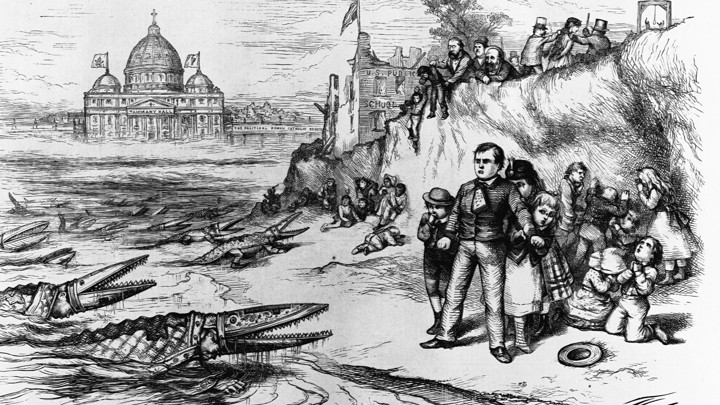
The Court Case That Could Finally Take Down Antiquated Anti-Catholic Laws


The Atlantic. January 12, 2020 
Later this month, the U.S. Supreme Court will hear one of the most significant education cases in decades: Espinoza v. Montana Department of Revenue. Centering around a modest tax-credit scholarship program in Montana, Espinoza could have major ramifications for educational-choice programs across America, which help nearly half a million students attend private schools.

In deciding Espinoza, the Court has the opportunity to do more than just settle the fate of one controversial tax credit; it could also junk Montana’s Blaine Amendment, finding it in violation of the Constitution’s religious-freedom and equal-protection clauses. In doing so, it would set a strong precedent against any law born of bigotry, even if other justifications seem neutral.

The Espinoza case dates back to 2015, when, shortly after state lawmakers enacted the tax-credit scholarship program, the Montana Department of Revenue devised a rule that banned families from using the scholarships to attend religious schools, which account for more than two-thirds of the state’s private schools. The case is brought by three Montana moms whose children are thriving at a private religious school; without the tax-credit scholarships, the families are struggling to pay tuition. (Litigating on behalf of the parents is the Institute for Justice, where I work, though I’m not directly involved with the lawsuit.)

In May 2017, a trial court ruled in their favor and struck down the Department of Revenue’s rule. But in December 2018, the Montana Supreme Court reversed the decision, citing what is commonly known as Montana’s Blaine Amendment. Enacted during a wave of anti-Catholic bigotry in 1889, the amendment bans “direct or indirect” public funding for any “sectarian purpose.” According to the majority opinion, the tax-credit scholarship program violates the Blaine Amendment, even though it’s funded entirely through voluntary, charitable, private donations incentivized by the state’s tax credit. This past summer, the U.S. Supreme Court agreed to hear the case, and it will be argued on January 22.

Today, 37 states have Blaine Amendments in their state constitution, though the precise wording varies. The amendments are named after Representative James G. Blaine of Maine, who in 1876 proposed a federal constitutional amendment that would have prohibited state funding for schools “under the control of any religious sect.” Blaine’s amendment passed the U.S. House of Representatives but fell just short of the supermajority it needed to pass the U.S. Senate.

Even though Blaine’s amendment was never enacted nationwide, Congress later required many potential states to adopt a version of the amendment in order to be admitted to the union. Starting with the Enabling Act of 1889, Congress granted statehood to Montana, North Dakota, South Dakota, and Washington only after their state constitutions guaranteed that their public schools would be “free from sectarian control.” Senator Henry Blair of New Hampshire, who regularly reintroduced the Blaine Amendment in subsequent sessions, called this provision of the Enabling Act “the very essence” of his proposal, and praised Congress for setting a “great precedent.”

At first glance, Blaine Amendments may seem like a benign way to ensure the government’s neutrality toward religion. In the 1875 speech that inspired Representative Blaine, President Ulysses S. Grant called for a federal ban on government funding for “sectarian schools” in order to “keep the Church and state forever separate.” More recently, nine states with Blaine Amendments collectively filed an amicus brief in the Espinoza case, arguing that no-aid provisions like theirs and Montana’s merely “sought to solidify the Framers’ original design separating church and State.”

But Blaine Amendments weren’t truly devoted to the separation of Church and state. Instead, they were mainly focused on separating the Catholic Church and state. Although public schools are largely secular today, that wasn’t the case in the 19th century. Public or “common” schools typically instilled in their students a nondenominational form of Protestantism, requiring them to sing hymns, pray, and read from the King James Bible—in direct conflict with Catholic dogma.

Refusing to send their children to schools that clashed with their values, many Catholic families (often immigrants) created their own private, religiously affiliated school systems. In turn, those parochial schools quickly became a target for bigoted attacks, most infamously by the Know Nothing party, and later by the American Protective Association. The association was particularly powerful in Montana: At the APA’s peak, up to one-tenth of Montana residents were members. The fact that Blaine Amendments featured so prominently in the platforms of those groups clearly shows that prejudice was a motivating factor behind state Blaine Amendments.      More

Friday, January 25, 2019

Is Matthew 28:19 evidence of Trinity baptism?

How do we refute that the Catholic Church changed the way she baptizes from "In Jesus' Name" only to the Trinitarian formula?
Image result for matthew 28:19

I don't think you can refute it. As far as I know, all of the evidence indicates that baptism was in the name of Jesus until the time of Justin Martyr in the mid 2nd century when the Trinity doctrine was invented. Whenever baptism is mentioned in the Bible, it is ALWAYS in the name of Jesus. NONE of the writings of the early church fathers prior to Justin Martyr around A.D. 150 taught Trinity baptism.

BRITANICA ENCYCLOPEDIA – Everywhere in the oldest sources it states that baptism took place in the name of Jesus Christ. Vol. 3, page 82.

As far as the Didache quote that someone posted, scholars are not in agreement regarding the date of the Didache. It may not have been written until after the Trinity doctrine was invented in the second century. Even if it was written earlier, there is evidence that the baptism passage was changed from Jesus only to the Trinity. In another section of the Didache, on the Eucharist, it says a person must be baptized "into the name of the Lord" to receive the Eucharist. I would not consider the Didache to be reliable evidence of Trinity baptism in the early church.
"But let no one eat or drink of your Thanksgiving (Eucharist), but they who have been baptized into the name of the Lord (Didache, Ch. 10)"
Is Matthew 28:19 evidence of Trinity baptism?

according to a wide scholarly consensus, it is not an authentic saying of Jesus, not even an elaboration of a Jesus-saying on baptism." (The Anchor Bible Dictionary, Vol. 1, 1992, page 585)

In place of the words "baptizing... Spirit" we should probably read simply "into my name," (Peake's Commentary on the Bible, 1929, page 723).”

“It has been customary to trace the institution of the practice (of baptism) to the words of Christ recorded in Matthew 28:19. But the authenticity of this passage has been challenged on historical as well as on textual grounds. It must be acknowledged that the formula of the threefold name, which is here enjoined, does not appear to have been employed by the primitive Church, which, so far as our information goes, baptized 'in' or 'into the name of Jesus' (The Dictionary of the Bible, 1947, page 83)”

Critical scholarship, on the whole, rejects the traditional attribution of the tripartite baptismal formula to Jesus and regards it as of later origin. (The Philosophy of the Church Fathers, Vol. 1, Harry Austryn Wolfson, 1964, pg 143)”

"It is often affirmed that the words in the name of the Father, and of the Son, and of the Holy Ghost are not the ipsissima verba [exact words] of Jesus, but...a later liturgical addition. (The Tyndale New Testament Commentaries, I, 275)"

"The testimony for the wide distribution of the simple baptismal formula [in the Name of Jesus] down into the second century is so overwhelming that even in Matthew 28:19, the Trinitarian formula was later inserted. (Wilhelm Bousset, Kyrios Christianity, page 295)"

the formal authenticity of Matt. 28:19 must be disputed (The Schaff-Herzog Encyclopedia of Religious Knowledge)”

Matthew 28:19 in particular only canonizes a later ecclesiastical situation, that its universalism is contrary to the facts of early Christian history, and its Trinitarian formula (is) foreign to the mouth of Jesus. (The International Standard Bible Encyclopedia, Vol. 4, page 2637, Baptism)”

Here's how the well respected church historian Eusebius quoted Matthew 28:19 in his writings before Constantine established the Trinity at the Council of Nicea:
"Whereas He, who conceived nothing human or mortal, see how truly he speaks with the voice of God, saying in these very words to those disciples of His, the poorest of the poor : ’Go forth, and make disciples of all the nations.’ ‘But how,’ the disciples might reasonably have answered the Master, ‘can we do it?’… But while the disciples of Jesus were most likely either saying thus, or thinking thus, the Master solved their difficulties, by the addition of one phrase, saying they should triumph ‘IN MY NAME.’ For He did not bid them simply and indefinitely 'make disciples of all nations,' but with the necessary addition 'In My Name.' And the power of His Name being so great, that the Apostle says: 'God has given him a name which is above every name, that in the name of Jesus every knee should bow, of things in heaven, and things in earth, and things under the earth.' He shewed the virtue of the power in His Name concealed from the crowd, when He said to His Disciples: 'Go, and make disciples of all nations in my name.'
Source - The Proof of the Gospel, Vol. 1, edited and translated by W.J. Ferrar, 1981, page 157

Why does Eusebius's quote matter? It matters because ALL known manuscripts of Matthew prior to A.D. 325 when Constantine established the Trinity doctrine are conveniently missing the last page, the page that would have contained Matt 28:19. I don't know whether they were burned to get rid of the original version, but what's known is there is NO biblical evidence that Jesus taught Trinity baptism since there aren't any other verses in the Bible that teach baptism in the name of a Trinity. In fact, they teach the opposite, that baptism was done in the name of Jesus.

There is also textual evidence against Matt 28:19. Which version do you think sounds authentic?

Matthew 28:18-19, Quoted by Eusebius in early 4th Century (A.D. 320)
Jesus said, “All authority … has been given to me. Therefore go and make disciples of all nations in my name…”

Matthew 28:18-19 (NIV), Current Version dated from late 4th Century (A.D. 390)
Jesus said, “All authority … has been given to me. Therefore go and make disciples of all nations, baptizing them in the name of the Father and of the Son and of the Holy Spirit…”

Why would Jesus, after announcing that all authority has been given to him, then say that, because of his authority, his disciples should baptize in someone else's name?

Don't think Matthew 28:19 could have been changed to support the new Catholic Trinity teaching? Research 1John 5:7, the other verse used to support the Trinity. The evidence is so overwhelming that it was added to the Bible, that it has been removed from all modern non-Catholic Bibles.

Unlike the modern Catholic Church, early Christians always did everything in the name of Jesus, and NEVER in the name of a Trinity.

“God greatly exalted him and bestowed on him the name that is above every name, that at the name of Jesus every knee should bend, of those in heaven and on earth and under the earth, and every tongue confess that Jesus Christ is Lord, to the glory of God the Father. (Phillipians 2:9-11, NAB)”

giving thanks always and for everything in the name of our Lord Jesus Christ to God the Father (Ephesians 5:20, NAB)”

“And whatever you do, in word or in deed, do everything in the name of the Lord Jesus, giving thanks to God the Father through him (Colossians 3:17, NAB)”
I think everything includes baptism.

*St. Paul (Acts 19) commands some disciples at Ephesus to be baptized in Christ's name: "They were baptized in the name of the Lord Jesus*." In Acts 10, we read that St. Peter ordered others to be baptized "in the name of the Lord Jesus Christ". Those who were converted by Philip. (Acts 8) "were baptized in the name of Jesus Christ", and above all we have the explicit command of the Prince of the Apostles: "Be baptized every one of you in the name of Jesus Christ, for the remission of your sins (Acts 2). Source - newadvent.org/cathen/02258b.htm Catholic

Saturday, October 13, 2018

The growing influence of evangelical churches


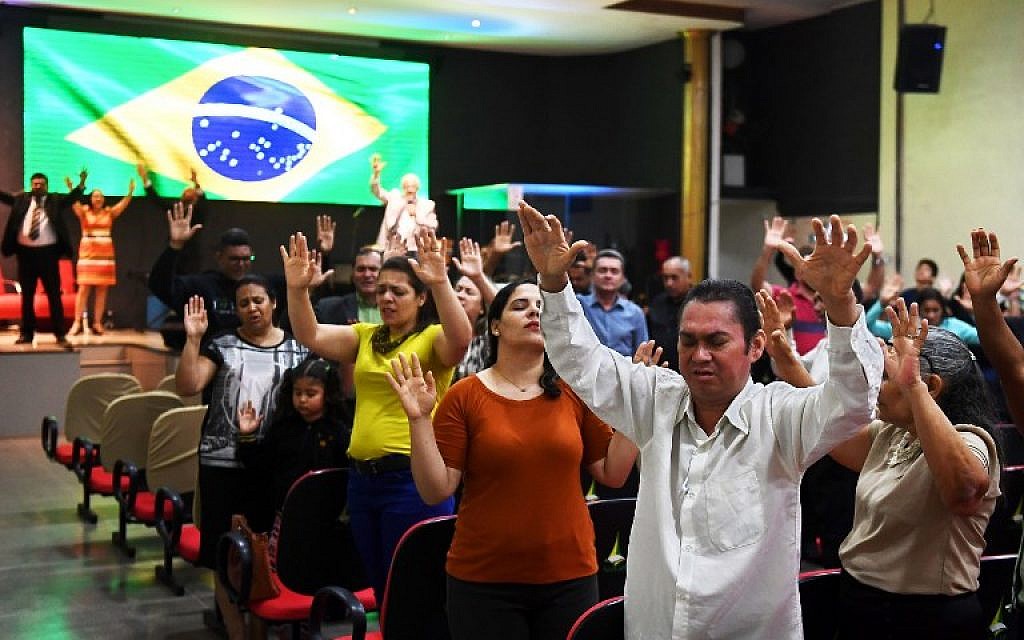
FILE -- In this photo taken on September 21, 2018 faithful pray at an evangelical church in Brasilia for the recovery of Brazilian right-wing presidential candidate Jair Bolsonaro, who suffered a knife attack during a campaign rally (AFP PHOTO / EVARISTO SA)

Times of Israel   6 October 2018
MONTEVIDEO, Uruguay (AFP) — Evangelical churches are flourishing across traditionally Catholic Latin America and as the religious movement grows, its influence — including in this weekend’s elections in Brazil — is transforming the region and swinging its politics to the right, analysts say.

Sharply opposed to abortion, same-sex marriage, the legalization of marijuana, and leftist ideology in general, the evangelical movement has boosted conservatives and helped unseat a slew of left-leaning governments across the region.

Powerful evangelical churches are now helping tip the balance in Brazil, where far-right candidate Jair Bolsonaro is riding high in the polls ahead of Sunday’s presidential election first round. 

“The recent elections in Chile, Costa Rica, Mexico, Colombia, Guatemala, and the upcoming one in Brazil reveal both greater electoral polarization and a shift to the political right,” says Andrew Chesnut, director of Catholic Studies at Virginia Commonwealth University.


In Mexico, “even though he’s left of center, Lopez Obrador felt he had to make an alliance with a small conservative party founded by a Pentecostal pastor, to ensure his victory,” Chesnut says, referring to President-elect Andres Manuel Lopez Obrador.

Sunday, April 29, 2018

Remarks by French President Emmanuel Macron that he wanted to repair church-state ties caused uproar


France24 2018-04-11 

The Catholic Church and the state were for centuries virtually indistinguishable in France but the 1789 Revolution and 19th century modernisation saw the two formally separated by a 1905 law.

Macron, who prides himself on tackling difficult issues head-on, told a meeting of bishops Monday that he hoped to repair relations with the Church through a "dialogue of truth".

"A president of the French republic who takes no interest in the Church and its Catholics would be failing in his duty," he said.

Former socialist prime minister Manuel Valls, who backed Macron for president in 2017, tweeted that "secularism is France".

"Secularism is the jewel in our crown. That is what a president of the republic should be defending," newly-installed Socialist Party leader Olivier Faure said in a tweet.

Jean-Luc Melenchon, lead of the left-wing France Insoumise (France Unbowed) party, said Macron's remarks were "irresponsible".

"Macron in full-on metaphysical delirium. Outrageous. One expects a president, one gets a little priest," Melenchon said in a tweet.

Interior Minister Gerard Collomb, who is responsible for government relations with religious groups, said Macron's remarks reflected the need for greater spiritual awareness and did not undermine France's secular traditions.

"What he is saying is that for human beings, there is not only the material world but also the search for absolute values, for spirituality, to find meaning in life," he said.

"It is perhaps a new tone but in no way does it break with the great tradition of secularism."

Opinion polls show the French roughly split between believers and non-believers while the role and place of religion in the country remains sensitive.

Saturday, September 30, 2017

Polish bishops favour outright ban on Sunday shopping

"Free Sundays is what all Catholics, non-Catholics and non-believers need,” Archbishop Stanisław Gądecki, head of the Polish Episcopate, has said, as quoted by IAR.
He was speaking ahead of a meeting of Poland’s diocesan bishops during which they plan to discuss issues including a proposal to ban shopping on Sundays.
In July, a Polish trade union leader rejected calls to relax a proposal -- filed by his union and several other organisations in parliament last year -- to ban shopping throughout the country on Sundays and urged its passage through parliament, according to IAR.
Piotr Duda, leader of the Solidarity trade union, told IAR at the time that his union did not agree to "any further concessions” amid a push to restrict trade on Sundays in Poland.
"Four free Sundays [a month], period, end of story," Duda said, as quoted by IAR.
He made the comment after an organisation representing some of Poland’s retailers suggested that grocery stores across the country should be allowed to keep their doors open every Sunday, while employees could be provided with guarantees of at least two free Sundays a month.    Polan Radio

Wednesday, August 30, 2017

Pope to Catholic lawmakers from around the world: let church teaching influence your work


Pope to Catholic politicians: Let Church teaching influence your work

Inés San Martín, August 29, 2017

ROME - Speaking to a group of Catholic lawmakers from around the world on Monday, Pope Francis urged them to bring a commitment to Church teaching to their public lives in order to build a better society.

The pontiff also urged Catholic politicians to transcend partisan divides, calling on them to “build bridges of dialogue between diverse political perspectives.

“While the contribution of the Church to the great questions of the society of our time can often be called into question, it is vital that your commitment is continually permeated by her moral and social teachings in order to build a more humane and just society,” Francis said, according to the Spanish edition of Vatican Radio.

The pope also asked the group to promulgate and apply laws that build bridges of dialogue between diverse political perspectives, particularly when their purpose is to promote greater care for the defenseless and the marginalized, “especially towards the many who are forced to leave their homeland.”

He also encouraged the legislators to draw on the fruits of their reflections in Rome about “how the Catholic faith conducts towards a just understanding of the person” when they go back to their countries.

The pope’s remarks came on Sunday, as he was addressing members of the International Catholic Legislators Network (ICLN), created in 2010 to discuss the promotion of Christian principles in the political arena.

With the patronage of Cardinal Christoph Schönborn of Vienna, Austria, and British parliamentarian Lord David Alton of Liverpool, it was founded by Dr. Christiaan Alting von Geusau of the Netherlands.

Speaking with Vatican Radio, Schönborn said that popes have always encouraged the group. He also said that Catholic politicians “find great encouragement from the Church’s approval to their commitment, because many times they feel quite alone in their parliaments as they have to face difficult situations.”

The scope of their annual meetings, he said, is to reinforce their faith which is the reason why the group has daily Mass, prays the Rosary together, and shares moments of Eucharistic adoration, in addition to having access to the sacrament of Reconciliation.

According to the network’s website, the ICLN meets near Rome each year at the end of August, bringing together some 120 people, including top-level politicians, to discuss urgent policy issues. The four-day event is held under the Chatham House Rule, with no journalists, press releases, or published speeches.

The Chatham House Rule, named after the headquarters of the UK Royal Institute of International Affairs, is invoked at meetings with the aim of providing anonymity to speakers and to encourage openness and the sharing of information.

In the case of the ICLN meetings, this applies also to the pope’s remarks, which is why Francis’s yearly addresses to the group haven’t been disclosed, nor those given by Benedict XVI on previous opportunities.

The list of topics discussed by the groups include abortion; euthanasia and assisted suicide; free market economy; communicating Catholic thought in secular politics, immigration and secularization and the persecution of Christians.

Among the participants of this year’s gathering was U.S. Congressman Alex Mooney (R-WV). Speaking with Vatican Radio, he said that it’s very “inspiring” to see “how people are fighting for family values.”

He defined the gathering as “an opportunity to meet here with other Catholic legislators and elected officials from other parts of the world, and to discuss common concerns - problems, opportunities - for our faith, and how to work together and support each other.”

At the end of the audience, when participants greeted the pope, there was a final twist definitely not on the official program: One participant took advantage of the moment to propose to his girlfriend in front of Francis.       Cruxnow

Thursday, May 18, 2017

Britain has reached new heights of secularization, with almost half of Britons now identifying as non-religious, a new study reveals.


Losing my religion? Secular Brits now outnumber Christians, but Islam & Hinduism growing

17 May, 2017
Britain has reached new heights of secularization, with almost half of Britons now identifying as non-religious, a new study reveals.
According to ‘The “No Religion” Population of Britain’ report by Stephen Bullivant, professor of theology and the sociology of religion at St Mary’s University, Twickenham, non-religious people, known as ‘nones’, account for 48.6 percent of Britain’s population.
Although there has been an overall trend towards secularization in Britain, the figures also show record numbers of people from non-Christian faiths, such as Islam and Hinduism.
The number of British people identifying as Christian dropped from 55 percent to 43 percent between 1983 and 2015. By contrast, non-Christian believers such as Muslims and Hindus quadrupled.
“The rise of the non-religious is arguably the story of British religious history over the past half-century or so,” Bullivant said.
“Looking at the long-term pattern, the non-religious share of the population has shown strong growth over our whole period,” the report states.
“The year 2009 was the first in which nones outnumbered all Christians put together.
“With the single exception of 2011, this pattern has held ever after. In two years, 2009 and 2013, nones formed a majority of the adult British population.”
However, the research, carried out with data from the annual British Social Attitudes survey and the biennial European Social Survey, also highlights how the falling number of worshipers with the Church of England seems to have stabilized.
Bullivant said patriotism might be driving this trend, as Christianity and Englishness tend to be conflated.
“People see Christianity as an expression of Englishness. There has been more rhetoric around Britain being a Christian nation,” he said, according to the Times.
“I suspect a larger proportion of people who do say they are Anglican tend to be patriotic.”
In 1983, the number of Anglicans accounted for 40 percent of Britain’s population. This dropped to 16.3 percent in 2009 before it slid back up to 17.1 in 2015.
The research also shows a spike in the number of ‘nonverts’, namely people who have been brought up believing in a certain religion, but who have turned to be non-religious.
Most ‘nonverts’ – more than six in 10 – are Christians, mainly Anglican and Catholic.
According to the report, most ‘nones’ have been brought up in Christian households; overall, a mere 2 percent of ‘nones’ have been raised in non-Christian homes.
The rate of people converting to non-religion was recorded as 14 percent for Jews, 10 percent for Muslims and Sikhs, and 6 percent for Hindus.
Bullivant pointed out how non-religion has stopped being an exclusive middle-class feature.
“It used to be middle-class people, who had gone to university, who were more likely to step out of their parents’ religiosity,” he said, as cited in the Guardian.
“As having no religion has become the norm, vast swaths of working-class people are now also identifying as nones.”     RT

Wednesday, November 30, 2016

Former Jesuit leader Peter Hans Kolvenbach dies at 87

Former Jesuit leader who faced stiff tests dies at 87
Father Peter Hans Kolvenbach. (Credit: Image courtesy of the Society of Jesus.)
Father Peter Hans Kolvenbach, who led the worldwide Jesuit order for a quarter century from 1983 to 2008, and who broke with tradition by voluntarily resigning what had once been a lifetime job, died on Sunday in Beirut four days shy of his 88th birthday.                  Cruxnow

Wednesday, July 27, 2016

What do Donald Trump, Tim Kaine and Pope Francis have in common?

Senate Foreign Relations Cmte Holds Hearing On Cartels And US Heroin Epidemic
Drew Angerer—Getty Images Tim Kaine listens to testimony during a Senate Foreign Relations Committee hearing on Capitol Hill, on May 26, 2016.
Christopher Hale is executive director at Catholics in Alliance for the Common Good and the co-founder of Millennial.

Hillary Clinton's VP pick was educated by Jesuit priests; he remains a devout Catholic—and he supports abortion rights

Here’s a quiz: What do Donald Trump, Tim Kaine and Pope Francis have in common?
Answer: all three men were educated by Jesuits, a religious order of Catholic priests whose most famous member is the Pope himself.
For Trump, his two years at Fordham University, a Jesuit school in the Bronx, seem to leave little impact on his life. After his sophomore year, Trump transferred to the Ivy league University of Pennsylvania
What compelled him to transfer from his hometown Jesuit university? “I decided that as long as I had to be in college, I might as well test myself against the best,” Trump said.
Ouch.
Tim Kaine is a different story. Kaine, who if elected, would be the second Catholic Vice President in American history (Joe Biden is the first), graduated Rockhurt High School in 1976, a Jesuit school in Kansas City.
“That high school experience with the Jesuits was a key part of my transition into an adult life where instead of just accepting the answers of my parents or others, I’ve been a person who wants to go out and find the answers on my own, and the Jesuits get credit for that,” Kaine says.
After being admitted to Harvard Law School, Kaine took a year off to volunteer with the Jesuits at a vocational school in El Progreso, Honduras. In Honduras Kaine learned to speak Spanish, a skill he will likely use on the campaign trail this fall.
According to Kaine, that year was a watershed time in his life. “I think of El Progreso everyday,” Kaine said. “The people, aside from my family, are the most important in shaping who I am today.”
He also claims his experiences with the Jesuits have inspired his public service: “I do what I do for spiritual reasons. I’m always thinking about the momentary reality, but also how it connects with bigger matters of what’s important in life.”
Kaine grew up in a very devout family. He told C-SPAN earlier this year that “when we got back from a vacation on a Sunday night at 7:30 PM, they would know the one church in Kansas City that had an 8 PM Mass that we can make.”
Kaine still attends Mass with his wife today at a predominantly African American parish in Richmond, where he once was a choir member before his demanding political schedule got in the way.
Kaine has had run-ins with the Church on social issues, most notably on abortion and the death penalty. Kaine supports abortion rights, which is against Catholic teaching.
Asked about this issue earlier this summer, Kaine responded: “I have a traditional Catholic personal position, but I am very strongly supportive that women should make these decisions and government shouldn’t intrude.”
That nuanced view will be difficult to swallow for many abortion rights activists within the Democratic Party and with many of his fellow Catholics who support the right to life from conception.
Kaine does, however, support many of the economic and social justice issues at the heart of the Church’s teaching, most notably support for comprehensive immigration reform.
During Pope Francis’s trip last fall, Kaine said he was moved to tears by the pontiff’s address to Congress. The Virginia Senator recently told me that he considered Pope Francis to be his hero.
After Francis’s address last September, Kaine said that Francis should force us to “ask what our motives are as a nation.”
He said it was the pope’s role to “challenge our thinking” as we face great questions about our nation’s common good.
Let’s hope he takes the same approach if he’s lucky enough to be elected this November.     Time

Sunday, May 15, 2016

Letting Roman Catholics Off the Hook

Well, fellow Members, this has certainly been an interesting week. Here's another article I received, just today, regarding a VERY significant change in viewpoint.  I think it is remarkable that we just read about how we're going around ripping signs down and dragging people into court on the one hand, but on the other hand we're making nice, lifting up, and even promoting others.  It's like we're cannibalizing ourselves, self-destructing, it seems.  I'm so thankful to God that He's not saving us in groups.  He is saving us INDIVIDUALLY.  You can trust that you will NOT get into Heaven based on the particular church roll your name is on. You will only get there based on the character you've developed, who rules your heart, and whether or not your name is listed in the Lamb's book of Life. PERIOD.  I am so thankful that I've never been one to follow the crowd.  I was always taught to know the Lord and His Word for myself.  So everyone is welcome to believe however they choose.  There is FREEDOM in serving the Lord (2 Corinthians 3:17).  As for me and my house, we will serve the Lord according to His Word, regardless of what man has to say about it.

"Many will be lost while hoping and desiring to be Christians. They do not come to the point of yielding the will to God. They do not now choose to be Christians. The Lord does not propose to save us in companies. Individually we are to make our choice (Faith I Live By 154.7). 

God's people (individuals) can and will be found all over the world, regardless of group.  So while the different groups are waffling back and forth and running along after whatever the particular wind of doctrine of the day is, God's people will be making their calling and election sure.  They will one day be part of the TRUE FOLD.  Just so we're clear.  What we're witnessing is the Church Militant.  May we ALL strive to be members of the Church Triumphant!

"I lay down my life for the sheep. And other sheep I have, which are not of this fold; them also must I bring, and they shall hear my voice; and there shall be one fold, and one shepherd." John 10:15-16 Christ is not only the propitiation for our sins, but also for the sins of the whole world.  {Signs of the Times, January 22, 1894}
   
Remember, the "old" view that is being spoken against in the article below was based STRICTLY off of the Bible and the Bible alone.  So when we throw that "old" view out, what are really saying?  What do we do with Bible Prophecy?  And if the Bible is wrong, then what do we do about the rest of what we believe?

Martin Luther (who's motto was also Sola Scriptura) identified the Antichrist over 500 years ago! (along with many others):

The quote copied below is from one of Martin Luther's last books. It was titled: "A Prelude by Martin Luther on the Babylonian Captivity of the Church," Page 536, chapter 3.

"Nevertheless, since few know this glory of baptism and the blessedness of Christian liberty, and cannot know them because of the tyranny of the pope, I for one will walk away from it all and redeem my conscience by bringing this charge against the pope and all his papists: Unless they will abolish their laws and traditions, and restore to Christ's churches their liberty and have it taught among them, they are guilty of all the souls that perish under this miserable captivity, and the papacy is truly the kingdom of Babylon, yes, the kingdom of the real Antichrist! For who is " the man of sin" and "the son of perdition" but he that with his doctrines and his laws increases sins and the perdition of souls in the Church, while he sits in the Church as if he were God? All this the papal tyranny has fulfilled, and more than fulfilled, these many centuries. It has extinguished faith, obscured the sacraments and oppressed the Gospel."

Keep in mind that it was NEVER the Roman Catholics who were on the "Hook" in the first place.  It was the Roman Catholic System.  God has precious souls in the Roman Catholic Church and in other denominations all over the world.  So even the topic of the article below is deceptive.

I'd love to hear your thoughts on this one.  Read it and weep 


 Adventist Today Magazine January 04, 2010
Letting Roman Catholics Off the Hook
Posted January 4th, 2010 by Loren Seibold
Editor's Note: This is a preview article that appears on page 22 of our brand-new winter 2010 print issue being delivered to our subscribers this month.

By Loren Seibold
For over a century, even before the publication of The Great Controversy, we Adventists have regarded the Roman Catholic Church leadership, typified in the first beast of Revelation 13, as our arch-nemesis, our bête noire, the enemy that takes the evil part in the apocalyptic scenario against God's remnant.
Here are seven reasons why it may be time to question them in that role.
1.   More than a hundred years have passed since our prophet approved these prophetic applications. Ellen White expected Jesus to return long before this.1We're not sure why that hasn't happened. But isn't it possible that some details of the apocalyptic scenario set out in the 1890s may have changed by the 2010s? It happened to Israel. Not all of the original Old Testament prophecies about them and their role came to pass. We call it "conditional prophecy."
2.   Principles might be more diagnostic than players. That we oppose those who would legislate matters that should be left to an individual's conscience is a principle I value, and I'm proud of Seventh-day Adventist efforts to protect religious liberty. But if it should happen that someone other than the Roman Catholic Church begins to act like the beast of Revelation 13, we will be more ready to respond if we are watching for a violation of the principle than if waiting for one specific group to offend.
3.   Ellen White fingered Catholicism in a very different world. Historians have shown that 19th-century American anti-Catholicism grew out of a general anti-immigrant nativism.2 In an era when we have had and could again have a liberty-loving Roman Catholic president, when Catholic immigrants have become our young work force, why can't we preach the gospel without identifying Roman Catholicism as Satan's exclusive tool?
4.   The Roman Catholic Church of today is a much different institution than it was during Ellen White's time.The Second Ecumenical Council of the Vatican (1962-1965) radically altered that denomination's theology and practices. Vatican II declared the gospel central to church theology, made worship accessible, denied that Roman Catholics only can be saved, encouraged lay Bible study, and affirmed religious liberty. While not quite a Protestant Reformation, today's Catholic Church is not the same Catholic Church referenced in our 19th-century eschatological studies. Among other things, the Second Ecumenical Council weakened Vatican authority over world Catholics-as evidenced by the 78 percent of American Catholics who oppose their church's ban on contraception.3
5.   By focusing on Roman Catholicism, we may miss more dangerous anti-Christian opponents. Far more Christians have been killed, persecuted, or denied their religious liberty by Communism, military Fascism, and Islamist extremism in the past century than by Roman Catholics; we've let these pass with minimal comment (in the case of Naziism, even offering some pusillanimous cooperation) as we continued to warn against the pope. Today religious liberty still has more dangerous enemies than Catholicism–in the United States, perhaps even some of our fellow conservative Protestants.
6.   God has given us time to become a world church, and that changes the cast of characters in our eschatology. The "antichrists"-opposers of Christ–to many of today's world Christians are radical imams or cruel dictators. One site of Christian persecution right now is northern Nigeria, where Muslims burn churches and killChristians.4 An eschatology that expects only Roman Catholics to initiate religious oppression, only in the United States, and only around the Sabbath question, may fail to speak prophetically should apocalyptic markers appear elsewhere.
7.   Religious liberty has arguably improved in countries where Catholicism has influence. During my lifetime, the papacy has frequently been a force for peace and freedom. Pope John Paul II opened the first breach in the Iron Curtain, and Catholics have been more forthright in speaking against violence and oppression than many of our fellow conservative Protestants. Consider the irony that our evangelists are employing anti-Catholic teachings for soul winning in countries where the papacy helped win them that freedom! (And the even greater irony that some of us still think that calling the Pope the Antichrist is necessary to win souls to Christ.)
Of course, we don't give the Roman Catholic church a free pass; we subject it to the same Biblical scrutiny we would any other influential world power. (And while we're at it, we'd do well always to scrutinize ourselves by the same metrics we use on others–which is Jesus' advice, not mine.5)
But perhaps we needn't single out Roman Catholicism any longer. Ellen White, who was often more flexible than her followers, wrote: "God wants us all to have common sense, and He wants us to reason from common sense. Circumstances alter conditions. Circumstances change the relation of things."6
Roman Catholicism has served us well as an enemy: provocative enough to keep us energized, yet doing minimal actual damage to us. Such an important enemy made us feel significant, "in the know," and in control, while not really disturbing our lives.
Opposing current enemies might thrust us into prophetic roles that take more commitment and action. My friend Bert B. Beach, speaking of Adventist eschatology, once said to me: "I'm suspicious when people are constantly focused on what's going to happen in the future. I think they're trying to avoid dealing with what's going on right now."
I think Bert is on to something. Could we become as enthusiastic in taking on the religious persecution that's happening to Christians right now, in places like Nigeria, as we've been in accusing Roman Catholicism of planning to someday persecute us here? -Adventist today magazine Jan. 04, 2010

1 She wasn't alone; the apostles expected Jesus in their lifetimes, too (see Matt. 24:34, Heb. 1:1-2, 2 Thess. 1:6-10).
2 See Ernest Tuveson's Redeemer Nation and John Higham's Strangers in the Land: Patterns of American Nativism, 1860-1925.
4 And sometimes, sadly, vice versa.
5 "For in the same way you judge others, you will be judged, and with the measure you use, it will be measured to you" (Matt. 7:2, NIV).
6 Selected Messages, Vol. 3, p. 217.