Showing posts with label Sun Worship. Show all posts

Saturday, October 31, 2020

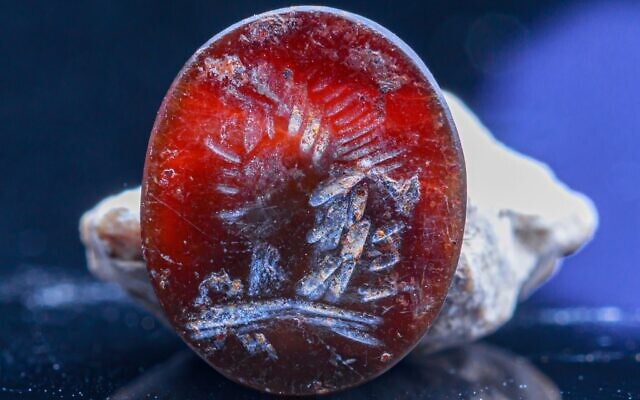
2,000-year-old seal with the image of Apollo discovered in the City of David near Jerusalem's Western Wall

2,000-year-old seal with the image of Apollo discovered in the City of David near Jerusalem's Western Wall. (Eliyahu Yanai/City of David)

Times of Israel  29 October 2020

Sun god, a symbol of health and prosperity, was the only member of the pagan pantheon used by Jews during the Second Temple period, says City of David archaeologist Eli Shukron

Discovery of a rare 2,000-year-old signet ring engraved with the Greek sun god Apollo gives new evidence of a pluralistic Jewry walking the streets of ancient Jerusalem during the Second Temple period, archaeologist Eli Shukron told The Times of Israel.

“It allows us to see a Jerusalem that wasn’t some kind of ultra-Orthodox city, it was more pluralistic,” Shukron said, who is convinced the ring would have adorned a Jew’s finger. The fact that a Jew chose the symbol of a Greek god, “shows the wide variety of practices in Jerusalem. Everyone was a Jew, but there were different groups and perspectives,” he said.

The dark brown jasper gem sealing (intaglio) was recently discovered at the Archaeological Sifting Project at Tzurim Valley National Park during the wet sifting of earth taken from ongoing City of David excavations of the foundations of the Western Wall. 

Shukron said there is absolutely no doubt that it is Apollo who is engraved on the tiny, oval-shaped, 13 millimeter-long, 11 millimeter-wide, and 3 millimeter-thick sealing. It would usually have been used as a signature stamp on beeswax to seal contracts, letters, wills, and goods or bundles of money, according to a City of David press release.

The profile of Apollo has long flowing hair spilling over his sturdy neck. He has a large nose, thick lips, and small prominent chin, according to the press release. The styled hair is braided above his forehead, with long curls reaching the shoulder.

All of this adds up to the god Apollo in the eyes of a trained archaeologist. “You cannot miss it,” Shukron said.


Saturday, January 25, 2020

Australia calls world to pray at sunrise


Australia Christian prayer leaders invite their brothers and sisters in Christ, prayer groups, prayer networks and churches to join with them all over the world to pray at sunrise on New Year's Day 2020.
Missions Box 
This year our focus is to pray for the nations. Over the last two years we had registrations from 50 different countries including USA, South Africa, Namibia, Pakistan, Japan, United Kingdom, Fiji, Vanuatu, New Zealand, and Australia.
Warwick Marsh, coordinator for Australia’s National Day of Prayer & Fasting said, “David said in Psalm 108:2, ‘I will wake the dawn with my song.’ During this time of prayer, we want to focus on giving great praise to God. We also want to pray for revival and transformation, that God will bring healing to each of our nations: 2 Chronicles 7:14.”
Marsh continued, “In declaring Jesus Christ as Lord at this worldwide Sunrise Prayer Relay we are circling the globe with prayer, praise and worship and surrendering our lives to Jesus Christ for the glory of God. This year we want to challenge people to pray for the nations. Use the prayer resources on the website and social media and register your location at: www.sunriseprayerrelay.org. This year we are asking you to help reach a billion people and get behind www.go2020.world/home.
Pat Steele, a prayer & evangelist leader in Wollongong Australia, said, “We encourage you to pray the Lord’s Prayer together aloud as the sun rises and make a declaration that Jesus Christ is Lord of your life, your family, your region and your nation. Let’s also join to pray for the nations. At your location we encourage you to include praise and worship, prayers, and scripture readings. We suggest 30 minutes, but you can pray for longer. You could even take communion, shine a torch, or light a candle. What you do for your sunrise celebration is up to you.”

Religious gathering with Kanye West to fill up Sun Devil Stadium

PHOENIX – College football season is over, but a huge crowd is expected to converge on Sun Devil Stadium in Tempe on Saturday for a daylong religious gathering featuring rapper Kanye West.
All of the free tickets for Awaken 2020 were quickly snapped up online. The event’s website invites attendees “to be part of the Jesus awakening that is shifting HISTORY.”

West and his Sunday Service Collective gospel choir may be the biggest draw, but the event runs from 10 a.m. to 10 p.m. with about a dozen evangelical leaders.

In addition to West, who released the Christian-themed album “Jesus is King” in October, Daniel Kolenda, David Herzog, Brian “Head” Welch, Cindy Jacobs, Jerame Nelson, Guillermo Maldonado, Jake Hamilton, Jeremy Riddle, Stephanie Herzog, Eddie James and Steve Swanson are scheduled to speak.

Tuesday, December 31, 2019

The church fights in Europe to prohibit working on Sunday

Actualidad.  August 31, 2017
On Wednesday, August 23, 2017, Polish bishops requested a total ban on work on Sunday in a country where the law is very liberal on this particular point. Likewise, throughout Europe, several episcopal conferences are trying again to place the issue of Sunday rest at the center of political debates.
 
The president of the Episcopal Conference of Poland, Archbishop Stanislaw Gadecki, declared on Wednesday, August 23, 2017, on behalf of the bishops of Poland that "both Catholics and non-Catholics and atheists need to rest on Sunday."
 
Although it has the support of the Solidarity Labor Union party , the Church in Poland has not been able to impose its point of view.
 
In this country deeply imbued with Catholicism, civil law allows work on Sunday and holidays. However, there has been progress: the current government is in favor of the ban, and will address the issue next fall.
 
As usually happens, the declaration of the episcopal conference is only limited to defending Sunday rest, but does not mention any religious motive. Proposes ad hominem arguments, such as the need for a "better quality of life". In the same context, the Archbishop of Katowice, Monsignor Wiktor Skworc, declared that "families not only need financial support, but also free time."
 
Sunday rest has its origin in the Decalogue: "Six days you will work, and you will do all your work. But the seventh day is a day of rest, consecrated to Yahweh your God; and you will not do any work in it, neither you, nor your son, neither your daughter, nor your servant, nor your servant, nor your cattle, nor the foreigner who is within your doors "(Exodus 20: 9-10) From the Resurrection of Christ, the rest day is Sunday, the" Lord's Day "- dies Domini. Therefore, Sunday as a day of rest is a matter of positive divine law; all the Church did was explain this command of God and make it more explicit. Later, he also included it in his code of canon law and in his universal catechism.
 
When, after the Edict of Milan, the Church's relations with temporal power were normalized, the latter followed the example of ecclesiastical law in this matter. Thus, in a decree of March 7, 321, Emperor Constantine declared: "On the venerable day of the sun, may the magistrates and the people rest in the cities, and may all the workshops be closed."
  1
This practice was constant in the Church throughout the centuries, until the first attacks against Sunday, the sacred day in which the faithful fulfill their duties to render to God the worship that is due. The first attacks took place during the French Revolution, with the republican calendar imposed between 1793 and 1806; this one suppressed the week of seven days thus eliminating Sundays.
 
Currently, where atheistic and secular ideologies have failed, commercial interests succeed. For many years now, there have been new laws in favor of Sunday work. Modern Popes have tried to control these changes. On May 31, 1998, in his Apostolic Letter Dies Domini , Pope John Paul II recalled that Sunday rest "is the way man has to withdraw from the plaintiff and excessive cycle of earthly tasks to remember that God is the author of everything."
 
Also, in August 2009, the 24 Eucharistic Congress was held in Bari, Italy, on the theme: "Without Sunday, we cannot live." At the closing of the congress, Benedict XVI asked Christians to rediscover the spiritual importance of Sunday, as "an expression of the identity of the Christian community" against "unbridled consumerism" and "religious indifference."
 
Paradoxically, in Europe, a small number of highly secularized countries, such as Austria and Germany, seem to be more respectful towards Sunday rest. In an article published in La Croix , Delphine Allaire cites the German Constitution stipulated in article 139: "Sundays and holidays recognized by the state remain legally protected as days of rest and spiritual edification." In Belgium, it is only allowed to work three Sundays a year, except in the tourist cities.
 
However, in most European countries, including the United Kingdom, Holland, Sweden, Norway, Romania, Czech Republic, Ireland, Italy and Portugal, as well as in Madrid, the capital of Spain, business is open 52 Sundays at year. In highly Catholic countries such as Italy, Portugal and Spain, heated public discussions regularly erupt, La Croix adds. Therefore, in 2014, the Spanish bishop of Santander, Vicente Jiménez, called for a "united front", appealing to the authorities to resist "economic pressures" that seek to liberalize working hours.
 
In France, Sunday rest lost importance after the promulgation of the Macron Law in 2015, which created 21 international tourist areas in a country where it is allowed, through a trade agreement, to work on Sundays.
 
In Italy, Delphine Allaire explains, the Episcopal Conference prefers to stick to the protection of the rights of "workers" to spend time with their families on Sundays, supporting the country's main business association, Confesercenti.
 
It should be noted that on June 9, 1873, at the feast of the Holy Trinity, the Blessed Virgin Mary appeared in Saint-Bauzille-de-la-Sylve in the Hérault, to Auguste Arnaud, a young winemaker of 30 years old , who worked during the week, and who was working in his small vineyard, and said very seriously: "You must not work on Sunday. Blessed are those who believe; woe to those who do not believe." This Marian apparition was recognized by the authorities of the Church, and serves to demonstrate once again the importance of sanctifying the Lord's Day. The Mother of God had already reminded men of the importance of this religious obligation in La Salette.
Tuesday, December 20, 2016

Christmas and Its Pagan Roots

Today Christians debate over nearly EVERYTHING rather than going directly to the word of God. What is the pre-Christian celebration called the 'Natalie Invitus Solis', that was kept in the occult world, which Christians have stolen and have called Christmas about? Can we really distinguish between what is Christianity and what is paganism? This in-depth study will settle this issue once and for all. It will upset and agitate but the truth is meant to set us free.

Origin of Christmas

The precise origin of assigning December 25 as the birth date of Jesus is unclear. The New Testament provides no clues in this regard. December 25 was first identified as the date of Jesus’ birth by Sextus Julius Africanus in 221 and later became the universally accepted date. One widespread explanation of the origin of this date is that December 25 was the Christianizing of the dies solis invicti nati (“day of the birth of the unconquered sun”), a popular holiday in the Roman Empire that celebrated the winter solstice as a symbol of the resurgence of the sun, the casting away of winter and the heralding of the rebirth of spring and summer. Indeed, after December 25 had become widely accepted as the date of Jesus’ birth, Christian writers frequently made the connection between the rebirth of the sun and the birth of the Son. One of the difficulties with this view is that it suggests a nonchalant willingness on the part of the Christian church to appropriate a pagan festival when the early church was so intent on distinguishing itself categorically from pagan beliefs and practices.

A second view suggests that December 25 became the date of Jesus’ birth by a priori reasoning that identified the spring equinox as the date of the creation of the world and the fourth day of creation, when the light was created, as the day of Jesus’ conception (i.e., March 25). December 25, nine months later, then became the date of Jesus’ birth. For a long time the celebration of Jesus’ birth was observed in conjunction with his baptism, celebrated January 6.

Christmas began to be widely celebrated with a specific liturgy in the 9th century but did not attain the liturgical importance of either Good Friday or Easter, the other two major Christian holidays. Roman Catholic churches celebrate the first Christmas mass at midnight, and Protestant churches have increasingly held Christmas candlelight services late on the evening of December 24. A special service of “lessons and carols” intertwines Christmas carols with Scripture readings narrating salvation history from the Fall in the Garden of Eden to the coming of Christ. The service, inaugurated by E.W. Benson and adopted at the University of Cambridge, has become widely popular.       Brittanica