The
earliest known examples of mathematical and geometric astronomy have
been identified in a series of ancient Babylonian cuneiform tablets.
An analysis of the tablets, reported in the journal
Science,
reveals ancient Babylonians were able to calculate the position of
Jupiter using geometric techniques previously believed to have been
first used some 1,400 years later in 14th century Europe.
"These
texts are the earliest evidence we have from antiquity of mathematical
astronomy," said the study's author Dr Mathieu Ossendrijver, a historian
on Babylonian astronomy with the Humboldt University in Berlin.
"It describes Jupiter's velocity across the sky and how that changes with time."
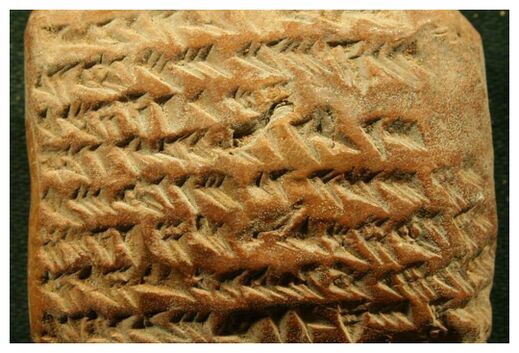
The
tablets, which are housed at the British Museum, are believed to have
been unearthed from an archaeological dig in what is now modern day Iraq
sometime in the 1800s.
The almost completely intact tablets are thought to have been written in Babylon between 350 and 50 BCE.
The
tablets are part of a larger collection of 450 astronomy tablets from
Babylon and Uruk containing celestial data arranged in rows and columns,
together with instructions.
Dr Ossendrijver examined five tablets
numbered as trapezoid text A to trapezoid text E, four of which deal
with geometrical trapezoid shapes, but nobody understood what they were
about.
One tablet key to puzzle
However, one of the tablets — trapezoid text A — provided Dr Ossendrijver with the key to understanding the other four tablets.
This is highly surprising. No-one expected to find something like this in antiquity.
Dr Mathieu Ossendrijver
"I discovered that they describe the motion of Jupiter
as a velocity, the number of degrees it moves across the sky in a day,"
Dr Ossendrijver said.
"If you plot the velocity of Jupiter against
time, you get a creeping curve which looks like a rectangle with a
slanted top — that's the trapezoid."
The tablets show two
intervals from when Jupiter first appears along the horizon at night, to
the planet's position in the sky after 60 and 120 days.
The
tablets also computed the time when Jupiter covers half of this 60-day
distance by partitioning the trapezoid into two smaller ones of equal
area.
"We're not really sure why the Babylonians
were so interested in the motion of the planet Jupiter, but one possible
explanation is that Jupiter was associated with Marduk the supreme god
of Babylon," Dr Ossendrijver said.
"These astronomers or priests
were employed by Babylon's main temple where Marduk was venerated. Each
god had a star and Marduk's was Jupiter."
Babylonian writing is
thought to have originally developed as an accounting system for keeping
track of property such as sheep, grain, or the size of a field.
"That's what most of the cuneiform tablets we have from Mesopotamia deal with," Dr Ossendrijver said.
"But
by about 2000 BCE they began to develop a form of mathematics with
sophisticated field computations and methods for solving what we call
quadratic equations that go beyond these practical things. It's a way of
describing and computing motion, similar to what we today call integral
calculus."
Tablets redefine history
These tablets
redefine our history books as the origins of calculus are generally
traced back to the Middle Ages when people began using geometry to
calculate velocity by plotting the position of an object against time.
"This is highly surprising. No-one expected to find something like this in antiquity," Dr Ossendrijver said.
"While
ancient Greeks used geometrical figures to describe configurations in
physical space, centuries earlier these Babylonian tablets used geometry
in an abstract sense to define time and velocity."
abc.au