Showing posts with label Plague. Show all posts

Monday, August 31, 2020

The Biblical locust plagues of 2020

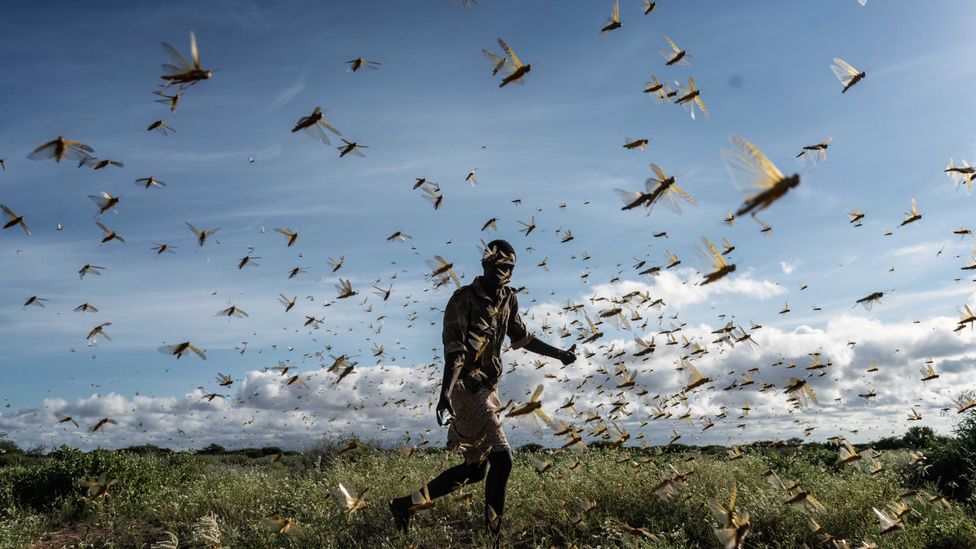
Locusts have been congregating in dozens of East African and West Asian countries in 2020, in the worst swarms in decades (Credit: Getty Images)

BBC   6th August 2020

Drawn to an emaciated avocado drooping from a drying mother tree, Esther Ndavu wonders aloud if it will ever mature into the fist-sized oval fruit that keeps city residents going. Like many others at her farm in Mathyakani village in central-eastern Kenya, this avocado tree has been attacked by desert locusts. With a wide sweep of her right hand, Ndavu counts about 10 avocado, mango and paw paw trees that are losing their boughs after the infestation.

The locust invasion that swept over farms in rural Kenya from December 2019 has left farmers like Ndavu not only counting crop losses, but struggling with emerging environmental and health problems. The swarms have been the worst seen in Kenya for 70 years, and experts are concerned that swarms later in the year will be even larger.

Desert locusts, or Schistocerca gregaria, have often been called the world’s most devastating pest, and for good reason. Swarms form when locusts’ numbers increase and they become crowded. This causes a switch from a relatively harmless solitary phase, to a gregarious, sociable phase. In this phase, the insects are able to multiply 20-fold in three months and reach densities of 80 million per square kilometre. Each can consume 2g of vegetation every day – combined, a swarm of 80 million can consume food equivalent to that eaten by 35,000 people a day.

In 2020, locusts have swarmed in large numbers in dozens of countries, including Kenya, Ethiopia, Uganda, Somalia, Eritrea, India, Pakistan, Iran, Yemen, Oman and Saudi Arabia. When swarms affect several countries at once in very large numbers, it is known as a plague.

Friday, February 28, 2020

Plague of locusts threatens East African economies as UN sounds emergency alarm


The worst desert locust infestation in 70 years is ravaging East Africa, potentially endangering economies in a region heavily dependent on agriculture for food security.
NTEB February 21, 2020
I honestly thought that the current locust swarming would have stopped by now, or at the very least lessened, but just the opposite is taking place. It is increasing in intensity, with the locusts eating the food of 35,000 people in a single day. Interestingly, the locust swarms seem to be affecting nations that reject the God of the bible who commands the locusts at His will.

“If I shut up heaven that there be no rain, or if I command the locusts to devour the land, or if I send pestilence among my people;” 2 Chronicles 7:13 (KJB)
“Hast thou entered into the treasures of the snow? or hast thou seen the treasures of the hail, Which I have reserved against the time of trouble, against the day of battle and war?” Job 38:22,23 (KJB)

The book of Job tells us that God uses the weather as a weapon, and it is more powerful than anything the militaries of the world can command. Read the book of Revelation sometime and see how God is going to use weather to judge this world. Hydrogen bombs are nothing more than mere firecrackers compared to what God will rain down upon this earth in the coming time of the great Tribulation. I am starting to think that this relentless locust plague is more than a seasonal outbreak, as it is rapidly approaching biblical territory. Birth pangs, perhaps? Time will tell.

Plague of locusts threatens East African economies as UN sounds emergency alarm

FROM CNBC: In recent days, locust swarms have begun to impact South Sudan, Uganda and Tanzania, having already decimated crops throughout Ethiopia, Kenya and Somalia, Eritrea and Djibouti. The Food and Agriculture Organization (FAO) of the United Nations earlier this week called the situation “extremely alarming.”
The UN warned of an unprecedented threat to food security in a part of the world where millions face hunger, and the FAO estimated that 70,000 hectares of crops in Kenya and around 30,000 hectares in Ethiopia had been infested. It added that locusts had attacked coffee and tea crops that account for approximately 30% of Ethiopia’s exports.
The FAO also estimated that around 8.5 million Ethiopians and 3.1 million Kenyans already face food insecurity. The locusts have now begun breeding along both sides of the Red Sea in Egypt, Sudan, Eritrea and Saudi Arabia.
Desert locusts can travel up to 150km (95 miles) a day, and a one-square-kilometer swarm can devour as much food as 35,000 people in a single day, according to the UN.