Fire
devours before them, and behind them a flame burns.The land is like
the garden of Eden before them, but behind them a desolate wilderness,
and nothing escapes them
(Joel 2:3).
|
|
This Scripture
is describing the Muslim invasion and destruction of North Africa.
By 300 AD,
North Africa was the most important province of the Roman Empire and was teeming
with cities:
By the
third century, there were five or six hundred cities. Two hundred of them
were in the rich farmlands of northern Tunisia. In places there were no
more than six or eight miles apart, and in the valley of the River Bagradas
(Medjerda) there was almost a kind of ribbon development along the main
road from Carthage to Theveste (Tebessa). (Raven, Rome in Africa,
p. 101).
Carthage—the second
largest city in the western Roman Empire—was the center of the Roman
province of Africa and a major breadbasket of the Empire.

Christian North
Africa circa 300 AD.
|
|
Christian
North Africa had millions of Christians, and Carthage was the
most important city, with a population of over 500,000.
|
|
|

Carthage was the main city in
Roman North Africa.
|
By 300 A.D.,
Christianity was the dominant religion in North Africa as paganism was just
about to be completely overthrown:
By this
time Christianity had taken a firm hold in North Africa. The Church had
survived persecution under Severus, Decius, and Valerian, and was ceasing
to be the religion of a poor minority. In contrast to the emptiness of pagan
literature of this period there were the vigorous works of Cyprian, Arnobius,
and Lactantius. The Church was making its impact felt on all classes and
in the farthest corners of the Roman provinces in Africa. (Frend, The
Donatist Church, p. 3)
Naturally,
the Roman Emperors were insanely jealous that more and more people were not
worshipping them as divinities.
In 303, the
last great Empire wide pagan persecution began and North African Christians
were ordered to hand over the Scriptures to be burned.
This last
pagan persecution was in the planning stage for at least 40 years prior to
300 A.D., as a very friendly ecumenical mood prevailed among the pagans:
In the
Roman cities the Emperor's orders appear to have been carried out firmly
but not without tact. For the previous forty years
Christians and pagans had lived side by side in relative peace. The
Church had become almost an established institution. At Cirta (modern Constantine),
the capital of the province of Numidia Cirtensis, the magistrate told Bishop
Paulus to produce the lectors who were responsible for looking after the
Scriptures. The reply was 'Everybody knows them'. At Apthungi (modern Henchir
Souar, in Tunisia), the chief magistrate, the Duumvir Alfius Caecilianus,
and the bishop Felix appear to have been on friendly terms, and indeed the
official did not know of the existence of the Emperor's edict until he was
told it by the Christians themselves. (Frend,
The Donatist Church, p. 4).
The main target of the
pagans was the New New Covenant . . . and the histories of Christ....All of
the great books portraying the Mount of Olives as the site of the Resurrection
were systematically destroyed.

Emperor Diocletian
(245-311).
Reigned from
284 to 305.
|
|
Roman
Emperors Diocletian and Galerius ordered all the Christians
in North Africa to hand over the Scriptures for burning.
They
were also ordered to burn incense to the statues of the Caesars.
Many
refused to give up the Scriptures and worship Caesar, so Christian
blood flowed like a river.
|
|
|

Emperor Galerius 302-311.
Reigned from 305-311.
|
British born Emperor Constantine
began his career of conquest from York, England.
Constantinean
"Christianity" began in 313 AD
The last
great persecution ended when Constantine became Emperor of the West. Together
with Emperor Licinius, he issued an edict of toleration called the Edict of
Milan.
This edict
of toleration did not apply to Christians who would not join his new imperial
"Christianity."
This edict
excluded many of the North African survivors of the persecution. Those surviving
Christians referred to people who handed over the Scriptures as traditores
(traitors) and insisted on their rebaptism.

Emperor Constantine (306-337).
|
|
Emperor
Constantine presided over the Council of Nicea in 325.
He
condemned the surviving Christians in North Africa because they
refused to join his new "Christian" Roman Empire.
From
then on, North African Christians were called DONATISTS after
a popular Christian leader named Donatus.
|
|
|

Icon of the
Council of Nicea.
|
The North
African Christians were first condemned a the Council of Arles for rebaptizing
those who handed over the Scriptures during the persecution.
Later they
were also condemned by Emperor Constantine at the Council of Nicea.
Donatus Magnus
(circa 273-355) was a GREAT Christian leader who ordered the rebaptism of
traditores (traitors) who turned over the Holy Scriptures
to the pagan magistrates. He was the Saint Martin Luther of North Africa:
Very little
is known about this remarkable man, who in Africa came to hold a position
not unlike that achieved by his contemporary, Athanasius, in Egypt. In Donatus'
case the Catholic damnatio memoriae has been particularly effective.
His literary works have not survived, we know little of his background,
his personal appearance, his friendships, and his way of life., We do know
that he was a great orator and leader of men; wherever he went the enthusiasm
was such as to be remembered fifty years after his death. In an age when
religious controversy took something of the place occupied by ideological
conflict in providing an outlet for popular discontent, Donatus was a dominating
figure. (Frend,
The Donatist Church, pp. 153-154).
Many of
the BISHOPS who attended the Council of Nicea were traditores and
Donatus demanded that they be rebaptized before admittance to the Christian
Congregation.
Constantine
was FURIOUS that anybody would withstand him, and actually contemplated invading
North Africa with his legions.
From then
on, the Vatican referred to the Christians of North Africa as DONATISTS. We
see this again at the time of the Reformation when the Reformed Christians
were called LUTHERANS or Protestants instead of Catholic Christians.
Augustine
was appointed bishop to destroy the North African Christians!!
Despite the
terrible persecution under the Emperors, Christianity rapidly recovered in
North Africa, so Augustine was appointed a bishop in Hippo Regius to fight
them with pen and ink.
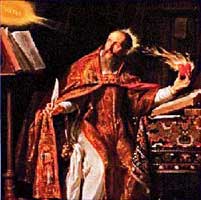
Augustine of
Hippo Regius
(354 - 430).
|
|
Augustine
was a bishop in Hippo Regius from 395 to 430.
A
prolific writer, his main job was to convince the survivors of
the Diocletian persecution to join the church of Rome.
He
derisively referred to the North African Christians as DONATISTS.
|
|
|

Thagaste in
present day Algeria was
the birthplace of Augustine.
|
Even though
the North African Christians claimed to be the true Catholics, Augustine derisively
referred to them as DONATISTS. Augustine had an intense HATRED for those uncompromising
Christians who refused to join the Constantinean church:
Now let
the proud and swelling necks of the heretics raise themselves, if they dare,
against the holy humility of this address. Ye mad
Donatists, whom we desire earnestly to return to the peace and unity
of the holy Church, that ye may receive health therein, what have ye to
say in answer to this? You are wont, indeed, to bring up against us the
letters of Cyprian, his opinion, his Council; why do ye claim the authority
of Cyprian for your schism, and reject his example when it makes for the
peace of the Church? (Augustine, Against
the Donatists, Book II, ch. III).
Every trick in the Roman
arsenal was used to make the Christians conform but most of the them remained
steadfast adherents of Apostolic Christianity.
Despite the
multiplicity of words written against them, the Christians still held steadfast
to the Scriptures and the Lord kept adding to his African Congregation.

Augustine's Confessions.
|
|
Augustine
derisively referred to the North African Christians as DONATISTS.
Many
of his writings are locked up in the secret archives of the
Vatican.
He
should be considered the real father of Islam.
|
|
|
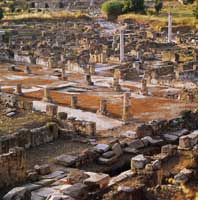
Ruins of Hippo
Regius.
|
Augustine
was the most powerful and influential teacher of the Latin church. He was
the originator of the Filioque and most of the false doctrines that emerged
from that church can be traced right back to him.
Some of these
false doctrines include: original sin, infant baptism, purgatory, clerical
celibacy, predestination.
Augustine
also laid the groundwork for the use of DISGUISED mercenaries in the age long
Vatican war against the saints. Some of these DISGUISED mercenaries include:
Pope Gregory
I sought Emperor Mauricius' help against the North African Christians
Despite all
the efforts of Augustine, the Christian faith continued to grow and Pope Gregory
I was alarmed at its increase.

Pope Gregory
I (540-604).
Reigned from 590 to 604.
|
|
By
the time of Pope Gregory I, the Christians of North Africa continued
to multiply.
The
Pope was ALARMED, and despite their bitter rivalry, he asked
Emperor Mauricius for military help.
|
|
|

Coin of Emperor
Mauricius (539-602).
Reigned from 582 to 602).
|
Here is a
quote from The Donatist Church:
By 596
the situation had become even less favourable. A further letter from the
pope to Columbus (not Christopher) repeats the story of the spread of Donatism,
but in August Gregory wrote to the Emperor Mauricius himself. The Imperial
commands against the Donatists were being disregarded 'by carelessness or
connivance'. The bribes of the Donatists 'so prevail in the province that
the Catholic Faith is publicly put up for sale'. The exarch, far from taking
action himself, was complaining of bishops who brought these things to his
notice. The emperor's personal assistance was requested, 'to issue strict
orders for the punishment of the Donatists and to arrest with saving hand
the fall of the perishing'. Whether this appeal was successful or not we
do not know. Except for Bishop Paulus' repeated effort to have his case
heard in Rome, there is no further literary record of Donatism. We are left
with the impression of the movement resurgent and triumphant in southern
Numidia, and then there is silence. (Frend,
The Donatist Church, p. 312).
Old Rome
saw the Christians of North Africa as a greater threat than the Eastern Empire
in Constantinople.
The rise
of Islam to destroy the North African Christians!!
By the year
600, the Lord's Congregation was triumphant over all her enemies. North Africa—comprising
over 600 cities—was the richest part of the Roman Empire. The city of Rome
itself was dependent on North Africa for her daily bread. With the rise of
Islam, Europe became permanently separated from the Continent of Africa.
 Muhammad (570-632).
|
|
Muhammad
began his bloody career of conquest around the year 630.
Beginning
around 660, his successors conquered Egypt and later invaded North
Africa.
Millions
died by the sword of Islam and the whole province became a wilderness.
|
|
|

The Arabs showed
no mercy to the
Christians of North Africa.
|
After conquering
all of North Africa, the Arabs crossed into Spain in 711. Their main target
in Spain was the Goths, who baptized by triune immersion, and refused to join
the church of Rome.

The Arabs destroyed
true Christianity in North Africa. |
|
The
Arabs conquered all of North Africa and destroyed true Christianity.
|
|
|

In 711, the
Arabs invaded Spain and
slaughtered the Christians.
|
In 711, they
invaded Spain in order to destroy the Goths.
The Arabs
stayed in Spain unto January 1492, when Portuguese Christopher Columbus was
about to follow a map to the New World.

King Ferdinand
and Queen Isabella.
|
|
The
Moors surrendered to Ferdinand and Isabella in January 1492,
after occupying Spain for 781 years!!
The
surrender of the Moors freed up the Spanish army for redeployment
to the New World.
|
|
|

Surrender of
Moors in January 1492.
|
This allowed
for the redeployment of the Spanish army to the New World just in time to
block the English, French and Dutch colonization.
In 674
the Arabs lay siege to Constantinople
Only 50 years
after the founding of Islam by Mohammad, a huge Arab army . . . and NAVY .
. . attacked Constantinople....Conquering Constantinople required a huge number
of ships which you would not normally associate with desert dwellers.

Constantinople
was surrounded on
3 sides by water.
|
|
Constantine
had a fantastic eye for terrain.
Anybody
attacking Constantinople would need a powerful land army and a
well equipped NAVY.
The
first besiegers were DESERT dwelling ARABS!!
|
|
|

A virtually
impregnable city.
|
A knowledge
of combined operations by land and sea was necessary for the conquest of Constantinople.
Also a knowledge of siegecraft and the use of battering rams and powerful
catapults.
It so happens
that the first besiegers of Constantinople were DESERT DWELLING Arabs. The
first siege began in 674 and lasted for 5 years. The Arab besiegers were almost
completely annihilated by the Eastern Romans.
 Muawiyah I (602-680)
led the first Arab siege of Constantinople.
Muawiyah I (602-680)
led the first Arab siege of Constantinople.
|
|
Caliph
Muawiyah I surrounded Constantinople with a huge Arab army and
navy.
Everybody
associated the Arabs with the DESERT.
Mecca
is in the DESERT of Saudi Arabia.
Old
Rome was quickly turning these sand dwellers into sailors.
|
|
|

Emperor Constantine
IV
(652-685).
|
Roman Emperor
Constantine IV led the heroic defense of the city.
The Eastern
Romans had a secret weapon called Greek Fire. It was somewhat like napalm
and actually burned on the water. It was the ancient world's equivalent of
the atomic bomb.

Greek Fire was
hotter than the desert sun and scorched the Arab besiegers.
|
|
Greek
Fire scorched the Muslim Papal mercenaries.
|
|
|

Greek Fire was
a potent secret weapon of the
defenders of Constantinople.
|
The besiegers
were barbecued with this Greek Fire:
The Saracen
ships carried heavy siege engines and huge catapults; but the fortifications
along the Marmara and the Golden Horn were proof against their assaults.
The Byzantines, moreover, possessed a secret weapon. To this day we are
uncertain of the composition of 'Greek fire'. Whether it was sprayed over
an enemy vessel or poured into long, narrow cartridges and catapulted against
its objective, the results were almost invariably catastrophic: the flaming,
oil-based liquid floated upon the surface of the sea, frequently igniting
the wooden hulls of the ships and causing an additional hazard to those
who tried to jump overboard. For long the Muslims refused to admit defeat;
only after the fifth year did the battered remnants of the Saracen fleet
turn about and head for home. In 679 Muawiya sulkily accepted Constantine's
offer of peace, which demanded the evacuation of the newly-conquered Aegean
islands and an annual tribute. A year later he was dead. Constantine, on
the other hand, was at the height of his popularity. He had inspired his
subjects with the morale to withstand five years of siege by a power hitherto
considered irresistible, and in doing so he had saved Western civilization.
Had the Saracens captured Constantinople in the seventh century rather than
the fifteenth, all Europe—and America—might be Muslim today.
(Norwich, A Short History of Byzantium, p. 101.)
The siege
turned out to be a total failure, with thousands of Arab casualties.
The 2nd
Arab siege of Constantinople occurred in 717
The proud
Arabs were very bitter about their failure to take Constantinople. The tried
again in 717 with a new Caliph.
 Caliph Umar ibn
Abd al-Aziz
Caliph Umar ibn
Abd al-Aziz
(682-720).
|
|
Caliph
Umar II tried to revenge the disastrous defeat of the 1st siege
of Constantinople.
Emperor
Leo III led the heroic defense of the city.
This
siege also turned into a disaster and the Arabs entered into a
reluctant detente with the Roman Emperors.
|
|
|

Emperor Leo
III (685-741).
|
Roman Emperor
Leo III led the heroic defense of the city:
For forty
years the setback at Constantinople rankled with the Umayyad caliphs in
Damascus. It remained inconceivable within Islamic theology that the whole
of humankind would not, in time, either accept Islam or submit to Muslim
rule. In 717 a second and even more determined attempt was made to overcome
the obstacle that hindered the spread of the Faith into Europe. The Arab
attack came at a time of turmoil within the empire. A new emperor, Leo III,
had been crowned on March 25, 717; five months later he found an army of
80,000 men dug in the length of the land walls and a fleet of 1,800 ships
controlling the straits. The Arabs had advanced their strategy from the
previous siege. It was quickly realized by the Muslim general Maslama that
the walls of the city were invulnerable to siege machines; this time there
was to be a total blockade. The seriousness of his intentions was underlined
by the fact that his army brought wheat seed with them. In the autumn of
717 they plowed the ground and planted a food supply outside the walls for
harvesting the following spring. Then they settled down to wait. A foray
by the Greek fire ships had some success but failed to break the stranglehold.
Everything had been carefully planned to crush the infidels. (Crowley, 1453:
The Holy War for Constantinople and the Clash of Islam and the West.
p. 13).
It seems
that all of JEHOVAH's creation was at war with the Muslims because on their
way home an undersea volcano erupted and a storm destroyed most of the fleet.
Constantinople
finally fell to the Muslim Turks in 1453
Thanks to
the Muslims, Old Rome was finally able to eliminate her Eastern rival in 1453.
After fighting heroically for 1000 years, the Empire finally came to an end.

Constantine XI (1449- 1453).
Considered the last Roman Emperor.
|
|
The
Latin church fought ferocious battles to overthrow the Eastern
Roman Emperors.
Finally
in 1453, they used the Ottoman Empire to conquer Constantinople.
After
that defeat, the Orthodox church moved to Russia, and Moscow
became known as the 3rd Rome.
|
|
|
 Sultan Mehmet
II (1449-1481). Conqueror of Constantinople.
Sultan Mehmet
II (1449-1481). Conqueror of Constantinople.
|
Only the
use of the new weapon of gunpowder cannon made the Muslim conquest of Constantinople
successful.
Millions
of Muslims are worshipping the Serpent Allah!!
The God of
the universe is a Triune being composed of 3 divine persons: Father, Son and
Holy Spirit. Never in the Bible does God ever call Himself by the name Allah.
God is called
JEHOVAH, Eloihim, El Shadai, Adonai, Emmanuel, etc., etc., but never is HE
referred to by the name of ALLAH....The Hebrew and Arabic languages come from
the same common root.

Mecca in Saudi
Arabia.
|
|
Thanks
to the Vatican, millions of Muslims worship the Serpent Allah.
Islam
is the Western leg of the Roman Empire as foretold
by Daniel the Prophet.
|
|
|

"Stoning
the devil" in Saudi Arabia.
|
The rise of Islam was also predicted by a real Prophet named
the Apostle John:
And the fifth angel
sounded, and I saw a star fall from heaven unto the earth: and to him
was given the key of the bottomless pit.
And he opened the bottomless pit; and there arose a smoke out of the pit,
as the smoke of a great furnace; and the sun and the air were darkened
by reason of the smoke of the pit.
And there came out of the smoke locusts upon the earth: and unto them
was given power, as the scorpions of the earth have power (Revelation
9:1-3).
The Messiah
of Israel, Joshua of Nazareth, gave this great promise to his chosen people:
Behold,
I give unto you power to tread on serpents
and on scorpions,
and over all the power of the enemy: and nothing shall by any means
hurt you (Luke 10:19).
References
Frend, W.H.C.
The Donatist Church. A Movement of Protest in Roman North Africa. Oxford
University Press, London, 1952.
Norwich,
John Julius. A Short History of Byzantium. Alfred A. Knopf, New York,
1997.
Raven, Susan.
Rome in Africa. Routledge, London & New York, 1993.
Reformation