
Showing posts with label David. Show all posts
Showing posts with label David. Show all posts
Wednesday, March 31, 2021


Wednesday, July 31, 2019
Be merciful unto me, O Lord: for I am poor and needy

Bow down thine ear, O Lord, hear me: for I am poor and needy.
2 Preserve my soul; for I am holy: O thou my God, save thy servant that trusteth in thee.
3 Be merciful unto me, O Lord: for I cry unto thee daily.
4 Rejoice the soul of thy servant: for unto thee, O Lord, do I lift up my soul.
5 For thou, Lord, art good, and ready to forgive; and plenteous in mercy unto all them that call upon thee.
6 Give ear, O Lord, unto my prayer; and attend to the voice of my supplications.
7 In the day of my trouble I will call upon thee: for thou wilt answer me.
8 Among the gods there is none like unto thee, O Lord; neither are there any works like unto thy works.
9 All nations whom thou hast made shall come and worship before thee, O Lord; and shall glorify thy name.
10 For thou art great, and doest wondrous things: thou art God alone.
11 Teach me thy way, O Lord; I will walk in thy truth: unite my heart to fear thy name.
12 I will praise thee, O Lord my God, with all my heart: and I will glorify thy name for evermore.
13 For great is thy mercy toward me: and thou hast delivered my soul from the lowest hell.
14 O
God, the proud are risen against me, and the assemblies of violent men
have sought after my soul; and have not set thee before them.
15 But thou, O Lord, art a God full of compassion, and gracious, long suffering, and plenteous in mercy and truth.
16 O turn unto me, and have mercy upon me; give thy strength unto thy servant, and save the son of thine handmaid.
17 Shew me a token for good; that they which hate me may see it, and be ashamed: because thou, Lord, hast holpen me, and comforted me. Psalm 86
Biblical City of Ziklag Where Philistines Gave Refuge to David Found

The biblical town of Ziklag may have been found, a team of Israeli and
Australian archaeologists announced on Monday. The ruins were found near
the southern town of Kiryat Gat in Israel and have been dated to the
early 10th century B.C.E. – the time associated with King David.
If they're right, it would bolster the theory
that David was more than just a local hilltop chieftain as some
researchers claim, and support the theory that he indeed ruled over a
united kingdom in the area of Judea, say the researchers, from the
Israel Antiquities Authority, the Hebrew University of Jerusalem and
Macquarie University, in Sydney, Australia. But the kingdom doesn't seem
to have been the mighty entity in antiquity that some envision.
Ziklag is mentioned in the Books of Joshua and Samuel as a Philistine town abutting the city of Gath (after which the modern city of Kiryat Gat is named).
In this context, the
archaeologists point out that the very name Ziklag stands out in the
biblical record because it isn’t Semitic or Canaanite, but apparently a
Philistine one. Apropos of that, recent genetic studies on skeletons
discovered in a Philistine cemetery in Ashkelon, on Israel’s coast, have
proved once and for all who these mysterious Philistines were: They originated in Europe.
Friday, September 1, 2017
Wednesday, August 30, 2017
Proof that the Burning of Jerusalem by the Babylonians was real
By Lulu Morris 03 August 2017
An excavation at The City of David in Jerusalem has unearthed an ancient biblical story.
Archaeologists at the site have exhumed burnt artefacts dated 2,600
years ago. The discovery of the artefacts solidifies the passage in the
bible, where Jerusalem is burnt down by the Babylonians around 587 BC.
Researchers found burnt pieces of wood, grape seeds, burnt pottery and
bone all concealed by layers of ash. The burning of Jerusalem was
described in the Old Testament in the book of Jeremiah.
"Now on the seventh day of the fifth month, which was the nineteenth year of King Nebuchadnezzar, king of Babylon, Nebuzaradan the captain of the guard, a
servant of the king of Babylon, came to Jerusalem. He burned the house
of the Lord, the king's house, and all the houses of Jerusalem; even
every great house he burned with fire."
The archaeologists from the Israel Antiquities Authority were looking
under layers of rock in the eastern area of the City of David when they
found the artefacts. Alongside the burnt remains found were storage
jars, many bearing stamped handles and rosette seals. The seals were the
driving evidence that led the researchers to date the artefacts at
2,600 years. Dr Joel Uziel, the leader of the excavation, explains
“These seals are characteristic of the end of the First Temple Period,
[They] were used for the administrative system that developed towards
the end of the Judean dynasty."
Find ing the burnt pottery and artefacts in the dig site corroborate
Jeremiah’s testament, though perhaps not to the extent he described it,
but Jerusalem was at one point, during 587BC burnt to the ground by
Babylonian invaders 2,600 years ago. National Geographic
Friday, May 26, 2017
Saturday, September 17, 2016
Archaeologists found evidence where David Battled Goliath
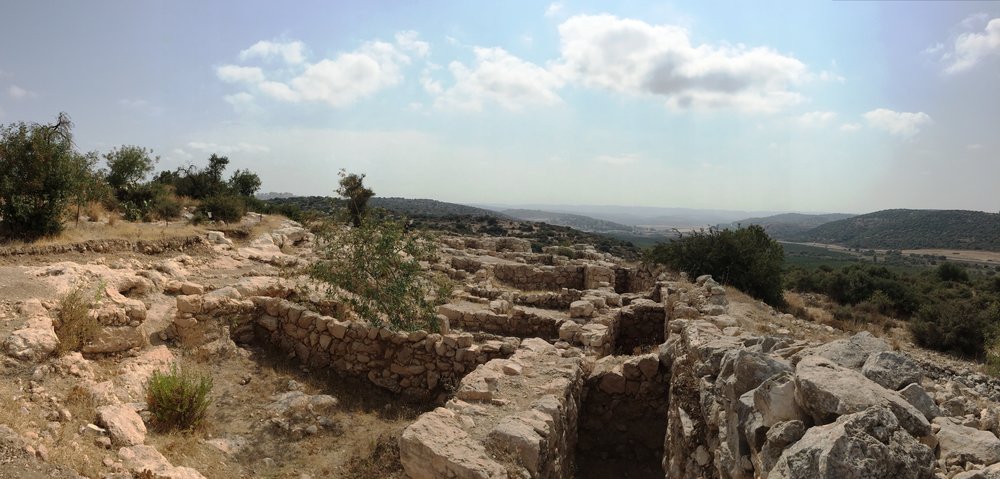
Archaeologists believe they have found evidence of King David’s footprints in a mysterious two-gated city from 3,000 years ago, mentioned in the Bible’s story of David and Goliath
The site is known by its modern name, Khirbet Qeiyafa, in Israel’s Elah Valley.Eviden
After nearly seven years of excavations, the public can now explore the archaeological findings of Qeiyafa through “In the Valley of David and Goliath,” a new Bible Lands Museum exhibition that opened earlier this week in Jerusalem. The Qeiyafa findings have sparked debate and intrigued historians and archaeologists since they were first revealed.
The city was discovered between Sokho and Azekah, on the border between the Philistines and the Judeans, in the place where David and Goliath battled. It’s mentioned in the Torah in 1 Samuel 17: 1-2.
Carbon-14 dating of some 28 charred olive pits found during excavations date the city as existing around the end of the 11th century BCE, until the early 10th century, in the days of Saul and David.
“No one can argue with this data,” said Prof. Yosef Garfinkel, Yigal Yadin Chair of Archeology at the Institute of Archeology at Hebrew University of Jerusalem. He, along with Sa’ar Ganor from the Israel Antiquities Authority and Prof. Michal Hazel of Southern Adventist University of Tennessee, led the excavations.
Among the site’s highlights are its two gates: the western gate, which faced Philistia, and the southern gate, which faced Judah. Having two gates for a relatively small city of 5.7 acres is unusual, according to Bible Lands curator Yehuda Kaplan. Gates are the weakest part of any city. The two gates are what led excavators to identify the site with Sha’arayim (Hebrew for “two gates”), a city mentioned in the David and Goliath story in the Book of Samuel, which reads, “…And the slain Philistines lay along the way of Sha’arayim, as far as Gath and Ekron.” (1 Samuel 17:52) It’s also in Judges 16:5 and in Jeremiah 17:19-20.
The gates were corroborated by additional evidence of Jewish activity at Qeiyafa, including thousands of sheep, goat, cow and fish bones, and the absence of non-kosher pig bones, Kaplan said.
Evidence of cultic activity throughout the city was also unearthed, as well as two inscriptions written in the Canaanite script. One was incised on a jar and contains the Hebrew name Eshbaal, son of Beda. The second was inscribed on a pottery shard with only a few identifiable words, including “king” and “judge.” Many of the letters seem to reflect Hebraic writing. Garfinkel suggests this is the earliest writing documentation of the Hebrew language discovered to date.
Among the pottery on the site, less than 2 percent was typical Philistine pottery. Kaplan said if the community had been Philistine, a minimum of 20 percent of Philistine design should have been found. Of the 24 weapons and tools discovered, 67 percent were made from iron and 33 percent from bronze. Use of iron during this period by other sites in Judah, such as Arad and Beersheva, helped archeologists identify Qeiyafa as a Judean site.
Finally,
casemate walls - two thinner, parallel walls with empty space in
between and a belt of houses abutting the casemates, incorporating them
as part of the construction - are reminiscent of the type of urban
planning found only in Judah and Transjordan.
Garfinkel explained
that before the period of King David, people lived in small farming
communities. Around 11th BCE, these agrarian communities became urban
societies.
“In this, the biblical tradition has historic memory,”
Garfinkel said. “If we ask, ‘Where is archaeology starting to support
biblical tradition, Khirbet Qeiyafa is the beginning.”
There’s
only one other archaeological reference to King David found in Israel,
the Aramaic inscription from the mid-9th century BCE found at Tel Dan.
This inscription, on display as part of the new exhibit, is attributed
to Hazel, king of Damascus, who boasts about killing a king of Israel
and a king of Judah, the latter of which is referred to in the
inscription as “King of the House of David.”
While the site stirs the biblical imagination, it also serves a political role.
Biblical
Minimalists, a band of biblical scholars and archaeologists trying to
eradicate the connection of the Jewish people to the land of Israel by
claiming there’s not reliable evidence for what had happened in ancient
Israel, can be negated by some of Qeiyafa’s findings. Within 10 days of
his publishing the first paper on Qeiyafa, another article claimed the
site as Palestinian, Garfinkel said.
“This happens a lot,” said
Jacob L. Wright, associate professor of Hebrew Bible at Emory University
in Atlanta. “In no other area of the world do you have such a
connection to biblical imagination.”
Wright said there’s likely a
middle ground. While he believes Garfinkel has placed Qeiyafa in the
right time period and that it’s likely a Judean community, experts
aren’t certain that King David had anything to do directly with the
site.
“One has to separate the bible and archaeology,” Wright
said. “The minimalists want to deny the state of Judah and Israel; they
are politically driven and have a loose agenda. … But it does not help
when the maximalists try to connect everything they find on the ground
with Jesus or King David.”
Bible Lands’ Kaplan is confident in the exhibit and the story it’s telling of Qeiyafa.
“Everything you touch at Khirbet Qeiyafa brings you to this biblical period,” he said. Jewish News Service
Saturday, December 5, 2015
David's dancing and the amusements of this world
"David's dancing in reverent joy before God has been cited by pleasure lovers in justification of the fashionable modern dance, but there is no ground for such an argument. In our day dancing is associated with folly and midnight reveling. Health and morals are sacrificed to pleasure. By the frequenters of the ballroom God is not an object of thought and reverence; prayer or the song of praise would be felt to be out of place in their assemblies. This test should be decisive. Amusements that have a tendency to weaken the love for sacred things and lessen our joy in the service of God are not to be sought by Christians. The music and dancing in joyful praise to God at the removal of the ark had not the faintest resemblance to the dissipation of modern dancing. The one tended to the remembrance of God and exalted His holy name. The other is a device of Satan to cause men to forget God and to dishonor Him." Patriarchs and Prophets p. 707
Subscribe to:
Posts (Atom)