Showing posts with label USDA. Show all posts

Wednesday, October 30, 2019

Crop losses all across the U.S. heartland will be “as devastating as we’ve ever seen”

EOTAD   October 14, 2019
An unprecedented October blizzard that hit just before harvest time has absolutely devastated farms all across the U.S. heartland.  As you will see below, one state lawmaker in North Dakota is saying that the crop losses will be “as devastating as we’ve ever seen”.  This is the exact scenario that I have been warning about for months, and now it has materialized.  Due to endless rain and horrific flooding early in the year, many farmers in the middle of the country faced very serious delays in getting their crops planted.  So we really needed good weather at the end of the season so that the crops could mature and be harvested in time, and that did not happen.  Instead, the historic blizzard that we just witnessed dumped up to 2 feet of snow from Colorado to Minnesota.  In fact, one city in North Dakota actually got 30 inches of snow.  In the end, this is going to go down as one of the worst crop disasters that the Midwest has ever seen, and ultimately this crisis is going to affect all of us.
 
According to the USDA, only 15 percent of all U.S. corn and only 14 percent of all U.S. soybeans had been harvested as of October 6th…
Only 58% of U.S. corn was mature as of Oct. 6 and just 15% was harvested, according to the latest data from U.S. Department of Agriculture (USDA). North Dakota’s crop was furthest behind, with just 22% of corn mature and none harvested as of Sunday, while South Dakota’s corn was 36% mature with 2% harvested.
U.S. soybeans were only 14% harvested as of Sunday, 20 percentage points behind the average pace, USDA data showed. North Dakota and Minnesota beans were just 8% gathered while Iowa’s and South Dakota’s crop was only 5% harvested.
So that means that the vast majority of our corn and the vast majority of our soybeans were exposed to this giant storm, and the losses are going to be off the charts.
I want you to consider the next quote very carefully.  According to North Dakota state lawmaker Jon Nelson, we should expect “massive crop losses – as devastating as we’ve ever seen”…
The early season snowstorm showed no mercy to some farmers and ranchers, especially in North Dakota.
“I’m expecting massive crop losses – as devastating as we’ve ever seen,” said Jon Nelson, a state lawmaker who farms several hundred acres near Rugby in north-central North Dakota.
Unharvested wheat in the region probably will be a total loss, he told the Associated Press.

Friday, May 31, 2019

Crop Catastrophe In The Midwest

fooding nebraska crops
TECB. May 26, 2019
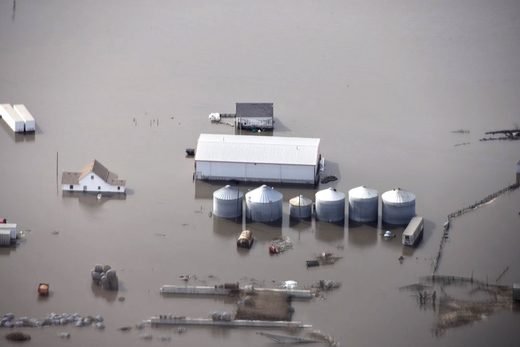
The last 12 months have been the wettest in all of U.S. history, and this has created absolutely horrific conditions for U.S. farmers.  Thanks to endless rain and historic flooding that has stretched on for months, many farmers have not been able to plant crops at all, and a lot of the crops that have actually been planted are deeply struggling.  What this means is that U.S. agricultural production is going to be way, way down this year.  The numbers that I am about to share with you are deeply alarming, and they should serve as a wake up call for all of us.  The food that each one of us eats every day is produced by our farmers, and right now our farmers are truly facing a nightmare scenario.
You can view the latest USDA crop progress report right here.  According to that report, corn and soybean production is way behind expectations.
Last year, 78 percent of all corn acreage had been planted by now.  This year, that number is sitting at just 49 percent.
And the percentage of corn that has emerged from the ground is at a paltry 19 percent compared to 47 percent at this time last year.
We see similar numbers when we look at soybeans.
Last year, 53 percent of all soybean acreage had been planted by now.  This year, that number has fallen to 19 percent.
And the percentage of soybeans that have emerged from the ground is just 5 percent compared to 24 percent at this time last year.
In other words, we are going to have a whole lot less corn and soybeans this year.
Farmers in the middle of the country desperately need conditions to dry out for an extended period of time, but so far that has not happened.
In fact, last week the heartland was hit by yet another string of devastating storms.  The following comes from CNN…
Ten people are dead and a 4 year-old boy remains missing after more than a week of severe weather across the central US that put tens of millions of people at risk.
The deadly spring storm system ravaged several states, unleashing more than 170 reported tornadoes, fierce winds, drenching rain, flash flooding and hail.
One of the tornadoes that was spawned absolutely devastated the capital city of Missouri.  It was reportedly a mile wide, and it stayed on the ground for almost 20 miles…
A clearer picture emerged Friday of the size and scope of the powerful tornadoes that tore across Missouri on Wednesday night, leaving a trail of destruction in their paths. The state’s capital, Jefferson City, was among the hardest-hit places, struck overnight by a tornado with a peak wind speed of 160 mph that has been given preliminary rating of EF3.
The monstrous nighttime tornado that struck Jefferson City, a city with a population of about 42,000, was almost a mile wide and was on the ground for nearly 20 miles, toppling homes, ripping roofs off homes and business below.
What we are witnessing is definitely not “normal”, and I have had a number of readers write to me about this recently.  The other day one of my readers in Montana sent me a photograph of a freak May snowstorm that had just hit his area, and another one of my readers in Missouri explained that his boss is freaking out because they haven’t been able to get soybeans in the ground.  All over the country people want answers, and they are frustrated with the lack of information that they are getting from the mainstream media.
Unfortunately, the truth is that things are going to get worse.  Global weather patterns are dramatically shifting, and there is nothing that the authorities will be able to do to stop it from happening.