Showing posts with label Martin Luther. Show all posts
Showing posts with label Martin Luther. Show all posts
Thursday, October 31, 2019


Thursday, November 2, 2017
Tuesday, October 31, 2017
500 years ago today: The birth of Protestantism

WND October 31, 2017
On Oct. 31, 1517, an Augustinian monk named Martin Luther posted 95
debate questions on the door of Wittenberg Church, which began the
movement known as “the Reformation.”
In 1521, 34-year-old Martin Luther was summoned to stand trial before
the most powerful man in the world, 21-year-old Holy Roman Emperor
Charles V. Charles V of Spain’s empire spanned nearly two million square
miles across Europe, the Netherlands, the Far East, North and South
America and the Caribbean.
The Philippine Islands were named after his son, King Philip II of Spain. The sun never set on the Spanish Empire.
At the Diet of Worms, Charles V initially dismissed Luther’s theses
as “an argument between monks” and simply declared Martin Luther an
outlaw. Martin Luther was hid by Frederick of Saxony in the Wartburg
Castle, where he translated the New Testament into German. Charles V’s
unruly troops sacked Rome and imprisoned Pope Clement VII for six
months.
Charles V oversaw the Spanish colonization of the Americas, and began
the Counter-Reformation. He eventually responded to the pleadings of
the priest Bartolomé de Las Casas and outlawed the enslavement of native
Americans.
Gold from the New World was used by Spain to push back the Muslim
Ottoman Empire’s invasion of Europe. Sultan Suleiman the Magnificent’s
Ottoman fleet dominated the Mediterranean Sea, the Red Sea and the
Persian Gulf. Suleiman conquered into Christian Hungary, Christian
Serbia and Christian Austria, in addition to controlling the Middle East
and North Africa. In 1529, 35-year-old Suleiman the Magnificent sent
100,000 Muslim Turks to surround Vienna, Austria.
Martin Luther wrote: “The Turk is the rod of the wrath of the Lord
our God. … If the Turk’s god, the devil, is not beaten first, there is
reason to fear that the Turk will not be so easy to beat. … Christian
weapons and power must do it. …”
Martin Luther continued: “(The fight against the Turks) must begin
with repentance, and we must reform our lives, or we shall fight in
vain. (The Church should) drive men to repentance by showing our great
and numberless sins and our ingratitude, by which we have earned God’s
wrath and disfavor, so that He justly gives us into the hands of the
devil and the Turk.”
In an attempt to unite the Holy Roman Empire against the Ottoman
Muslims, Charles V agreed to a truce recognizing the Protestants, as
Eric W. Gritisch wrote in “Martin – God’s Court Jester: Luther in
Retrospect” (Philadelphia: Fortress, 1983, p. 69-70): “Afraid of losing
the much-needed support of the German princes for the struggle against
the Turkish threat from the south, Emperor Charles V agreed to a truce
between Protestant and Catholic territories in Nuremberg in 1532. … Thus
the Lutheran movement was, for the first time, officially tolerated and
could enjoy a place in the political sun of the Holy Roman Empire.”
As the Islamic threat intensified, reformer John Calvin wrote to
Philip Melanthon in 154 (“Selected Works of John Calvin: Tracts &
Letters,” I: 373): “I hear of the sad condition of your Germany! … The
Turk again prepares to wage war with a larger force. Who will stand up
to oppose his marching throughout the length and breadth of the land, at
his mere will and pleasure?”
Followers of the reformers who “protested” certain doctrines, were
generally referred to as “Protestants.” Some Protestants refused to help
Charles V who was defending Europe from the Muslim invasion. Finally,
Charles V made a treaty with the German Lutheran Princes by signing the
Peace of Augsburg, September 25, 1555, ceasing the religious struggle
between Lutherans and Catholics.
A line in the treaty, “cuius regio, eius religio,” allowed each king to decide what was to be believed in his kingdom.
A month later, Oct. 25, 1555, suffering from severe gout, Charles V
abdicated his throne and lived the rest of his life secluded in the
monastery of Yuste, leaving his son Philip II to rule.
As different kings in Europe chose different denominations for their
kingdoms, millions migrated from one country to another simply for
conscience sake. Many of these Christian religious refugees fled Europe
to settle colonies in America.
New York University Professor Emeritus Patricia Bonomi, in her
article “The Middle Colonies as the Birthplace of American Religious
Pluralism” wrote: “The colonists were about 98 percent Protestant.”
Of the 56 signers of the Declaration, most were Protestant, with the notable exception of Catholic Charles Carroll of Maryland.
British Statesman Edmund Burke addressed Parliament, 1775: “All
Protestantism … is a sort of dissent. But the religion most prevalent in
our Northern Colonies is a refinement on the principle of resistance;
it is the dissidence of dissent, and the protestantism of the Protestant
religion.”
Samuel Adams stated when he signed the Declaration of Independence:
“This day, I trust, the reign of political protestantism will commence.”
Martin Luther, who died in 1546, wrote: “I am much afraid that
schools will prove to be the great gates of hell unless they diligently
labor in explaining the Holy Scriptures, engraving them in the hearts of
youth.”
Catholic and Protestant leaders will stress their mutual bonds 500 years after the start of the Reformation
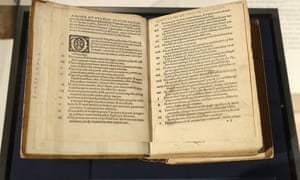
The Guardian Tuesday 31 October 2017
Catholic and Protestant leaders will stress their mutual bonds 500
years after the start of the Reformation, a movement which tore apart
western Christianity and sparked a string of bloody religious wars in Europe lasting more than a century.
A service in Westminster Abbey on Tuesday will mark the anniversary
of the date in 1517 on which the German theologian Martin Luther
submitted The 95 Theses to the archbishop of Mainz as well as nailing a
copy to the door of a church in Wittenburg, lighting the fuse of the
Reformation.
The archbishop of Canterbury, Justin Welby, will present a text by
the Anglican communion affirming a joint declaration by the Roman
Catholic church and global Protestant bodies described as “a sign of healing after 500 years of division”.
Last week, Pope Francis said
Catholics and Protestants were now enjoying a relationship of “true
fraternity” based on mutual understanding, trust and cooperation.
He told Derek Browning, moderator of the Church of Scotland, who was visiting the Vatican
as part of the Reformation commemorations, that the two traditions were
“no longer … adversaries, after long centuries of estrangement and
conflict”
The pontiff added: “For so long we regarded one another from afar,
all too humanly, harbouring suspicion, dwelling on differences and
errors, and with hearts intent on recrimination for past wrongs.”
The 95 Theses, written in Latin, was a backlash against increasing
corruption in the Catholic church and, in particular, the highly
profitable sale of “indulgences”. These promised a fast-track to heaven
and were sold to fund the building of St Peter’s Basilica in Rome.
Luther argued that salvation could not be bought or brokered by the church, but was a matter between an individual and God.
His challenge to the authority and elitism of the Catholic church was
translated into German and other European languages. Thanks to
revolutionary new printing presses, his message spread rapidly and was
taken up by others, including the French theologian John Calvin.
Rome condemned Luther as a heretic and launched the
Counter-Reformation, but by the end of the 16th century most of northern
Europe was Protestant.
In England, Henry VIII, desperate to dissolve his marriage to
Catherine of Aragon in pursuit of a male heir, launched his own, less
clear-cut, separation from the Catholic church which involved the
destruction of much of the country’s religious heritage.
In 1999, the Catholic and Lutheran churches agreed a “joint
declaration on the doctrine of justification” that resolved many of the
theological issues at the heart of the schism. This document has now
been welcomed and affirmed by the Anglican communion.
A spokesperson for the Catholic church in England and Wales said:
“The desire for reconciliation is such that mistakes can be recognised,
injuries can be forgiven and wounds healed.
“We give thanks to the joy of the gospel we share as Christians,
express repentance for the sadness of our divisions and renew our
commitment to common witness and service to the world.”
But despite the warm words of reconciliation issued by leaders, there
are issues blocking the prospect of a reunification of the two
traditions, not least that of female priests.
Meanwhile, pockets of sectarianism remain in parts of northern Europe, including Northern Ireland and Scotland.
Last year, a document
released by an evangelical Protestant group, Reformanda Initiative,
drew a distinction between individual Catholics and the “unchecked
dogmatic claims and complex political and diplomatic structure … [of
the] the institutional Catholic church”.
It concluded: “The issues that gave birth to the Reformation 500
years ago are still very much alive in the 21st century for the whole
church.”
Friday, October 27, 2017
Wednesday, October 25, 2017
Monday, October 31, 2016
Wednesday, December 23, 2015
Mother Teresa will be made a Catholic saint after Pope Francis approved a second miracle needed for her canonization
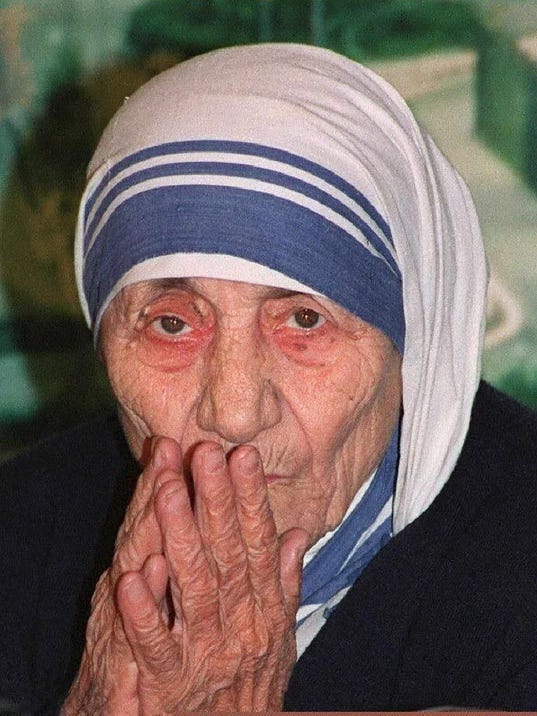
Mother Teresa will be made a Catholic saint after Pope Francis approved a second miracle needed for her canonization, a move welcomed by the archbishop of Kolkata, India, as “a real Christmas gift” from the pontiff.
Francis took the step by signing a decree late
Thursday declaring that the inexplicable 2008 recovery of a Brazilian
man who suddenly woke from a coma caused by a viral brain infection was
due to the intercession of the Albanian nun, who died at age 87 in 1997.
Mother Teresa, known as "the saint of the gutters," was awarded the Nobel Peace Prize
in 1979 after dedicating her life to working on behalf of the poor,
particularly in the slums of Kolkata (formerly known as Calcutta.)
She
was beatified in 2003 by Pope John Paul II after being attributed to a
first miracle, answering an Indian woman's prayers to cure her brain
tumor, according to the Vatican. One miracle is needed for beatification
— described by the Catholic Church as recognition of a person's
entrance into heaven — while sainthood requires two.
By the time
of her death, Mother Teresa's India-based Missionaries of Charity
supported 4,000 nuns and ran hundreds of orphanages, soup kitchens,
homeless shelters and clinics around the world.
Church observers
said the pope would probably canonize Mother Teresa on Sept. 4, the day
before the anniversary of her death, which is also her official feast
day.
“It is a real Christmas gift that the Holy Father has given,
especially the Church in (Kolkata),” said Archbishop Thomas D’Souza, the
Indian city's archbishop. “We were waiting for this moment, since many
years really, and now that it has come we are very happy, overjoyed."
Francis,
who has made outreach to the poor a priority for the Catholic Church,
met Mother Teresa more than two decades ago while he was Archbishop
Jorge Mario Bergoglio in Argentina. He is known for admiring her
ministry as well as her fearlessness in speaking out on behalf of
society’s outcasts.
“I would have been afraid to have had her as my superior, since she was so tough,” he once joked.
Mother
Teresa was born Agnes Gonxha Bojaxhiu on Aug. 26, 1910, into an ethnic
Albanian family in what is today the Republic of Macedonia.
She
joined the Loreto order of nuns in 1928. In 1946, while traveling by
train from Kolkata to Darjeeling, was inspired to found the Missionaries
of Charity order.
The order was established four years later and
has since opened more than 130 houses worldwide to provide comfort and
care for the needy.
While her actions gained widespread
admiration, Mother Teresa was not beloved by all and was criticized for
the quality of care in her clinics and taking donations from Haitian
dictator Jean-Claude Duvalier and disgraced American financier Charles
Keating, according to the Associated Press.
Contributing: David Gibson and Rosie Scammell, Religion News Service
SOURCES: U.S. Conference of Catholic Bishops, www.catholicdoors.com, AP and USA TODAY research; PHOTO: AP USA Today
Note: Martin Luther once said: “Good works do not make a good man, but a good man
does good works; evil works do not make a wicked man, but a wicked man
does evil works.” Goodreads Good works must emanate from the real source (Christ) to be consider a blessing, otherwise we will be deceiving ourselves. Worshiping God is my first and most important duty towards Him. Supplying the needs of my neighbors is my second duty. Matthew 6:33 says: "But seek ye first the kingdom of God, and his righteousness; and all these things shall be added unto you." What is His righteousness? The perfect character of God as described in His Word (Job 36:3; Isaiah 51:5-8; John 17:25) That said, if we seek God's kingdom but not His righteousness then the great deceiver called the serpent and satan who deceives the whole world (Rev 12:9) and who transforms himself into an angel of light (2 Cor 11:14) will try to perform miracles in the place of Christ.
Subscribe to:
Posts (Atom)