Showing posts with label Animals. Show all posts

Tuesday, March 31, 2020

Where on earth were all the penguins?


Science Magazine Mar. 19, 2020
Where on Earth, wondered Henri Weimerskirch, were all the penguins? It was early 2017. Colleagues had sent the seabird ecologist aerial photos of Île aux Cochons, a barren volcanic island halfway between Madagascar and Antarctica that humans rarely visit. The images revealed vast areas of bare rock that, just a few decades before, had been crowded with some 500,000 pairs of nesting king penguins and their chicks. It appeared that the colony—the world’s largest king penguin aggregation and the second biggest colony of any of the 18 penguin species—had shrunk by 90%. Nearly 900,000 of the regal, meter-high, black, white, and orange birds had disappeared without a trace. “It was really incredible, completely unexpected,” recalls Weimerskirch, who works at the French national research agency CNRS.

Soon, he and other scientists were planning an expedition to the island—the first in 37 years, and only the third ever—to search for explanations. “We had to go see for ourselves,” says CNRS ecologist Charles Bost.

As the researchers prepared for the journey, they had to grapple with the logistical, political, and scientific challenges that have long bedeviled biologists trying to understand Antarctica’s remote ecosystems. The vast distances, rough weather, and rugged terrain make travel difficult and expensive. They needed a ship—and a helicopter, because frigid seas and rocky shores make for perilous boat landings on Antarctic islands. Complying with the tough permitting and biosecurity rules governing the French-controlled island—meant to prevent researchers from disturbing fragile ecosystems—required careful planning and paperwork that took months to complete. And once they arrived, they would have precious little time: just 5 days to investigate a multitude of suspects in the disappearance, including disease, predators, and a warming Southern Ocean.

Tuesday, December 3, 2019

China’s African Swine Fever Now Global Threat

ASF32452
Neo  30.11.2019
The worst outbreak of fatal African Swine Fever disease ever has devastated the world’s largest pig population, that of China, over the past months. Now it is spreading to neighboring states and even threatens the United States pig herds. The political and human impact could be far worse than imagined as a de facto pandemic disease situation spreads. Globalization of agribusiness is not helping matters.

On August 3, 2018 a case of African Swine Fever (ASF) was confirmed in China’s Liaoning Province. Since then despite various measures to contain the deadly disease it has spread across China where as of November, 2019 in little more than a year, nearly half of China’s huge pig population has either died or been eliminated in a desperate effort to contain the disease. ASF is not deadly to humans but is 100% fatal to any pig that is infected. There is no known treatment to cure it. It can be spread by direct contact with an infected pig, body fluids, contact with equipment or clothing and via certain tick species.

The China Agriculture Ministry issued a report in August that the size of China’s live pig herd had declined by a very precise 38.7% from August 2018. Industry sources suspect underreporting and put the actual number at more like 50%. In any event it is huge, and has impacted the politically sensitive measure of China food price inflation over the past year. Pork is a mainstay of the Chinese diet for meat protein and considered a national security issue. Most pigs in China are raised by small-scale farmers who face ruin now. According to reports inside China this has led many desperate small farmers to try to hide the presence of ASF in their herds, to slaughter and sell, to avoid financial ruin.

The disease is especially dangerous. According to experts it’s hard to kill. One report notes, “It lives in feces for 11 days and blood for 15 weeks. It lives in salted meat for 182 days, dried meat for almost a year, and frozen meat for three years. The Chinese love to take meat snacks with them when they travel. Rules can be bent in Asia.”

Friday, August 2, 2019

Cancer is a germ and can be received by infected meat

Related image
Flesh was never the best food; but its use is now doubly objectionable, since disease in animals is so rapidly increasing. Those who use flesh foods little know what they are eating. Often if they could see the animals when living and know the quality of the meat they eat, they would turn from it with loathing. People are continually eating flesh that is filled with tuberculous and cancerous germs. Tuberculosis, cancer, and other fatal diseases are thus communicated.    

Monday, December 12, 2016

World’s Giraffes Now Threatened with Extinction


A recent announcement by the International Union for Conservation of Nature (IUCN) reveals that the global population of one of the most majestic mammals, the giraffe, has plummeted by up to 40% over the last 30 years. The population of the iconic giraffe, one of the world’s most recognizable mammals, now falls below 98,000 worldwide.
According to the IUCN, the giraffe population is being pushed towards extinction by one very infectious species – homo sapiens. Activities such as “illegal hunting, expanding agriculture and mining, increasing human-wildlife conflict, and civil unrest,” are all negatively impacting giraffe (Giraffa Camelopardalis) subpopulations, as well as okapi (Okapia johnstoni), which are part of the Giraffidae family.    Walking Times

Thursday, September 15, 2016

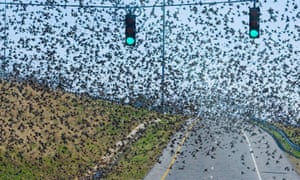
Dozens of birds have mysteriously fallen out of the sky in Boston, prompting health officials to launch an investigation.

A flock of grackles in Alabama in 2011. More than 30 of the birds mysteriously died recently in Boston. Officials are investigating possible causes.

Dozens of birds have mysteriously fallen out of the sky in Boston, prompting health officials to launch an investigation.
A total of 47 grackles rained down upon the Dorchester neighborhood of Boston on Thursday. The Animal Rescue League of Boston said that 32 of these birds died, either at the scene or afterwards as rescuers attempted to tend to them. The remaining birds are in “good condition” and will be sent to a wildlife center in Grafton, Massachusetts.
The Animal Rescue League said it also gave “emergency treatment” to a cat at the scene, but it died. Another cat also reportedly died, with homeowners advised to keep their cats and dogs indoors and check what they are eating.
“When I arrived, birds would fly, like from a house to a tree, they would flop in the tree and they would fall to the ground,” said Alan Borgal of the Animal Rescue League of Boston. “The weaker ones were just falling right out the sky.”
City officials have sent the dead grackles, which are a type of songbird that travels in flocks, to Tufts University to help determine the cause of death. It is currently unclear whether the birds perished due to a virus, some sort of environmental pollution or intentional poisoning. Test results are expected next week.
“We don’t know what is going on,” John Meaney of the city of Boston’s Inspectional Services told NECN. “So we are investigating all avenues.”
Local resident Willien Pugh told the Boston Herald that his cat Sally B was found dying on the back porch as deceased birds fell from the sky.
“We took the cat from outside and we thought it was a girl so we named it Sally – then when we took it to the vet, we found out it was a boy, so we started calling her Sally B,” Pugh said. “Real good cat.”             The Guardian