Showing posts with label Congress. Show all posts

Friday, December 6, 2019

While Congress subjects the nation to its carefully orchestrated impeachment drama, our civil liberties continue to die a slow, painful death


Image result for liberties at stake"
Rutherford    December 02, 2019
“It is the responsibility of the patriot to protect his country from its government.”—Thomas Paine
While Congress subjects the nation to its impeachment-flavored brand of bread-and-circus politics, our civil liberties continue to die a slow, painful death by a thousand cuts.

Case in point: while Americans have been fixated on the carefully orchestrated impeachment drama that continues to monopolize headlines, Congress passed and President Trump signed into law legislation extending three key provisions of the USA Patriot Act, which had been set to expire on December 15, 2019.

Once again, to no one’s surprise, the bureaucrats on both sides of the aisle—Democrats and Republicans alike—prioritized political grandstanding over principle and their oath of office to protect and defend the Constitution...

The legislation passed the Senate with a bipartisan 74-to-20 vote. It squeaked through the House of Representatives with a 231-192 margin. And it was signed by President Trump—who earlier this year floated the idea of making the government’s surveillance powers permanent—with nary a protest from anyone about its impact on the rights of the American people.

Spending bill or not, it didn’t have to shake down this way, even with the threat of yet another government shutdown looming.

Congress could have voted to separate the Patriot Act extension from the funding bill, as suggested by Rep. Justin Amash, but that didn’t fly. Instead as journalist Norman Solomon writes for Salon, “The cave-in was another bow to normalizing the U.S. government’s mass surveillance powers.”
That, right there, is the key to all of this: normalizing the U.S. government’s mass surveillance powers.

In the 18 years since the USA Patriot Act—a massive 342-page wish list of expanded powers for the FBI and CIA—was rammed through Congress in the wake of the so-called 9/11 terror attacks, it has snowballed into the eradication of every vital safeguard against government overreach, corruption and abuse.

The Patriot Act drove a stake through the heart of the Bill of Rights, violating at least six of the ten original amendments—the First, Fourth, Fifth, Sixth, Seventh and Eighth Amendments—and possibly the Thirteenth and Fourteenth Amendments, as well.

The Patriot Act also redefined terrorism so broadly that many non-terrorist political activities such as protest marches, demonstrations and civil disobedience are now considered potential terrorist acts, thereby rendering anyone desiring to engage in protected First Amendment expressive activities as suspects of the surveillance state.

The Patriot Act justified broader domestic surveillance, the logic being that if government agents knew more about each American, they could distinguish the terrorists from law-abiding citizens—no doubt a reflexive impulse shared by small-town police and federal agents alike.

This, according to Washington Post reporter Robert O’Harrow, Jr., was a fantasy that “had been brewing in the law enforcement world for a long time.” And 9/11 provided the government with the perfect excuse for conducting far-reaching surveillance and collecting mountains of information on even the most law-abiding citizen.

Federal agents and police officers are now authorized to conduct covert black bag “sneak-and-peak” searches of homes and offices while you are away and confiscate your personal property without first notifying you of their intent or their presence.

The law also granted the FBI the right to come to your place of employment, demand your personal records and question your supervisors and fellow employees, all without notifying you; allowed the government access to your medical records, school records and practically every personal record about you; and allowed the government to secretly demand to see records of books or magazines you’ve checked out in any public library and Internet sites you’ve visited (at least 545 libraries received such demands in the first year following passage of the Patriot Act).

In the name of fighting terrorism, government officials are now permitted to monitor religious and political institutions with no suspicion of criminal wrongdoing; prosecute librarians or keepers of any other records if they tell anyone that the government has subpoenaed information related to a terror investigation; monitor conversations between attorneys and clients; search and seize Americans’ papers and effects without showing probable cause; and jail Americans indefinitely without a trial, among other things.

The federal government also made liberal use of its new powers, especially through the use (and abuse) of the nefarious national security letters, which allow the FBI to demand personal customer records from Internet Service Providers, financial institutions and credit companies at the mere say-so of the government agent in charge of a local FBI office and without prior court approval.

In fact, since 9/11, we’ve been spied on by surveillance cameras, eavesdropped on by government agents, had our belongings searched, our phones tapped, our mail opened, our email monitored, our opinions questioned, our purchases scrutinized (under the USA Patriot Act, banks are required to analyze your transactions for any patterns that raise suspicion and to see if you are connected to any objectionable people), and our activities watched.

We’re also being subjected to invasive patdowns and whole-body scans of our persons and seizures of our electronic devices in the nation’s airports. We can’t even purchase certain cold medicines at the pharmacy anymore without it being reported to the government and our names being placed on a watch list.
It’s only getting worse, folks.

Monday, July 29, 2019

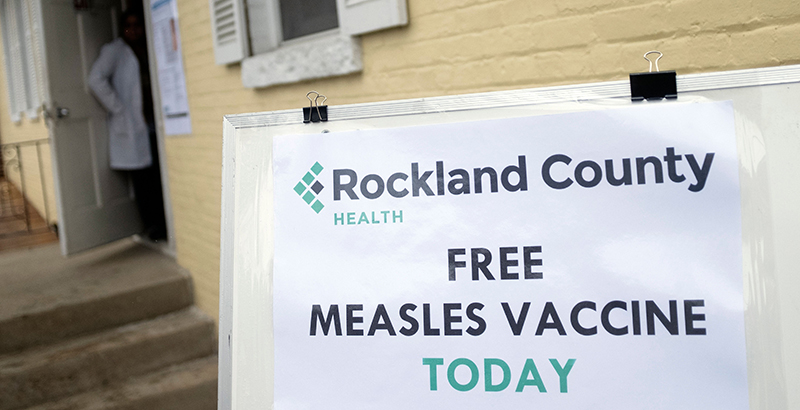
No Exceptions: New York, Washington, Maine Abolish Religious Exemptions for Measles Vaccine

The74million June 17, 2019
Update, June 18: California Sen. Richard Pan updated the proposed legislation there to expand the list of medical conditions for vaccine exemptions and loosen the role of government oversight in granting exemptions. The state Assembly Health Committee is expected to vote on the measure Thursday, according to The Los Angeles Times.

The measles outbreaks that have spread through different parts of the country this year are causing lawmakers and advocates in several states to rethink their policies about vaccinations, despite ongoing skepticism and sometimes-fierce political pushback from anti-vaxxers.

New York, Maine and Washington state have all taken steps to restrict vaccine exemptions based on religious beliefs this year, and California is considering a measure to tighten up its existing policy governing medical exemptions.

Since Jan. 1, 1,044 cases of measles have been reported in the United States. The disease was declared eliminated from the U.S. in 2000, but the Centers for Disease Control warned in May that if the outbreaks continue through the summer and fall, the United States could lose its status as a country that has eradicated measles.

The most recent measles death in the U.S. occurred in 2015, but before the vaccine was common, the disease killed hundreds of children each year, according to the CDC.

The battle over heritable genome editing


Evolution NewsJuly 23, 2019
Genetic engineering is among the most powerful human technologies ever invented. It holds great hope for everything from medical uses to cleaning up the environment. But it could also unleash a deadly pandemic or lead to a “new eugenics” with very sharp teeth.
The last time we witnessed something like this was the splitting of the atom. At that time, we had a sufficiently cohesive and responsible world community to enact meaningful legal and regulatory restrictions to govern the technology’s development, which have been generally successful — with some obvious exceptions. Imagine where we would be if atomic energy had developed under an “anything goes” paradigm.

Anything Goes?   

We are apparently no longer sufficiently cohesive or responsible to similarly come to grips with the vast power of biotechnology. As a consequence, experiments are going forward that are both unwise and potentially unsafe. For example, even though the biotech world was in a supposed uproar about the birth of the first germ-line genetically engineered babies (meaning the changes will flow down the generations), nothing has been done to stifle supposedly rogue scientists from continuing to pursue such unethical human experimentation.

And now, two influential bioethicists take to the venerable Journal of the American Medical Association to ask: “Heritable Genome Editing: Is a Moratorium Needed?” You can guess what their answer is: no.

No Principled Opposition
Indeed, the Brave New Worlders candidly reveal that within the biotech/bioethics community, there is essentially no moral or principled opposition to engaging in germ-line human engineering:
The battle lines over heritable genome editing currently pit those who choose to ask “whether” to proceed against those who ask “how” to press on.
The latter hold that the collective ethical good is best served by a “responsible path” toward the prevention of crippling monogenic disorders; they are willing to trust that regulatory agencies such as the U.S. Food and Drug Administration will hold applications for heritable genome editing to rigorous demonstrations of safety and efficacy before they garner agency approval.
The “latter” approach is rank subterfuge. Without an enforceable, international legal ban on these experiments in humans to allow the regulations to catch up with the technology — which these authors and many other heavy hitters in the sector oppose — experimenters will simply do what they want. If U.S. agencies won’t give the green light, some will simply resort to “outsourcing ethics” (a term coined by my friend, the Stanford bioethicist, William Hurlbut) and conduct research in other countries, particularly China or Africa. I suspect that is already going on.

Saturday, April 15, 2017

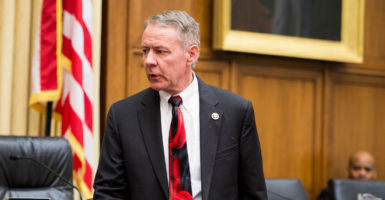
Corruption on Capitol Hill is “worse than you think,” according to Colorado Rep. Ken Buck


Corruption on Capitol Hill is “worse than you think,” according to Colorado Rep. Ken Buck.
“When you first get here, you think that you are in some sort of fairy-tale novel,” Buck, a Republican, said. “They wine and dine you and they show you just exactly what it’s like if you play the game. It’s a wonderful life.”
Things quickly change, however, if “you don’t play the game.”
“If you don’t play the game  …  it becomes a much less conformable existence here,” Buck said.  
Buck, who has served Colorado’s 4th Congressional District since 2015, also previewed his new book, “Drain the Swamp: How Washington Corruption is Worse Than You Think,” which was published on Tuesday.  
Chapters in Buck’s book include “Why Washington is a Swamp,” “Play the Game–Or Else,” “Beating the Beltway Bullies,” and “What You Can Do To Drain the Swamp.”
Buck said his book addresses corruption present in government today that he was not prepared for after being elected to Congress in 2014.
“One of the things that I found startling when I got here is that you have to pay dues to be on a committee,” Buck said.
During the time he served on the House Judiciary Committee, Buck said he had to pay periodic dues of $200,000 to the National Republican Congressional Committee, the campaign committee of the House of Representatives.
Now, as a member of the House Rules Committee, Buck’s periodic dues are $450,000.       Read More

Saturday, July 25, 2015


Boehner invites Pope Francis to address Congress


WASHINGTON — House Speaker John Boehner, R-Ohio, extended a formal and open invitation Thursday to Pope Francis to address a joint meeting of Congress.
If the pontiff accepts, it would be unprecedented. No pope or religious leader that serves as a head of state has ever addressed Congress, according to the U.S. House Historian's office.
"His address as a visiting head of state before a joint meeting of the House and Senate would honor our nation in keeping with the best traditions of our democratic institutions," Boehner said in a statement. " It would also offer an excellent opportunity for the American people as well as the nations of the world to hear his message in full."
Boehner, who is Catholic, said Pope Francis has inspired millions of Americans with his "pastoral manner and servant leadership" to reflect on matters of human dignity, freedom and social justice.
"These principles are among the fundamentals of the American idea," Boehner said, "and though our nation sometimes fails to live up to these principles, at our best, we give them new life as we seek the common good."
House Minority Leader Nancy Pelosi, D-Calif., also a Catholic, said she joined welcoming Pope Francis to address Congress. Pelosi attended his inauguration at the Vatican and praised him as "a moral force."
Thursday marks one year since the papal conclave elected Pope Francis, born Jorge Mario Bergoglio, after the resignation of Pope Benedict.
Francis marked the occasion on his @Pontifex Twitter account with a simple message to his 3.7 million followers: "Please pray for me.
USA Today