Showing posts with label MInd Control. Show all posts

Tuesday, October 29, 2019

Most of the content that is fed to us through our televisions, phones, tablets and computers is controlled by the elite


TECB   October 24, 2019
Why do you believe what you believe?  Some people have a really solid answer to that question, but much of the population never thinks much about deeper questions such as this.  In fact, for most Americans it is simply easier to let others do their thinking for them.  Today, most of us spend multiple hours each day absorbing information through a screen, and most of the content that is fed to us through our televisions, phones, tablets and computers is controlled by the elite.  And if you allow anyone to feed information into your mind for several hours every day, it is going to have a dramatic impact on how you view the world.

When I was younger, one of my favorite movies was “The Matrix”, and I think that it is a really good metaphor for what is going on in our society today.  In the film, nearly the entire human population was plugged into a system which continuously fed a computer-generated reality into their minds that wasn’t real at all.  Later on, I eventually came to realize that we are willingly doing the same thing to ourselves.  Our personal interactions with one another are extremely limited, but we willingly “plug in” to the enormous matrix of news, information and entertainment that the elite have constructed for many hours each day.

 According to numbers that were released earlier this year, the average American spends more than three hours watching television and more than three hours on mobile devices every single day…

 If Americans from previous generations could visit our society right now, they would probably be horrified that we are all constantly staring at our screens like some sort of zombies.
And perhaps it wouldn’t be so bad if we were feeding our minds healthy things, but instead most of what we are absorbing is garbage that has been produced by the elite.      More..

Monday, July 29, 2019

U.S. religious leaders issue “Religious Declaration of Unprecedented Human Emergency”

Yale May 9, 2019
What is an emergency? Merriam-Webster defines emergency as “an unforeseen combination of circumstances or the resulting state that calls for immediate action.” Does climate change count as an emergency? Not if an “emergency” is necessarily “unforeseen,” for when it comes to climate change, scientists have been sounding the alarm for decades, telling us that burning massive quantities of fossil fuels would lead to catastrophe. Of course, the fossil fuel industry (see #ExxonKnew) has spent millions of dollars trying to make the climate emergency as “unforeseen” as possible, for as long as possible, to as many people as possible. But the clock has run out. The time of reckoning is at hand. Foreseen or unforeseen, the climate crisis is upon us and it calls for immediate action.
In the same week that the U.K. became the first country to declare “an environment and climate emergency,” and in the same week that the Anglican Communion became, as far as I know, the first global religious body to recognize a climate emergency, National Religious Coalition for Creation gathered for its 20th annual prayer breakfast in Washington, DC. NRCCC is a group composed of members of major faith groups in America, including Catholic, Protestant, Evangelical, and Orthodox Christians, and Jews. After opening prayers, a lively presentation by Chad Hanson (Director of the John Muir Project) on forest protection as an essential aspect of addressing climate change, and the bestowal of the 2019 Steward of God’s Creation award to two outstanding climate champions – the Rev. Dr. Gerald L. Durley and the Rev. Dr. Jim Antal – we moved outside to announce the release of Religious Declaration of Unprecedented Climate Emergency.

Religious Declaration of Unprecedented Human Emergency
clarifies two essential facts: humanity has an extremely short window of time in which to avert irreversible climate chaos, and religions around the world consider protecting God’s Creation a moral and spiritual imperative.
Perhaps it was fitting that the Religious Declaration was publicly announced in Pershing Park, a National World War I Memorial. Just as William James and Jimmy Carter spoke of “the moral equivalent of war,” so, too, are increasing numbers of citizens realizing that we need to address climate change with the same focus, fervor and self-sacrifice of a nation that is mobilized to fight a war.
The stakes are high. As stated in the opening lines of the Religious Declaration, climate change is unlike any other challenge that confronts humanity, “because it is largely irreversible ‘for 1,000 years after emissions stop’ with ‘profound impacts on global climate, ecosystems and human societies for the next ten millennia and beyond.’1 The shocking truth is that decisions we make now could, in the words of climate economist Ross Garnaut, ‘haunt humanity until the end of time.’2 Nuclear war, while also irreversible, is only a possibility. Human-induced climate change is underway now, and its impacts are greater and more extensive than scientific models predicted. We will significantly alter the future of civilization as we know it and may eventually cause its collapse if we continue down this path.”
The Declaration calls for bold, concerted action: “Decades of delay on climate action have made small corrective measures and incremental approaches useless. Those who are invested in maintaining the status quo, or who put forth proposals that are clearly incompatible with what climate science demands, are condemning innocent young people – including their own children and generations to come – to a future of unimaginable suffering: the mass death of human populations and the extinction of species.

Saturday, September 30, 2017

NFL Hysteria a Reminder of How the Elite Have Controlled Men for Thousands of Years

September 25, 2017 by Isaac Davis

“So long as they (the Proles) continued to work and breed, their other activities were without importance… Films, football, beer and above all, gambling filled up the horizon of their minds. To keep them in control was not difficult.” ~ George Orwell, 1984
Few things in American culture exemplify the fractured status of the collective psyche quite like the popularity of the National Football League (NFL). The NFL has become a de facto symbol of American freedom, while in reality it performs the function of the Roman circus, keeping the distracted from the extortion and crimes of state.
The NFL is sponsored by major corporations and by the U.S. Armed Forces. The games played in multi-billion dollar subsidized stadiums have become patriotically charged events, where spectators conflate fighting for freedom with watching games for entertainment. Men are told to pick a team and go to war for that team. Fans of different teams are mortal enemies. Military planes conduct fly-bys overhead, and participants are apparently expected to stand for the national anthem.
The euphoria of football has political value. The sport is an important program of deflection and subjugation of the natural male will to protect community and to fight against foe if necessary. This natural drive is captured and projected onto the tightly controlled images of the league, its teams, and its players. Games are presented as life and death struggles, while real-life issues are downplayed in favor of this never-ending drama.
Author William Cooper talked about the importance of football and other major league sports in a society where men must be pacified in order for the government to continually abuse the populace. Cooper’s perspective is that such enormous investment in the sport as a national pastime serves to distract the people from important social issues, deflecting blame away from the oligarchy for it’s contributions in destroying real freedom. When men’s passions are levied on sport, they pay little attention to the workings of the state, and have no gumption to resist creeping tyranny.
“What does the emperor do when the people have become restive, and when the people are asking questions, or when the people don’t like the policies of the emperor? He sends them to the circus. He creates a circus. He builds a giant coliseum and he begins to throw the Christians to the lions, and he has great chariot races, and football games, and basketball games. All to keep the idiots preoccupied with things that don’t mean anything in the scheme of the entire world. So that they don’t have the time to learn what the truth is, so that they don’t ever get smart enough to learn how they’re being manipulated. So that they don’t ever question the emperor.” ~William Cooper

“When a hundred and fifty of the most powerful men and women in the world can meet in secret… to plot the fate of billions, and nobody even cares about it, but six football players go to lunch together, and it’s in the headlines across the country, you have a reflection of the society in which that exists. And it is a sick, sick society that is doomed to self-destruction.” ~William Cooper
And now, as ‘take a knee‘ protests have swept the nation, the NFL’s image has just been shattered in a catch-22 of brainwashing and cognitive dissonance. What originally started as a statement against the very real and destructive issue of police brutality has become a hysteria-fueled social movement and front page news. People are destroying thousands of dollars worth of team branded merchandise to demonstrate that complaints against the state will not be tolerated.
Now, the president has even chimed in, adding fuel to the fire and doubling down on the notion that the National Football League is first and foremost a patriotic organization. In this country, and in this sport, the government is not to be criticized. Not for brutalizing the citizenry with out of control police, or anything else.

Final Thoughts

In a society as rigidly controlled by a monolithic, top-down, know-it-all organization like the state, the archetypal energy of the male is manageable only by suppressing man’s natural drive to protect his community. This is how the elite have controlled men since the days of the Roman Empire.
When President Eisenhower left office, he warned us that the U.S. was changing under the pressures of a new world, and that a military industrial complex had emerged which would pose a sincere menace to a free society. Fast forward almost 60 years and his words are quite prescient.
“Now this conjunction of an immense military establishment and a large arms industry is new in the American experience. The total influence—economic, political, even spiritual—is felt in every city, every Statehouse, every office of the Federal government.

In the councils of government, we must guard against the acquisition of unwarranted influence, whether sought or unsought, by the military-industrial complex. The potential for the disastrous rise of misplaced power exists and will persist. We must never let the weight of this combination endanger our liberties or democratic processes. We should take nothing for granted. Only an alert and knowledgeable citizenry can compel the proper meshing of the huge industrial and military machinery of defense with our peaceful methods and goals, so that security and liberty may prosper together.” ~Dwight D. Eisenhower         Walking Times

Saturday, March 11, 2017

Media's Job: Control What People Think

UPDATE: Brzezinski took to Twitter to clarify her remarks, saying, “Today I said it’s the media’s job to keep President Trump from making up his own facts, NOT that it’s our job to control what people think.” She added, “Of course, that is obvious from the transcript but some people want to make up their own facts. SAD!”
On Wednesday’s broadcast of MSNBC’s “Morning Joe,” co-host Mika Brzezinski stated President Trump “could have undermined the messaging so much that he can actually control exactly what people think. And that is our job.”
Brzezinski said, “I think that the dangerous, you know, edges here are that he’s is trying to undermine the media, trying to make up his own facts. And it could be that, while unemployment and the economy worsens, he could have undermined the messaging so much that he can actually control exactly what people think. And that is our job.”     Breitbart

Wednesday, March 9, 2016

The internet: The new mind control

Header essay 42 70635245
by Robert Epstein

Over the past century, more than a few great writers have expressed concern about humanity’s future. In The Iron Heel (1908), the American writer Jack London pictured a world in which a handful of wealthy corporate titans – the ‘oligarchs’ – kept the masses at bay with a brutal combination of rewards and punishments. Much of humanity lived in virtual slavery, while the fortunate ones were bought off with decent wages that allowed them to live comfortably – but without any real control over their lives.
In We (1924), the brilliant Russian writer Yevgeny Zamyatin, anticipating the excesses of the emerging Soviet Union, envisioned a world in which people were kept in check through pervasive monitoring. The walls of their homes were made of clear glass, so everything they did could be observed. They were allowed to lower their shades an hour a day to have sex, but both the rendezvous time and the lover had to be registered first with the state.
In Brave New World (1932), the British author Aldous Huxley pictured a near-perfect society in which unhappiness and aggression had been engineered out of humanity through a combination of genetic engineering and psychological conditioning. And in the much darker novel 1984 (1949), Huxley’s compatriot George Orwell described a society in which thought itself was controlled; in Orwell’s world, children were taught to use a simplified form of English called Newspeak in order to assure that they could never express ideas that were dangerous to society.
These are all fictional tales, to be sure, and in each the leaders who held the power used conspicuous forms of control that at least a few people actively resisted and occasionally overcame. But in the non-fiction bestseller The Hidden Persuaders (1957) – recently released in a 50th-anniversary edition – the American journalist Vance Packard described a ‘strange and rather exotic’ type of influence that was rapidly emerging in the United States and that was, in a way, more threatening than the fictional types of control pictured in the novels. According to Packard, US corporate executives and politicians were beginning to use subtle and, in many cases, completely undetectable methods to change people’s thinking, emotions and behaviour based on insights from psychiatry and the social sciences.
Most of us have heard of at least one of these methods: subliminal stimulation, or what Packard called ‘subthreshold effects’ – the presentation of short messages that tell us what to do but that are flashed so briefly we aren’t aware we have seen them. In 1958, propelled by public concern about a theatre in New Jersey that had supposedly hidden messages in a movie to increase ice cream sales, the National Association of Broadcasters – the association that set standards for US television – amended its code to prohibit the use of subliminal messages in broadcasting. In 1974, the Federal Communications Commission opined that the use of such messages was ‘contrary to the public interest’. Legislation to prohibit subliminal messaging was also introduced in the US Congress but never enacted. Both the UK and Australia have strict laws prohibiting it.
Subliminal stimulation is probably still in wide use in the US – it’s hard to detect, after all, and no one is keeping track of it – but it’s probably not worth worrying about. Research suggests that it has only a small impact, and that it mainly influences people who are already motivated to follow its dictates; subliminal directives to drink affect people only if they’re already thirsty.
Packard had uncovered a much bigger problem, however – namely that powerful corporations were constantly looking for, and in many cases already applying, a wide variety of techniques for controlling people without their knowledge. He described a kind of cabal in which marketers worked closely with social scientists to determine, among other things, how to get people to buy things they didn’t need and how to condition young children to be good consumers – inclinations that were explicitly nurtured and trained in Huxley’s Brave New World. Guided by social science, marketers were quickly learning how to play upon people’s insecurities, frailties, unconscious fears, aggressive feelings and sexual desires to alter their thinking, emotions and behaviour without any awareness that they were being manipulated.
By the early 1950s, Packard said, politicians had got the message and were beginning to merchandise themselves using the same subtle forces being used to sell soap. Packard prefaced his chapter on politics with an unsettling quote from the British economist Kenneth Boulding: ‘A world of unseen dictatorship is conceivable, still using the forms of democratic government.’ Could this really happen, and, if so, how would it work?

The forces that Packard described have become more pervasive over the decades. The soothing music we all hear overhead in supermarkets causes us to walk more slowly and buy more food, whether we need it or not. Most of the vacuous thoughts and intense feelings our teenagers experience from morning till night are carefully orchestrated by highly skilled marketing professionals working in our fashion and entertainment industries. Politicians work with a wide range of consultants who test every aspect of what the politicians do in order to sway voters: clothing, intonations, facial expressions, makeup, hairstyles and speeches are all optimised, just like the packaging of a breakfast cereal.
Fortunately, all of these sources of influence operate competitively. Some of the persuaders want us to buy or believe one thing, others to buy or believe something else. It is the competitive nature of our society that keeps us, on balance, relatively free.
But what would happen if new sources of control began to emerge that had little or no competition? And what if new means of control were developed that were far more powerful – and far more invisible – than any that have existed in the past? And what if new types of control allowed a handful of people to exert enormous influence not just over the citizens of the US but over most of the people on Earth?
It might surprise you to hear this, but these things have already happened.
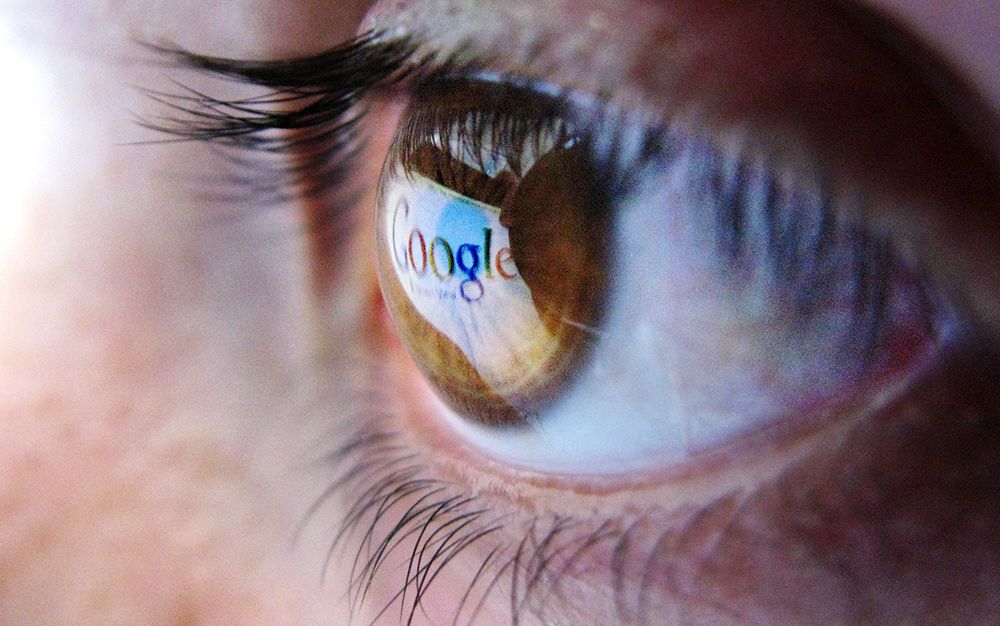
Google decides which web pages to include in search results, and how to rank them. How it does so is one of the best-kept secrets in the world, like the formula for Coca-Cola
To understand how the new forms of mind control work, we need to start by looking at the search engine – one in particular: the biggest and best of them all, namely Google. The Google search engine is so good and so popular that the company’s name is now a commonly used verb in languages around the world. To ‘Google’ something is to look it up on the Google search engine, and that, in fact, is how most computer users worldwide get most of their information about just about everything these days. They Google it. Google has become the main gateway to virtually all knowledge, mainly because the search engine is so good at giving us exactly the information we are looking for, almost instantly and almost always in the first position of the list it shows us after we launch our search – the list of ‘search results’.
That ordered list is so good, in fact, that about 50 per cent of our clicks go to the top two items, and more than 90 per cent of our clicks go to the 10 items listed on the first page of results; few people look at other results pages, even though they often number in the thousands, which means they probably contain lots of good information. Google decides which of the billions of web pages it is going to include in our search results, and it also decides how to rank them. How it decides these things is a deep, dark secret – one of the best-kept secrets in the world, like the formula for Coca-Cola.
Because people are far more likely to read and click on higher-ranked items, companies now spend billions of dollars every year trying to trick Google’s search algorithm – the computer program that does the selecting and ranking – into boosting them another notch or two. Moving up a notch can mean the difference between success and failure for a business, and moving into the top slots can be the key to fat profits.
Late in 2012, I began to wonder whether highly ranked search results could be impacting more than consumer choices. Perhaps, I speculated, a top search result could have a small impact on people’s opinions about things. Early in 2013, with my associate Ronald E Robertson of the American Institute for Behavioral Research and Technology in Vista, California, I put this idea to a test by conducting an experiment in which 102 people from the San Diego area were randomly assigned to one of three groups. In one group, people saw search results that favoured one political candidate – that is, results that linked to web pages that made this candidate look better than his or her opponent. In a second group, people saw search rankings that favoured the opposing candidate, and in the third group – the control group – people saw a mix of rankings that favoured neither candidate. The same search results and web pages were used in each group; the only thing that differed for the three groups was the ordering of the search results.
To make our experiment realistic, we used real search results that linked to real web pages. We also used a real election – the 2010 election for the prime minister of Australia. We used a foreign election to make sure that our participants were ‘undecided’. Their lack of familiarity with the candidates assured this. Through advertisements, we also recruited an ethnically diverse group of registered voters over a wide age range in order to match key demographic characteristics of the US voting population.
All participants were first given brief descriptions of the candidates and then asked to rate them in various ways, as well as to indicate which candidate they would vote for; as you might expect, participants initially favoured neither candidate on any of the five measures we used, and the vote was evenly split in all three groups. Then the participants were given up to 15 minutes in which to conduct an online search using ‘Kadoodle’, our mock search engine, which gave them access to five pages of search results that linked to web pages. People could move freely between search results and web pages, just as we do when using Google. When participants completed their search, we asked them to rate the candidates again, and we also asked them again who they would vote for.
We predicted that the opinions and voting preferences of 2 or 3 per cent of the people in the two bias groups – the groups in which people were seeing rankings favouring one candidate – would shift toward that candidate. What we actually found was astonishing. The proportion of people favouring the search engine’s top-ranked candidate increased by 48.4 per cent, and all five of our measures shifted toward that candidate. What’s more, 75 per cent of the people in the bias groups seemed to have been completely unaware that they were viewing biased search rankings. In the control group, opinions did not shift significantly.
This seemed to be a major discovery. The shift we had produced, which we called the Search Engine Manipulation Effect (or SEME, pronounced ‘seem’), appeared to be one of the largest behavioural effects ever discovered. We did not immediately uncork the Champagne bottle, however. For one thing, we had tested only a small number of people, and they were all from the San Diego area.
Over the next year or so, we replicated our findings three more times, and the third time was with a sample of more than 2,000 people from all 50 US states. In that experiment, the shift in voting preferences was 37.1 per cent and even higher in some demographic groups – as high as 80 per cent, in fact.
We also learned in this series of experiments that by reducing the bias just slightly on the first page of search results – specifically, by including one search item that favoured the other candidate in the third or fourth position of the results – we could mask our manipulation so that few or even no people were aware that they were seeing biased rankings. We could still produce dramatic shifts in voting preferences, but we could do so invisibly.
Still no Champagne, though. Our results were strong and consistent, but our experiments all involved a foreign election – that 2010 election in Australia. Could voting preferences be shifted with real voters in the middle of a real campaign? We were skeptical. In real elections, people are bombarded with multiple sources of information, and they also know a lot about the candidates. It seemed unlikely that a single experience on a search engine would have much impact on their voting preferences.
To find out, in early 2014, we went to India just before voting began in the largest democratic election in the world – the Lok Sabha election for prime minister. The three main candidates were Rahul Gandhi, Arvind Kejriwal, and Narendra Modi. Making use of online subject pools and both online and print advertisements, we recruited 2,150 people from 27 of India’s 35 states and territories to participate in our experiment. To take part, they had to be registered voters who had not yet voted and who were still undecided about how they would vote.
unlike subliminal stimuli, SEME has an enormous impact – like Casper the ghost pushing you down a flight of stairs
Participants were randomly assigned to three search-engine groups, favouring, respectively, Gandhi, Kejriwal or Modi. As one might expect, familiarity levels with the candidates was high – between 7.7 and 8.5 on a scale of 10. We predicted that our manipulation would produce a very small effect, if any, but that’s not what we found. On average, we were able to shift the proportion of people favouring any given candidate by more than 20 per cent overall and more than 60 per cent in some demographic groups. Even more disturbing, 99.5 per cent of our participants showed no awareness that they were viewing biased search rankings – in other words, that they were being manipulated.
SEME’s near-invisibility is curious indeed. It means that when people – including you and me – are looking at biased search rankings, they look just fine. So if right now you Google ‘US presidential candidates’, the search results you see will probably look fairly random, even if they happen to favour one candidate. Even I have trouble detecting bias in search rankings that I know to be biased (because they were prepared by my staff). Yet our randomised, controlled experiments tell us over and over again that when higher-ranked items connect with web pages that favour one candidate, this has a dramatic impact on the opinions of undecided voters, in large part for the simple reason that people tend to click only on higher-ranked items. This is truly scary: like subliminal stimuli, SEME is a force you can’t see; but unlike subliminal stimuli, it has an enormous impact – like Casper the ghost pushing you down a flight of stairs.
We published a detailed report about our first five experiments on SEME in the prestigious Proceedings of the National Academy of Sciences (PNAS) in August 2015. We had indeed found something important, especially given Google’s dominance over search. Google has a near-monopoly on internet searches in the US, with 83 per cent of Americans specifying Google as the search engine they use most often, according to the Pew Research Center. So if Google favours one candidate in an election, its impact on undecided voters could easily decide the election’s outcome.
Keep in mind that we had had only one shot at our participants. What would be the impact of favouring one candidate in searches people are conducting over a period of weeks or months before an election? It would almost certainly be much larger than what we were seeing in our experiments.
Other types of influence during an election campaign are balanced by competing sources of influence – a wide variety of newspapers, radio shows and television networks, for example – but Google, for all intents and purposes, has no competition, and people trust its search results implicitly, assuming that the company’s mysterious search algorithm is entirely objective and unbiased. This high level of trust, combined with the lack of competition, puts Google in a unique position to impact elections. Even more disturbing, the search-ranking business is entirely unregulated, so Google could favour any candidate it likes without violating any laws. Some courts have even ruled that Google’s right to rank-order search results as it pleases is protected as a form of free speech.
Does the company ever favour particular candidates? In the 2012 US presidential election, Google and its top executives donated more than $800,000 to President Barack Obama and just $37,000 to his opponent, Mitt Romney. And in 2015, a team of researchers from the University of Maryland and elsewhere showed that Google’s search results routinely favoured Democratic candidates. Are Google’s search rankings really biased? An internal report issued by the US Federal Trade Commission in 2012 concluded that Google’s search rankings routinely put Google’s financial interests ahead of those of their competitors, and anti-trust actions currently under way against Google in both the European Union and India are based on similar findings.
In most countries, 90 per cent of online search is conducted on Google, which gives the company even more power to flip elections than it has in the US and, with internet penetration increasing rapidly worldwide, this power is growing. In our PNAS article, Robertson and I calculated that Google now has the power to flip upwards of 25 per cent of the national elections in the world with no one knowing this is occurring. In fact, we estimate that, with or without deliberate planning on the part of company executives, Google’s search rankings have been impacting elections for years, with growing impact each year. And because search rankings are ephemeral, they leave no paper trail, which gives the company complete deniability.
Power on this scale and with this level of invisibility is unprecedented in human history. But it turns out that our discovery about SEME was just the tip of a very large iceberg.
Recent reports suggest that the Democratic presidential candidate Hillary Clinton is making heavy use of social media to try to generate support – Twitter, Instagram, Pinterest, Snapchat and Facebook, for starters. At this writing, she has 5.4 million followers on Twitter, and her staff is tweeting several times an hour during waking hours. The Republican frontrunner, Donald Trump, has 5.9 million Twitter followers and is tweeting just as frequently.
Is social media as big a threat to democracy as search rankings appear to be? Not necessarily. When new technologies are used competitively, they present no threat. Even through the platforms are new, they are generally being used the same way as billboards and television commercials have been used for decades: you put a billboard on one side of the street; I put one on the other. I might have the money to erect more billboards than you, but the process is still competitive.
What happens, though, if such technologies are misused by the companies that own them? A study by Robert M Bond, now a political science professor at Ohio State University, and others published in Nature in 2012 described an ethically questionable experiment in which, on election day in 2010, Facebook sent ‘go out and vote’ reminders to more than 60 million of its users. The reminders caused about 340,000 people to vote who otherwise would not have. Writing in the New Republic in 2014, Jonathan Zittrain, professor of international law at Harvard University, pointed out that, given the massive amount of information it has collected about its users, Facebook could easily send such messages only to people who support one particular party or candidate, and that doing so could easily flip a close election – with no one knowing that this has occurred. And because advertisements, like search rankings, are ephemeral, manipulating an election in this way would leave no paper trail.
Are there laws prohibiting Facebook from sending out ads selectively to certain users? Absolutely not; in fact, targeted advertising is how Facebook makes its money. Is Facebook currently manipulating elections in this way? No one knows, but in my view it would be foolish and possibly even improper for Facebook not to do so. Some candidates are better for a company than others, and Facebook’s executives have a fiduciary responsibility to the company’s stockholders to promote the company’s interests.
The Bond study was largely ignored, but another Facebook experiment, published in 2014 in PNAS, prompted protests around the world. In this study, for a period of a week, 689,000 Facebook users were sent news feeds that contained either an excess of positive terms, an excess of negative terms, or neither. Those in the first group subsequently used slightly more positive terms in their communications, while those in the second group used slightly more negative terms in their communications. This was said to show that people’s ‘emotional states’ could be deliberately manipulated on a massive scale by a social media company, an idea that many people found disturbing. People were also upset that a large-scale experiment on emotion had been conducted without the explicit consent of any of the participants.
Facebook’s consumer profiles are undoubtedly massive, but they pale in comparison with those maintained by Google, which is collecting information about people 24/7, using more than 60 different observation platforms – the search engine, of course, but also Google Wallet, Google Maps, Google Adwords, Google Analytics, Chrome, Google Docs, Android, YouTube, and on and on. Gmail users are generally oblivious to the fact that Google stores and analyses every email they write, even the drafts they never send – as well as all the incoming email they receive from both Gmail and non-Gmail users.
if Google set about to fix an election, it could identify just those voters who are undecided. Then it could send customised rankings favouring one candidate to just those people
According to Google’s privacy policy – to which one assents whenever one uses a Google product, even when one has not been informed that he or she is using a Google product – Google can share the information it collects about you with almost anyone, including government agencies. But never with you. Google’s privacy is sacrosanct; yours is nonexistent.
Could Google and ‘those we work with’ (language from the privacy policy) use the information they are amassing about you for nefarious purposes – to manipulate or coerce, for example? Could inaccurate information in people’s profiles (which people have no way to correct) limit their opportunities or ruin their reputations?
Certainly, if Google set about to fix an election, it could first dip into its massive database of personal information to identify just those voters who are undecided. Then it could, day after day, send customised rankings favouring one candidate to just those people. One advantage of this approach is that it would make Google’s manipulation extremely difficult for investigators to detect.
Extreme forms of monitoring, whether by the KGB in the Soviet Union, the Stasi in East Germany, or Big Brother in 1984, are essential elements of all tyrannies, and technology is making both monitoring and the consolidation of surveillance data easier than ever. By 2020, China will have put in place the most ambitious government monitoring system ever created – a single database called the Social Credit System, in which multiple ratings and records for all of its 1.3 billion citizens are recorded for easy access by officials and bureaucrats. At a glance, they will know whether someone has plagiarised schoolwork, was tardy in paying bills, urinated in public, or blogged inappropriately online.
As Edward Snowden’s revelations made clear, we are rapidly moving toward a world in which both governments and corporations – sometimes working together – are collecting massive amounts of data about every one of us every day, with few or no laws in place that restrict how those data can be used. When you combine the data collection with the desire to control or manipulate, the possibilities are endless, but perhaps the most frightening possibility is the one expressed in Boulding’s assertion that an ‘unseen dictatorship’ was possible ‘using the forms of democratic government’.
Since Robertson and I submitted our initial report on SEME to PNAS early in 2015, we have completed a sophisticated series of experiments that have greatly enhanced our understanding of this phenomenon, and other experiments will be completed in the coming months. We have a much better sense now of why SEME is so powerful and how, to some extent, it can be suppressed.
We have also learned something very disturbing – that search engines are influencing far more than what people buy and whom they vote for. We now have evidence suggesting that on virtually all issues where people are initially undecided, search rankings are impacting almost every decision that people make. They are having an impact on the opinions, beliefs, attitudes and behaviours of internet users worldwide – entirely without people’s knowledge that this is occurring. This is happening with or without deliberate intervention by company officials; even so-called ‘organic’ search processes regularly generate search results that favour one point of view, and that in turn has the potential to tip the opinions of millions of people who are undecided on an issue. In one of our recent experiments, biased search results shifted people’s opinions about the value of fracking by 33.9 per cent.
Perhaps even more disturbing is that the handful of people who do show awareness that they are viewing biased search rankings shift even further in the predicted direction; simply knowing that a list is biased doesn’t necessarily protect you from SEME’s power.
Remember what the search algorithm is doing: in response to your query, it is selecting a handful of webpages from among the billions that are available, and it is ordering those webpages using secret criteria. Seconds later, the decision you make or the opinion you form – about the best toothpaste to use, whether fracking is safe, where you should go on your next vacation, who would make the best president, or whether global warming is real – is determined by that short list you are shown, even though you have no idea how the list was generated.
The technology has made possible undetectable and untraceable manipulations of entire populations that are beyond the scope of existing regulations and laws
Meanwhile, behind the scenes, a consolidation of search engines has been quietly taking place, so that more people are using the dominant search engine even when they think they are not. Because Google is the best search engine, and because crawling the rapidly expanding internet has become prohibitively expensive, more and more search engines are drawing their information from the leader rather than generating it themselves. The most recent deal, revealed in a Securities and Exchange Commission filing in October 2015, was between Google and Yahoo! Inc.
Looking ahead to the November 2016 US presidential election, I see clear signs that Google is backing Hillary Clinton. In April 2015, Clinton hired Stephanie Hannon away from Google to be her chief technology officer and, a few months ago, Eric Schmidt, chairman of the holding company that controls Google, set up a semi-secret company – The Groundwork – for the specific purpose of putting Clinton in office. The formation of The Groundwork prompted Julian Assange, founder of Wikileaks, to dub Google Clinton’s ‘secret weapon’ in her quest for the US presidency.
We now estimate that Hannon’s old friends have the power to drive between 2.6 and 10.4 million votes to Clinton on election day with no one knowing that this is occurring and without leaving a paper trail. They can also help her win the nomination, of course, by influencing undecided voters during the primaries. Swing voters have always been the key to winning elections, and there has never been a more powerful, efficient or inexpensive way to sway them than SEME.
We are living in a world in which a handful of high-tech companies, sometimes working hand-in-hand with governments, are not only monitoring much of our activity, but are also invisibly controlling more and more of what we think, feel, do and say. The technology that now surrounds us is not just a harmless toy; it has also made possible undetectable and untraceable manipulations of entire populations – manipulations that have no precedent in human history and that are currently well beyond the scope of existing regulations and laws. The new hidden persuaders are bigger, bolder and badder than anything Vance Packard ever envisioned. If we choose to ignore this, we do so at our peril.            Aeon

Obedience Training: The Truth about the Pledge of Allegiance

TRUTHstreammedia

Wednesday, February 3, 2016

Magnifying the character of Lucifer on TV

, USA TODAY Life 10:44 a.m. EST January 31, 2016
Lucifer Morningstar (Tom Ellis) brings a different kind of devilish character to television. Fox's Lucifer (Mondays, 9 ET/PT) gives us a charming demonic dude who takes up residence in Los Angeles as a nightclub owner. Of course, he's quite the ladies' man, and well, he doesn't want to go back to hell, where his father wants him.
What’s next? Will the son of Satan walk among us? Oh wait, that's Damien, coming to A&E March 7.
But the Devil isn't new to the small screen. USA TODAY takes a look at other recent TV devils.


Lucifer (Supernatural, CW, Wednesdays, 9 ET/PT)
 Lucifer has had multiple faces on the drama series, which started in 2005. In most of his appearances, he's portrayed by Mark Pellegrino. But if you follow the show, you know this baddie also inhabited the characters played by Jared Padalecki and more recently, Misha Collins. It's a devil of a headache to follow.


Super Devil (Family Guy, Fox, Sundays, 9 ET/PT)
 Super Devil's appearance in Season 5 of the animated series is the stuff of legend.  He's got red skin, ram's horns, a flying motorcycle and a jar of marmalade that forces people to commit adultery. Ultimately, he's killed by Brian, the dog, randomly firing a revolver.


Devil Flanders (The Simpsons, Fox, Sundays, 8 ET/PT) 
Devil Flanders on the long-running Fox animated series is Simpsons neighbor Ned Flanders, transformed into Satan. One day, when Homer is out of doughnuts at work, he mutters something about being willing to sell his soul for a doughnut. So Devil Flanders  strikes a deal with Homer,  who thinks he can get out of the deal by not finishing it. Well, complications ensue and after a trial, Marge wins ownership of Homer's soul, beating the devil. Devil Flanders also appears on several "Treehouse of Horror" Halloween episodes.


Satan (South Park, Comedy Central)
The animated comedy series has its own demonic spirit. Satan, who here is openly gay, occasionally rises from Hell to South Park to carry out wicked deeds, but he's not completely without compassion. He's had relationships with Saddam Hussein and more recently, Chris. And he has a son named (what else?) Damien.

USAToday

Monday, November 2, 2015

The anesthetization of Mankind


television-brainwashing
By Waking Times, October 29, 2015
Humanity's been carefully anesthetized.

Things are moving so fast and crazy and in so many weird directions it's tantamount to mass insanity going on. Yet most don't even notice, and that's the weirdest thing of all. That polarization is what compounds the problem, and that's why the cryptos love to try to continue to confuse and divide us in every way they can.

Hence the growing divide between the awakened and anesthetized.

It's coming down to those who dare wake up to reality vs. those who continue on within the projected mindframe. All have a chance to wake up, but not all will take the challenge and opportunity.

Such is the nature of the Universe apparently. This ongoing contest seems to be the playing field into which we have been planted, and it is each of our choices individually that will make up any sort of outcome.

All will be eventually resolved, but at what cost? Where and in what lies our response-ability?

Medication and Conditioning, Bread and Circus, Omission and Denial

This is where the great schism lies. The awake and aware have snapped out of the control system. Those who haven't are being tooled around like puppets on a million nano strings. When you don't know, you don't know that you don't know...and are very easy to keep being fooled.

When you've woken up, the world is completely reversed from everything you were told and believed before. You now know that you now know! And everything rights itself and all is clear.
It takes some cobweb clearing to get a handle on the real picture but it happens, and in a relative hurry.

Truth not only defends itself, but drives itself.

How do they maintain this illusion? Mental conditioning is the name of the game for the designers and propagators of the matrix. Once the pattern is established in its captive subjects, the more you can pour the lies on without them being noticed. Also disguised is the fact that their every intention for humanity is for control and exploitation....at any cost or consequence to these expendable "human resources".

To achieve this conditioning requires quite an effort on their part, because we are ultimately irrepressible and they know that. It's like chemtrails. If they don't keep spraying the required concentration of their toxic soup the effects start to wane, like the fluoride dosing and the rest. To keep the vast majority sleep walking they use all kinds of methods and have to maintain them.

It's also inspiring...because no matter what they do to us they can't put us out of commission. Unless they kill us off entirely, but that's just a promotion to the next level.

Tools that Numb

But what specifically do they control us by? They flood our bodies with drugs delivered by any means possible; deprivation of nutrition, sunlight and clean air, water and food; dumbed down education and a fully controlled media with mind numbing false news and so-called entertainment; electromagnetic smog blasting on the human nervous system wavelength; violence and oppressive fear and terror tactics, and on and on.

They do this with impunity. Imagine the world is a massive internment camp where the captors give the illusion the inmates are free by letting them have a few choices within this massive facility, and disguise the barbed wire fence as gorgeous murals, and the control devices as modern marvels for their advancement.

Wars are a perfect example. All supposedly for our defense, safety and security, when it's the exact opposite.

Basic Simple Questions

Some fundamental questions that beg answers that are evident before any clear thinking individual:

- How can a government usurping monstrosity like the United Snakes Corporation and its affiliate thugs gang rape a planet and make it look benevolent?

- How can obviously lying elitist politicians bought off by the highest bidder be taken as serious entities in governing institutions?

- How can known secretive government sponsored agencies pull off assassinations and staged bombings and shootings in plain sight?
- How can the most murderous, supremacist, fascist, arrogant, racist people on earth be called "the chosen ones" and given title to anything they want including their own sanctioned Zionist territory and ravenous, genocidal agenda and be given complete religious, social and political immunity and massive financial support? All supposedly based on clearly misguided insane religious zeal?

- How can sweeping freedom destroying measures be instituted by "executive order" and other means in a representative republic, or any supposedly democratic regime?

- How can the food, water and air be deliberately poisoned in public knowledge and in plain sight?

- How can the genetic modification of not just plants and animals but human beings be tolerated, no matter the stated justification?

- How can technocratic electro-surveillance, artificial intelligence, robotic warfare and social and mental manipulation be known and accepted as legitimate human altering science and in full implementation for mass control?

....and on and on...why wouldn't people in such an abused situation not go virtually berserk in protest, or a least speak out on a massive scale?

The Hypnotic Rhythm of Anesthesia

Every day I'm just amazed that so few seem to notice what's going on. The business as usual behavior and shallow chatter about nothing and the complete dependence on routine behavior for money and phony goals is just mind-boggling.
Clearly, there won't be a world in which to live even those shallow goals if things aren't changed drastically.

The day we hope our children and grandchildren to grow up in is quickly becoming not just night, but a literal nightmare.

The snapshot above is from the movie Time Machine from one of globalist insider H.G. Wells' predictive programming pieces where cultivated humans are routinely harvested in the maws of parasitic beings.

Despite this meme of humanity being fodder for others being shown to mankind for eons via literature or inside messengers, humanity doesn't get it. It's another surreptitious way to hide the Truth; sci-fi or story-fy it. Turn the real direction of the controllers into a fiction, a fantasy, and entertainment.

"A tale told by an idiot full of sound and fury, signifying nothing," as Shakespeare famously said through Macbeth.

Who's Behind This?

I'm convinced there's something very occult and spiritual that is ultimately behind all this, and these described techniques are just to augment the signal from the bowels of the matrix, be they archontic or some other form of inter-dimensional influence perpetrated by willing psychopaths amongst us. Just as how chemtrails are used by the EMFs to manipulate weather patterns while serving other purposes, they provide an enhanced medium for these spiritual influences to take effect.

The question arises, is something else being perpetrated on a massive scale? Are we subjects of another realm?

I don't know. But does it matter where this oppression originates? I'm sure aware of the possibility and inclined to think so, but that doesn't excuse or distance me from the very real struggle we find ourselves in.

Fundamentally my awareness of these possibilities profoundly indicates to me that I am truly free.

Extremely free. And that has power. Wonderful, conscious, awakening power. And it's for all of us.

Don't begin to believe this massive lie, as real as it is being temporarily manifested due to the accepting ignorance of the majority of humanity. From the religious or financial paradigms to the scarcity and fear of death memes, when you realize what effort they have to make to keep the illusion in place you also realize the extent of your innate power and what they innately fear, a complete reversal of their paradigm.

Grow in the peace of understanding and the courage of conviction, no matter how alone you may feel.
Walking Times

Wednesday, October 28, 2015

10 Modern Methods of Mind Control

Nicholas West Activist Post

Image

© Activist Post
The more one researches mind control, the more one will come to the conclusion that there is a coordinated script that has been in place for a very long time with the goal to turn the human race into non-thinking automatons. For as long as man has pursued power over the masses, mind control has been orchestrated by those who study human behavior in order to bend large populations to the will of a small "elite" group. Today, we have entered a perilous phase where mind control has taken on a physical, scientific dimension that threatens to become a permanent state if we do not become aware of the tools at the disposal of the technocratic dictatorship unfolding on a worldwide scale.

Modern mind control is both technological and psychological. Tests show that simply by exposing the methods of mind control, the effects can be reduced or eliminated, at least for mind control advertising and propaganda. More difficult to counter are the physical intrusions, which the military-industrial complex continues to develop and improve upon.

    Image
  1. Education - This is the most obvious, yet still remains the most insidious. It has always been a would-be dictator's ultimate fantasy to "educate" naturally impressionable children, thus it has been a central component to Communist and Fascist tyrannies throughout history. No one has been more instrumental in exposing the agenda of modern education than Charlotte Iserbyt - one can begin research into this area by downloading a free PDF of her book, The Deliberate Dumbing Down of America, which lays bare the role of Globalist foundations in shaping a future intended to produce servile drones lorded over by a fully educated, aware elite class.
  2.  Advertising and Propaganda - Edward Bernays has been cited as the inventor of the consumerist culture that was designed primarily to target people's self-image (or lack thereof) in order to turn a want into a need. This was initially envisioned for products such as cigarettes, for example. However, Bernays also noted in his 1928 book, Propaganda, that "propaganda is the executive arm of the invisible government." This can be seen most clearly in the modern police state and the growing citizen snitch culture, wrapped up in the pseudo-patriotic War on Terror. The increasing consolidation of media has enabled the entire corporate structure to merge with government, which now utilizes the concept of propaganda placement. Media; print, movies, television, and cable news can now work seamlessly to integrate an overall message which seems to have the ring of truth because it comes from so many sources, simultaneously. When one becomes attuned to identifying the main "message," one will see this imprinting everywhere. And this is not even to mention subliminal messaging.
  3. Image
  4. Predictive Programming - Many still deny that predictive programming is real. I would invite anyone to examine the range of documentation put together by Alan Watt and come to any other conclusion. Predictive programming has its origins in predominately elitist Hollywood, where the big screen can offer a big vision of where society is headed. Just look back at the books and movies which you thought were far-fetched, or "science fiction" and take a close look around at society today. For a detailed breakdown of specific examples, Vigilant Citizen is a great resource that will probably make you look at "entertainment" in a completely different light.
  5. Sports, Politics, Religion - Some might take offense at seeing religion, or even politics, put alongside sports as a method of mind control. The central theme is the same throughout: divide and conquer. The techniques are quite simple: short circuit the natural tendency of people to cooperate for their survival, and teach them to form teams bent on domination and winning. Sports has always had a role as a key distraction that corrals tribal tendencies into a non-important event, which in modern America has reached ridiculous proportions where protests will break out over a sport celebrity leaving their city, but essential human issues such as liberty are giggled away as inconsequential. Political discourse is strictly in a left-right paradigm of easily controlled opposition, while religion is the backdrop of nearly every war throughout history.
  6. Food, Water, and Air - Additives, toxins, and other food poisons literally alter brain chemistry to create docility and apathy. Fluoride in drinking water has been proven to lower IQ; Aspartame and MSG are excitotoxins which excite brain cells until they die; and easy access to the fast food that contains these poisons generally has created a population that lacks focus and motivation for any type of active lifestyle. Most of the modern world is perfectly groomed for passive receptiveness - and acceptance - of the dictatorial elite. And if you choose to diligently watch your diet, they are fully prepared to spray the population from the above.
  7. Image
  8. Drugs - This can be any addictive substance, but the mission of mind controllers is to be sure you are addicted to something. One major arm of the modern mind control agenda is psychiatry, which aims to define all people by their disorders, as opposed to their human potential. This was foreshadowed in books such as Brave New World. Today, it has been taken to even further extremes as a medical tyranny has taken hold where nearly everyone has some sort of disorder - particularly those who question authority. The use of nerve drugs in the military has led to record numbers of suicides. Worst of all, the modern drug state now has over 25% of U.S. children on mind-numbing medication.
  9. Military testing - The military has a long history as the testing ground for mind control. The military mind is perhaps the most malleable, as those who pursue life in the military generally resonate to the structures of hierarchy, control, and the need for unchallenged obedience to a mission. For the increasing number of military personal questioning their indoctrination, a recent story highlighted DARPA's plans for transcranial mind control helmets that will keep them focused.
  10. Electromagnetic spectrum - An electromagnetic soup envelops us all, charged by modern devices of convenience which have been shown to have a direct impact on brain function. In a tacit admission of what is possible, one researcher has been working with a "god helmet" to induce visions by altering the electromagnetic field of the brain. Our modern soup has us passively bathed by potentially mind-altering waves, while a wide range of possibilities such as cell phone towers is now available to the would-be mind controller for more direct intervention.
  11. Image
  12. Television, Computer, and "flicker rate" - It's bad enough that what is "programmed" on your TV (accessed via remote "control") is engineered; it is all made easier by literally lulling you to sleep, making it a psycho-social weapon. Flicker rate tests show that alpha brain waves are altered, producing a type of hypnosis - which doesn't portend well for the latest revelation that lights can transmit coded Internet data by "flickering faster than the eye can see." The computer's flicker rate is less, but through video games, social networks, and a basic structure which overloads the brain with information, the rapid pace of modern communication induces an ADHD state. A study of video games revealed that extended play can result in lower blood flow to the brain, sapping emotional control. Furthermore, role-playing games of lifelike war and police state scenarios serve to desensitize a connection to reality. One look at the WikiLeaks video Collateral Murder should be familiar to anyone who has seen a game like Call of Duty.
  13. Nanobots - From science fiction horror, directly to the modern brain; the nanobots are on the way. Direct brain modification already has been packaged as "neuroengineering." A Wired article from early 2009 highlighted that direct brain manipulation via fiber optics is a bit messy, but once installed "it could make someone happy with the press of a button." Nanobots take the process to an automated level, rewiring the brain molecule by molecule. Worse, these mini droids can self-replicate, forcing one to wonder how this genie would ever get back in the bottle once unleashed. Expected date of arrival? Early 2020s.
A concerted effort is underway to manage and predict human behavior so that the social scientists and the dictatorial elite can control the masses and protect themselves from the fallout of a fully awake free humanity. Only by waking up to their attempts to put us to sleep do we stand a chance of preserving our free will.
SOTT