Showing posts with label Wine of Babylon. Show all posts

Monday, April 26, 2021

The doctrine contrary to reason and common sense


Roswell F. Cottrell - Wikipedia

“That one person is three persons, and that three persons are only one person, is the doctrine which we claim is contrary to reason and common sense. The being and attributes of God are above, beyond, out of reach of my sense and reason, yet I believe them: But the doctrine I object to is contrary, yes, that is the word, to the very sense and reason that God has himself implanted in us. Such a doctrine he does not ask us to believe. A miracle is beyond our comprehension, but we all believe in miracles who believe our own senses. What we see and hear convinces us that there is a power that effected the most wonderful miracle of creation. But our Creator has made it an absurdity to us that one person should be three persons, and three persons but one person; and in his revealed word he has never asked us to believe it. This our friend thinks objectionable.…

“But to hold the doctrine of the Trinity is not so much an evidence of evil intention as of intoxication from that wine of which all the nations have drunk. The fact that this was one of the leading doctrines, if not the very chief, upon which the bishop of Rome was exalted to popedom, does not say much in its favor. This should cause men to investigate it for themselves; as when the spirits of devils working miracles undertake the advocacy of the immortality of the soul. Had I never doubted it before, I would now probe it to the bottom, by that word which modern Spiritualism sets at nought.…

“Revelation goes beyond us; but in no instance does it go contrary to right reason and common sense. God has not claimed, as the popes have, that he could “make justice of injustice,” nor has he, after teaching us to count, told us that there is no difference between the singular and plural numbers. Let us believe all he has revealed, and add nothing to it.” —R. F. Cottrell, July 6, 1869, Review & Herald

Saturday, October 31, 2020

The most fundamental and essential teaching in the Catholic faith

Catechism

The mystery of the Most Holy Trinity is the central mystery of Christian faith and life. It is the mystery of God in himself. It is therefore the source of all the other mysteries of faith, the light that enlightens them. It is the most fundamental and essential teaching in the "hierarchy of the truths of faith".   

"Now this is the Catholic faith: We worship one God in the Trinity and the Trinity in unity, without either confusing the persons or dividing the substance; for the person of the Father is one, the Son's is another, the Holy Spirit's another; but the Godhead of the Father, Son and Holy Spirit is one, their glory equal, their majesty coeternal" (Athanasian Creed: DS 75; ND 16).        

The beginnings of paganism

 “The trinity got its start in Ancient Babylon with Nimrod – Tammuz – and Semiramis. Semiramis demanded worship for both her husband and her son as well as herself. She claimed that her son, was both the father and the son. Yes, he was “god the father” and “god the son” – The first divine incomprehensible trinity.”   The Two Babylons p. 51

Tuesday, December 31, 2019

The church fights in Europe to prohibit working on Sunday

Actualidad.  August 31, 2017
On Wednesday, August 23, 2017, Polish bishops requested a total ban on work on Sunday in a country where the law is very liberal on this particular point. Likewise, throughout Europe, several episcopal conferences are trying again to place the issue of Sunday rest at the center of political debates.
 
The president of the Episcopal Conference of Poland, Archbishop Stanislaw Gadecki, declared on Wednesday, August 23, 2017, on behalf of the bishops of Poland that "both Catholics and non-Catholics and atheists need to rest on Sunday."
 
Although it has the support of the Solidarity Labor Union party , the Church in Poland has not been able to impose its point of view.
 
In this country deeply imbued with Catholicism, civil law allows work on Sunday and holidays. However, there has been progress: the current government is in favor of the ban, and will address the issue next fall.
 
As usually happens, the declaration of the episcopal conference is only limited to defending Sunday rest, but does not mention any religious motive. Proposes ad hominem arguments, such as the need for a "better quality of life". In the same context, the Archbishop of Katowice, Monsignor Wiktor Skworc, declared that "families not only need financial support, but also free time."
 
Sunday rest has its origin in the Decalogue: "Six days you will work, and you will do all your work. But the seventh day is a day of rest, consecrated to Yahweh your God; and you will not do any work in it, neither you, nor your son, neither your daughter, nor your servant, nor your servant, nor your cattle, nor the foreigner who is within your doors "(Exodus 20: 9-10) From the Resurrection of Christ, the rest day is Sunday, the" Lord's Day "- dies Domini. Therefore, Sunday as a day of rest is a matter of positive divine law; all the Church did was explain this command of God and make it more explicit. Later, he also included it in his code of canon law and in his universal catechism.
 
When, after the Edict of Milan, the Church's relations with temporal power were normalized, the latter followed the example of ecclesiastical law in this matter. Thus, in a decree of March 7, 321, Emperor Constantine declared: "On the venerable day of the sun, may the magistrates and the people rest in the cities, and may all the workshops be closed."
  1
This practice was constant in the Church throughout the centuries, until the first attacks against Sunday, the sacred day in which the faithful fulfill their duties to render to God the worship that is due. The first attacks took place during the French Revolution, with the republican calendar imposed between 1793 and 1806; this one suppressed the week of seven days thus eliminating Sundays.
 
Currently, where atheistic and secular ideologies have failed, commercial interests succeed. For many years now, there have been new laws in favor of Sunday work. Modern Popes have tried to control these changes. On May 31, 1998, in his Apostolic Letter Dies Domini , Pope John Paul II recalled that Sunday rest "is the way man has to withdraw from the plaintiff and excessive cycle of earthly tasks to remember that God is the author of everything."
 
Also, in August 2009, the 24 Eucharistic Congress was held in Bari, Italy, on the theme: "Without Sunday, we cannot live." At the closing of the congress, Benedict XVI asked Christians to rediscover the spiritual importance of Sunday, as "an expression of the identity of the Christian community" against "unbridled consumerism" and "religious indifference."
 
Paradoxically, in Europe, a small number of highly secularized countries, such as Austria and Germany, seem to be more respectful towards Sunday rest. In an article published in La Croix , Delphine Allaire cites the German Constitution stipulated in article 139: "Sundays and holidays recognized by the state remain legally protected as days of rest and spiritual edification." In Belgium, it is only allowed to work three Sundays a year, except in the tourist cities.
 
However, in most European countries, including the United Kingdom, Holland, Sweden, Norway, Romania, Czech Republic, Ireland, Italy and Portugal, as well as in Madrid, the capital of Spain, business is open 52 Sundays at year. In highly Catholic countries such as Italy, Portugal and Spain, heated public discussions regularly erupt, La Croix adds. Therefore, in 2014, the Spanish bishop of Santander, Vicente Jiménez, called for a "united front", appealing to the authorities to resist "economic pressures" that seek to liberalize working hours.
 
In France, Sunday rest lost importance after the promulgation of the Macron Law in 2015, which created 21 international tourist areas in a country where it is allowed, through a trade agreement, to work on Sundays.
 
In Italy, Delphine Allaire explains, the Episcopal Conference prefers to stick to the protection of the rights of "workers" to spend time with their families on Sundays, supporting the country's main business association, Confesercenti.
 
It should be noted that on June 9, 1873, at the feast of the Holy Trinity, the Blessed Virgin Mary appeared in Saint-Bauzille-de-la-Sylve in the Hérault, to Auguste Arnaud, a young winemaker of 30 years old , who worked during the week, and who was working in his small vineyard, and said very seriously: "You must not work on Sunday. Blessed are those who believe; woe to those who do not believe." This Marian apparition was recognized by the authorities of the Church, and serves to demonstrate once again the importance of sanctifying the Lord's Day. The Mother of God had already reminded men of the importance of this religious obligation in La Salette.

Friday, January 25, 2019

Is Matthew 28:19 evidence of Trinity baptism?

How do we refute that the Catholic Church changed the way she baptizes from "In Jesus' Name" only to the Trinitarian formula?
Image result for matthew 28:19

I don't think you can refute it. As far as I know, all of the evidence indicates that baptism was in the name of Jesus until the time of Justin Martyr in the mid 2nd century when the Trinity doctrine was invented. Whenever baptism is mentioned in the Bible, it is ALWAYS in the name of Jesus. NONE of the writings of the early church fathers prior to Justin Martyr around A.D. 150 taught Trinity baptism.

BRITANICA ENCYCLOPEDIA – Everywhere in the oldest sources it states that baptism took place in the name of Jesus Christ. Vol. 3, page 82.

As far as the Didache quote that someone posted, scholars are not in agreement regarding the date of the Didache. It may not have been written until after the Trinity doctrine was invented in the second century. Even if it was written earlier, there is evidence that the baptism passage was changed from Jesus only to the Trinity. In another section of the Didache, on the Eucharist, it says a person must be baptized "into the name of the Lord" to receive the Eucharist. I would not consider the Didache to be reliable evidence of Trinity baptism in the early church.
"But let no one eat or drink of your Thanksgiving (Eucharist), but they who have been baptized into the name of the Lord (Didache, Ch. 10)"
Is Matthew 28:19 evidence of Trinity baptism?

“according to a wide scholarly consensus, it is not an authentic saying of Jesus, not even an elaboration of a Jesus-saying on baptism." (The Anchor Bible Dictionary, Vol. 1, 1992, page 585)

“In place of the words "baptizing... Spirit" we should probably read simply "into my name," (Peake's Commentary on the Bible, 1929, page 723).”

“It has been customary to trace the institution of the practice (of baptism) to the words of Christ recorded in Matthew 28:19. But the authenticity of this passage has been challenged on historical as well as on textual grounds. It must be acknowledged that the formula of the threefold name, which is here enjoined, does not appear to have been employed by the primitive Church, which, so far as our information goes, baptized 'in' or 'into the name of Jesus' (The Dictionary of the Bible, 1947, page 83)”

“Critical scholarship, on the whole, rejects the traditional attribution of the tripartite baptismal formula to Jesus and regards it as of later origin. (The Philosophy of the Church Fathers, Vol. 1, Harry Austryn Wolfson, 1964, pg 143)”

"It is often affirmed that the words in the name of the Father, and of the Son, and of the Holy Ghost are not the ipsissima verba [exact words] of Jesus, but...a later liturgical addition. (The Tyndale New Testament Commentaries, I, 275)"

"The testimony for the wide distribution of the simple baptismal formula [in the Name of Jesus] down into the second century is so overwhelming that even in Matthew 28:19, the Trinitarian formula was later inserted. (Wilhelm Bousset, Kyrios Christianity, page 295)"

“the formal authenticity of Matt. 28:19 must be disputed (The Schaff-Herzog Encyclopedia of Religious Knowledge)”

“Matthew 28:19 in particular only canonizes a later ecclesiastical situation, that its universalism is contrary to the facts of early Christian history, and its Trinitarian formula (is) foreign to the mouth of Jesus. (The International Standard Bible Encyclopedia, Vol. 4, page 2637, Baptism)”

Here's how the well respected church historian Eusebius quoted Matthew 28:19 in his writings before Constantine established the Trinity at the Council of Nicea:
"Whereas He, who conceived nothing human or mortal, see how truly he speaks with the voice of God, saying in these very words to those disciples of His, the poorest of the poor : ’Go forth, and make disciples of all the nations.’ ‘But how,’ the disciples might reasonably have answered the Master, ‘can we do it?’… But while the disciples of Jesus were most likely either saying thus, or thinking thus, the Master solved their difficulties, by the addition of one phrase, saying they should triumph ‘IN MY NAME.’ For He did not bid them simply and indefinitely 'make disciples of all nations,' but with the necessary addition 'In My Name.' And the power of His Name being so great, that the Apostle says: 'God has given him a name which is above every name, that in the name of Jesus every knee should bow, of things in heaven, and things in earth, and things under the earth.' He shewed the virtue of the power in His Name concealed from the crowd, when He said to His Disciples: 'Go, and make disciples of all nations in my name.'
Source - The Proof of the Gospel, Vol. 1, edited and translated by W.J. Ferrar, 1981, page 157

Why does Eusebius's quote matter? It matters because ALL known manuscripts of Matthew prior to A.D. 325 when Constantine established the Trinity doctrine are conveniently missing the last page, the page that would have contained Matt 28:19. I don't know whether they were burned to get rid of the original version, but what's known is there is NO biblical evidence that Jesus taught Trinity baptism since there aren't any other verses in the Bible that teach baptism in the name of a Trinity. In fact, they teach the opposite, that baptism was done in the name of Jesus.

There is also textual evidence against Matt 28:19. Which version do you think sounds authentic?

Matthew 28:18-19, Quoted by Eusebius in early 4th Century (A.D. 320)
Jesus said, “All authority … has been given to me. Therefore go and make disciples of all nations in my name…”

Matthew 28:18-19 (NIV), Current Version dated from late 4th Century (A.D. 390)
Jesus said, “All authority … has been given to me. Therefore go and make disciples of all nations, baptizing them in the name of the Father and of the Son and of the Holy Spirit…”

Why would Jesus, after announcing that all authority has been given to him, then say that, because of his authority, his disciples should baptize in someone else's name?

Don't think Matthew 28:19 could have been changed to support the new Catholic Trinity teaching? Research 1John 5:7, the other verse used to support the Trinity. The evidence is so overwhelming that it was added to the Bible, that it has been removed from all modern non-Catholic Bibles.

Unlike the modern Catholic Church, early Christians always did everything in the name of Jesus, and NEVER in the name of a Trinity.

“God greatly exalted him and bestowed on him the name that is above every name, that at the name of Jesus every knee should bend, of those in heaven and on earth and under the earth, and every tongue confess that Jesus Christ is Lord, to the glory of God the Father. (Phillipians 2:9-11, NAB)”

“giving thanks always and for everything in the name of our Lord Jesus Christ to God the Father (Ephesians 5:20, NAB)”

“And whatever you do, in word or in deed, do everything in the name of the Lord Jesus, giving thanks to God the Father through him (Colossians 3:17, NAB)”
I think everything includes baptism.

*St. Paul (Acts 19) commands some disciples at Ephesus to be baptized in Christ's name: "They were baptized in the name of the Lord Jesus*." In Acts 10, we read that St. Peter ordered others to be baptized "in the name of the Lord Jesus Christ". Those who were converted by Philip. (Acts 8) "were baptized in the name of Jesus Christ", and above all we have the explicit command of the Prince of the Apostles: "Be baptized every one of you in the name of Jesus Christ, for the remission of your sins (Acts 2). Source - newadvent.org/cathen/02258b.htm Catholic

Saturday, September 15, 2018

The intoxicated doctrines of Babylon

The cause of the fall of Babylon is thus stated: "she made all nations drink of the wine of the wrath of her fornication." Her fornication was her unlawful union with the kings of the earth. The wine of this, is that with which the church has intoxicated the nations of the earth. There is but one thing that this can refer to; viz., false doctrine. This harlot, in consequence of her unlawful union with the powers of earth, has corrupted the pure truths of the Bible, and with the wine of her false doctrine, has intoxicated the nations. A few instances of her corruption of the truths of the Bible must suffice:

1. The doctrine of the natural immortality of the soul. This was derived from the Pagan mythology, and was introduced into the church by means of distinguished converts from Paganism, who became
"fathers of the church." This doctrine makes man's last foe, death, the gate to endless joy, and leaves the resurrection as a thing of minor importance. It is the foundation of modern spiritualism.

2. The doctrine of the Trinity which was established in the church by the council of Nice, A. D. 325. This doctrine destroys the personality of God, and his Son Jesus Christ our Lord. The infamous, measures by which it was forced upon the church which appear upon the pages of ecclesiastical history might well cause every believer in that doctrine to blush.        J.N. Andrews, Review & Herald, March 6, 1855

Monday, June 12, 2017

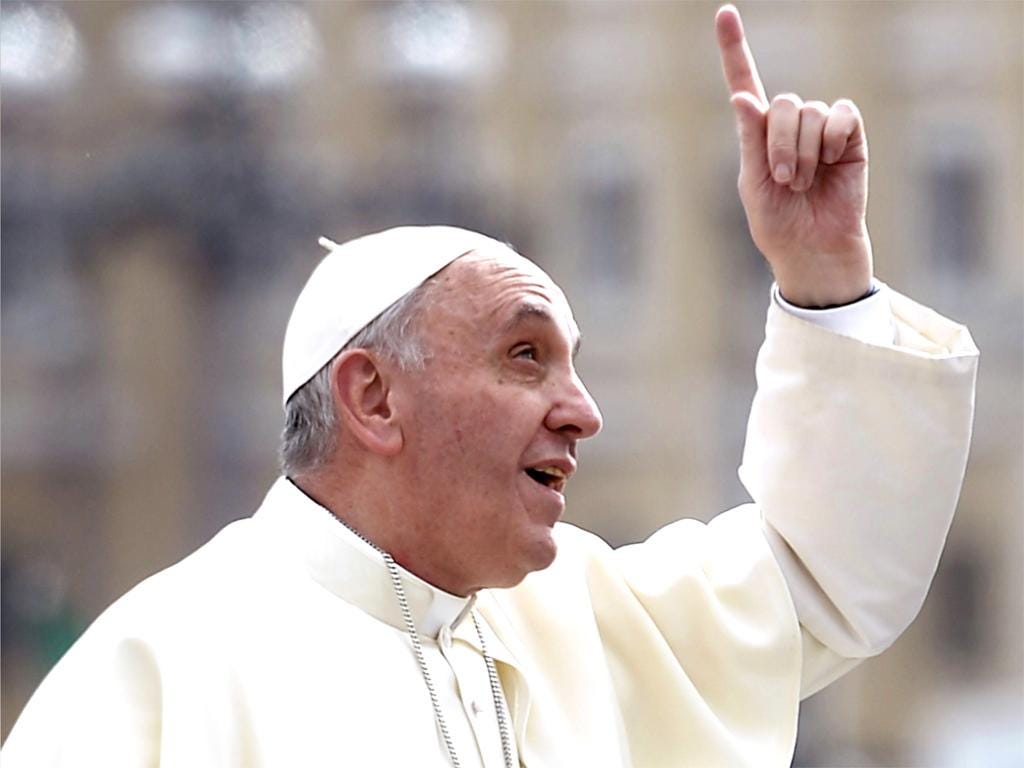
The Church can become an image of the communion and goodness of the Trinity, Pope Francis said Sunday in St. Peter's Square

Through God's mercy the Church can become an image of the communion and goodness of the Trinity, Pope Francis said Sunday in St. Peter's Square.
“The Christian community, though with all its human limitations, can become a reflection of the communion of the Trinity, of its goodness and beauty,” he said Jun 11 during his Angelus address.
“But this – as Paul himself testifies – passes necessarily through the experience of the mercy of God, of his pardon.”
The Pope's address on Trinity Sunday reflected on the “mystery of the identity of God,” which so affected St. Paul.     More

Wednesday, January 11, 2017

Dr. Herold Weiss: "You Can Be a Christian Without Being a Fundamentalist."

As a student at Andrews University at the end of the 1970s, I heard the names Vick, Weiss, and Hilgert mentioned, almost in a whisper, but they had been so effectively airbrushed out of the institutional history that I never learned why they were no longer there. Then Spectrum went online with its blog, and there was Dr. Herold Weiss, first in Spanish, then in English. I began reading his essays and studies in 2008 out of curiosity, and I was immediately fascinated by his ability to drill down to the exegetical bedrock of the biblical texts so that they could speak freely, unconstrained by the fundamentalist mandate that they speak with one voice in support of creed and tradition.

In an essay that I wrote some time back for Spectrum ("Tell Me Why I Should Become a Christian"), I asked the readers if it is possible to come up with a contemporary restatement of Christianity that might resonate with people searching for a meaningful faith, a faith that goes beyond the known facts without requiring you to believe against established facts. Dr. Weiss comes as close to doing that as I think anybody could. Faith to him is a way of living in obedience to the call of God in Christ, not a treasure chest of doctrines.
....

You grew up in a Catholic country, and you spent the greater part of your academic career teaching at Saint Mary’s College, Notre Dame, Indiana. What are the greatest misunderstandings about Catholicism that you encounter among Protestants in general and Adventists in particular?

As a young person in Uruguay and Argentina, I grew up with the notion that we Adventists were firmly established on a moral platform high above what any Catholic could ever attain. Catholics, by definition, were people without morals. Since they lived in open depravity, there was no way they could be saved by God. Besides they were superstitious and idolaters. This was surely due to their dependence on the Catechism, where the day of Rest has been changed, rather than the Bible. Obviously, they were in great need to be redeemed from their sins. This view of Catholics was challenged by my friendship with a fellow student on my second year of secondary school. He had transferred to the public school from the Catholic seminary. Our fellow students decided that he and I should have an open debate for their benefit. Our debate proved my self-confidence and sense of superiority totally wrong.

In the USA, I was somewhat astonished to find out two things: One, that Catholics were the largest single denomination in the country and, two, that Catholic bashing was the most popular sport among Adventists and Evangelicals in general. There is a difference between prejudice and bashing. The prevalence of a conspiracy mentality among Adventists in the USA is a lamentable flaw. Few mental disorders are more pernicious than the conspiracy syndrome. That the Bible’s prophesies support or demand Catholic bashing can only be claimed by those who are controlled by a sick ideology rather than the love of Christ (2 Cor. 5: 14). Unfortunately, it is a recurring phenomenon in Adventist pulpits that are open to television audiences, not only the one occupied by Doug Bachelor but even the one commanded by Dwight Nelson. One does not have to be Catholic to abhor such prejudicial preaching. Obviously, we have forgotten that for some time we were just as good at Turkey bashing.     Spectrum Magazine

Thursday, April 28, 2016

God gave his mother cancer so that he would stop being gay


CancerGodStraight

25 Apr 2016 at 15:52 ET                   
The Church Militant  has posted a new video in which he thanks God for giving his mother stomach cancer and dying so that he would be brought back to the Catholic Church. Michael Voris, president and founder of St. Michael’s Media and producer of the website Church Militant, took to YouTube to reveal details of the sinful life he lived prior to his “reversion” to Catholicism.
He was posting the video now, he said, because there were forces seeking to “publicly discredit me, the apostalate, and my work here.” He says that he had always publicly spoken of his life prior to his reversion as a time in which he was living in “mortal sin.” He just hadn’t thought that “a full public confession of details was necessary.”
Voris is not outing himself as a gay man. He denies being gay. He does say, however, that “..most of my thirties, confused about my own sexuality, I lived a life of live-in relationships with homosexual men.” And he is aware of how that looks. “From the oustide, I lived the lifestyle and contributed to the scandal in addition to the sexual sins. On the inside, I was deeply conflicted about all of it.” He says that in his twenties, he slept with both men and women.
He now abhors all of that behavior, which he says was about “seeking solace in lust and surrendering my masculinity.” While Voris seems confused about the relationship between sexuality and gender, he is positive that it was his mother who became the instrument of God’s grace.
“As a last resort, she prayed to be given whatever suffering so that I would be granted sufficient grace to revert.” And, shortly after her prayers, she received an early diagnosis of stomach cancer, which killed her a few years later. It was while watching his mother suffer through her last year of life that Voris began to change his life, but it was her death that made the miracle happen.
“I pledged at her coffin that I would change. I said, ‘Mom, what you went through for me, you will not have gone through in vain.’ I returned fully and completely to the faith.” Two years later, he says, he founded the apostolate that he is now trying to save.
Voris has more to say, however, about how wonderful it was that his mother got cancer. “I was thrilled, over the top with gratitude, with what God had done for me through my mom and her suffering.”
How evil was Voris prior to his mother’s death? He explains a couple of times that things were so bad that if he had been killed in a car accident at the time of his co-habiting with homosexual men that he would have been damned. In fact, he “shudders” every time he thinks about just how bad he used to be.
“I gave up my self, my masculinity, my self-understanding, my identity and my own dignity as a baptized Catholic.”
Voris isn’t certain that all of his followers are going to understand about his failure to disclose the nature of his previous sins. He offers the by-now standard apology that he wants to apologize to “anyone who was wounded in any way.” But he never intended to deceive anyone. He was just so eager to “experience the joy and life-giving truth of the Catholic Church.”
Voris says that being rescued is proof that God can do all things. He can even “restore your formerly shattered confused sexuality.” Through the grace of the Church, he says, “I was given back my masculinity that I had squandered.” In fact, the Church has rescued people like Paul, Augustine, Francis, and Ignatius. So much so, he says while arguing that he himself is not a saint, that you “could almost say that the Church’s mission is to collect miserable sinners and turn them into saints.”
Voris claims that the threat to expose his past means that he is being targeted by the Diabolical (by which he means Satan). But he remains convinced that he is under the protection of St. Michael and the Virgin Mary, who will always defeat the plans made by the devil to bring men like him down.
Voris also assures those watching that there is little chance that he will engage in sexual sin with homosexual men again. Six years ago, at the Fatima’s shrine, he “consecrated my chastity to our Blessed Mother.”        Rawstory

Wednesday, March 9, 2016

New Workshop Tool Helps Congregations Open Conversation with LGBT Adventists


Covers
From News Release, March 9, 2016:    Can Adventist congregations create safe spaces for positive, healing, informed and authentic conversation on a topic often ignored? A Sanctuary for Conversation: Listening, Loving, and Learning is a three-hour workshop that helps to answer that question. Through this workshop, congregations will be introduced to a model for engaging in conversations that lead to clarity, hope, and healing.
This workshop responds to the Statement on Human Sexuality, from the denomination’s North American Division (NAD). The NAD stated, “The vital and opportune role of the Adventist Church is to educate its members about sexuality and purity within the context of grace.”
A Sanctuary for Conversation also addresses the Call for Peace, from the General Conference (GC). The GC stated, “There needs to be dialogue and discussion in place of diatribe. In particular, Christians should always be ready to ‘reason together,’ as the Bible says.”
The workshop opens with active learning activities and includes interviews with lesbian, gay, bisexual and transgender (LGBT) people and parents of LGBT children. Also, a professional psychologist defines terms and answers questions about orientation and gender. Participants will learn better listening skills, statistics about LGBT youth, the difference between acceptance and agreement, and signs of safe and unsafe churches. At the end of the workshop participants brainstorm practical ways to transform their church into a sanctuary for Jesus and for God’s Holy Spirit.
For more information or to purchase copies of the leader’s guide and workbook, visit OpenDialogueResources.org or email OpenDialogueResources@gmail.com.
A Sanctuary for Conversation has been tested with pastors, youth ministries leaders and local churches. Here is some of the feedback from people who were part of the workshop:
“I have grown because of the time I spent listening to the presentations, discussions, and panel. As a result of this workshop, I have taken away an understanding of how to become a better minister to all.”
“The spirit of loving, humble discussion was filled with opportunities to sense and share God’s Holy Spirit.”
“We asked [those who attended] to become more empathetic, not to change their beliefs.” (a presenter)
“During my 27 years in Adventism, I have never seen such a spirit of humility expressed from the leaders of the church. No one came to prove ‘I’m right, you’re wrong,’ or to ‘school’ someone else on their theology. Instead, we all came to learn, be honest, and work together to improve the lives of our LGBT youth.”
“If you want your church to be a true community that is loving and compassionate, then do this workshop—it will make everyone more aware of their humanity.”     AToday

Tuesday, February 23, 2016

The Pope's Wall And Immigration

Published on Feb 20, 2016
The Pope made news recently when he claimed someone interested in a security wall, could not be a Christian, apparently forgetting that the Pope in the 9th Century did precisely that, and his wall was even expanded and fortified in the 12th century. Catholic "Spin doctors" have hit the internet declaring the comparison invalid (because anyone can "buy tickets" to get in). The comparison was much more valid than anyone on TV would ever dare admit in public, not because of the Vatican's wall, but because of what goes on inside them. Anyone who would like to use the Pope as political leverage to get a vote, should have to be confronted with and face, what goes on inside those Vatican walls.(That is a threat to American sovereignty)

Saturday, February 6, 2016

The Vatican is this morning facing a further crisis after routine DNA tests revealed that the communion wafers used in Sunday mass contain 0% of the body and blood of Christ.

Communion wafer DNA test
The Vatican is this morning facing a further crisis after routine DNA tests revealed that the communion wafers used in Sunday mass contain 0% of the body and blood of Christ.
The findings are sure to pile further pressure on the ailing religious organisation, just days after their Chief Executive resigned citing ‘personal reasons’ and ‘being a bit old’.
The news will concern billions of Catholic consumers, previously led to believe they were consuming Christ himself each Sunday morning during mass.
Catholic Simon Williams told us, “So what have I been eating all these years? It’s not horse again is it?”
“It’s always had a funny taste that I couldn’t quite place. But having been a choir boy in the catholic church I grew up being told by priests that putting strange things in my mouth was the done thing.”
“That said, with the amount of cash I’m encouraged to put in the collection plate on a Sunday morning I can’t believe they’re scrimping on the ingredients.”
“You’ll be telling me next that the stuff they dip the wafer in isn’t actually blood.”

Catholic crisis

A spokesperson for the Vatican explained that the DNA test results merely highlight the incompatibility of science and religion.
They told us, “Where is your faith that the wafer is the body of Christ? Science can’t tell you everything, and just as it can’t prove God doesn’t exist, it can’t prove the wafer ISN’T the body of Christ.”
“Oh, it has done exactly that? Right. Well.  There’s probably something in the Bible about that. I’ll have to go and look.”         NewsThump

Saturday, January 23, 2016

The mesmerizing gospel of the celebrity pastors


Hoda Kotb and Kathie Lee Gifford interview 'Rich in Faith' stars Rich and DawnChere Wilkerson.
Over the past few years I have noticed a disturbing trend with so-called "celebrity pastors" – the trend actually isn't related to them, but rather the hatred that is thrown towards them on a regular basis.
Whether it's Billy Graham, Joel Osteen, Carl Lentz, or Rich Wilkerson Jr., there always seem to be certain pastors that garner more attention and notoriety than others. While I don't agree whole heartedly with each of these pastors' doctrine, preaching style or opinions, I do think that they each of them have the capability to bring people to Christ. 
Additionally, I do not believe that they deserve to be demonized simply because they have been labeled as popular, cool, modern, hip or famous. Instead, I believe they deserve our support, because they are reaching people that no one else can.
People like to condemn these pastors and others like them for their celebrity status when in reality being a celebrity isn't exactly something you can control. It isn't like they all woke up one day and said, "I think I'll become a famous celebrity pastor." Becoming famous should never be the goal of a pastor, but if it occurs while trying to reach people that generally means you will reach even more people.
I believe that many people who are against these kinds of pastors fail to realize that Jesus also dealt with an unwanted celebrity status as he traveled to preach the Good News (Mark 1:28).
While Jesus didn't desire fame or notoriety, He didn't reject the crowds. Instead, He used it as an opportunity to reach more people. He often preached where crowds of thousands would gather (Luke 12:1, John 6:2).     More..

Note:
Are these celebrity preachers presenting the real Jesus of the bible that loves the sinner but hates sin, that  is an equal entity of grace measure to an equal entity of justice,  that walked 2000 years ago on this planet, that rejected tradition and put the word of God above any tradition, that would touch the leper, or just another Jesus? An experiential Jesus? A Jesus based on feelings and not on the word of God? A Jesus based on emotions and not on principles? Martin Luther said regarding the Jews: “if they could reject the one that healed the sick, that comforted the broken hearted, that raised the dead, what kind of God must they have; I hate to know what kind of God they had.” Are we going to do the same? Are we going to fail to recognize the real Jesus of the bible just as the Jews did and nail the Lord to the cross and reject his mercy and truth?  We need a heart felt religion. We need a real experience with the Lord, not a plastic one. 

2 Corinthians 11:4 says: For if he that cometh preacheth another Jesus, whom we have not preached, or if ye receive another spirit, which ye have not received, or another gospel, which ye have not accepted, ye might well bear with him.

Tuesday, December 29, 2015

Pope Francis: Atheists And Homosexuals Welcome In Heaven


Pope Francis gestures upon his arrival in St Peter's square

Pope Francis’ progressive attitude toward non-Catholics and non-believers has shocked many followers of God since he took on the papal position. His inane desire to accept everyone for who they are, and not reject them for the label they carry, has drawn attention toward him in both positive and negative lights. He has openly declared that Catholic individuals who partake in a homosexual lifestyle are welcome in heaven and should be treated no different than their heterosexual counterparts. Now, in an announcement that has surprised many in the Catholic community, Pope Francis has declared that even Atheists are welcome into heaven, regardless of their non belief in god or religion as a whole.
Founder of La Repubblica, Eugenio Scalfari, wrote an article for his newspaper, openly asking Pope Francis whether the Christian God would openly accept a non-believer into his heaven, according to the Independent. Rather than ignore the article written from the non-Roman Catholic newspaper founder, Pope Francis chose to respond with an open letter to the paper and its founder, explaining what he believes God would say if asked the same question.
Rather than respond defensively, Pope Francis chose to keep his tone friendly and open for further discussion, claiming that those that do not believe in God are simply ignoring their conscience and that disbelief in something does not discount its existence.
“You ask me if the God of the Christians forgives those who don’t believe and who don’t seek the faith. I start by saying – and this is the fundamental thing – that God’s mercy has no limits if you go to him with a sincere and contrite heart. The issue for those who do not believe in God is to obey their conscience.”
Pope Francis continued by stating that sin exists in all beliefs.
“Sin, even for those who have no faith, exists when people disobey their conscience.”
Bustle summed up Pope Francis’ comments and stated that the existence of God is not a matter of belief or disbelief, but a matter of following one’s conscience.
“[Y]ou should at least follow your heart, if you’re not going to become Catholic, and that God will be cool with that.”
In other words, it seems as though Pope Francis is saying that one’s faith, or lack thereof, should not be the basis on which an individual is judged. Instead, his or her moral character, behaviors, and attitudes toward others, should be how an individual is judged. However, Pope Francis’ comments are not limited to religion alone, but also spread into an individual’s lifestyle.
Scalfari noted that Pope Francis’ comments further advance his position to unite everyone and open the world to real conversations that will hopefully lead to love and acceptance of all fellow men and women.
“… further evidence of his ability and desire to overcome barriers in dialogue with all…”
The dialogue Scalfari references goes back to July when Pope Francis openly accepted homosexuals into the Catholic church, advising that God loves and accepts them in the same manner as one with a devout heterosexual faith.
“If someone is gay and is looking for the Lord, who am I to judge him?”
His new remarks lend one to believe that it doesn’t matter whether an individual is a devout Catholic, homosexual, atheist, a member of ISIS, or any other living man or woman on the Earth. In the end, it all comes down to following one’s conscience. If God opens the doors of heaven to everyone, their earthly belief does not matter, he will still welcome them into his home.

Pope Francis has created an upheaval of the Catholic church since taking on the moniker. However, his openness to acceptance has opened dialogue that previously was suppressed. What are your thoughts on the Pope and his comments?     Inquisitor

Note: The only thing the pope forgot to mention was true repentance. Yes, God loves the sinner but hates sin. We can not live contemplating sin once God's grace has reached us. We need to come closer to God, let go self and begin to have a real experience with Him. But go ye and learn what that meaneth, I will have mercy, and not sacrifice: for I am not come to call the righteous, but sinners to repentance.   Matthew 9:13  KJV
By the way, the word "repentance" is missing in the new bible translations. 

Tuesday, December 22, 2015

7 evangelical Christians jailed for refusing to convert not to Islam but to Catholicism in Mexico

Seven evangelical Christians are facing a different kind of persecution—this time not by Islamic radicals but, surprisingly, by fellow Christ-believing Catholics.
In a report carried by Charisma News, the International Christian Concern (ICC) said it has learned that the seven evangelical Christians were sent to jail in Chiapas, Mexico, on Dec. 15 after they refused to convert to Catholicism.
ICC said Mexican state and federal authorities had been informed of threats to illegally expel or send to prison members of the evangelical community in the area, but they refused to intervene.
The evangelicals earlier received an ultimatum to convert to Catholicism or face expulsion and imprisonment by local officials of the place where they reside—in Leyva Velazques, a municipality of Las Margaritas, Chiapas.
Roman Catholicism is the predominant religion in Mexico where 82.7 percent of the people adhere to the faith, based on a census conducted in 2010. However, Mexico's Constitution explicitly protects the right of all citizens to profess and practice the religious belief of their choice.
Reports said the Catholics' ultimatum forced eight families in the village to sign documents indicating their willingness to convert to Catholicism.
But seven of their fellow evangelicals refused to sign the document and were sent to jail, according to Luis Herrera, Director of the Coordination of Christian Council of Churches.
Other evangelical Christians in the community are continually being pressured to renounce their faith by local officials of Leyva Velazques, according to ICC.
The Christian group said this incident shows the growing trend of religious persecution in rural areas of Mexico under the noses of state and federal government officials who refuse to do anything to protect religious minorities.
In June, ICC reported more than 70 cases of religious persecution against minority Christian communities in the states of Chiapas, Hidalgo, Oaxaca, Puebla and Guerrero. Each case involved 20 to 100 victims.
Isaac Six, ICC's Advocacy Director, has appealed to the Mexican government to stop the persecution of Christian minorities in the country's rural areas.
It is simply unconscionable for the state and federal governments of Mexico to repeatedly ignore the arbitrary arrest and expulsion of their own citizens by local governments on the basis of religious belief," he said.
"Today, hundreds of men, women, and children are homeless in Mexico because they chose to follow their beliefs, and because their government refused to act. We call on the federal government of Mexico to immediately intervene and halt the unlawful detention of members of the evangelical community in Leyva Velazques," Six said.    CT

Friday, December 18, 2015

Evangelical College Suspends Professor For Showing Solidarity With Muslims

Wheaton College, an Evangelical school outside of Chicago, has been roiled by questions about Christianity's posture toward Islam and academic freedom at religious schools. An associate professor who vowed recently to wear a headscarf in solidarity with Muslims was suspended from her job this week. The college says it's not because of the headscarf, but because of theological questions raised by a Facebook post in which she cited Pope Francis's recent statement that Muslims and Christians worship the same God.   NPR

Monday, December 14, 2015

Jews are saved even without believing in Christ, Vatican claims

Pope Francis (R)
By Stoyan Zaimov , Christian Post Reporter
December 11, 2015|8:24 am 
The Vatican's Commission for Religious Relations with Jews has released a major new document claiming that Jews are saved even without believing in Jesus Christ.
The theological document, titled "The Gifts and Calling of God are irrevocable," was presented by a group of Catholic and Jewish leaders during a press conference at the Vatican on Thursday.
"That the Jews are participants in God's salvation is theologically unquestionable, but how that can be possible without confessing Christ explicitly, is and remains an unfathomable divine mystery," the document argues, in part.
 The theologians, including Cardinal Kurt Koch and Fr. Norbert Hofmann of the Vatican Commission, reflect on that "mystery," but note that Catholic doctrine rejects that there can be more than one path to God.
"Since God has never revoked his covenant with his people Israel, there cannot be different paths or approaches to God's salvation," they add.
"The theory that there may be two different paths to salvation, the Jewish path without Christ and the path with the Christ, whom Christians believe is Jesus of Nazareth, would in fact endanger the foundations of Christian faith."
The document further talks of a "highly complex theological question" in how "Christian belief in the universal salvific significance of Jesus Christ can be combined in a coherent way with the equally clear statement of faith in the never-revoked covenant of God with Israel."
The Vatican also says that conversion outreach efforts by Christians toward Jewish people are a "very delicate and sensitive matter."
It says that it "neither conducts nor supports any specific institutional mission work directed toward Jews," but at the same time notes that Christians are "called to bear witness to their faith in Jesus Christ also to Jews."
The text concludes by stating that Jews and Christians come together through "humanitarian aid for justice and peace in the world" in which they "bear witness to the loving care of God."
"No longer in confrontational opposition but cooperating side by side, Jews and Christians should seek to strive for a better world," it states, adding the words of Pope John Paul II from November 1980, when the pontiff said that Jews and Christians must commit themselves together for peace for all people, "with the fullness and depth that God Himself intended us to have, and with the readiness for sacrifices that this goal may demand."
Israeli news site Arutz Sheva said that Catholic-Jewish relations have been improved under Pope Francis, who once jointly published a book on ethics, morality and faith with his long-standing friend and Argentinian Rabbi Abraham Skorka.
Francis is also to become the third pope in history to visit Rome's main synagogue on Jan. 17, 2016.
Back in September, Francis greeted the Jewish community around the world on Yom Kippur, the Day of Atonement on the Hebrew calendar.
"I would like to send my greetings to the Hebrew community, to our Jewish brothers, for whom today is a sacred day, Yom Kippur," Francis said during a visit to Washington D.C. "I hope the Lord brings down his blessing of peace and will keep in life and holiness, according to the Word of the Lord we have heard today: Be Holy, for I am Holy," he added.   CP

Note:  Praise God for the Reformation!!!  Luis

Thursday, December 3, 2015

The preaching of the cross: the power of God or God's failure?


ROME REPORTS in English ROME REPORTS   "I am going to tell you something private. In my pocket I always carry two things: a rosary to pray something which seems odd, this is here is the history of God’s failure, it’s the way of the cross, a small way of the cross, as Jesus suffered and when they condemned him right up to where he was buried with these two things I do the best I can. And thanks to these two things, I never lose hope.”


Note:   For the preaching of the cross is to them that perish foolishness; but unto us which are saved it is the power of God. 1 Corinthians 1:18

But now is Christ risen from the dead, and become the first fruits of them that slept.    For since by man came death, by man came also the resurrection of the dead.    For as in Adam all die, even so in Christ shall all be made alive.    But every man in his own order: Christ the first fruits; afterward they that are Christ's at his coming.    1 Corinthians 20-23  

Jesus did not fail at the cross,  Jesus is no longer on the cross,  Jesus is no longer in the grave,  Jesus is coming in power and glory to raise all who are His.   Scripture says the cross is not a failure but the power of God!