Showing posts with label Farming. Show all posts
Showing posts with label Farming. Show all posts
Monday, November 30, 2020


Wednesday, September 30, 2020
10 million acres of corn, soybeans flattened; farmers 'have never seen anything like this
Desmoines August, 2020
In less than an hour, the nearly 2,000 acres of corn and soybeans that Corey Hillebo and his family farm near Slater were flattened.
"Nothing in the path of the storm was unscathed," said Hillebo, who lives near where Monday's derecho, packing hurricane-force winds, left Heartland Cooperative's massive grain storage bins twisted and crumpled.
"You drive around, there's nothing that's not leaning or flat," he said.
Across Iowa, the storm hit about 10 million acres of crops, Gov. Kim Reynolds said Tuesday during a news conference. The Iowa Department of Agriculture said the storm affected roughly a third of the state, which grows about 32 million acres of corn, soybeans and other crops.
Reynolds said farmers have told her the damage "has just been devastating ... they have never seen anything like this."
The storm, with straight-line winds nearing 100 mph, pummeled homes, farms and businesses across dozens of counties in central Iowa. In addition to crops, it destroyed grain bins, machine sheds, barns and livestock buildings.
Friday, July 31, 2020
Tuesday, January 21, 2020
What You Need to Know About Gene-Edited Farm Animals

Organic Consumer January 8, 2020
For
decades, the biotech industry has spun a narrative around genetically
engineered crops that could be summed up very simply as “jam tomorrow,
instead of bread and butter today.”
Sustained—and financed—largely on the promise of spectacular success at some unidentified point in the future,
the research and development of new types of GMO foods, made with a
whole host of new genetic engineering technologies, has gathered pace in
recent years.
These
days, without most people being aware of it, genetic engineering is
spreading from the crops in the field to the animals in the barn.
Using new genome editing (sometimes referred to as “gene editing”) techniques like CRISPR, biotech
breeders are proposing to breed a brave new world of farm animals that
don’t get sick, don’t feel pain and produce more meat, milk and eggs at a
lower cost than ever before.
Not
many NGOs are currently working on this issue and it can be hard to
find good information to help make sense of it all. But two recent
reports provide in-depth information on the mechanics as well as the
ethical issues around gene-edited farm animals.
One, from Friends of the Earth, entitled “Genetically Engineered Animals: From Lab to Factory Farm,”
is an extensively referenced report that provides key background
information and highlights the urgent need for safety assessments of
genome-edited animals.
The other, “Gene-edited Animals in Agriculture,”
is a report from a day-long roundtable in June 2019, co-hosted by my
organization, Beyond GM, and Compassion in World Farming in the UK. The
roundtable involved individuals representing a wide range of
perspectives. What emerged was a fascinating glimpse into not only the
technology, but also the ethics and values systems that underpin that
technology.
If
you are new to the subject of genetically engineering farm animals for
food, if it concerns you or if you just want to know more in order to be
an informed consumer, these two reports provide an important starting
point
Friday, May 31, 2019
The worst agricultural downturn since the 1980s is taking its toll on the emotional well-being of American farmers.
Bloomberg March 20, 2019
The worst agricultural downturn since the 1980s is taking its toll on the emotional well-being of American farmers.
In
Kentucky, Montana and Florida, operators at Farm Aid’s hotline have
seen a doubling of contacts for everything from financial counseling to
crisis assistance. In Wisconsin, Dale Meyer has started holding monthly
forums in the basement of his Loganville church following the suicide of
a fellow parishioner, a farmer who’d fallen on hard times. In
Minnesota, rural counselor Ted Matthews says he’s getting more and more
calls.
“Can you imagine doing your job and having your boss say
‘well you know things are bad this year, so not only are we not going to
pay you, but you owe us’,” Matthews said by telephone. “That’s what’s
happened with farmers.’’
Glutted grain markets have sparked a years-long price slump made worse
by a trade war with top buyer China. As their revenues decline, farmers
have piled on record debt -- to the tune of $427 billion. The industry’s
debt-to-income ratio is the highest since the mid 1980s, when Willie
Nelson, Neil Young and John Mellencamp organized the first Farm Aid concert.
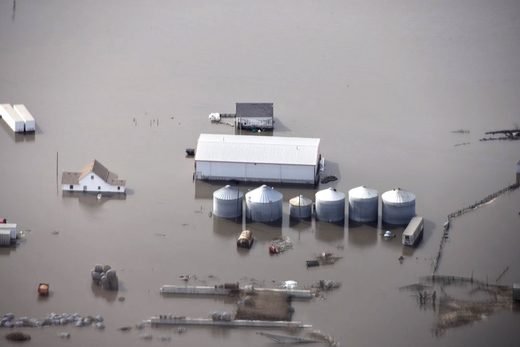
Crop Catastrophe In The Midwest
TECB. May 26, 2019
The last 12 months have been the wettest in all of U.S. history,
and this has created absolutely horrific conditions for U.S. farmers.
Thanks to endless rain and historic flooding that has stretched on for
months, many farmers have not been able to plant crops at all, and a lot
of the crops that have actually been planted are deeply struggling.
What this means is that U.S. agricultural production is going to be way,
way down this year. The numbers that I am about to share with you are
deeply alarming, and they should serve as a wake up call for all of us.
The food that each one of us eats every day is produced by our farmers,
and right now our farmers are truly facing a nightmare scenario.
You can view the latest USDA crop progress report right here. According to that report, corn and soybean production is way behind expectations.
Last year, 78 percent of all corn acreage had been planted by now. This year, that number is sitting at just 49 percent.
And the percentage of corn that has emerged from the ground is at a
paltry 19 percent compared to 47 percent at this time last year.
We see similar numbers when we look at soybeans.
Last year, 53 percent of all soybean acreage had been planted by now. This year, that number has fallen to 19 percent.
And the percentage of soybeans that have emerged from the ground is
just 5 percent compared to 24 percent at this time last year.
In other words, we are going to have a whole lot less corn and soybeans this year.
Farmers in the middle of the country desperately need conditions to
dry out for an extended period of time, but so far that has not
happened.
In fact, last week the heartland was hit by yet another string of devastating storms. The following comes from CNN…
Ten people are dead and a 4 year-old boy remains missing after more than a week of severe weather across the central US that put tens of millions of people at risk.
The deadly spring storm system ravaged several states, unleashing more than 170 reported tornadoes, fierce winds, drenching rain, flash flooding and hail.
One of the tornadoes that was spawned absolutely devastated the
capital city of Missouri. It was reportedly a mile wide, and it stayed
on the ground for almost 20 miles…
A clearer picture emerged Friday of the size and scope of the powerful tornadoes that tore across Missouri on Wednesday night, leaving a trail of destruction in their paths. The state’s capital, Jefferson City, was among the hardest-hit places, struck overnight by a tornado with a peak wind speed of 160 mph that has been given preliminary rating of EF3.
The monstrous nighttime tornado that struck Jefferson City, a city with a population of about 42,000, was almost a mile wide and was on the ground for nearly 20 miles, toppling homes, ripping roofs off homes and business below.
What we are witnessing is definitely not “normal”, and I have had a
number of readers write to me about this recently. The other day one of
my readers in Montana sent me a photograph of a freak May snowstorm
that had just hit his area, and another one of my readers in Missouri
explained that his boss is freaking out because they haven’t been able
to get soybeans in the ground. All over the country people want
answers, and they are frustrated with the lack of information that they
are getting from the mainstream media.
Unfortunately, the truth is that things are going to get worse.
Global weather patterns are dramatically shifting, and there is nothing
that the authorities will be able to do to stop it from happening.
Subscribe to:
Posts (Atom)