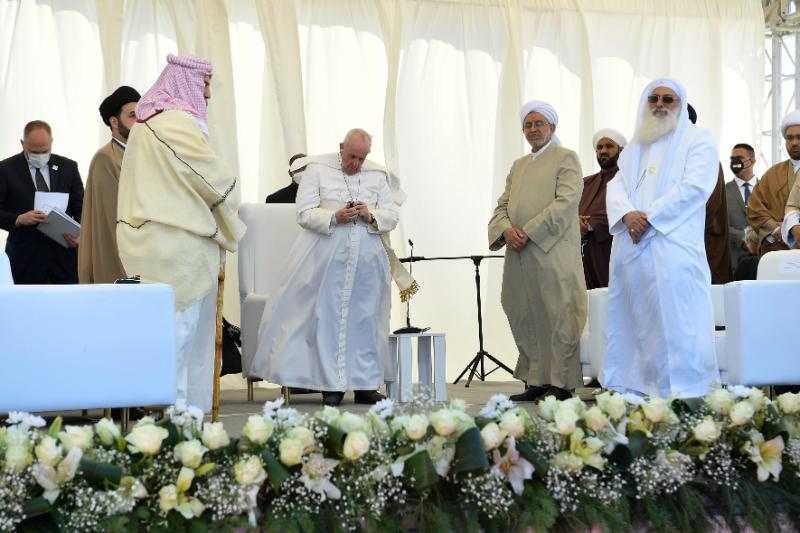
VATICAN CITY (RNS) — Speaking on Saturday (March 6) before the
monumental remains of Ur, the once-great city where Muslims, Jews and
Christians believe their common spiritual forefather Abraham first heard
the voice of God, Pope Francis condemned religious hatred and mapped a
path to peaceful coexistence among different faiths.
“Hostility, extremism and violence are not born of a religious heart;
they are betrayals of religion,” the pope told a crowd of roughly 100
leaders of the three faiths gathered near the historic site on his
second day in Iraq. “We believers cannot be silent when terrorism abuses
religion; indeed, we are called unambiguously to dispel all
misunderstandings.
“Let us not allow the light of heaven to be overshadowed by the clouds of hatred!” he added.
The pope’s visit to Ur has been a much anticipated moment in his
three-day apostolic visit to Iraq, the first by any pope. The day marked
other papal firsts, including the first-ever encounter between a Roman
pontiff and a Shiite religious leader and the first Chaldean Mass
celebrated by a Roman Catholic pope.
VATICAN CITY -- Two
authoritative religious bodies on Thursday called on Christians to band
together to fight “sins” laid bare or aggravated by the pandemic,
including racism and economic injustice.
The Vatican and the World
Council of Churches, which is based in Switzerland, issued a joint
document noting that the COVID-19 outbreak has drawn attention to "the
scandalous gap between the rich and the poor.” The document declared
that Christians are compelled to work to heal inequalities, including
between men and women.
Christians
must “own up to our own complicity and guilt in many systems of
oppression” and resist the “temptation” to blame the poor for their
poverty, it said.
The inter-religious appeal encourages reflection
during the pandemic about the “scourge of religious intolerance,
discrimination, racism, economic and ecological injustice and many other
sins.”
Preparing the document for the Vatican was the Pontifical Council for Inter-religious Dialogue. The effort reflects Pope Francis'
push for Christians to stress their common values in working to combat
environmental degradation and to help those on life's margins, such as
migrants.
The World Council of Churches brings together churches,
denominations and church fellowships in more than 110 countries and
territories, representing more than a half-billion Christians.
The
document cites the New Testament parable of the Good Samaritan as
inspiration to “overcome religious prejudice and cultural biases in
relation both to those whom we serve, and to those with whom we serve,
as we strive to alleviate suffering and to restore healing and wholeness
in a pluralistic world.”
Citing the gap between rich and poor,
the appeal said the pandemic has “exacerbated racial prejudices and led
to increased violence against those who have for long been considered a
threat to the dominant body politic that is structured and sustained” by
systems of inequality, discrimination and domination. The document
named no country, society or political system.
Now is the “time
for discovering new forms of solidarity for rethinking the post-COVID-19
world,” the document said. Religions, it said, can contribute to
reawakening and guiding humanity “in building a new social order at the
local, regional, national and international levels.”
That vision
can draw on “a heritage of moral values common to all human beings.”
And, the document's authors contended, such a reawakening would benefit
from young people, “whose idealism and energy can be an antidote to the
temptation of cynicism, in the endeavor to heal the wounded world of
which we are part.”
World Council of Churches general secretary Rev. Dr
Olav Fykse Tveit invites all member churches for a joint prayer, saying
the Lord’s Prayer together on Wednesday 25 March at noon.
Pope Francis has extended an invitation to all
Christian leaders, including the World Council of Churches (WCC), to
join in praying the Lord’s Prayer simultaneously on 25 March at noon
Rome time, or noon local time at any location across the world.
In a letter of invitation, Cardinal Kurt Koch expressed
his hope that all will join “this initiative in which all Christians
invoking together the graces from heaven, will ask for the end of this
pandemic, trusting in the power of God.”
WCC general secretary Rev. Dr Olav Fykse Tveit welcomed
the invitation and the opportunity for so many people to participate in
a united prayer for all of humanity as the world faces the pandemic of
COVID-19.
“As people across the globe are in their scattered
working places at home, we will have the opportunity to unite our voices
in praying to God with the words that our Lord Jesus Christ taught us”
said Tveit. “At this challenging time, prayerful activities that unite
us are a reminder that we are one human family.”
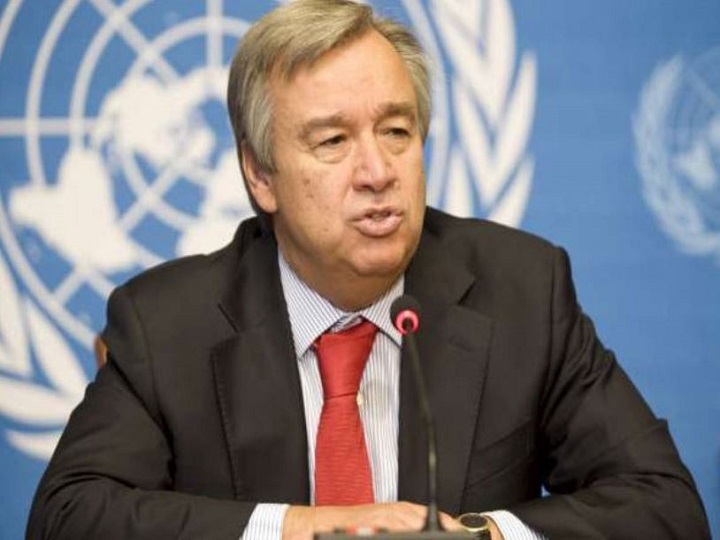
United Nations: UN Secretary-General Antonio Guterres
has made an emotional plea to put all "armed conflicts on lockdown and
focus together on the true fight of our lives" against coronavirus.
Calling
for a "global ceasefire," he said at a news conference on Monday, "The
fury of the virus illustrates the folly of war. That is why today, I am
calling for an immediate global ceasefire in all corners of the world."
He
was overcome by emotions as he started to speak and broke off and
gathered himself to start again to speak to a world where conflicts rage
even as it is engulfed by coronavirus.
In
keeping with the UN headquarters directives and New York City
regulations against gatherings, Guterres held the news conference via
interactive teleconferencing.
Guterres also appealed for a coordinated international response to the coronavirus pandemic.
"We
need a much stronger coordination, coordination in suppression of the
disease, coordination in making sure that not only the developed
countries can respond effectively to the disease but that there is
massive support to the developing world not to let the disease spread
like wildfire in the developing world," he said.
The annual Conference of Secretaries of Christian
World Communions (CS/CWC) took place from 8–10 October 2019 in
Christiansfeld, Denmark. The meeting was hosted by the Moravian Church
Unity Worldwide Board, represented by Reverend Dr Jørgen Bøytler. The
Catholic Church was represented by Bishop Brian Farrell, Secretary of
the Pontifical Council for Promoting Christian Unity.
The CS/CWC was established in 1957, bringing together general
secretaries from diverse Christian communions as well as representatives
of some global ecumenical organisations. The Conference is a fraternal
forum of Church leaders aiming at exchange of information on important
events in their particular Communions as well as giving an update on the
bilateral and multilateral dialogues in which their Communions are
involved. The Conference does not pass resolutions and does not issue an
official communiqué. Meeting without interruption for over sixty years,
the Conference has significantly contributed to build trust and
partnership among the Church leaders and between their respective
traditions, and to foster the coherence of the ecumenical movement
worldwide. The Conference is currently chaired by Reverend Dr Martin
Junge, General Secretary of the Lutheran World Federation, who is
seconded by the secretary, Dr Ganoune Diop, Director of Public Affairs
and Religious Liberty for the worldwide Seventh–day Adventist Church.
Reports from the following Communions were received during this
year’s Conference: the Armenian Apostolic Church (on behalf of the
Oriental Orthodox Churches), the Anglican Communion, the Disciples
Ecumenical Consultative Council, the Ecumenical Patriarchate (Orthodox
Church of Constantinople), the Friends World Committee for Consultation,
the General Conference of Seventh–day Adventists, Global
Pentecostalism, the International Old Catholic Bishops’ Conference
(Union of Utrecht), the Lutheran World Federation, the Mennonite World
Conference, the Moravian Church Worldwide Unity Board, the Organisation
of African Instituted Churches, the Pontifical Council for Promoting
Christian Unity (Roman Catholic Church), the Salvation Army, the World
Convention of Churches of Christ, the World Communion of Reformed
Churches, the World Methodist Council, the World Evangelical Alliance,
and two ecumenical bodies: the World Council of Churches and the Global
Christian Forum.
Participation in the opening prayer service led according to the
Moravian tradition and in a traditional Moravian Lovefast, as well as
the visit to the historic Moravian Settlement in Christiansfeld (UNESCO
World Heritage), offered the participants an opportunity to gain more
familiarity with this Church.
‘I think constantly of these suffering souls and I pray that the fires
of war will finally die down … I shall never tire of repeating this:
peace is possible’
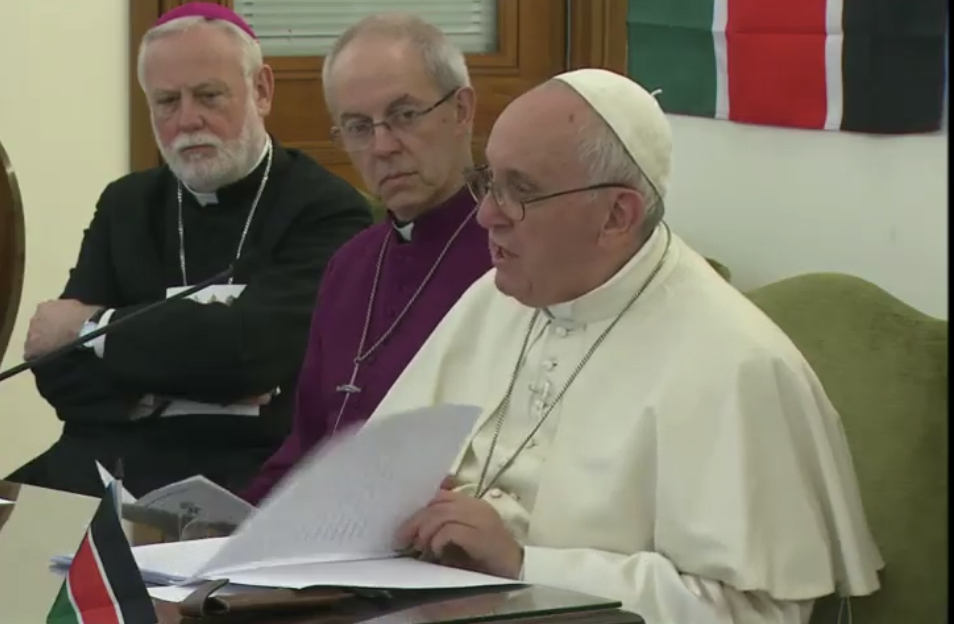
Pope Francis addressed top South Sudanese civil and church
authorities today, April 11, urging them to overcome what divides them,
reminding that peace is possible and expressing his desire to visit the
country.
His remarks came at the end of their two-day spiritual retreat in the
Vatican, proposed and organized by Archbishop of Canterbury, Justin
Welby, which brought together those who will lead as president and
vice-president of the country following a peace accord signed last
September, and Church representatives, both Catholic and Protestant
leaders.
In his address, Pope Francis stressed: “I urge you, then, to seek
what unites you, beginning with the fact that you belong to one and the
same people, and to overcome all that divides you.”
“People are wearied, exhausted by past conflicts: remember that with
war, all is lost! Your people today are yearning for a better future,
which can only come about through reconciliation and peace.”
The Pope has on various conditions expressed his desire to visit the
civil-war struck nation, along with Archbishop of Canterbury, Justin
Welby, who presented the proposal to organize this retreat and has led
it.
The Christian Conference of Asia gathered over 100
participants representing seven religions including Christian, Buddhist,
Islamic, Jewish, Bahai, Hindu and Sikh to meet with the participants of
the World Council of Churches (WCC) Pilgrimage of Justice and Peace
Reference Group to discuss relevant issues about religion and their
implications to the Asian society.
“Continuous interfaith dialogue is key to better mutual
understanding, tolerance and respect and long term-peace and stability”
said Dr Mathews George Chunakara, representing Christianity, general
secretary of the Christian Conference of Asia, at the Inter-Religious
Fellowship and Dinner Reception in Chiang Mai, Thailand, on 4 March. “In
several situations in Asia, although the churches and Christians are
small in number, and the Christians are small in number, and the
Christians are only a microscopic minority, they are directly involved
in peace building in various ways. They are upholding the dignity and
rights of people and communities irrespective of their religious and
faith identities. Peacefulness is a common denominator of all major
religions”.
Vatican City – Pope Francis spoke Friday to participants
in the Plenary Assembly of the Pontifical Council for Christian Unity,
whose theme was “Pentecostals, Charismatics, and Evangelicals: Impact on
the Concept of Unity”. In his address, the pontiff called for
overcoming mistrust and prejudices that exist between the Catholic
Church and other Christian movements.
For him, “The constant growth of these new expressions of Christian
life is a very significant phenomenon, which cannot be overlooked. [. .
.] First of all, we have the duty to discern and recognize the presence
of the Holy Spirit in these communities, trying to construct bonds of
authentic fraternity with them. This will be possible by multiplying the
opportunities for meeting and overcoming mutual distrust, motivated
many times by ignorance or lack of understanding. And I would like to
offer you a personal experience and declare a mea culpa. When I
was provincial [superior], I had forbidden Jesuits to enter into
relationships with these people - with the Catholic Renewal - and I said
that more than a prayer meeting it seemed like a “samba school”! Then I
apologized, and as a bishop I had a good relationship with them, with
Mass in the cathedral ... But it takes a journey to understand.
America Magazine June 21, 2018 “The
Lord asks us for unity; our world, torn apart by all too many divisions
that affect the most vulnerable, begs for unity,” Pope Francis told top
representatives of the World Council of Churches during a prayer
service at its headquarters in Geneva soon after his arrival on June 21.
This
push for unity was the leitmotif of his visit for the 70th anniversary
of the founding of the largest ecumenical movement in the world that
today represents 348 churches and 560 million Christians from 110
countries. The Catholic Church works with the council in several ways,
though not yet as a full member.
On the plane from Rome to Geneva,
Francis told reporters that this “was a journey to unity” and “a desire
for unity.” On arrival in this country of eight million people, Francis
was given a particularly warm welcome by the president of the Swiss
Federation and those gathered for a prayer service with which he began
his visit.
Rev. Samuel Rodriguez and Rev. Johnnie Moore are teaming up to form
The Congress of Christian Leaders in hopes of fostering unity in the
Body of Christ.
But don't let the word Congress confuse you. The men say the group is non-partisan and interdenominational.
"The CCL is the embodiment of our conviction that we are more
powerful when we stand together for righteousness and justice,"
Rodriguez explained.
A lot of attention has been focused on St. Francis of Assisi after
Cardinal Bergoglio took the name of Francis upon his election as Pope.
As well we should, because St Francis taught his followers to share the
Gospel more by what they do than what they say.
But this week, on
April 8, we mark the life of another Francis who, it is believed, is
also a role model for the new Pope. On that date in 1541, Francis Xavier
began his extraordinary missionary journey to the East. Over the next
10 years, he traveled through 50 kingdoms and baptized over 1,000,000
people. He founded churches from India to Japan, earning the title
"Apostle to the Indies."
Beyond his importance as an Asian
missionary, Francis Xavier pioneered a return of Christian missions to
its gospel roots. The medieval model of missions called for conquest and
forced conversion, as exemplified by the Spanish conquests and failed
conversations in the New World. Francis Xavier showed that heartfelt
conversion won by the love of God was not only more scriptural, it was
more effective. In that sense he is the father of all modern Christian
missions.
Francis Xavier lived in an age of upheaval, when
Europeans had begun challenging the pagan kingdoms of the East for
commerce and, later, military supremacy. The European traders were
interested in gold, not God, but they undermined the power of the pagan
kings and the pagan gods they claimed to represent. The traders also
curtailed the power of the Islamic merchants and stopped the Islamic
expansion into the Far East. As a result, societies which had been
closed to Christianity became more open, and Christian missionaries were
able to present the Gospel. For Francis Xavier, a million baptisms
followed.
These European powers eventually spread their empires
throughout the world, replacing pagan kingdoms in the Americas, Africa
and Asia. While these nations were seldom, if ever, interested in
spreading Christianity, many missionaries followed in the footsteps of
Francis Xavier and brought God's love to the colonized peoples. Today
there are thriving Christian communities in the Americas, Africa and
Asia because of these missionary efforts.
Also, today, we find that it is Europe which has abandoned its
Christian roots and fallen into darkness. So it seems somehow to be
fitting that the new pope taking the name Francis would come from a
place which was Christianized by missionaries like Francis Xavier and
would now return to Europe to preach a new evangelism to the lost
Europeans.
We pray for Pope Francis, a man of the Spirit and a
uniter of Christians, that he will help lead the whole church to
challenge the European societies and open them to the gospel as the
Europeans did to the pagan world 500 years ago.
We pray also for
the unity of the church and a spiritual awakening of the church to
enable it to be faithful in our generation as Francis Xavier was in his
[WCC] The World Council of Churches (WCC) General Secretary, Revd
Dr Olav Fykse Tveit, has reflected on the work of the ecumenical
movement in 2017, describing the present as “an extraordinary ecumenical
chance at this point in history.”
Addressing a week long conference of the International Ecumenical
Fellowship in Wittenberg, in Germany, Revd Olav reflected that, if we
are living in a very dangerous phase of human history, we are also
witnessing a moment of renewed hope for life.
“The tensions around the Korean Peninsula have brought us even closer
to a nuclear stand-off during the last weeks,” he said. “In addition,
the denial of global warming and its consequences and the violence and
war in the Middle East and other regions are other factors darkening the
horizon of the future of humankind.” In contrast to this bleak picture,
however, more and more people are realising they cannot remain silent
bystanders but must act.
“Was this not the case for so many who were moved and motivated by
Martin Luther, Ulrich Zwingli or John Calvin at the time of the
Reformation?” Revd Olav asked. “Of course, we learned that this momentum
can get lost, can even be turned upside down as a legitimisation of
human power and a justification for violence and war.”
Revd Olav also described the signs of hope he has seen in his
travels. “I just visited the people and churches in the Pacific who
still suffer the consequences of nuclear testing in their region and see
their islands threatened by the consequences of climate change,” he
said. “But they continue to celebrate life and to look out for the
solidarity of their sisters and brothers worldwide that is so important
for them.”
He also described the hope he felt when the WCC leadership met recently with Pope Francis for a private audience.
“There is only one common future and hope for all or there is no hope
for the future at all,” he continued. “We have seen in the ecumenical
movement how repentance and mutual accountability have contributed to
the deepening of the fellowship and the capacity to address the dividing
powers of this world.”
Rather than focusing on our enemies, we should pay attention to the
forces that make people enemies to one another, he said. “We have to
analyse how the polarizing and dividing powers that lead to conflict and
war today are working against the will of God in this world.”
The churches are in many ways affected by the divisions of our times,
Revd Olav continued. “In theological terms the lack of the capacity to
relate to the other or the neighbour in responsible ways reflects the
brokenness of community with the other and with God,” he said. “The
continuing existence of injustice, racism, war, killings, persecution
and despair driving people to flee from their dear homes and families
reminds us that these are not just matters of history but remain a
reality for Europe and the world today.”
Revd Olav urged people to see the value of moving forward together as
churches in a pilgrimage of justice and peace. “We do have an
extraordinary ecumenical chance at this point in history. Let us pray
that we don’t miss it.” Anglican News
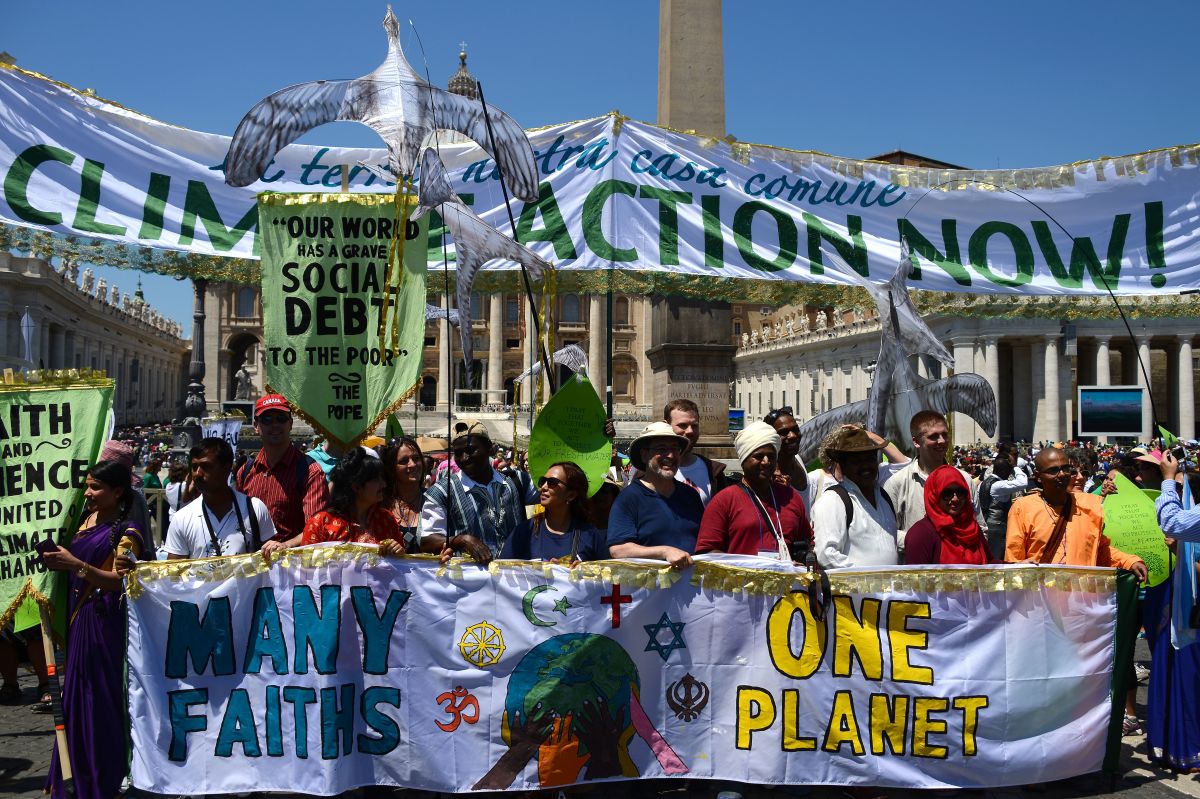
Two years after Pope Francis launched Laudato Si, the Vatican's plea to
save the Earth, Trump rejected its tenets and the Paris Agreement. But
people of all faiths are unified globally to beat climate change.
On May 24th, a grim-faced Pope Francis handed a signed copy of Laudato Si
to President Donald Trump during his visit to Rome. The United States
president, who has called climate change "a hoax," promised to read the
papal encyclical, a spiritual and secular plea to save the Earth from
environmental destruction.
A week later, Trump announced plans to yank the U.S. out of the 2015 Paris Agreement, whose prologue was influenced by the principles embodied in Laudato Si.
In doing so, Trump repudiated 195 nations' pledges to reduce their
carbon footprint to mitigate the worst effects of climate change; he
repudiated Pope Francis and his encyclical as well. More
In
1957, six European nations agreed on a single economic market that laid
the groundwork for the European Union, bringing together a continent
that in the previous decade had been shattered by total war.
On Monday, some sixty years after those six countries signed Treaty of Rome, Pope Francis reminded diplomats of the agreement’s importance as he called for a new European humanism.
“Europe as a whole is experiencing a decisive moment in
its history, one in which it is called to rediscover its proper
identity. This requires recovering its roots in order to shape its
future,” said the pope in the annual papal “state of the world” address.
“In
response to currents of divisiveness, it is all the more urgent to
update the idea of Europe, so as to give birth to a new humanism based
on the capacity to integrate, dialogue and generate that made the Old
Continent great,” he said.
Pope
France’s annual foreign policy speech comes, as he noted in his
address, at a time when Europe is in the midst of a migrant crisis, the
threat of religious-inspired violence, and a shakeup through Brexit. The
pope’s speech represents another effort on his part to urge peace and
reconciliation in Europe and abroad.
The
process of European unification "continues to be a unique opportunity
for stability, peace and solidarity between peoples," he said. "On this
occasion, I can only reaffirm the interest and concern of the Holy See
for Europe and its future, conscious that the values that were the
inspiration and basis of that project, which this year celebrates its
60th anniversary, are values common to the entire continent and
transcend the borders of the European Union itself."
The pope’s call for unity in Europe comes just months before Britain is expect to begin the formal process of
withdrawing from the EU. Britain’s Prime Minister Theresa May has said
she will invoke Article 50 of the Lisbon Treaty by the end of March.
Speaking
in front of diplomats from 180 countries in the Vatican on Monday, the
pope also denounced “fundamentalists-inspired terrorism” in 2016,
listing attacks by Islamist militants in Europe, Africa, Asia, and the
United States.
He
called such violence “homicidal madness, which misuses God’s name in
order to disseminate death, in a play for domination and power,” and
urged religious and political leaders to play their part in stopping it.
The pope said such violence is “spiritual poverty” often borne out of
material poverty. He said religious leaders should preach God’s message
of love and peace and political leaders should ensure economic
opportunities for young people.
In
addition to safety, “government leaders are also responsible for
ensuring that conditions do not exist that can serve as fertile terrain
for the spread of forms of fundamentalism.”
Pope
Francis’s speech is in line with his past remarks on Islamic extremism,
nuclear weapons, and even the proliferation of fake news. Last month,
the pope said that both the creation and spread of fake news is a sin, urging the media to do its part to stop it.
"The communications media have a very great responsibility.
Nowadays they have in their hands the possibility and the capacity to
form opinion: they can form a good or a bad opinion," the pope said in
an interview with Belgian Catholic weekly, Tertio. He added,
"Disinformation is probably the greatest damage that the media can do,
as opinion is guided in one direction, neglecting the other part of the
truth."
This warning wasn’t directed at just the media, but also those who post or repost harmful stories through social media. Yahoo News
Pope Francis this week implored world leaders not to postpone the
implementation of global environmental pacts, an appeal that appeared
aimed at President-elect Donald Trump’s vows to end the United States’
leading role in combating climate change.
The pope’s remarks came
during a gathering of scientists at the Vatican, at which he said there
has “never been such a clear need for science” to guide human actions
to safeguard the future of the planet.
“It is worth noting that
international politics has reacted weakly — albeit with some
praiseworthy exceptions — regarding the concrete will to seek the common
good and universal goods, and the ease with which well-founded
scientific opinion about the state of our planet is disregarded,” the
pontiff said, according to a translation provided
by the Vatican. He added that the “‘distraction’ or delay” in
implementing global agreements on the environment demonstrates how
politics have become submissive “to a technology and an economy which
seek profit above all else.”
Trump,
who is set to become one of the only world leaders to question the
notion of global warming, has vowed to “cancel” U.S. participation in
the international climate accord signed last year in Paris, in which
countries pledged to cut carbon dioxide emissions sharply in coming
years. In addition, Trump has called for rolling back pollution
regulations on the oil, gas and coal industries and shrinking the role
of the Environmental Protection Agency.
This week’s comments echoed an encyclical regarding the environment issued by Francis
last year in which he wrote about the “urgent challenge to protect our
common home” and argued that “the earth herself, burdened and laid
waste, is among the most abandoned and maltreated of our poor.”
At
the Vatican, Francis praised the work of scientists, who he said must
remain independent and emerge as leaders in fighting for climate action.
“I
would say that it falls to scientists, who work free of political,
economic or ideological interests, to develop a cultural model which can
face the crisis of climatic change and its social consequences,” he
said, “so that the vast potential of productivity will not be reserved
for only a few.”Washington Post
An ecumenical service with
Pope Francis at Lund Cathedral in Sweden on Monday. Some Catholics and
Lutherans hoped his visit would be a step toward the two faiths allowing
members to take communion in each other’s services.Credit
Emil Langvad/Agence France-Presse — Getty Images
LUND, Sweden — Almost 500 years after Martin Luther nailed his 95 theses
to a church door, setting off more than a century of religious warfare
and forever changing the practice of Christianity worldwide, Pope Francis on Monday urged atonement and Christian reconciliation.
Visiting the cities of Lund and Malmo in southern Sweden for a joint Catholic-Lutheran commemoration of the Reformation,
the pope observed the 499th anniversary of Luther’s protest of the sale
of indulgences by noting the beneficial impact it had on Catholicism.
“With
gratitude we acknowledge that the Reformation helped give greater
centrality to sacred Scripture in the church’s life,” the pope said in a
joint declaration at Lund Cathedral with Bishop Munib A. Younan, the head of the Evangelical Lutheran Church in Jordan and the Holy Land and the president of the Lutheran World Federation.
The trip, which kicked off a year of events leading up to the 500th anniversary of the Reformation, was announced in January,
but it was no less striking for those who listened to the pope. Sweden
played a pivotal and troubling role in Protestant and Catholic history.
From the 16th century, Catholics were persecuted and even put to death
in Sweden. As recently as 1951, Catholics were barred from becoming
doctors, teachers and nurses, and Catholic convents were banned until
the 1970s.
Some
Catholics and Lutherans, especially those whose families are
intermingled, hoped that the event would produce a concrete step toward
the two churches’ allowing their members to take communion in each
other’s worship services. In their joint declaration, Pope Francis and
Bishop Younan acknowledged the divide, but said only that they were
working toward a resolution through dialogue.
“We
experience the pain of those who share their whole lives, but cannot
share God’s redeeming presence at the Eucharistic table,” the
declaration said. “We long for this wound in the body of Christ to be
healed. This is the goal of our ecumenical endeavors, which we wish to
advance, also by renewing our commitment to theological dialogue.”
The
Lutheran World Federation was founded in Lund in 1947, in an effort to
unite churches after World War II. One of the main obstacles to
relations between Lutherans and Roman Catholics was bridged in 1999,
when the Vatican and the federation signed a joint declaration on the doctrine of justification, a core belief about God’s forgiveness of sins.
Francis
was the first pope to visit Sweden in 27 years, and only the second
pope to visit the Scandinavian country. In Lund, he met with King Carl
XVI Gustaf, Queen Silvia and Prime Minister Stefan Lofven.
“We, too, must look with love and honesty at our past, recognizing error and seeking forgiveness,” Francis said.
The prayer service in Lund was watched by about 10,000 people who packed Malmo Arena, about 14 miles away, where Caritas and the Lutheran World Service, humanitarian arms of the two churches, pledged to work together for peace and justice.
Teresa
Jodar, 58, who lives in Stockholm but is a native of Valencia, Spain,
said she had taken the train from Stockholm to Malmo in the morning to
bear witness.
“This
is a historic event,” she said. “I am a Catholic. We are not
celebrating the Reformation. That was a sad separation. But we are
celebrating taking a step closer. It is wonderful that we can work
together instead of thinking about all of the differences that separate
us.”
Ms. Jodar said she planned to stay for an All Saints’ Day Mass that the pope will celebrate on Tuesday in Malmo for an estimated 19,000 people.
Her
friend Luisa Hugosson, 67, a native of Colombia, chimed in. “The pope’s
visit is good for Lutherans and Catholics,” Ms. Hugosson said. “We are
living in a new time, and we must be open and show respect.”
Carmen
Godawszky, 71, sat with three friends on a train from Stockholm to
Malmo, and they reflected on the pope’s message urging countries in
Europe to open their doors to migrants.
“Of
course, we can’t be against that,” Mrs. Godawszky said. “My husband
came to Sweden as a refugee from Hungary in 1956. Everyone has been a
refugee at one point or another. Just think of all the Swedes who moved
to the U.S.A. because they didn’t have food or money.”
Although Sweden is predominantly Lutheran, the Roman Catholic Diocese of Stockholm counts 113,000 members in 44 parishes throughout the country.
Anders Arborelius, who converted to Catholicism when he was 20, is the country’s first Catholic bishop of Swedish origin since the Reformation.
“We
are leaving the past behind us and focusing on what we have in common,
that we can together go out and help people,” he said in a telephone
interview on Sunday.
Although
the ecumenical service on Monday marked a reconciliation, there are
still major doctrinal differences between the churches, on subjects like
the role of women in the church and the Eucharist. NY Times
As summer turns to autumn, Christians worldwide will unite in prayer and commit to the ministry of healing the earth during the Season of Creation, an annual initiative spearheaded by global Anglican, Roman Catholic, ecumenical, and interfaith organizations.
The Season of Creation runs from Sept. 1—proclaimed as the World Day
of Prayer for the Care of Creation by the Orthodox Church in 1989, and
subsequently recognized by other denominations—through the Feast of St.
Francis of Assisi on Oct. 4. During this period, Christians across
denominations and national borders are encouraged to join together in
prayer for creation and environmental stewardship.
To raise awareness of the 2016 Season of Creation, the Anglican Communion Environmental Network
(ACEN) is partnering with the World Council of Churches, the Global
Catholic Climate Movement, the Pope’s Worldwide Prayer Network,
GreenFaith, and the ACT Alliance.
The need for a period within the church calendar focusing especially
on creation has drawn increasing support across denominations in recent
years.
“A season such as Advent or Lent or Easter looks at significant
events in the life of Christ, different parts of Christ’s story … and
creation factors into every one of those seasons,” said the Rev. Ken
Gray, secretary of the ACEN, co-chair of the Creation Matters Working
Group, and dean of St. Paul’s Cathedral in Kamloops, B.C.
“Essentially, since the late 1960s, there has not been a profound
conversation or theological reflection on God as creator or God in
creation in some way, apart from persons such as St. Francis,” he added.
“So it’s time, and we’re trying to figure out a way to help folks focus
on this particular aspect of God’s graciousness.”
Creation Matters co-chair Nancy Harvey, who also serves as the
co-chair of the EnviroAction Committee in the Anglican Diocese of Huron,
drew a connection between the Season of Creation and the fifth Mark of
Mission: To strive to safeguard the integrity of creation, and sustain and renew the life of the earth.
“For us as Anglicans, that time is a way for us really to reflect and
pray and act and live out the fifth Mark of Mission,” Harvey said.
The season also serves as a way to reflect upon the 17 Sustainable Development Goals
identified by the United Nations and highlighted by Anglican leaders,
including Archbishop of Canterbury Justin Welby and Archbishop Fred
Hiltz, Primate of the Anglican Church of Canada. These goals include
clean water, affordable clean energy, sustainable cities and
communities, and action to tackle climate change.
A website for the Season of Creation includes a list of liturgical resources and steps to help organize prayer services.
Individuals and parishes can pray as they see fit, while churches may
organize their own services related to the care of creation.
St. Paul’s Cathedral, for example, is planning a four-week program of
worship for each Sunday starting on Sept. 11 that will delve into four
themes: Jesus and climate science; Sabbath as a life principle;
footprints (i.e. how does the congregation itself affect creation); and
life lessons from St. Francis and Pope Francis I—the latter of whom
highlighted problems of consumerism and environmental degradation in his
2015 encyclical Laudato Si’.The
cathedral will also host a public lecture series with presentations
from local members of the community, along with educational and artistic
events and field trips.
Though clergy and lay leaders may find it too late at the moment to
organize prayer services for the 2016 Season of Creation, Gray and
Harvey emphasized that the primary goal is consciousness-raising around
environmental issues, and that individuals and parishes are welcome to
pray for creation at any time. At St. Mark’s Church in Brantford, Ont.,
parishioners including Harvey will be celebrating the Season of Creation
this year at Thanksgiving.
“It’s not [necessarily] going to give them time to act this year,”
Harvey said. “But it is making them aware that there’s an example being
set, there’s leadership there, and this is happening across the
country.” Anglican