Showing posts with label Bank System. Show all posts

Monday, November 30, 2020

America says banks can now transact using so-called digital dollars


The US Treasury Department's Office of the Comptroller of the Currency (OCC) on Monday published a letter clarifying how federally chartered banking groups can use cryptocurrency and associated technology to manage financial transactions.

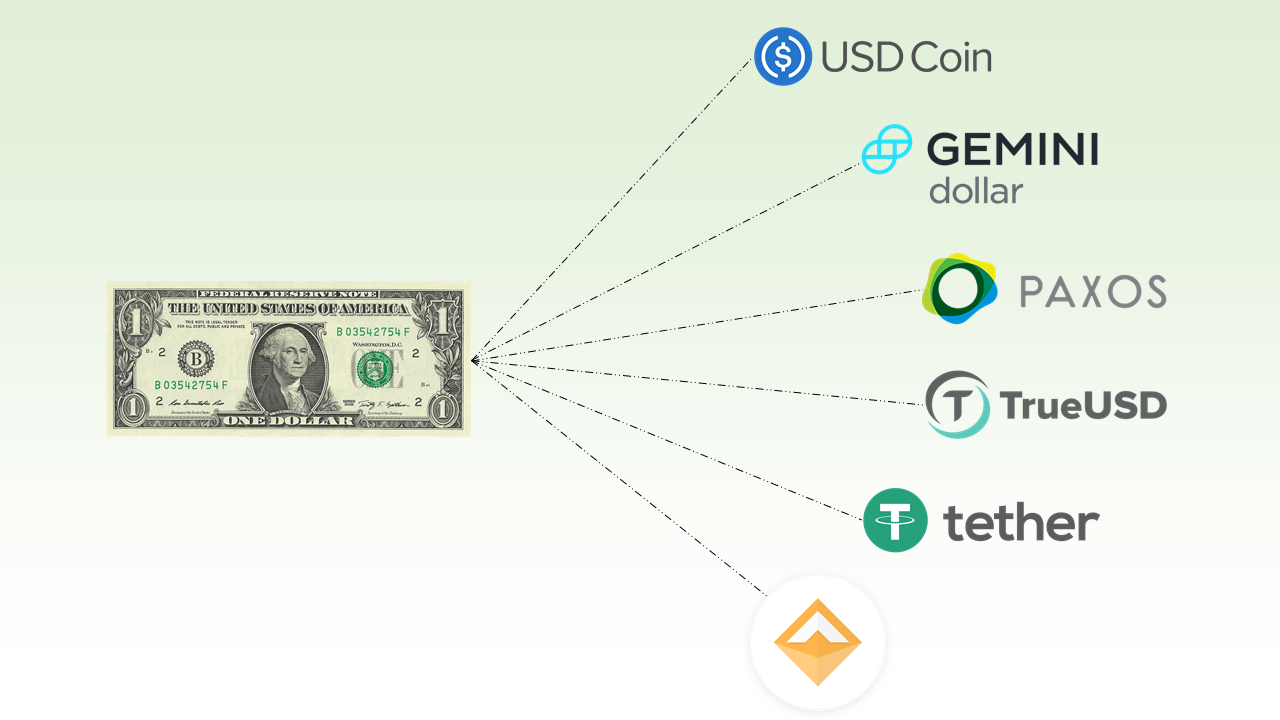
The letter endorses the use of independent node verification networks (INVN), such as blockchain distributed ledgers, and stablecoins – cryptocurrencies tied to fiat currencies, like Ethereum-based USD Coin (USDC) – as a means to settle customer transactions.

"Our letter removes any legal uncertainty about the authority of banks to connect to blockchains as validator nodes and thereby transact stablecoin payments on behalf of customers who are increasingly demanding the speed, efficiency, interoperability, and low cost associated with these products," said Acting Comptroller of the Currency Brian Brooks in a statement.

The agency letter blesses the use of independent node verification network (INVN) systems to validate, store, and record payment transactions, and lets banks use INVNs and associated stablecoins (those pegged to a physical currency) for other lawful payments, per existing banking laws.

In an email to The Register, David Yermack, a professor of finance at the New York University Stern School of Business and adjunct professor of law at New York University School of Law, said that this looks like a big deal.

"It indirectly encourages banks to explore using FinTech platforms, and it seems to open the door for them to transact in instruments such as Tether, Diem (Libra), and other so-called stablecoins that are pegged to the US dollar," said Yermack.

Tuesday, March 31, 2020

Ex-PM calls for global government to tackle coronavirus

The Guardian 26 Mar 2020 
Gordon Brown has urged world leaders to create a temporary form of global government to tackle the twin medical and economic crises caused by the Covid-19 pandemic.
The former Labour prime minister, who was at the centre of the international efforts to tackle the impact of the near-meltdown of the banks in 2008, said there was a need for a taskforce involving world leaders, health experts and the heads of the international organisations that would have executive powers to coordinate the response.
A virtual meeting of the G20 group of developed and developing countries, chaired by Saudi Arabia, will be held on Thursday, but Brown said it would have been preferable to have also included the UN security council.

Monday, November 18, 2019

The Royal Bank of Scotland will open Britain’s first cashless bank

The Royal Bank of Scotland will open what is believed to be Britain’s first cashless bank branch next month in as the move towards online banking continues at pace.

The bank is to open at 49 Bishopsgate, London on November 20, replacing the branch at 62-63 Threadneedle Street, London, which is being closed on December 20.

The “digital bank” will remove the frontline cashier services in the store and will not have an ATM fitted, meaning customers will not be able to pay in and take cash out.

Instead, the branch will be used for other banking needs, including appointments to open Isas and other savings accounts as well as applying for mortgages.

Video banking, where people can book appointments to talk to bankers via video chat will be available, as well as staff to assist with online banking and “presentation space” for anyone to attend sessions on protecting against scammers and managing their finances.

Tuesday, October 29, 2019

Global ‘terrorist’ list provides banks with names of 3 million people to be denied service

Global ‘terrorist’ list dominated by Muslims provides banks with names of 3 MILLION people to be denied service – report
RT 23 Oct, 2019
A massive, ever-growing database used by the world’s largest banks to track terrorism financing and other crimes has compiled millions of names from unverified sources – including scandal sheets and search engine results.

The World-Check database adds 25,000 names every month to its massive risk list, used by 49 of the world’s 50 largest banks to monitor possible financial, regulatory and reputational liabilities. Over three million people are currently on the list – many not convicted of any crime, some not even aware they are suspected of one. 

Getting on the list is easy – employees scour publicly available sources, from court records to search engine results, and apparently make little effort to verify what they find. An investigation by Al Jazeera found hundreds of thousands of Muslim names, some seemingly absurd. In one example, retired Egyptian football player Mohamed Aboutrika was designated a “terrorist” after the Egyptian government added him to its domestic terrorism list for supporting the country’s first democratically elected president, Mohamed Morsi, after he was overthrown. 

Beyond the overpopulated terrorist databases, the Qatari outlet found that World-Check scours the scandal-sheets and tabloid newspapers of Israel and other countries for names, though its own website claims “research is sourced from reputable public domain sources.” Indeed, World-Check boasts that its database includes not only convictions but “person accused, investigated, arrested, charged, indicted, detained, questioned, or on trial” for a laundry list of crimes including everything from bribery and corruption to slave labor, “cheating,” or “environmental crimes.”

Monday, July 29, 2019

A Bank With 49 Trillion Dollars In Exposure To Derivatives Is Melting Down Right In Front Of Our Eyes


TECB
Could it be possible that we are on the verge of the next “Lehman Brothers moment”?  Deutsche Bank is the most important bank in all of Europe, it has 49 trillion dollars in exposure to derivatives, and most of the largest “too big to fail banks” in the United States have very deep financial connections to the bank.  In other words, the global financial system simply cannot afford for Deutsche Bank to fail, and right now it is literally melting down right in front of our eyes.  For years I have been warning that this day would come, and even though it has been hit by scandal after scandal, somehow Deutsche Bank was able to survive until now.  But after what we have witnessed in recent days, many now believe that the end is near for Deutsche Bank.  On July 7th, they really shook up investors all over the globe when they laid off 18,000 employees and announced that they would be completely exiting their global equities trading business…
It takes a lot to rattle Wall Street.
But Deutsche Bank managed to. The beleaguered German giant announced on July 7 that it is laying off 18,000 employees—roughly one-fifth of its global workforce—and pursuing a vast restructuring plan that most notably includes shutting down its global equities trading business.
Though Deutsche’s Bloody Sunday seemed to come out of the blue, it’s actually the culmination of a years-long—some would say decades-long—descent into unprofitability and scandal for the bank, which in the early 1990s set out to make itself into a universal banking powerhouse to rival the behemoths of Wall Street.
These moves may delay Deutsche Bank’s inexorable march into oblivion, but not by much.
And as Deutsche Bank collapses, it could take a whole lot of others down with it at the same time.  According to Wall Street On Parade, the bank had 49 trillion dollars in exposure to derivatives as of the end of last year…
During 2018, the serially troubled Deutsche Bank – which still has a vast derivatives footprint in the U.S. as counterparty to some of the largest banks on Wall Street – trimmed its exposure to derivatives from a notional €48.266 trillion to a notional €43.459 trillion (49 trillion U.S. dollars) according to its 2018 annual report. A derivatives book of $49 trillion notional puts Deutsche Bank in the same league as the bank holding companies of U.S. juggernauts JPMorgan Chase, Citigroup and Goldman Sachs, which logged in at $48 trillion, $47 trillion and $42 trillion, respectively, at the end of December 2018 according to the Office of the Comptroller of the Currency (OCC). (See Table 2 in the Appendix at this link.)
Yes, the actual credit risk to Deutsche Bank is much, much lower than the notional value of its derivatives contracts, but we are still talking about an obscene amount of exposure.
And this is especially true when we consider the state of Deutsche Bank’s balance sheet.  According to Nasdaq.com, as of the end of last year the bank had total assets of 1.541 trillion dollars and total liabilities of 1.469 trillion dollars.
In other words, there wasn’t much equity there at the end of December, and things have deteriorated rapidly since that time.  In fact, it is being reported that a billion dollars a day is being pulled out of the bank at this point.
I know that most Americans don’t really care if Deutsche Bank lives or dies, but as the New York Post has pointed out, the failure of Deutsche Bank could quickly become a major crisis for the entire global financial system…

Friday, May 31, 2019

Nearly 25% of Americans Are Using Debt To Pay For Necessities Like Food


SHTFPlan   May 30th, 2019
Even though we are told the economy is doing great, all the evidence shows that main street Americans are struggling more and more every day. A recent report claimed that the costs of goods have risen to the point that 25% must use debt to pay for necessities, such as food.

According to a new Experian report that came out last week, Americans have an average of $6,506 in credit card debt. But some expenses are weighing much more heavily on the credit cards of the average American…

Necessities, like food and rent, are being put on credit cards. A full 23% of Americans say that paying for basic necessities such as rent, utilities, and food contributes the most to their credit card debt, according to a new survey of approximately 2,200 U.S. adults that CNBC Make It performed in conjunction with Morning Consult. Another 12% say medical bills are the biggest portion of their debt.  Medical bills additionally likely contribute to the purchases of food on a credit card.

This news isn’t shocking unless you believe the mainstream media’s glorification of the false “recovery” we’ve experienced since the Great Recession of a decade ago.  American households have taken on historic levels of debt, which will crush them in the next economic downturn.

Friday, August 17, 2018

10 numbers that prove America’s current financial condition


Related image

America’s long-term “balance sheet numbers” just continue to get progressively worse.  Unfortunately, since the stock market has been soaring and the GDP numbers look okay, most Americans assume that the U.S. economy is doing just fine.  But the stock market was soaring and the GDP numbers looked okay just prior to the great financial crisis of 2008 as well, and we saw how that turned out.  The truth is that GDP is not the best measure for the health of the economy.  Judging the U.S. economy by GDP is basically like measuring the financial health of an individual by how much money he or she spends, and I will attempt to illustrate that in this article.

#1 U.S. consumer credit just hit another all-time record high.  In the second quarter of 2008, total consumer credit reached a grand total of 2.63 trillion dollars, and now ten years later that number has soared to 3.87 trillion dollars.  That is an increase of 48 percent in just one decade.

#2 Student loan debt has surpassed 1.5 trillion dollars for the first time ever.  Over the last 8 years, the total amount of student loan debt has shot up 79 percent in the United States.

#3 According to the Federal Reserve, the credit card default rate in the U.S. has risen for 7 quarters in a row.

#4 One recent survey found that 42 percent of American consumers paid their credit card bill late “at least once in the last year”, and 24 percent of Americans consumers paid their credit card bills late “more than once in the last year”.

#5 Real wage growth in the United States just declined by the most that we have seen in 6 years.

#6 According to one recent study, the “rate of people 65 and older filing for bankruptcy is three times what it was in 1991”.

#7 We are in the midst of the greatest “retail apocalypse” in American history.  At this point, 57 major retailers have announced store closings so far in 2018.

#8 The size of the official U.S. budget deficit is up 21 percent under President Trump.

#9 It is being projected that interest on the national debt will surpass half a trillion dollars for the first time ever this year.

#10 Goldman Sachs is projecting that the yearly U.S. budget deficit will surpass 2 trillion dollars by 2028.

Wednesday, October 4, 2017

Goldman Sachs considers trading bitcoin & other cryptocurrencies


Goldman Sachs considers trading bitcoin & other cryptocurrencies

RT, 3 Oct, 2017
A new trading operation dedicated to digital currencies is being explored by Goldman Sachs, sources told the Wall Street Journal. It could be the first blue-chip Wall Street firm to deal directly in the growing yet controversial cryptocurrency market. 
“In response to client interest in digital currencies, we are exploring how best to serve them in this space,” said an unnamed Goldman spokeswoman.
According to people familiar with the matter, Goldman’s effort involves both its currency trading division and the bank’s strategic investment group. The firm sees bitcoin’s future more as a payment method rather than a store of value.

Sources also said Goldman’s effort is in its early stages and may not proceed. The firm’s interest, however, could strengthen bitcoin’s position as digital currencies were initially viewed as havens for illicit activity.
Big banks such as UBS, Barclays, ING, Goldman Sachs and BNY Mellon have recently announced ventures into the blockchain technology that allows digital currencies to function and be transferred safely.
BNP Paribas has said it is looking to add bitcoin to one of its currency funds and has been doing "beta testing" involving the cryptocurrency.
Societe Generale and JPMorgan even published job offers for an IT developer and technician on bitcoin, blockchains, and cryptocurrencies.

Morgan Stanley Chief Executive James Gorman said bitcoin is “obviously highly speculative, but it’s not inherently bad.”
According to research firm Autonomous NEXT, around 70 hedge funds are currently investing in cryptocurrencies.
Control over virtual currencies’ trading platforms has been tightened recently to prevent them from becoming money laundering sites.
Last month, Chinese authorities cracked down on cryptocurrencies, ordering the country’s exchanges to suspend operations. Beijing banned initial coin offerings (ICOs), referring to them as an unauthorized fundraising tool that may involve financial scams.
The move was followed by South Korea, with the country’s financial regulator saying it will ban money raising through all forms of virtual currencies.
In July, the US Securities and Exchange Commission warned that some ICOs should be regulated like other securities. Authorities in Singapore and Canada have issued similar warnings.        RT

Monday, July 31, 2017

EU Proposes Freezing Bank Accounts to Bailout Megabanks

After nervous customers panicked and drained their accounts, ultimately causing the collapse of Spanish bank, Banco Popular, equally jittery European Union officials are debating the merits of freezing access — preventing anyone from withdrawing any money — at the first sign of a bank run.
Proponents claim measures to halt a rush of withdrawals would prevent the downfall of floundering financial institutions at their most vulnerable point — in hopes of staving off a catastrophe at least as harrowing as that of 2008 — while detractors admonish the move might have precisely the opposite effect, with investors rushing to yank funds at the slightest indication of trouble.
“The desire is to prevent a bank run, so that when a bank is in a critical situation it is not pushed over the edge,” ‘a person familiar with German government’s thinking’ told Reuters.
“Giving supervisors the power to temporarily block bank accounts at ailing lenders is ‘a feasible option,’ a paper prepared by the Estonian presidency of the EU said, acknowledging that member states were divided on the issue,” Reuters reports.
“EU countries which already allow a moratorium on bank payouts in insolvency procedures at national level, like Germany, support the measure, officials said.”     More

Sunday, April 16, 2017

In A Cashless Economy, Your Money’s Never Idle Money


By Lauren Wright  
The global financial crisis opened the world’s eyes on how dependent we were on the big banks. Today, we could be held as much hostage to the banking system as we were before, if not much more. As several countries push for a dematerialization of payment means, have we already forgotten the lessons learned after the crash?
Many of the major banks in the U.S or in Europe still haven’t recovered fully from the multiple crashes and the collapse that shattered the system worldwide. At the time, many citizens realized how fragile the banking system was and they lost their trust. After Lehman Brothers’ bankruptcy many swore that never again they would allow the banks to play with their money like they had in the past. At the time, masses of several countries rushed to their banks to withdraw their assets and keep it in the form that seemed safer to them: cash.
Today, however, the prophets of media and governments around the world have asked us to start saying goodbye to physical money. They want to go cash-free. The idea seems wonderful, no more heavy coins in our pockets and no more ‘cling cling’ sound from the laundry machine. Instead of it; cards, mobile wallets, e-payment systems. We would live in societies where all of our assets are kept in banks, but not physically.       Read More

Sunday, April 17, 2016

The centralization of the bank system and the NWO

by FRA
FRA Co-founder Gordon T. Long is joined by Jeff Berwick in discussing the article Central banks beat Bitcoin at own game with rival supercurrency, the central banking system, and blockchain technology.
Jeff Berwick is the founder of The Dollar Vigilante, CEO of TDV Media & Services and host of the popular video podcast,Anarchast.  Jeff is a prominent speaker at many of the world’s freedom, investment and gold conferences including his own,Anarchapulco, as well as regularly in the media including CNBC, Bloomberg and Fox Business.
Jeff’s background in the financial markets dates back to his founding of Canada’s largest financial website, Stockhouse.com, in 1994. In the late ‘90s the company expanded worldwide into 8 different countries and had 250 employees and a market capitalization of $240 million USD at the peak of the “tech bubble”.  To this day more than a million investors use Stockhouse.com for investment information every month.  He has since started numerous businesses including TDV Offshore and TDV Wealth Management to help others internationalize their assets.
FIAT CURRENCIES AND BITCOIN
There’s going to be a lot of chaos this year, beginning in January with the worst first month of the world stock market in history. A lot of financial leads have been warning about it, even saying this is a debt jubilee and will end up in utter collapse if people aren’t careful.
“I think by 2018 they’ll be bringing in a one world currency… All Fiat currencies, including the US Dollar, are going to collapse sometime between 2015-2020.”
The market came up with a solution. Launched in 2009, Bitcoin is a free market currency, and one of the ways that we can avoid this total collapse.
RESPONSE TO AMBROSE-EVANS PRITCHARD
“It looked like a propaganda piece, like it was written by the Bank of England as a press release.”
In no way does this new central bank crypto-currency compete or defeat Bitcoin in any way. In fact, central banks are extremely worried about Bitcoin. They’re trying to bring everyone into the banking system so they can establish a one-world central bank and taxation system. They planned to create a system that impoverishes people to get the wealth into the hands of the 0.0001%.
They want to collapse the entire system so they can bring in a new system. We’re reaching the end of that plan, when every government is insolvent with debt. The US Federal Reserve has essential kept interest rates at zero for eight years, because if interest rates rise the US government would quickly be insolvent.
“With $19T worth of debt, if the interest rate rose to 10%, a very low level, that’d be almost $2T a year in interest payments alone.”
They’re trying to delay that and get everyone into the banking system first. If you try to open a new bank account, it’s very difficult and they want to know every detail because it’s going into a central database so no one can evade taxes. Then they’re going to go even further with negative interest rates and really impoverish people.
If people start getting into Bitcoin, they can’t control it. The only way would be to turn off the internet or the power.
BITCOIN
Bitcoin is an internet-based currency that’s completely decentralized. To get rid of it, they’d have to remove it from the millions of computers around the world, and that’s almost impossible. If you control the money supply, you control the governments. That’s what the Federal Reserve and all central banks do.
“The governments do not control the big decisions. It’s the people behind the scenes who control the money, who tell the government what they want done, and that’s been going on for decades.”
Bitcoin cannot be fraudulent because it’s open-source software. Anyone who wants to can look at the code. There’s no CEO, there’s no central office, and it’s on so many computers they can’t stop it. Central banks want to tax everything and control the economy.
“I don’t call things like Bitcoin a revolution so much as an evolution. It’s creating something that circumvents the entire system completely.”
BLOCKCHAIN TECHNOLOGY
Blockchain type technology could change everything, and goes beyond just money. This could be where everything is based. This technology is also starting to being used be for governance, starting in Africa, as a system of private property. Eventually it could be used to replace the government.
“Your average person still doesn’t know what a big deal is going on behind the scenes, but this is going to revolutionize the world… There’s going to be so many things built on top of this technology that it’s going to change the world.”
BACK TO THE ARTICLE – RSCOIN
Central banks will get rid of fiat currency and use RSCoin instead, but since it’s a crypto-currency it can be tracked even more. The population will likely use it, but it does not “beat Bitcoin at its own game”.
RSCoin will supposedly be good as it gives the government and central bank more control over the money system, and this will apparently make us less prone to boom-bust cycles. However, the central bank’s control over interest rates is what creates boom-bust cycles in the first place.
THOUGHTS FOR THE FUTURE
You want to get your assets out of the banking system, especially anti-system sorts of investments and trades and speculations, ad moving assets out of your own country.
“You want to get assets internationalized. That’s the new diversification in my opinion: not stocks, bonds, or cash, it’s where your assets are, in what countries are they, and under what structures are they.”
We’re headed for a collapse, and how it plays out is anyone’s guess. This is going to be a time talked about in history for centuries, after the collapse happens. We have a global fiat currency that is just computer bits controlled by central bankers with no intrinsic value, and they will return to that.
“Do your own research. There’ a lot more going on out there than most people know.”     Source
Sunday, November 29, 2015

Moving Toward A One World Government, A One World Economy And A One World Religion

Global Hands - Public Domain
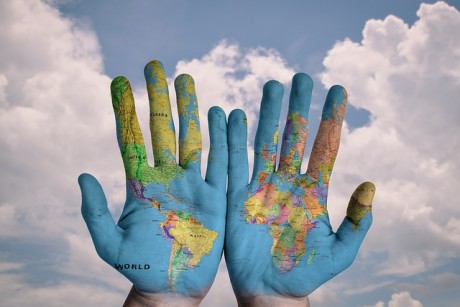
The global elite have never been closer to their goal of a united world.  Thanks to a series of interlocking treaties and international agreements, the governance of this planet is increasingly becoming globalized and centralized, but most people don’t seem alarmed by this at all.  In the past 30 days, we have seen some of the biggest steps toward a one world government, a one world economy and a one world religion that we have ever witnessed, but these events have sparked very little public discussion or debate.  So please share this article with as many people as you can.  We need to wake people up about this before it is too late.
From September 25th to September 27th, the United Nations launched a “new universal agenda” for humanity.  Those are not my words, they actually come directly out of the core document for this new agenda.  The Pope traveled to New York City to give the address that kicked off this conference, thus giving his considerable endorsement to this new plan.  Virtually every nation on the entire planet willingly signed up for the 17 goals that are included in this plan, but this stunning turn of events made very few international headlines.
The United Nations is promising that if we all work together that we can turn our planet into some kind of “utopia”, but the truth is that all of this talk about “unity” masks a very insidious agenda.  The following comes from a recent piece by Paul McGuire, the author of a groundbreaking new book entitled “The Babylon Code”…
The UN is not asking permission, but issuing a command that the entire planet will commit to 17 sustainable development goals and 169 sustainable development targets designed to radically transform our world by 2030. The UN 2030 plan promoted by the Pope will advance Agenda 21 on steroids. Through a controlled media the mass populations will be told that this is all about saving the environment and “ending poverty.” But that is not the true agenda of Agenda 21. The true agenda of Agenda 21 is to establish a global government, global economic system, and global religion. When UN Secretary General Ban Ki-Moon spoke of “a dream of a world of peace and dignity for all” this is no different than when the Communists promised the people a “workers paradise.”
For the general population, “the 2030 Agenda” has been rebranded as “the global goals”.  On September 26th, some of the biggest names in the music world (including Beyonce) promoted these new “global goals” at the “Global Citizen Festival” that was held in Central Park.  And you can watch a YouTube video where some of the most famous names on the entire planet urge all of us to get behind these new “global goals” right here.
None of this is by accident.  We are being trained to think of ourselves as “global citizens” that belong to a “global community”.  Decades ago, most Americans would have been up in arms over something like this.  But now most people just seem to accept these changes passively.  Very powerful secret societies and international organizations have been moving us in this direction for a very long time, and most Americans simply have no idea what is happening.  Here is more from Paul McGuire…
The United Nations is a de facto global government and does not rule by the “consent of the governed.” The United Nations is a global government to which American politicians of both parties have surrendered our Constitutional rights. If you look at the Republican Presidential debates you see the vast majority of those running are “bought men and women.” They are there to do the bidding of their true masters, the international banking families and their interlocking secret societies. If a candidate has a different set of beliefs than the “Orwellian group think” which constitutes domestic and foreign policy, he is allowed to go only so far.
Who are these powerful elite groups and the secret societies that run them? As we extensively document in our new book, The Babylon Code, co-authored by this author and Troy Anderson, a Pulitzer Prize-nominated investigative journalist, there exists a very real network of semi-secretive and secret groups. Groups like The Council on Foreign Relations, The Trilateral Commission, Royal Institute of International Affairs, United Nations, Club of Rome, The Bilderberg Group, and others control presidents, prime ministers, media networks, politicians, CEO’s, and entire nations. You will almost never hear any substantive analysis by the media, which is controlled by these groups nor of attempts at holding them accountable by governments around the world.
Another way that our planet is being “united” is through the use of international trade agreements.
The ultimate goal is for the entire world to become a “single market” with uniform laws, rules and regulations.  But as we merge our economy with the rest of the globe, the United States has been losing tens of thousands of businesses and millions of jobs as the monolithic corporations that now dominate our economy shift production to areas where labor is much cheaper.  This is absolutely destroying the middle class, but very few people seem to care.
Negotiations for one of the biggest international trade treaties that the world has ever seen recently concluded.  The Trans-Pacific Partnership, also known as “Obamatrade”, would represent a giant step toward a truly unified global economy.  The following is an excerpt from one of my previous articles…
We have just witnessed one of the most significant steps toward a one world economic system that we have ever seen.  Negotiations for the Trans-Pacific Partnership have been completed, and if approved it will create the largest trading bloc on the planet.  But this is not just a trade agreement.  In this treaty, Barack Obama has thrown in all sorts of things that he never would have been able to get through Congress otherwise.  And once this treaty is approved, it will be exceedingly difficult to ever make changes to it.  So essentially what is happening is that the Obama agenda is being permanently locked in for 40 percent of the global economy.
The United States, Canada, Japan, Mexico, Australia, Brunei, Chile, Malaysia, New Zealand, Peru, Singapore and Vietnam all intend to sign on to this insidious plan.  Collectively, these nations have a total population of about 800 million people and a combined GDP of approximately 28 trillion dollars.
And do you want to know who pushed really hard to give Obama fast track negotiating authority so that these negotiations could be brought to a successful conclusion?
It was the traitorous Republican leadership in Congress.  They did everything that they could to pave the way for Obamatrade.
We are also seeing some stunning moves in the direction of a one world religion.
In recent years, you may have noticed that it has become very trendy to say that all religions are just different paths to the same God.  In fact, many prominent religious leaders are now openly proclaiming that the two biggest faiths on the entire planet, Christianity and Islam, worship the exact same deity.
For example, just consider what the Pope is saying publicly on this matter.  The following is an extended excerpt from one of my recent articles on End of the American Dream…
*****
What Pope Francis had to say at St. Patrick’s Cathedral in Manhattan has received very little coverage by the mainstream media, but it was exceedingly significant.  The following is how he began his address…
I would like to express two sentiments for my Muslim brothers and sisters: Firstly, my greetings as they celebrate the feast of sacrifice. I would have wished my greeting to be warmer. My sentiments of closeness, my sentiments of closeness in the face of tragedy. The tragedy that they suffered in Mecca.
In this moment, I give assurances of my prayers. I unite myself with you all. A prayer to almighty god, all merciful.
He did not choose those words by accident.  In Islam, Allah is known as “the all-merciful one”.  If you doubt this, just do a Google search.
And this is not the first time Pope Francis has used such language.  For instance, the following comes from remarks that he made during his very first ecumenical meeting as Pope…
I then greet and cordially thank you all, dear friends belonging to other religious traditions; first of all the Muslims, who worship the one God, living and merciful, and call upon Him in prayer, and all of you. I really appreciate your presence: in it I see a tangible sign of the will to grow in mutual esteem and cooperation for the common good of humanity.
The Catholic Church is aware of the importance of promoting friendship and respect between men and women of different religious traditions – I wish to repeat this: promoting friendship and respect between men and women of different religious traditions – it also attests the valuable work that the Pontifical Council for interreligious dialogue performs.
Pope Francis clearly believes that Christians and Muslims worship the exact same God.  And so that helps to explain why he authorized “Islamic prayers and readings from the Quran” at the Vatican for the first time ever back in 2014.
*****
What is happening is undeniable.
We are steamrolling toward a one world government, a one world economy and a one world religion.
Of course we will not get there overnight.  It is going to take some time, and there are going to be quite a few bumps along the way.  In fact, I believe that our planet will experience an extreme amount of chaos before we actually get there.
But every major crisis will be used as an excuse to advance this agenda.  Virtually every solution that the elite offer us will involve more globalization and more centralization.  We will be told that all of our problems will be solved if humanity will just come together in unity.
For some, the goal of a “united planet” where we are all working together to eradicate things like poverty, war and disease makes all the sense in the world.
For others, a one world government, a one world economy and a one world religion would simply mean setting the stage for “one world tyranny”.