Showing posts with label Priest. Show all posts

Saturday, October 31, 2020

A Sincere Priest Finds Contradictions in the Teachings of the Holy Fathers

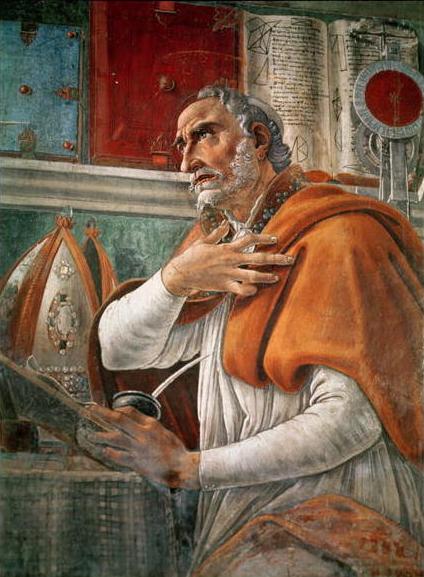
https://jamesjpn.net/wp-content/uploads/2014/04/Saint_Augustine_Portrait.jpg

The most desolate work of a sincere Catholic priest is the study of the Holy Fathers. He does not make a step in the labyrinth of their discussions and controversies without seeing the dreams of his theological studies and religious views disappear as the thick morning mist, when the sun rises above the horizon. Bound as he is, by a solemn oath, to interpret the Holy Scriptures only according to the unanimous consent of the Holy Fathers, the first thing which puzzles and distresses him is their absolute want of unanimity on the greater part of the subjects which they discuss. The fact is, that more than two-thirds of what one Father has written is to prove that what some other Holy Father has written is wrong and heretical.

The student of the Fathers not only detects that they do not agree with one another, but finds that many of them do not even agree with themselves. Very often they confess that they were mistaken when they said this or that; that they have lately changed their minds; that they now hold for saving truth what they formerly condemned as a damning error!

What becomes of the solemn oath of every priest in presence of this undeniable fact? How can he make an act of faith when he feels that its foundation is nothing but falsehood?

No words can give an idea of the mental tortures I felt when I saw positively that I could not, any longer, preach on the eternity of the suffering of the damned, nor believe in the real presence of the body, soul, and divinity of Christ in the sacrament of communion; nor in the supremacy of the sovereign Pontiff of Rome, nor in any of the other dogmas of my church, without perjuring myself! For there was not one of those dogmas which had not been flatly and directly denied by some Holy Fathers.

It is true, that in my Roman Catholic theological books I had long extracts of Holy Fathers, very clearly supporting and confirming my faith in those dogmas. For instance, I had the apostolic liturgies of St. Peter, St. Mark, and St. James, to prove that the sacrifice of the mass, purgatory, prayers for the dead, transubstantiation, were believed and taught from the very days of the apostles. But what was my dismay when I discovered that those liturgies were nothing else than vile and audacious forgeries presented to the world, by my Popes and my church, as gospel truths. I could not find words to express my sense of shame and consternation, when I became sure that the same church which had invented those apostolical liturgies, had accepted and circulated the false decretals of Isidore, and forged innumerable additions and interpolations to the writings of the Holy Fathers, in order to make them say the very contrary of what they intended.

How many times, when alone, studying the history of the shameless fabrications, I said to myself: “Does the man whose treasury is filled with pure gold, forge false coins, or spurious pieces of money? No! How, then, is it possible that my church possess the pure truth, when she has been at work during so many centuries, to forge such egregious lies, under the names of liturgies and decretals, about the holy mass, purgatory, the supremacy of the Pope, ect. If those dogmas could have been proved by the gospel and the true writings of the Fathers, where was the necessity of forging lying documents? Would the Popes and councils have treasuries with spurious bank bills, if they had had exhaustless mines of pure gold in hand? What right has my church to be called holy and infallible, when she is publicly guilty of such impostures.”

From my infancy I had been taught, with all the Roman Catholics, that Mary is the mother of God, and many times, every day, when praying to her, I used to say, “Holy Mary, mother of God, pray for me.” But what was my distress when I read in the “Treatise on Faith and Creed,” by Augustine, Chapter iv. 9, these very words: “When the Lord said, ‘Woman, what have I to do with thee? Mine hour is not yet come’ (John ii. 4), He rather admonishes us to understand that, in respect of His being God, there was no mother for Him.”

This was so completely demolishing the teachings of my church, and telling me that it was blasphemy to call Mary mother of God, that I felt as if struck with a thunderbolt.         Fifty Years in the Church of Rome, Capter 46

Friday, November 29, 2019

Is the Holy Spirit a personal Holy Spirit?

Behold those disciples, hidden in that upper chamber for fear of the priests and rulers. They were to go everywhere to preach the Word. They were to speak with new tongues, not a foreign language, but words eloquent from lips which had been touched with a live coal from off the altar. After the disciples had received the baptism of the Holy Spirit, the priests and rulers marveled at the words which they spake, for they knew them as unlearned and ignorant men. But they took knowledge of them that they had been with Jesus. 

Their teaching was a second edition of the teachings of Christ, the utterance of simple, grand truths that flashed light into darkened minds, and converted thousands in a day. The disciples began to understand that Christ was their advocate in the heavenly courts, and that He was glorified. They could speak because the Holy Spirit gave them utterance. “The entrance of Thy words giveth light; it giveth understanding unto the simple” [Psalm 119:130].  

Bible truth spoken by sanctified lips is eloquence and power. The disciples had a saving understanding of the words of Christ. Because they were united with Christ, eating His flesh and drinking His blood, the inspired book was to them spirit and life. We may understand the Bible as we understand other books, but it is not thus taken into our minds and hearts as the living bread from heaven...

“Greater works than these shall he do; because I go unto My Father.” He would then intercede for them, and would send His own representative, the Holy Spirit, who would attend them in their work. This representative would not appear in human form, but by faith would be seen and recognized by all who believe in Christ....

Before He left them, Christ gave His followers a positive promise that after His ascension He would send them the Holy Spirit. “Go ye therefore,” He said, “and teach all nations, baptizing them in the name of the Father [a personal God] and of the Son [a personal Saviour], and of the Holy Ghost [sent from heaven to represent Christ]: teaching them to observe all things whatsoever I have commanded you: and, lo, I am with you alway, even unto the end of the world” [Matthew 28:19, 20]

This positive assurance was given to the disciples, to be given to all who should believe on Him to the close of this earth's history.  

Christ desired His disciples to understand that He would not leave them orphans. “I will not leave you comfortless,” He declared; “I will come to you. Yet a little while, and the world seeth Me no more; but ye see Me: because I live, ye shall live also” [verses 18, 19]. A precious, glorious assurance of eternal life! Even though He was to be absent, their relation to Him was to be that of a child to its parent.  

The influence of the Holy Spirit is the life of Christ in the soul. We do not see Christ and speak to Him, but His Holy Spirit is just as near us in one place as in another. He works in and through every one who receives Christ. Those who know the indwelling of the Spirit reveal the fruits of the Spirit—love, joy, peace, long-suffering, gentleness, goodness, faith.   MR 12 pp 257-261

- Definitions -

Name:  Authority; behalf; part; as in the name of the people. When a man speaks or acts in the name of another, he does it by their authority or in their behalf, as their representative.  Webster

Baptize: To administer the sacrament of baptism to; to christen. By some denominations of christians, baptism is performed by plunging, or immersing the whole body in water. Webster

Personal:  1. Of, relating to, or affecting a particular person; 2. Done in person without the intervention of another; 3. relating to the person or body; 4. Relating to an individual or an individual's character; 5. a) being rational and self-conscious;  b) having the qualities of a person rather than a thing or abstraction. Webster 
1. Relating to an individual; 2. Pertaining to the corporal nature; 3. Present in person; not acting by representative. Webster 1828

Representative:  1. Exhibiting a similitude; 2. Bearing the character or power of another; 3. One that exhibits the likeness of another.  Webster

Represent: 1. To show or exhibit by resemblance; 2. To describe; 3. To exhibit; 4. To personate; to act the character;  5. To supply the place of; to act as a substitute for another; 6. To show by arguments, reasoning or statement of facts; 7. To stand in the place of. Webster

Monday, June 25, 2018

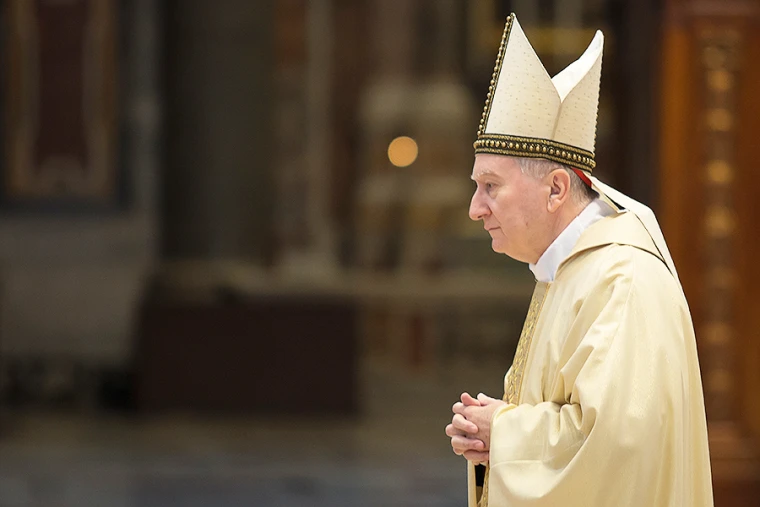
Vatican Secretary of State, will take part in the Bilderberg Conference

.- Cardinal Pietro Parolin, Vatican Secretary of State, will take part in the Bilderberg Conference, an annual private gathering of global political, business and media leaders, set to take place this year in Turin, Italy, June 7 – 10.

Cardinal Parolin’s name is included in the list of 131 participants in this year’s Bilderberg meeting.

His participation in the meeting has not been officially announced by the Vatican, though sources within the Secretariat of State have confirmed that he is scheduled to take part in the meeting.

If his participation were confirmed, it would be the first time high-ranking Vatican official has taken part in the Bilderberg Conferences.

Started in 1954 the Hotel de Bilderberg in Oosterbeek, The Netherlands, and named after the same hotel, the Bilderberg Conference gathers each year some 120 – 150 participants, among them European and North American political élites, along with industrial, financial, academic and media figures.

The first meeting took place at the invitation of Prince Bernhard of Lippe-Biesterfeld. Co-founders of the meeting were Polish politician Jozef Retinger, former Belgian prime minister Paul van Zeeland and Paul Rijkens, who was then the head of Unilever.

The success of the first meeting brought the organizers to stage an annual meeting.

According to the groups' official website, about two-thirds of the participants come from Europe, and the rest from North America, and one-third are political figures or government officials.

Wednesday, February 8, 2017

More than 4,000 children, mostly boys, were allegedly sexually abused by Catholic priests in Australia over decades

More than 4,000 children, mostly boys, were allegedly sexually abused by Catholic priests in Australia over decades, an investigation says, adding that since the 1950s some 7 percent of priests in the country were alleged perpetrators.
The report was released on Monday by the Australian Royal Commission into Institutional Responses to Child Sexual Abuse.
The commission will resume its public hearing into the current policies of the Catholic Church on Tuesday.     RT