By Michael Snyder, on November 18th, 2015
If
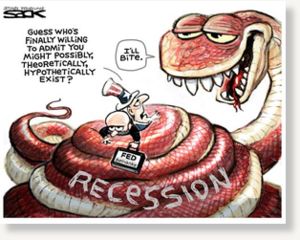
the U.S. economy really is in “great shape”, then why do all of the
numbers keep telling us that we are in a recession? The manufacturing
numbers say that we are in a recession, the
trade numbers
say that we are in a recession, and as you will see below the retail
numbers say that we are in a recession. But just like in 2008, the
Federal Reserve and our top politicians will continue to deny that a
major economic downturn is happening for as long as they possibly can.
In this article, I want to look at more signs that a dramatic shift is
happening in our economy right now.
First of all, let’s consider what is happening to hedge funds. For
many years, hedge funds had been doing extremely well, but now they are
closing up shop at a pace that we haven’t seen since the last financial
crisis. The following is an excerpt from a Business Insider article
entitled “
Hedge funds keep on imploding” that was posted on Wednesday…
BlackRock is winding down its Global Ascent Fund, a
global macro hedge fund that once contained $4.6 billion in assets,
according to Bloomberg’s Sabrina Willmer.
“We believe that redeeming the Global Ascent Fund was the right thing
to do for our clients, given the headwinds that macro funds have
faced,” a BlackRock spokeswoman told Business Insider.
The winding down of the Ascent fund is the second high-profile hedge fund closing in 24 hours. The Wall Street Journal reported Tuesday that Achievement Asset Management, a Chicago-based hedge fund, was closing.
And those are just two examples. Quite a few other prominent hedge
funds have shut down recently, and many are wondering if this is just
the beginning of a major “bloodbath” on Wall Street.
Another troubling sign is the implosion of so many energy companies.
Just like in 2008, a major crash in the price of oil is hitting the
energy sector really hard. Just check out these stock price declines…
A number of smaller energy companies have already gone out of
business, and several of the big players are teetering on the brink. If
the price of oil does not rebound significantly very soon, it is just a
matter of time before the dominoes begin to fall.
The retail sales report for October was much worse than
expected. Not only that, but the Government’s original estimates for
retail sales in August and September were revised lower. A colleague of
mine said he was chatting with his brother, who is a tax advisor, this
past weekend who said he doesn’t understand how the Government can say
the economy is growing (Hillary Clinton recently gave the economy an
“A”) because his clients are lowering their estimated tax payments.
Businesses lower their estimated tax payments when their business
activity slows down.
The holiday season is always the best time of the year for retailers,
but in 2015 there is a lot of talk of gloom and doom. Most large
retailers will not start announcing mass store closings until January or
February, but without a doubt many analysts are anticipating that once
we get past the Christmas shopping season we will see stores shut down
at a pace that we haven’t seen since at least 2009. Here is more
from the article that I just quoted above…
Retail sales this holiday season are setting up to be a
disaster. Already most retailers are advertising “pre-Black Friday”
sales events. Remember when holiday shopping didn’t begin, period,
until the day after Thanksgiving? Now retailers are going to
cannibalize each other with massive discounting before
Thanksgiving. Anybody notice over the weekend that BMW is now offering
$6500 price rebates? The collapsing economy is affecting everyone,
across all income demographics.
Last week we saw the stocks of Macy’s, Nordstrom and Advance Auto
Parts do cliff-dives after they announced their earnings. I mentioned
to a colleague that the Nordstrom’s report should be the most troubling
for analysts. Nordstrom in their investor conference call said
that they began seeing an “unexplainable slowdown in sales in August in
transactions across all formats, across all catagories and across all
geographies that has yet to recover.”
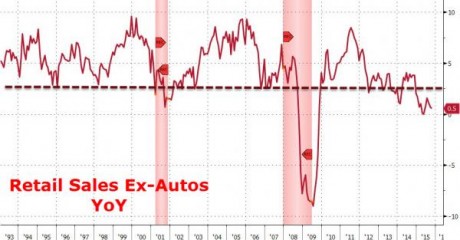
I think that a chart would be helpful to give you an idea of how bad things have already gotten.
Jim Quinn
shared this in an article that he just posted, and it shows the change
in retail sales once you remove the numbers for the auto industry. As
you can see, the numbers have never been this dreadful outside of a
recession…
But stocks went up 247 points on Wednesday so everything must be great, right?
Wrong.
The stock market has never been a good barometer for the overall economy, and this is especially true these days.
In 2008, stocks didn’t crash until well after the U.S. economy as a
whole started crashing, and the same thing is apparently happening this
time around as well.
One of the things that is keeping stocks afloat for the moment is
stock buybacks. In recent years, big corporations have spent hundreds
of billions of dollars buying back their own stocks. The following
comes from
Wolf Richter…
IBM has blown $125 billion on buybacks since 2005, more
than the $111 billion it invested in capital expenditures and R&D.
It’s staggering under its debt, while revenues have been declining for
14 quarters in a row. It cut its workforce by 55,000 people since 2012.
And its stock is down 38% since March 2013.
Big-pharma icon Pfizer plowed $139 billion into buybacks and
dividends in the past decade, compared to $82 billion in R&D and $18
billion in capital spending. 3M spent $48 billion on buybacks and
dividends, and $30 billion on R&D and capital expenditures. They’re
all doing it.
Later in that same article, Richter explains that almost 60 percent
of all publicly traded non-financial corporations have engaged in stock
buybacks over the past five years…
Nearly 60% of the 3,297 publicly traded non-financial US
companies Reuters analyzed have engaged in share buybacks since 2010.
Last year, the money spent on buybacks and dividends exceeded net income
for the first time in a non-recession period.
Big corporations like to do this for a couple of reasons. Number
one, it pushes the price of the stock higher, and current investors
appreciate that. Number two, corporate executives are usually in favor
of conducting stock buybacks because it increases the value of their
stock options and their own stock holdings.
But now corporate profits are falling and it is becoming tougher for
big corporations to borrow money. So look for stock buybacks to start
to decline significantly.
All of the indicators that I watch are flashing red, and even though
things are moving slowly, they are definitely moving in the same
direction that we saw in 2008.
But just like in 2008, there will be people that mock the warnings up
until the day when it becomes completely and utterly apparent that the
mockers were dead wrong.