Showing posts with label Germany. Show all posts

Wednesday, March 31, 2021

Merkel urges Putin to pull troops back from Ukraine border

Aljazeera    8 Apr 2021

German Chancellor Angela Merkel told Russian President Vladimir Putin on Thursday to pull back a military build-up near the country’s border with Ukraine amid heightened tensions in the conflict-stricken Donbas region.

Ukrainian government troops have battled Russian-backed separatists in the country’s eastern Donetsk and Lugansk regions, which form part of Donbas, since the rebels seized a swath of territory there in April 2014.

Fears of an escalation in hostilities have mounted in recent weeks, with Ukraine raising the alarm about an increase in Russian forces along the countries’ shared border and renewed front-line clashes.

“The Chancellor demanded that this build-up be unwound in order to de-escalate the situation,” Germany’s government said in a readout of a telephone call between Merkel and Putin.


Sunday, January 31, 2021

Mask Harms in Kids: 68% of Parents Report Alarming Psychological and Physical Problems In First-of-its-kind Study

GreenMed 

A German study involving over 25,000 children reveals that major negative impacts on the physical, psychological, and behavioral health of children may be far more widespread than reported in the media and by government officials -- affecting approximately 68% and contributing to 24 distinct health complaints, according to parent submitted observations. 


A concerning study conducted in Germany has been posted online as a preprint (not yet peer-reviewed) titled, “Corona children studies "Co-Ki": First results of a Germany-wide registry on mouth and nose covering (mask) in children,” describing the results of 17,854 parent submitted reports on health complaints or impairments experienced as a result of wearing masks by their 25,930 children.


The study was designed to both explore the accumulating narratives reported by parents, educators, and doctors about increasing problems and health complaints in children and adolescents wearinng masks, as well as to provide the first known online registry where parents, doctors, teachers, and others can enter their first-hand observations. The registry and the questionnaire can be found online at www.co-ki-masken.de


The study authors stated:

“There are no manufacturer-independent studies on the use of masks for children and adolescents that are certified as medical products for occupational safety in professional applications. In addition, due to the unknown materials used, there are no findings on the potential protective effects or side effects of the often home-made "everyday masks" worn by the majority of children. In view of the ongoing measures to contain the COVID-19 pandemic, and in particular the varying obligations for children and adolescents to wear masks in school over a longer period of time, there is an urgent need for research.”

Friday, July 31, 2020

German economy shrinks at record pace in recession of a century

Reuters July 30, 2020
The German economy contracted at its steepest rate on record in the second quarter as consumer spending, company investment and exports all collapsed during the peak of the COVID-19 pandemic, wiping out nearly 10 years of growth.

The Federal Statistics Office said gross domestic output in Europe’s largest economy shrank by 10.1% quarter-on-quarter from April to June after a revised 2.0% contraction in the first three months of the year.

The plunge was the steepest since the office began collecting quarterly growth data in 1970 and was worse than the 9% contraction predicted by economists in a Reuters poll. Adjusted for inflation, seasonal and calendar effects, it erased almost a decade of growth, the statistics office said.

Friday, February 28, 2020

Majority of Germans say shops should be closed on Sundays


Evangelical Focus. 13 FEBRUARY 2020 
A survey published by news agency Idea in Germany concludes that most agree that businesses should remain closed on Sundays. 61% of the respondents said they agree with the view that, as a general rule, shops should remain closed on Sundays. Only 28% were against and 11% did not know or did not respond. According to the survey conducted by INSA-Consulere, the highest percentage support for closed shops on Sunday was found among women (64% vs 57% of men). All age groups seemed to agree on this issue except those between 18 and 29 years old: 54% prefer businesses to work on Sundays. 

CONTRAST BETWEEN CHRISTIANS AND MUSLIMS 
The survey also showed a different approach to the issue depending on the religion of the respondents. Protestants (66%), Catholics (67%) and members of free churches-evangelicals (62%) were in favour of shops closed on Sundays. In contrast, Muslims did disagree, with only 37% saying businesses should remain closed. 

POLAND AND THE UK 
The trend in European countries in the last years has been to allow businesses to extend the trading hours, including Sundays. But social initiatives have also called to “Keep Sunday Special”, as a campaign led by Christians in the UK has been asking for decades. In Poland, the calls to allow time “for family, rest and social relations” led the parliament to restrict the number of working Sundays. From 2020 on, businesses will be able to open only eight Sundays a year.

Thursday, November 29, 2018

Merkel: EU leaders should one day consider “a real, true European army”

The Guardian   13 Nov 2018
Angela Merkel has said EU leaders should one day consider “a real, true European army” shortly after Donald Trump ramped up a Twitter attack on Emmanuel Macron over the same idea.

Speaking to the European parliament in Strasbourg, the German chancellor backed the bold step in European defence policy, as part of a speech extolling the need for EU cooperation in migration, climate change and counter-terrorism. “The times when we could rely on others is past,” she said.

To a mix of applause and jeers from Eurosceptic MEPs, she said: “We have to look at the vision of one day creating a real, true European army.” The chancellor said the idea would complement Nato, but gave no details on when the ambitious idea could become reality.

Her words echoed those of the French president, who in an interview said Europe needed to better defend itself.

Trump took umbrage at what he saw as a call by Macron for a European army as protection against the US, conflating earlier comments from the French president on cyber threats. The US president escalated his attack on Tuesday with a number of insulting tweets.

Saturday, April 28, 2018

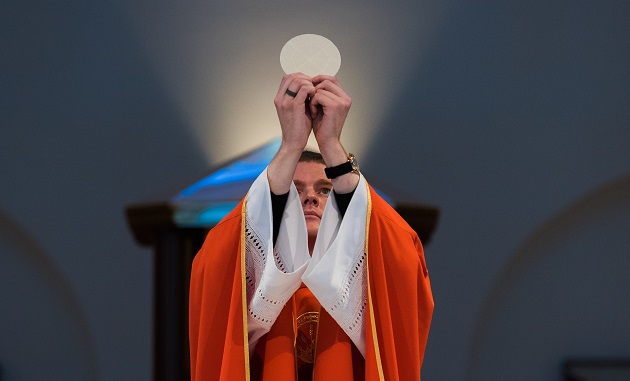
German Catholic bishops plan to allow some Protestants to cake Communion in their churches.


EF  19 April 2018
The German Catholic Episcopal Conference, headed by Cardinal Reinhard Marx, approved in its February gathering a proposal that has sparked a huge theological debate. 
The 62 German bishops have voted to produce a guide on how to allow Protestants married to Catholics to receive Communion. 
This non-Catholic spouses in “mixed marriages” could access the Catholic rite if they “affirm the Catholic Eucharist”. 
The Intercommunion, the bishops said, would be a solution for cases in which “the spiritual hunger to receive Communion together (…) is so strong that it could threat the marriage and the faith”. 

PROTESTANT CHURCH WELCOMES PROPOSAL 
The President of the German Protestant Church (EKD), Heinrich Bedford-Strohm, welcomed the announcement as “an important step in our ecumenical path”. 
Bedford-Strohm and his Catholic counterpart Reinhard Marx have been very proactive in sending pro-ecumenical messages during the commemoration of the 500 anniversary of the Protestant Reformation, in 2017, with calls to “heal the wounds of the past” and advance to stronger “unity” among the two Church institutions. 

STRONG CRITICISM OF SOME BISHOPS 
The open door for Protestants has been challenged by important Catholic sectors in Germany. Among them, seven German bishops that have written an open letter expressing their opposition to what they define as a “Protestantisation of the Church”. 
In interviews with the media, some of the signatories have criticised what they believe is a “banalisation” of the “holiest Sacrament” of Catholicism. 
Protestant taking part in the Communion would ‘de facto’ contradict the Protestant doctrines and its view of the Lord’s Supper. These bishops called the Vatican and Pope Francis to step into the debate. 
Catholic media have reported in the last days that the Vatican’s Congregation for the Doctrine of the Faith would have sent a letter to the German conference asking to pause the proposal. It is not expected, though, that Rome will express this position publicly. 

EVANGELICALS SEE ECUMENIAL STRATEGY 
Evangelical leaders have also reacted with surprise to the moves towards Intercommunion. In an interview with German news agency Idea, evangelical theology professor Ulrich Körtner said it would be difficult for a Protestant believer to accept the Catholic doctrine of the Eucharist, which “includes the veneration of Mary as the Mother of God, and the intercession of the Apostles, martyrs and saints”. 
The decision of the German Episcopal Conference can be understood as a strategy to attract Protestants to the Catholic liturgy. “I would not be surprised that someday other ecumenical formulas are presented to us to try to sell us that high prayers of the Catholic Eucharist are evangelical”.