Showing posts with label Christ Righteousness. Show all posts
Showing posts with label Christ Righteousness. Show all posts
Wednesday, March 31, 2021


Sunday, January 31, 2021
Jesus the Messiah alone is the Chief Cornerstone
Early Christians fully understood the symbolism of the demolished Temple, because Jehovah alone is referred to as a STONE hundreds of times in the Holy Bible. That is why they did not build stone churches until after the year 1000 AD.
He is the Rock, his work is perfect: for all his ways are judgment: an Elohim of truth and without iniquity, just and right is he (Deuteronomy 32:4).
For who is Elohim save Jehovah? or who is a rock save Elohim? (Psalm 18:31).
Daniel the Prophet told King Nebuchadnezzar that the Stone cut out of the mountain was indeed Jehovah himself:
You (Nebuchadnezzar) watched while a stone was cut out without hands, which struck the statue on its feet of iron and clay, and broke them in pieces. Then the iron, the clay, the bronze, the silver, and the gold were crushed together, and became like chaff from the summer threshing floors; the wind carried them away.so that no trace of them was found. And the stone that struck the statue became a great mountain and filled the whole earth (Daniel 2:34-35).
Saint Paul—a Hebrew of the Hebrews—reiterated that Truth when he wrote that Christ was the Rock:
And they all drank the same spiritual drink, for they drank of the spiritual Rock that followed them, and that Rock was Christ (I Corinthians 10:4).
The Exodus from Egypt is an end of the world scenario; Pharaoh and his followers are the inhabitants of Vanity Fair at the end of time.
 Pharaoh Ramses II, died by drowning in 1533 BC. |
|
 Pharaoh and his chariots were drowned in the Red Sea. |
The Jewish Rock promised to continue doing heart surgery until the end of time:
And I will give you a new heart and put a new spirit within you; and I will take the heart of stone out of your flesh and give you a heart of flesh (Ezekiel 36:26).
St. Peter was very explicit about who was the real Rock of Ages:
Wherefore it is said in the scripture: Behold I lay in Zion a chief corner stone, elect, precious. And he that shall believe in him, shall not be confounded (I St. Peter 2:6, Douay-Rheims Version). Reformation
Monday, November 30, 2020
Do grace make us free from obedience to God?
Salvation is a gift from God (Ephesians 2:8-9). There is nothing we can do to earn it. But, do grace make us free from obedience to God?
Do we then make void the law through faith? God forbid: yea, we establish the law Romans 3:31
For sin shall not have dominion over you: for ye are not under the law, but under grace. What then? shall we sin, because we are not under the law, but under grace? God forbid. Know ye not, that to whom ye yield yourselves servants to obey, his servants ye are to whom ye obey; whether of sin unto death, or of obedience unto righteousness? Romans 6:14-16
Wherefore the law is holy, and the commandment holy, and just, and good. Romans 7:12
Therefore by the deeds of the law there shall no flesh be justified in his sight: for by the law is the knowledge of sin. Romans 3:20
Jesus said, “If ye love me, keep my commandments…If ye keep my commandments, ye shall abide in my love; even as I have kept my Father’s commandments, and abide in his love” John 14:15, 15:10.
For this is the love of God, that we keep his commandments: and his commandments are not grievous. 1 John 5:3
Woman, where are those thine accusers? hath no man condemned thee? She said, No man, Lord. And Jesus said unto her, Neither do I condemn thee: go, and sin no more” John 8:10-11
There is therefore now no condemnation to them which are in Christ Jesus, who walk not after the flesh, but after the Spirit. Romans 8:1
What does it profit, my brethren, if someone says he has faith but does not have works? Can faith save him? If a brother or sister is naked and destitute of daily food, and one of you says to them, “Depart in peace, be warmed and filled,” but you do not give them the things which are needed for the body, what does it profit? Thus also faith by itself, if it does not have works, is dead. But someone will say, “You have faith, and I have works.” Show me your faith without your works, and I will show you my faith by my works. You believe that there is one God. You do well. Even the demons believe—and tremble! But do you want to know, O foolish man, that faith without works is dead? Was not Abraham our father justified by works when he offered Isaac his son on the altar? Do you see that faith was working together with his works, and by works faith was made perfect? And the Scripture was fulfilled which says, “Abraham believed God, and it was accounted to him for righteousness.” And he was called the friend of God. You see then that a man is justified by works, and not by faith only. Likewise, was not Rahab the harlot also justified by works when she received the messengers and sent them out another way? For as the body without the spirit is dead, so faith without works is dead also. James 2:14-26
There is none other name under heaven given among men, whereby we must be saved.
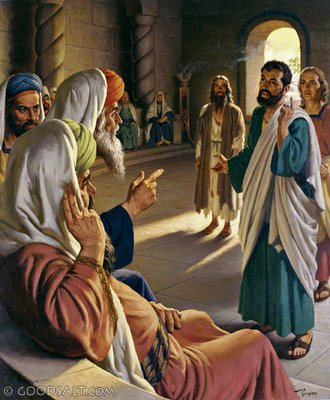 7 And when they had set them in the midst, they asked, By what power, or by what name, have ye done this?
8 Then Peter, filled with the Holy Ghost, said unto them, Ye rulers of the people, and elders of Israel,
9 If we this day be examined of the good deed done to the impotent man, by what means he is made whole;
10 Be it known unto you all, and to all the people of Israel, that by the name of Jesus Christ of Nazareth, whom ye crucified, whom God raised from the dead, even by him doth this man stand here before you whole.
11 This is the stone which was set at nought of you builders, which is become the head of the corner.
12 Neither is there salvation in any other: for there is none other name under heaven given among men, whereby we must be saved. Acts 4:7-12
Wednesday, September 30, 2020
Jesus loves to have children pray to Him
Jesus represents us as his children. He declares that he is our Father, and that we are to come to him as children come to an earthly parent. Youth Instructor Sep 13,1894 par6
That which is to distinguish Christians from all others is their union with Christ. This union is their strength and their efficiency. It leads them to love Jesus, to pray to Him, and to honor Him by doing His commandments. The fruit of this union is seen in their love for one another. MS 1901 par9
I hope all you that are praying children will endeavor to live your prayers. Pray in faith, believing that Jesus hears you; then watch, bearing in remembrance your prayers. Jesus loves to have children pray to Him. Believe and trust Him. When you are tempted to speak impatiently, lift up your heart in prayer—silent prayer, if it is not convenient for you to go by yourself. Jesus knows every trial that you bear, every self-denial that you may make, and he can appreciate just how much it costs you every time to give up your will and way to the desire of others. And Jesus is ready to help when you call upon Him for help. He loves to have you feel how weak you will be in your own strength, without His special help. Letter 12 1867 par6
Try to live humble, prayerful lives and expect the blessing of the Lord to be with you. Believe that He hears you when you pray to Him. Tell Jesus all your troubles, all your perplexities. He will delight to bear your burdens and griefs for you. We have a tender, compassionate, loving, pitiful Saviour. Love Him and trust Him with your whole heart, my precious, dutiful boy. Letter 13 1867 par6
I cannot tell you how many letters came to me across the broad Pacific, when I was in Australia, asking for counsel. What did Christ promise His disciples if they would believe in Him as their personal Saviour? “Lo, I am with you alway,” He said, “even unto the end of the world” [Matthew 28:20]. Again He says, “I am at thy right hand to help thee” [see Psalm 16:8]. Think of how many promises He has given us, which we may grasp by the hand of faith. When we go to the Source of power, we know that we shall receive that intelligence and wisdom which comes from the pure source, which is not mixed with anything of humanity. As we pray, it is our privilege to know that God wants us to pray, to ask Him for help. “Ask, and ye shall receive” [John 16:24]. It is for you to believe that you will receive. He wants us to become acquainted with Him, to speak to Him, to tell Him of our difficulties, and obtain an experience in asking of One who never misjudges and never makes a mistake. 2 Sermons & Talks p.164
Monday, August 31, 2020
The Beatitudes

3Blessed are the poor in spirit: for theirs is the kingdom of heaven.
4Blessed are they that mourn: for they shall be comforted.
5Blessed are the meek: for they shall inherit the earth.
6Blessed are they which do hunger and thirst after righteousness: for they shall be filled.
7Blessed are the merciful: for they shall obtain mercy.
8Blessed are the pure in heart: for they shall see God.
9Blessed are the peacemakers: for they shall be called the children of God.
10Blessed are they which are persecuted for righteousness' sake: for theirs is the kingdom of heaven.
11Blessed are ye, when men shall revile you, and persecute you, and shall say all manner of evil against you falsely, for my sake.
12Rejoice, and be exceeding glad: for great is your reward in heaven: for so persecuted they the prophets which were before you. Matthew 5
Friday, July 31, 2020
In the Lord put I my trust
 In the Lord put I my trust: how say ye to my soul, Flee as a bird to your mountain?
2 For, lo, the wicked bend their bow, they make ready their arrow upon the string, that they may privily shoot at the upright in heart.
3 If the foundations be destroyed, what can the righteous do?
4 The Lord is in his holy temple, the Lord's throne is in heaven: his eyes behold, his eyelids try, the children of men.
5 The Lord trieth the righteous: but the wicked and him that loveth violence his soul hateth.
6 Upon the wicked he shall rain snares, fire and brimstone, and an horrible tempest: this shall be the portion of their cup.
7 For the righteous Lord loveth righteousness; his countenance doth behold the upright. Psalms 11
Friday, April 26, 2019
The judgment of those who profess the truth

On
the morning of October 23, 1879, about two o'clock, the Spirit of the
Lord rested upon me, and I beheld scenes in the coming judgment.
Language fails me in which to give an adequate description of the things
which passed before me and of the effect they had upon my mind.
The
great day of the execution of God's judgment seemed to have come. Ten
thousand times ten thousand were assembled before a large throne, upon
which was seated a person of majestic appearance. Several books were
before Him, and upon the covers of each was written in letters of gold,
which seemed like a burning flame of fire: “Ledger of Heaven.” One of
these books, containing the names of those who claim to believe the
truth, was then opened. Immediately I lost sight of the countless
millions about the throne, and only those who were professedly children
of the light and of the truth engaged my attention. As these persons
were named, one by one, and their good deeds mentioned, their
countenances would light up with a holy joy that was reflected in every
direction. But this did not seem to rest upon my mind with the greatest
force.
Another book was opened, wherein were recorded the sins
of those who profess the truth. Under the general heading of
selfishness came every other sin. There were also headings over every
column, and underneath these, opposite each name, were recorded, in
their respective columns, the lesser sins.
Under
covetousness came falsehood, theft, robbery, fraud, and avarice; under
ambition came pride and extravagance; jealousy stood at the head of
malice, envy, and hatred; and intemperance headed a long list of fearful
crimes, such as lasciviousness, adultery, indulgence of animal
passions, etc. As I beheld I was filled with inexpressible anguish and
exclaimed: “Who can be saved? who will stand justified before God? whose
robes are spotless? who are faultless in the sight of a pure and holy
God?”
As
the Holy One upon the throne slowly turned the leaves of the ledger,
and His eyes rested for a moment upon individuals, His glance seemed to
burn into their very souls, and at the same moment every word and action
of their lives passed before their minds as clearly as though traced
before their vision in letters of fire. Trembling seized them, and their
faces turned pale. Their first appearance when around the throne was
that of careless indifference. But how changed their appearance now! The
feeling of security is gone, and in its place is a nameless terror. A
dread is upon every soul, lest he shall be found among those who are
wanting. Every eye is riveted upon the face of the One upon the throne;
and as His solemn, searching eye sweeps over that company, there is a
quaking of heart; for they are self-condemned without one word being
uttered. In anguish of soul each declares his own guilt and with
terrible vividness sees that by sinning he has thrown away the precious
boon of eternal life.
One
class were registered as cumberers of the ground. As the piercing eye
of the Judge rested upon these, their sins of neglect were distinctly
revealed. With pale, quivering lips they acknowledged that they had been
traitors to their holy trust. They had had warnings and privileges, but
they had not heeded nor improved them. They could now see that they had
presumed too much upon the mercy of God. True, they had not such
confessions to make as had the vile and basely corrupt; but, like the
fig tree, they were cursed because they bore no fruit, because they had
not put to use the talents entrusted to them.
This class had made self
supreme, laboring only for selfish interests. They were not rich toward
God, not having responded to His claims upon them. Although professing
to be servants of Christ, they brought no souls to Him. Had the cause of
God been dependent on their efforts, it would have languished; for they
not only withheld the means lent them of God, but they withheld
themselves. But these could now see and feel that in occupying an
irresponsible position in reference to the work and cause of God they
had placed themselves on the left hand. They had had opportunity, but
would not do the work that they could and should have done.
The
names of all who profess the truth were mentioned. Some were reproved
for their unbelief, others for having been slothful servants. They had
allowed others to do the work in the Master's vineyard, and to bear the
heaviest responsibilities, while they were selfishly serving their own
temporal interests. Had they cultivated the abilities God had given
them, they could have been reliable burden bearers, working for the
interest of the Master. Said the Judge: “All will be justified by their
faith and judged by their works.” How vividly then appeared their
neglect, and how wise the arrangement of God in giving to every man a
work to do to promote the cause and save his fellow men. Each was to
demonstrate a living faith in his family and in his neighborhood, by
showing kindness to the poor, sympathizing with the afflicted, engaging
in missionary labor, and by aiding the cause of God with his means. But,
like Meroz, the curse of God rested upon them for what they had not
done. They had loved that work which would bring the greatest profit in
this life; and opposite their names in the ledger devoted to good works
there was a mournful blank.
The
words spoken to these were most solemn: “You are weighed in the
balances, and found wanting. You have neglected spiritual
responsibilities because of busy activity in temporal matters, while
your very position of trust made it necessary that you should have more
than human wisdom and greater than finite judgment. This you needed in
order to perform even the mechanical part of your labor; and when you
disconnected God and His glory from your business, you turned from His
blessing.”
The
question was then asked: “Why have you not washed your robes of
character and made them white in the blood of the Lamb? God sent His Son
into the world, not to condemn the world, but that through Him it might
be saved. My love for you has been more self-denying than a mother's
love. It was that I might blot out your dark record of iniquity, and put
the cup of salvation to your lips, that I suffered the death of the
cross, bearing the weight and curse of your guilt. The pangs of death,
and the horrors of the darkness of the tomb, I endured, that I might
conquer him who had the power of death, unbar the prison house, and open
for you the gates of life. I submitted to shame and agony because I
loved you with an infinite love, and would bring back my wayward,
wandering sheep to the paradise of God, to the tree of life. That life
of bliss which I purchased for you at such a cost, you have disregarded.
Shame, reproach, and ignominy, such as your Master bore for you, you
have shunned. The privileges He died to bring within your reach have not
been appreciated. You would not be partaker of His sufferings, and you
cannot now be partaker with Him of His glory.” Then were uttered these
solemn words: “He that is unjust, let him be unjust still: and he which
is filthy, let him be filthy still: and he that is righteous, let him be
righteous still: and he that is holy, let him be holy still.” The book
then closed, and the mantle fell from the Person on the throne,
revealing the terrible glory of the Son of God.
The
scene then passed away, and I found myself still upon the earth,
inexpressibly grateful that the day of God had not yet come, and that
precious probationary time is still granted us in which to prepare for
eternity. Testimonies for the Church, Vol 4, pp. 384-387
Monday, March 4, 2019
Is Christ God?
 This name was not given to Christ in consequence of some great achievement, but it is His by right of inheritance. Speaking of the power and greatness of Christ, the writer to the Hebrews says that He is made so much better than the angels, because "He hath by inheritance obtained a more excellent name than they." Heb. 1:4. A son always rightfully takes the name of the father; and Christ, as "the only begotten Son of God," has rightfully the same name. A son, also, is, to a greater or less degree, a reproduction of the father; he has to some extent the features and personal characteristics of his father; not perfectly, because there is no perfect reproduction among mankind. But there is no imperfection in God, or in any of His works, and so Christ is the "express image" of the Father's person. Heb. 1:3. As the Son of the self- existent God, He has by nature all the attributes of Deity.
 It is true that there are many sons of God, but Christ is the "only begotten Son of God," and therefore the Son of God in a sense in which no other being ever was or ever can be. The angels are sons of God, as was Adam (Job 38:7; Luke 3:38), by creation; Christians are the sons of God by adoption (Rom. 8:14, 15), but Christ is the Son of God by birth. The writer to the Hebrews further shows that the position of the Son of God is not one to which Christ has been elevated, but that it is one which He has by right.” Ellet J. Waggoner, Christ And His Righteousness, pp. 9-10, 1890
Monday, January 28, 2019
The want of the world is Christ.
The want of the world is Christ.
Poor hungry souls, how they long for food;
Poor lonely hearts, how they search for good,
But they seek it not as we know they should ;
This is found alone in Christ.
The want of the world is Christ;
He is wisdom and power and truth and grace,
And those who behold with joy his face,
Will ask for no richer, better place;
For all is given in Christ.
The want of the world is Christ;
How it groans today 'neath its load of sin,
So drunk with confusion and noise and din,
And will till the thousand years set in,
When the saints shall reign with Christ.
The want of the world is Christ;
But the hosts of the wicked have had their day,
The pride of their power has passed away,
And now to mountains and rocks they pray
To be hid from an awful Christ.
Then the joy of the world is Christ.
When the fate of each soul has been decreed,
The earth from sinners and sin is freed,
And life to Abraham and all his seed,—
The joy of the world is Christ.
Poor hungry souls, how they long for food;
Poor lonely hearts, how they search for good,
But they seek it not as we know they should ;
This is found alone in Christ.
The want of the world is Christ;
He is wisdom and power and truth and grace,
And those who behold with joy his face,
Will ask for no richer, better place;
For all is given in Christ.
The want of the world is Christ;
How it groans today 'neath its load of sin,
So drunk with confusion and noise and din,
And will till the thousand years set in,
When the saints shall reign with Christ.
The want of the world is Christ;
But the hosts of the wicked have had their day,
The pride of their power has passed away,
And now to mountains and rocks they pray
To be hid from an awful Christ.
Then the joy of the world is Christ.
When the fate of each soul has been decreed,
The earth from sinners and sin is freed,
And life to Abraham and all his seed,—
The joy of the world is Christ.
Friday, January 25, 2019
We are troubled on every side, yet not distressed
Therefore seeing we have this ministry, as we have received mercy, we faint not;
But have renounced the hidden things of dishonesty, not walking in craftiness, nor handling the word of God deceitfully; but by manifestation of the truth commending ourselves to every man's conscience in the sight of God.
But if our gospel be hid, it is hid to them that are lost:
In whom the god of this world hath blinded the minds of them which believe not, lest the light of the glorious gospel of Christ, who is the image of God, should shine unto them.
For we preach not ourselves, but Christ Jesus the Lord; and ourselves your servants for Jesus' sake.
For God, who commanded the light to shine out of darkness, hath shined in our hearts, to give the light of the knowledge of the glory of God in the face of Jesus Christ.
But we have this treasure in earthen vessels, that the excellency of the power may be of God, and not of us.
We are troubled on every side, yet not distressed; we are perplexed, but not in despair;
Persecuted, but not forsaken; cast down, but not destroyed;
Always bearing about in the body the dying of the Lord Jesus, that the life also of Jesus might be made manifest in our body.
For we which live are always delivered unto death for Jesus' sake, that the life also of Jesus might be made manifest in our mortal flesh.
So then death worketh in us, but life in you.
We having the same spirit of faith, according as it is written, I believed, and therefore have I spoken; we also believe, and therefore speak;
Knowing that he which raised up the Lord Jesus shall raise up us also by Jesus, and shall present us with you.
For all things are for your sakes, that the abundant grace might through the thanksgiving of many redound to the glory of God.
For which cause we faint not; but though our outward man perish, yet the inward man is renewed day by day.
For our light affliction, which is but for a moment, worketh for us a far more exceeding and eternal weight of glory;
While we look not at the things which are seen, but at the things which are not seen: for the things which are seen are temporal; but the things which are not seen are eternal. 2 Corinthians 4
But have renounced the hidden things of dishonesty, not walking in craftiness, nor handling the word of God deceitfully; but by manifestation of the truth commending ourselves to every man's conscience in the sight of God.
But if our gospel be hid, it is hid to them that are lost:
In whom the god of this world hath blinded the minds of them which believe not, lest the light of the glorious gospel of Christ, who is the image of God, should shine unto them.
For we preach not ourselves, but Christ Jesus the Lord; and ourselves your servants for Jesus' sake.
For God, who commanded the light to shine out of darkness, hath shined in our hearts, to give the light of the knowledge of the glory of God in the face of Jesus Christ.
But we have this treasure in earthen vessels, that the excellency of the power may be of God, and not of us.
We are troubled on every side, yet not distressed; we are perplexed, but not in despair;
Persecuted, but not forsaken; cast down, but not destroyed;
Always bearing about in the body the dying of the Lord Jesus, that the life also of Jesus might be made manifest in our body.
For we which live are always delivered unto death for Jesus' sake, that the life also of Jesus might be made manifest in our mortal flesh.
So then death worketh in us, but life in you.
We having the same spirit of faith, according as it is written, I believed, and therefore have I spoken; we also believe, and therefore speak;
Knowing that he which raised up the Lord Jesus shall raise up us also by Jesus, and shall present us with you.
For all things are for your sakes, that the abundant grace might through the thanksgiving of many redound to the glory of God.
For which cause we faint not; but though our outward man perish, yet the inward man is renewed day by day.
For our light affliction, which is but for a moment, worketh for us a far more exceeding and eternal weight of glory;
While we look not at the things which are seen, but at the things which are not seen: for the things which are seen are temporal; but the things which are not seen are eternal. 2 Corinthians 4
Tuesday, April 10, 2018
Who is the third person of the Godhead?
This video is intended primarily for Seventh-day Adventists.
Who is the third person of the Godhead? The Bible is clear, the Spirit
of Prophecy is clear, but many are confused or misled.
Our allegiance must not be to the doctrines of men or to any church. We
need to lay aside preconceived ideas, lay aside tradition and look to
the Word of God and follow His Word alone, for only there will we find
the truth.
Thursday, March 29, 2018
Lord, take my heart; for I cannot give it

The Lord says, "Because thou sayest, I am rich, and
increased with goods, and have need of nothing; and knowest
not that thou art wretched, and miserable, and poor, and
blind, and naked: I counsel thee to buy of Me gold tried
in the fire, that thou mayest be rich; and white raiment,
that thou mayest be clothed, and that the shame of thy
nakedness do not appear; and anoint thine eyes with
eyesalve, that thou mayest see." Rev. 3:17, 18. The gold
tried in the fire is faith that works by love. Only this can
bring us into harmony with God. We may be active, we
may do much work; but without love, such love as dwelt in
the heart of Christ, we can never be numbered with the
family of heaven.
No man can of himself understand his errors. "The
heart is deceitful above all things, and desperately wicked;
who can know it?" Jer. 17:9. The lips may express a
poverty of soul that the heart does not acknowledge. While
speaking to God of poverty of spirit, the heart may be
swelling with the conceit of its own superior humility and
exalted righteousness. In one way only can a true knowledge
of self be obtained. We must behold Christ. It is
ignorance of Him that makes men so uplifted in their own
righteousness. When we contemplate His purity and excellence,
we shall see our own weakness and poverty and
defects as they really are. We shall see ourselves lost and
hopeless, clad in garments of self-righteousness, like every
other sinner. We shall see that if we are ever saved, it
will not be through our own goodness, but through God's
infinite grace.
The prayer of the publican was heard because it showed
dependence reaching forth to lay hold upon Omnipotence.
Self to the publican appeared nothing but shame. Thus it
must be seen by all who seek God. By faith--faith that
renounces all self-trust--the needy suppliant is to lay hold
upon infinite power.
No outward observances can take the place of simple
faith and entire renunciation of self. But no man can empty
himself of self. We can only consent for Christ to accomplish
the work. Then the language of the soul will be,
Lord, take my heart; for I cannot give it. It is Thy
property. Keep it pure, for I cannot keep it for Thee.
Save me in spite of myself, my weak, unchristlike self.
Mold me, fashion me, raise me into a pure and holy
atmosphere, where the rich current of Thy love can flow through
my soul.
It is not only at the beginning of the Christian life that
this renunciation of self is to be made. At every advance step heavenward it is to be renewed. All our good works
are dependent on a power outside of ourselves. Therefore
there needs to be a continual reaching out of the heart after
God, a continual, earnest, heartbreaking confession of sin
and humbling of the soul before Him. Only by constant
renunciation of self and dependence on Christ can we walk
safely.
Saturday, March 17, 2018
Who shall separate us from the love of Christ?

Romans 5:8 ..."But God commendeth his love toward us, in that, while we were yet sinners, Christ died for us."
John 3:16 ..."For God so loved the world, that he gave his only begotten Son, that whosoever believeth in him should not perish, but have everlasting life."
1 John 3:1 ..."Behold, what manner of love the Father hath bestowed upon us, that we should be called the sons of God."
1 Corinthians 2:9 ..."But as it is written, Eye hath not seen, nor ear heard, neither have entered into the heart of man, the things which God hath prepared for them that love him."
Romans 8:32-39 ..."He that spared not his own Son, but delivered him up for us all, how shall he not with him also freely give us all things? ... It is Christ that died, yea rather, that is risen again, who is even at the right hand of God, who also maketh intercession for us. Who shall separate us from the love of Christ? shall tribulation, or distress, or persecution, or famine, or nakedness, or peril, or sword? As it is written, For thy sake we are killed all the day long; we are accounted as sheep for the slaughter. Nay, in all these things we are more than conquerors through him that loved us. For I am persuaded, that neither death, nor life, nor angels, nor principalities, nor powers, nor things present, nor things to come, Nor height, nor depth, nor any other creature, shall be able to separate us from the love of God, which is in Christ Jesus our Lord"
Friday, August 4, 2017
Jesus, thy blood and righteousness
Jesus, Thy blood and righteousness my beauty are, my glorious dress; ’midst flaming worlds, in these arrayed, with joy shall I lift up my head. Bold shall I stand in Thy great day; for who aught to my charge shall lay? Fully absolved through these I am from sin and fear, from guilt and shame. The holy, meek, unspotted Lamb, who from the Father’s bosom came, who died for me, e’en me to atone, Now for my Lord and God I own. Lord, I believe Thy precious blood, which, at the mercy seat of God, forever doth for sinners plead, for me, e’en for my soul, was shed. Lord, I believe were sinners more than sands upon the ocean shore, thou hast for all a ransom paid, for all a full atonement made.
When from the dust of death I rise to claim my mansion in the skies, ev’n then this shall be all my plea, Jesus hath lived, hath died, for me. This spotless robe the same appears, when ruined nature sinks in years; no age can change its glorious hue, the robe of Christ is ever new. Jesus, the endless praise to Thee, whose boundless mercy hath for me— for me a full atonement made, an everlasting ransom paid. O let the dead now hear Thy voice; now bid Thy banished ones rejoice; their beauty this, their glorious dress, Jesus, Thy blood and righteousness.
Words: Nikolaus L. von Zinzendorf, 1739 (Christi Blut und Gerechtigkeit); first published in the eighth appendix to his Das Gesang-Buch der Gemeine in Herrn-Huth.; translated from German to English by John Wesley, Hymns and Sacred Poems, 1740, alt.
John Wycliffe, the medieval reformer
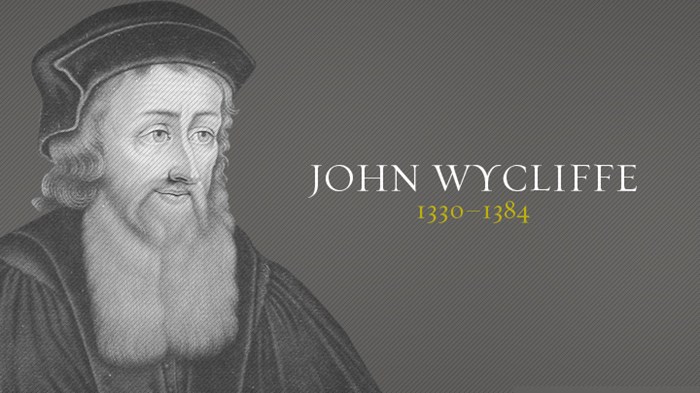
"Trust wholly in Christ; rely altogether on his sufferings; beware of
seeking to be justified in any other way than by his righteousness."
John Wycliffe left
quite an impression on the church: 43 years after his death, officials
dug up his body, burned his remains, and threw the ashes into the river
Swift. Still, they couldn't get rid of him. Wycliffe's teachings, though
suppressed, continued to spread. As a later chronicler observed, "Thus
the brook hath conveyed his ashes into Avon; Avon into Severn; Severn
into the narrow seas; and they into the main ocean. And thus the ashes
of Wycliffe are the emblem of his doctrine which now is dispersed the
world over."
Timeline |
|
1302
|
Unam Sanctam proclaims papal supremacy
|
1309
|
Papacy begins "Babylonian" exile in Avignon
|
1321
|
Dante completes Divine Comedy
|
1330
|
John Wycliffe born
|
1384
|
John Wycliffe dies
|
1415
|
Jan Hus burned at stake
|
"Master of errors"
Wycliffe had been born in the hinterlands, on a sheep farm 200 miles
from London. He left for Oxford University in 1346, but because of
periodic eruptions of the Black Death, he was not able to earn his
doctorate until 1372. Nonetheless, by then he was already considered
Oxford's leading philosopher and theologian.
In 1374 he became rector of the parish in Lutterworth, but a year later
he was disappointed to learn he was not granted a position at Lincoln
nor the bishopric of Worcester—setbacks that some have seized upon as
motives for his subsequent attacks on the papacy.
In the meantime, Rome had demanded financial support from England, a
nation struggling to raise money to resist a possible French attack.
Wycliffe advised his local lord, John of Gaunt, to tell Parliament not
to comply. He argued that the church was already too wealthy and that
Christ called his disciples to poverty, not wealth. If anyone should
keep such taxes, it should be local English authorities.
Such opinions got Wycliffe into trouble, and he was brought to London
to answer charges of heresy. The hearing had hardly gotten underway when
recriminations on both sides filled the air. Soon they erupted into an
open brawl, ending the meeting. Three months later, Pope Gregory XI
issued five bulls (church edicts) against Wycliffe, in which Wycliffe
was accused on 18 counts and was called "the master of errors."
At a subsequent hearing before the archbishop at Lambeth Palace,
Wycliffe replied, "I am ready to defend my convictions even unto death….
I have followed the Sacred Scriptures and the holy doctors." He went on
to say that the pope and the church were second in authority to
Scripture.
This didn't sit well with Rome, but because of Wycliffe's popularity in
England and a subsequent split in the papacy (the Great Schism of 1378,
when rival popes were elected), Wycliffe was put under "house arrest"
and left to pastor his Lutterworth parish.
Disputing the church
He deepened his study of Scripture and wrote more about his conflicts
with official church teaching. He wrote against the doctrine of
transubstantiation: "The bread while becoming by virtue of Christ's
words the body of Christ does not cease to be bread."
He challenged indulgences: "It is plain to me that our prelates in
granting indulgences do commonly blaspheme the wisdom of God."
He repudiated the confessional: "Private confession … was not ordered by Christ and was not used by the apostles."
He reiterated the biblical teaching on faith: "Trust wholly in Christ;
rely altogether on his sufferings; beware of seeking to be justified in
any other way than by his righteousness."
Believing that every Christian should have access to Scripture (only
Latin translations were available at the time), he began translating the
Bible into English, with the help of his good friend John Purvey.
The church bitterly opposed it: "By this translation, the Scriptures
have become vulgar, and they are more available to lay, and even to
women who can read, than they were to learned scholars, who have a high
intelligence. So the pearl of the gospel is scattered and trodden
underfoot by swine."
Wycliffe replied, "Englishmen learn Christ's law best in English. Moses
heard God's law in his own tongue; so did Christ's apostles."
Wycliffe died before the translation was complete (and before
authorities could convict him of heresy); his friend Purvey is
considered responsible for the version of the "Wycliffe" Bible we have
today. Though Wycliffe's followers (who came to be called
"Lollards"—referring to the region of their original strength) were
driven underground, they remained a persistent irritant to English
Catholic authorities until the English Reformation made their views the
norm. Christianity Today
Subscribe to:
Posts (Atom)