- Venezuela is rolling out a new, smart-card ID known as the "carnet de la patria," or "fatherland card," manufactured by Chinese telecom giant ZTE Corp.
- The ID transmits data about cardholders to government computer servers, and is increasingly linked to subsidized food, health, and other social programs most Venezuelans rely on to survive.
- The fatherland card, critics argue, illustrates how China, through state-linked companies like ZTE, exports technological know-how that can help like-minded governments track, reward, and punish citizens.
Showing posts with label Venezuela. Show all posts
Showing posts with label Venezuela. Show all posts
Thursday, November 29, 2018
Venezuela is rolling out a new, smart-card ID
Business Insider Nov. 18, 2018


Tuesday, February 13, 2018
Venezuela’s neighbours are tightening their borders as crisis spurs exodus
Venezuela’s neighbours are tightening their borders, alarmed by the
exodus of hundreds of thousands of desperate refugees fleeing hunger,
hyperinflation and a spiralling political crisis.
Brazil and Colombia are sending extra troops to patrol frontier regions where Venezuelans have arrived in record numbers over recent months.
Colombia, which officially took in more than half a million
Venezuelans over the last six months of 2017, also plans to make it
harder to cross the frontier or stay illegally in Colombia. Brazil said it will shift refugees from regions near the border where social services are badly strained.
The economic crisis and food shortages which have driven so many from their homes show no signs of easing.
The International Monetary Fund forecasts hyperinflation in Venezuela will hit 13,000% this year, so most salaries are now worth the equivalent of just a few British pounds a month.
Saturday, September 30, 2017
Thousands of Venezuelans are searching for a new life in Colombia as crisis deepens
28 September 2017
Many have queued overnight, waiting patiently for the Simón Bolívar
International bridge to open. Some 25,000 people cross the bridge into
Colombia every day.
It is a short walk between the two countries but with the political and economic crisis in Venezuela deepening, the two neighbours now seem worlds apart.
Venezuela
is suffering from acute shortages of medicines, hospitals struggle to
treat patients and staple goods have become scarce and unaffordable to
many.
Mothers cradle their babies, bringing them to the hospital in the
town of Cúcuta, on the Colombian side of the border, to get them
vaccinated.
Families push poorly relatives in wheelchairs. Others
cross into Colombia with empty suitcases, filling them up with food and
supplies they cannot get in Venezuela.
Two women with a baby in a
pushchair walk past the border guard, muttering: "What a humiliation."
They are clearly embarrassed they have to do this.
Crossing the border for food
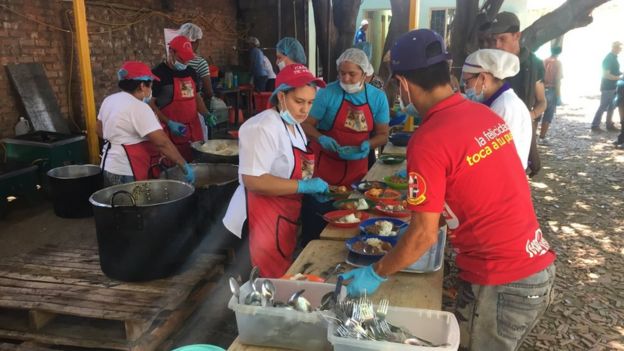
The
local church in Cúcuta is feeding between 600 and 2,000 people a day in
an open-air courtyard filled with plastic tables and chairs.
Verónica Mendoza, 24, is five months pregnant. She is tucking in to a
meal of rice, beans, potatoes and mince with her mother, Mariluz.
The two women travel two hours every day from Venezuela to sell fruit at a market in Colombia.
They cannot find work back home. They come here for their only proper meal of the day.
"Look
at the weight I've lost," says Mariluz, grabbing her once fleshy arms
and showing the loose skin. "I used to be healthy and strong. But we
have to walk such a long way and work so hard."
Mariluz's case is not rare. Recent research [in Spanish] suggests that three-quarters of Venezuelans lost weight in the past year, an average of 9kg (20lb).
Living on the streets
The
Colombian government recently introduced "border mobility cards" to
allow Venezuelans to go back and forth across the border without the
need for a passport.
More than 700,000 people have applied for the scheme so far.
But some like Carlos Alberto Ledesma, a professional jazz musician from Caracas, want to stay in Colombia for good.
Mr Ledesma arrived in Cúcuta eight days ago. "I spent a year living on the streets," he says.
"I stopped working in Venezuela because the bars aren't open, half of the musicians have gone."
Official
figures put the number of Venezuelans who have left their homeland for
Colombia because of the crisis at 300,000. But the actual number is
thought to be much higher.
The influx is putting strain on
communities in Colombia, which have lived through more than five decades
of armed conflict between left-wing guerrilla groups, the armed forces
and right-wing paramilitaries.
Luis Fernando Niño López is the
secretary for victims, peace and post-conflict for the province of Norte
de Santander, where Cúcuta is located.
"At the moment, there's a pretty big flow but not everybody stays," he says of the Venezuelans arriving in the region.
"But
what's going to happen when they can't go back because [Venezuelan
President Nicolás] Maduro closes the border or because armed groups that
control the border won't let people go back?"
Sheltering Venezuelans
At
a shelter run by the Scalabrini International Migration Network in the
centre of Cúcuta, the growing scale of the problem is evident.
Between January and June, 650 people came through its doors. In August alone, there were 850 people.
Mr
Franklin Díaz, who runs the shelter, says those who come to the shelter
are in urgent need of attention and more should be done to help them.
"The action of the authorities is fundamental, they are the ones who manage the resources."
Many of those crossing into Colombia from Venezuela originally fled the armed conflict in Colombia.
Nereidis Ascanio is one of them. Her father was killed by paramilitaries so her family left for Venezuela when she was a child.
A single mother, her two little boys have Venezuelan nationality.
She
recently returned to Colombia and now lives in a little shack made out
of wooden beams and a corrugated iron roof on the outskirts of Cúcuta.
The tarpaulin walls do not even cover the entire shack.
Ms Ascanio is desperate. "I need to find food for my kids," she says while she wipes away tears.
"And I need to find a job that will allow me to look after my boys."
Getting stuck in Cúcuta
Other Colombians left for Venezuela when the oil industry started booming there in the 1980s.
With oil prices now low and the economic crisis in Venezuela worsening, they too are returning in large numbers.
Many arrive in Colombia with great expectations of a new life.
But
Venezuela's triple-digit inflation means their savings in Venezuelan
bolivares are worthless once converted into Colombian pesos, so many get
stuck.
In the middle of the town is a roundabout with a large
sculpture which reads "I love Cúcuta". Some people are curled up
sleeping in the letters "c".
Jeferson José Gutierres is one of those sleeping rough along with his wife and their three children.
He came here a month ago and cannot find work.
But he says
life in Cúcuta is still better than in Venezuela and he is not planning
on going back while President Maduro is in power.
"I'll return when Maduro goes," he says.
"He's a president who spends money while his people die of hunger." BBC
Friday, June 9, 2017
United Airlines will end its daily flight service to Venezuela in July, further isolating the crisis-hit South American country
| WASHINGTON
United
Airlines will end its daily flight service to Venezuela in July, further
isolating the crisis-hit South American country from international
travel after the exit of many major airlines in recent years.
Many
airlines have left after a protracted dispute over billions of dollars
they say the government owes them. They say President Nicolas Maduro's
administration has failed to reimburse companies in hard currency for
ticket sales in local currency, as per strict currency controls in the
socialist nation.
United, which
flies daily between Caracas and Houston'sGeorge Bush Intercontinental
Airport, confirmed to Reuters that it was halting that route, though
said it was not because of any payment dispute.
While
the flight is popular with Texas-based oil executives and Venezuelans
living in the United States, few tourists travel to the crisis-stricken
country and flights often have low occupancy.
"In
every market we serve, we continually review demand for service and
because our Houston-Caracas service is not meeting our financial
expectations we have decided to suspend it, effective July 1," United
spokesman Charles Hobart said in an email to Reuters.
In
addition to currency disputes and low occupancy on flights to
Venezuela, airlines also fret about security for their crews on the
ground.
Unrest
prompted by food shortages has resulted in the deaths of at least 64
people since April. On Saturday, a few hundred activists staged a
protest in western Caracas.
United
in April added a one-hour stop in the Caribbean island of Aruba to its
Houston-to-Caracas leg, a move analysts said was to ensure crews would
not have to stay overnight in Venezuela. Reuters
Wednesday, June 7, 2017
Venezuela is facing complete socioeconomic ruin. What comes next?

By Salvatore Giannavola, Jun 3, 2017
The
economic and political crisis in Venezuela is rapidly deteriorating
into a monumental human tragedy. Essential goods are becoming
exceedingly rare and political violence is on the rise.
We
decided to analyze the Venezuelan paradox from close up. Alejandra, a
Venezuelan girl who left her country about four years ago for
Europe,offered us some perspective on what is happening in her homeland.
Today she works as an architect in Malta. Find the video of the complete interview here at Blogstermind.
Venezuela through Alejandra's eyes
Hi Alejandra, thank you for accepting our proposal. For us, this testimony has enormous value. Let's start with the first question.
Hi Alejandra, thank you for accepting our proposal. For us, this testimony has enormous value. Let's start with the first question.
How is the typical day of a young Venezuelan?
I can answer this question as I have a 23-year-old brother. There is nothing to do because it is dangerous to walk in the streets, there is no money to devote to something other than food, water, and utilities. Those few who have the money work for the government, for criminal organizations or are tourists.
We read in the international newspapers that today electricity and other essential goods have been rationed. Is this true?
Yes, the rationing of resources in my country has been a sad reality for years and the situation is aggravated by the unpredictability with which the government operates. It often happens that electricity and water are missing for several hours without any notice and this does not allow the population an adequate organization. This economic war pushes companies, nationally and not, to impose fixed prices that increase each day.
Who are the Bachaqueros? How did this profession come out?
The Bachaqueros are marginal people willing to wait for hours in lines at the shop, and then resell the necessities on the black market for three times their purchase price. They're the "daughter-in-law" of the food shortage, which has caused endless lines in front of supermarkets, accompanied by party restrictions that allow purchases only one day a week per person.
How long have you been abroad? How often do you visit your family?
I've been twice in my country for the last four years. Traveling is only possible if you have your passport; they're very difficult to obtain because the bureaucracy doesn't even have the paper needed to print them. Those who managed to leave without a passport have serious problems coming back because then when he returns, he would not get one. There is no paper to print them in the offices.
I can answer this question as I have a 23-year-old brother. There is nothing to do because it is dangerous to walk in the streets, there is no money to devote to something other than food, water, and utilities. Those few who have the money work for the government, for criminal organizations or are tourists.
We read in the international newspapers that today electricity and other essential goods have been rationed. Is this true?
Yes, the rationing of resources in my country has been a sad reality for years and the situation is aggravated by the unpredictability with which the government operates. It often happens that electricity and water are missing for several hours without any notice and this does not allow the population an adequate organization. This economic war pushes companies, nationally and not, to impose fixed prices that increase each day.
Who are the Bachaqueros? How did this profession come out?
The Bachaqueros are marginal people willing to wait for hours in lines at the shop, and then resell the necessities on the black market for three times their purchase price. They're the "daughter-in-law" of the food shortage, which has caused endless lines in front of supermarkets, accompanied by party restrictions that allow purchases only one day a week per person.
How long have you been abroad? How often do you visit your family?
I've been twice in my country for the last four years. Traveling is only possible if you have your passport; they're very difficult to obtain because the bureaucracy doesn't even have the paper needed to print them. Those who managed to leave without a passport have serious problems coming back because then when he returns, he would not get one. There is no paper to print them in the offices.
Alejandra, history teaches us that discontent and repression cannot last long, when and how will you end all this? Do you think the Trump administration will intervene?
Power needs to change but I do not want American intervention at all. I would not like to see Trump's intervention, I hope rather than the national governments of other states pledge to help us get out of this crisis situation. Russia Insider
Power needs to change but I do not want American intervention at all. I would not like to see Trump's intervention, I hope rather than the national governments of other states pledge to help us get out of this crisis situation. Russia Insider
Saturday, May 20, 2017
Saturday, April 15, 2017
Four more citizens have been killed in opposition-led street violence in Venezuela

Caracas, April 12, 2017 (venezuelanalysis.com)
– Four more citizens have been killed in opposition-led street violence
in Venezuela, bringing the death count to a total of six since the
protests began nine days ago.
The victims are: Bryan Principal, 13, Miguel Ángel Colmenares, 36, Oliver Villa Camargo, 29, and Antonio Gruseny Canelon, 32.
Principal, Colmenarez, and Canelon were all killed in the
western state of Lara, one of the focal points of the violence, while
Camargo was shot dead in central Caracas.
According to reports, Principal was killed by opposition
protestors who opened fire on the Ali Primera government housing project
in Barquisimeto during a black-out on Tuesday night. He later died from
his injuries in the hospital.
In statements released following the minor’s death,
residents at Ali Primera explained that the housing project had been at
the centre of an ongoing confrontation between pro-government supporters
and opposition protesters throughout the day. Read More
Wednesday, December 7, 2016
Venezuela’s Economic Crisis Is So Bad That Women Are Selling Their Hair

By Reuters,
“I’m here because I have nothing to eat,” said one woman.
Women from crisis-hit Venezuela are
crossing the border in droves and selling their hair in a Colombian
border town in order to afford scarce basic necessities such as food,
diapers or medicines.
The trend, which has taken off in recent weeks, is another sign of
the oil-rich country’s deepening crisis amid shortages and spiraling
inflation that have millions skipping meals and forgoing costly medical
treatment.
Dozens of middlemen, known as “draggers,” stand on a bridge linking San Antonio, Venezuela, to Colombia’s La Parada, calling out: “We buy hair!”
Some 200 women a day are taking up their offer at one of seven
makeshift stands dotting La Parada, according to estimates from five
middlemen. The locks are then sold as extensions in the western
Colombian city of Cali.
Celina Gonzales, a 45-year-old street vendor, stood in line for an
hour to sell her mid-length brown hair for 60,000 Colombian pesos, or
about $20 – the equivalent of a monthly minimum wage and food tickets
back home.
“I suffer arthritis and I need to buy medicine. This won’t be much,
but at least I can buy painkillers,” said Gonzales, who had not told her
family what she was doing.
Venezuela‘s leftist government blames
the crisis on businessmen waging an “economic war” to sabotage it. The
Information Ministry did not respond to a request for comment.
‘THEY GO BUY FOOD’
As the economy teeters under a third year of recession, Venezuelans
are increasingly ending up empty-handed despite long lines for
heavily-subsidized food. Non-subsidized food is far too expensive, with a
bag of rice sometimes costing around a tenth of monthly earnings.
Many are forced to survive on starches or forage through garbage for
scraps. In recent months, hundreds have drifted across to Colombia to
buy groceries.
In the border towns, the hair business is booming.
“I can take off volume, cut strands here and there or make a ponytail
and cut all the hair,” explained Jenifer Nino, 31, a so-called dragger,
as she stood next to informal hair salons housed on street corners,
sidewalks and even a tire store.
“Most of the women come here with little kids and after cutting their hair they go buy food,” Nino added.
Some women complain the haircuts are sloppy and end up regretting the decision, while others are turned away.
Maribel, a poor woman from Venezuela‘s Tachira state traveled to Colombia after her brother told her about the hair business.
“I’m here because I have nothing to eat,” she said, but was later rebuffed because her hair was too short and thin. Fortune
Saturday, October 29, 2016
The Other Explanation for Venezuela’s Economic Crisis
By Peter Bolton, Research Fellow at the Council on Hemispheric Affairs
To download a PDF version of this article, click here.
Reports in the English-language press last week highlighted a series
of small-scale street protests in Venezuela that bemoaned the scarcity
of certain basic products, chronic shortages of medical supplies, and
continued power and water outages throughout the country. According to
Reuters, for instance, more than a thousand such protests occurred in
January and February and, taken together, “show the depth of public
anger” and “could become a catalyst for wider unrest.”[1]
News accounts proclaiming Venezuela’s state of emergency are not new
but in recent weeks have reached hysterical levels, with the
Boston-based Global Post claiming that Venezuela’s economic situation is
now “worse than 1960s Cuba.”[2]
The mainstream narrative explanation is that the crisis is the result
of economic mismanagement and the ideological rigidity of the country’s
“authoritarian” Chavista led-government. For instance, Andreas E.
Feldmann, Federico Merke, and Oliver Stuenkel, writing for the Carnegie
Endowment for International Peace, wrote last November that “Venezuela’s
steep recession has been worsened by economic mismanagement leading to
mounting inflation, a widening fiscal deficit, and growing shortages of
essential goods including food, soap, and diapers.”[3]
Similarly, Arlecchino Gomez at The Daily Signal, wrote, also last
November, that Venezuela’s recession “was largely due to government
incompetence and mismanagement.”[4]
The Workings of the “Free” Market
These sentiments are strongly predicated on the standard line of
economic thought prevailing in the Western media and political class:
that stringent price and currency controls are distorting the mechanisms
of the “free” market and have led to stagnant production, soaring
inflation and a burgeoning black market in U.S. dollars and consumer
goods. The explicit or strongly implied conclusion is that the crisis
proves beyond doubt that socialism “doesn’t work” and that the solution
to Venezuela’s ills is a return with gusto to Chicago School economic
policy and hence a restoration of the unimpeded mechanisms of the
market. Making this point in Forbes magazine, Tim Walstall goes
so far as to compare the situation in Venezuela with the collapse of
the Soviet Union; he argues that the solution “is to do as Russia did at
the end of their socialist nightmare… [and implement] an immediate move
to full blown free marketry [sic].”[5]
To achieve this, “regime change” is presented as an imperative
prerequisite and the only viable way for things to improve. Michael
Shifter, writing in Foreign Affairs, says that even though many
on the Latin American left initially found Chavismo an “appealing
alternative to market-based approaches,” these days “few dispute that it
has failed.”[6]
The Alternative Thesis
Within Venezuela itself, however, this analysis is just one of two
competing narratives, both of which are discussed and taken seriously in
discussions of policy, governance, and economic dynamics. The economic
mismanagement thesis is the natural position taken by the Venezuelan
opposition and its allies. But the fact that it is practically the only
narrative reported in the English-language press misrepresents the
intricacies of Venezuela’s economic problems while revealing how Western
media heavily favor the opposition’s analysis, often by its own
admission. (Rory Carroll of The Guardian, for instance, boasted
that he moved almost exclusively in opposition elite circles while
based in Caracas as the paper’s Latin America editor.)
But there is another narrative, favored by the government and the
pro-Chavista social movements and civil society sectors, which, it is
important to stress, are independent of the government. This perspective
can loosely be called the economic war thesis. It explains the crisis
in terms of the economic and social dynamics at play outside policy and
governmental action. It holds that business sectors friendly to the
opposition are waging an aggressive and protracted campaign of economic
sabotage to deliberately stir up social unrest to destabilize and
discredit the governing Chavista bloc and in the ensuing chaos bring
about an end to the PSUV government and the installation of a new one
made up of opposition parties. The central pillars of the economic war
thesis are that these hostile sectors have been engaging in acts such as
hoarding and price speculation and have purposely generated scarcity in
pursuit of calculated chaos.
Naturally, all of the allegations that make up this narrative are
dismissed out of hand by the opposition, which argues that they amount
to a desperate propaganda stunt to shift blame from the government’s own
incompetence onto its political opponents. President Nicolás Maduro’s
use of the term “bourgeois parasites” in particular has been seized on
by opposition commentators to portray him as a hopeless buffoon
desperately holding onto to power and flailingly seeking to prop up a
failed political project. Friendly commentators in the Western press are
equally disparaging, with the aforementioned Michael Shifter, for
instance, claiming that these accusations “have no merit,” but do serve
to “show that any semblance of cooperation between the executive and the
assembly to alleviate the country’s economic collapse is, at least for
now, far-fetched.”[7]
Similarly, Jeffrey Taylor writes in Foreign Policy, “Maduro’s response
[to shortages and currency crises] has been to blame everything on
scheming “Yanquis,” Venezuela’s “far-right elite,” the “parasitic
bourgeois,” and, of course, the opposition, “even though he has
effectively neutralized its leadership.”[8]
But though more scholarly research is necessary for a detailed and
considered analysis of the myriad factors contributing to Venezuela’s
economic situation, it is worth giving the claims of Chavismo a fair
hearing. A fuller picture shows that this alternate thesis should not be
so glibly dismissed.
Take hoarding, for instance. Before Hugo Chávez was elected president
in 1998, the economic levers of society were near-exclusively in the
hands of a social elite of overwhelmingly light-skinned Venezuelans: the
inhabitants of the wealthy neighborhoods of Venezuela’s urban centers
and wealthy landowners of the campo. Not only were they in
charge of importation, distribution and wholesaling of all manner of
goods for the Venezuelan markets, but they also had a stranglehold over
the state apparatus needed to profiteer from effective importation in
the first place. A central goal of Chavismo was to wrest control of the
economic levers from this elite and more evenly disperse it throughout
society. The Chávez and Maduro administrations have sought to
democratize economic decision-making and predicate it on serving the
public interest rather than the pursuit of private profit.
Confronting Entrenched Privilege
Political psychology provides important insights into the socio-economic dynamics of Venezuelan society. In his book, Angry White Men,
sociologist Michael Kimmel argues that much of white men’s rage in the
United States is the result of privileges that were historically
bestowed on them gradually becoming less automatic. As historically
disadvantaged sectors gain more opportunities and influence, the change
appears to the previously favored group as a great injustice.[9]
The same dynamic is evident in Venezuela: an unaccountable elite of
overwhelmingly white, Euro-descent Venezuelans hold positions of
influence and has had control of many of the important economic
decisions. In great part the Chavista movement was based on giving voice
to the country’s poor majority, which incidentally is overwhelmingly
black, brown, indigenous, and/or mixed race. Hugo Chávez was himself of
mixed-race heritage, with European, native Venezuelan, and African
ancestry. The mere idea that such a person (or mono, meaning monkey, as the opposition frequently called him) could be president and give voice to the dark-skinned chusma was seen as a veritable insult to the Venezuelan elite.
The Chávez and Maduro governments have attempted to transition
Venezuela away from a society that has been not only inherently racist
and classist, but also highly rigid, stratified and oligarchic. Problems
inevitably arise because this elite already holds the reins and can
aggressively resist a recalibration of economic and social power. In
1998, the highly corrupt business class controlled almost every economic
structure imaginable from distribution of food and production of oil to
systems for obtaining dollars and importing consumer goods. As James
Petras and Henry Veitmeyer argue in their 2013 book What’s Left in Latin America? Regime Change in New Times,
“The government’s socialist project depends on mass social
organizations capable of advancing on the economic elite and cleaning
the neighborhoods of rightwing thugs, gangsters and paramilitary agents
of the Venezuelan oligarchs and [Colombia’s] Uribe regime.”[10]
Since these are the people who were already in positions of economic
power and influence when the Bolivarian process began, their ability to
throw a wrench in the government’s efforts for reform has been
formidable. Ryan Mallet-Outtrim, writing in Venezuela Analysis, points
out that “Venezuela’s private sector has long attacked the socialist
government.” So much so, he adds, “that for years Venezuelans have
acknowledged that scarcity of basic consumer goods spikes around
important elections, as businesses seek to pressure voters into turning
against Chavismo.”[11]
Evidence of such efforts by pro-opposition sectors has not been
lacking. Immediately following the opposition victory in the 2015
National Assembly elections, for instance, social media commentators
indicated that staple goods miraculously began to reappear on shelves
throughout the country.[12]
Tellingly, some of the products had expiration dates that suggested
that the problem was not with production but rather with distribution,
which is largely controlled by the right-wing business elite. By
creating this kind of scarcity, the elite were essentially trying to
starve the public into rejecting the revolution, a tactic influenced by
the United States’ economic blockade against Cuba.
When these dynamics are taken in the wider context of Venezuelan
politics over the last two decades, they begin to seem less and less
ridiculous and more and more plausible. Throughout the period of
Chavismo there have been times when these aggressive tactics of economic
sabotage have been too obvious to allow for the opposition’s usual
equivocation. During the so-called oil strike, for example, opposition
forces led by Venezuela’s largest business association, Fedecamaras,
orchestrated a nationwide disruption of oil production in hopes that the
ensuing economic chaos would destabilize the government and precipitate
a coup.[13]
Taken in the context of this history of instigated pandemonium, the
economic war thesis emerges as at least equally worthy of consideration
as its major competitor.
Internal and External Challenges to the Revolution
None of this is to say, of course, that there are no legitimate
criticisms of the central government, far less that the opposition’s
explanation for the economic crisis should be dismissed as casually as
it dismisses the government’s. Yet there are mitigating factors that
must be raised in the government’s defense. The Bolivarian process has
attempted not just to pay the social debt that was owed the country’s
poor majority, but also to radically transform society by offering an
alterative development model to the neoliberal consensus of the 1980s
and 1990s that plunged the entire region into disarray. The Chávez and
Maduro administrations have attempted this task while facing constant
hostility not only from an aggressive internal political opposition that
has often resorted to violence, but also from the hemisphere’s hegemon,
the United States. Washington, which almost instinctively has been
opposed to Chavismo from day one, has consistently interfered in
Venezuela’s internal affairs in the hope of crushing the Bolivarian
process. From a Bush administration-backed[14] and CIA-aided[15]
coup in 2002, in which then-President Chavez was nearly removed from
power by force, to refusals to recognize Chavista electoral victories,
threats of sanctions, and covert funding for opposition candidates, the
United States had been determined to do everything possible to ensure
that it would fail. The United States has viciously opposed anything
that threatens the dominance of the unfettered neoliberal capitalist
vision that it has sought to defend, and then spread, throughout the
world. As William Camacaro and COHA Senior Research Fellow Fred Mills
wrote early last year in Counterpunch, “A great deal hangs in
the balance with regard to the feasibility of advancing a democratic
socialist project while under the continuous attack of a U.S.-backed
opposition, elements of which are bent on restoring the neoliberal
regime.”[16]
The U.S. mainstream media, overwhelmingly owned by large corporations
and loyal to their interests, naturally reflects and promulgates the
ideological contours of this worldview. Herein lies the explanation for
why the debate has been so narrow, so inordinately skewed toward the
opposition’s account of the situation, and so disregarding of the
complexities and subtleties of the discourse regarding the admittedly
tragic and desperate circumstances in which the Venezuelan people find
themselves.
By Peter Bolton, Research Fellow at the Council on Hemispheric Affairs
Please accept this document as a free contribution from COHA, but
if re-posting, please afford authorial and institutional attribution.
Exclusive rights can be negotiated. For additional news and analysis on
Latin America, please go to: LatinNews.com and Rights Action.
Featured Photo: Venezuela Central Madeirense. Taken from Wikimedia.

[1] “Small Protests Proliferate in Simmering Venezuela,” The New York Times,
accessed March 21, 2016,
http://www.nytimes.com/reuters/2016/03/17/world/americas/17reuters-venezuela-politics-protests.html?ref=americas&_r=0.
[2]
“Venezuelans in the US say their country is worse than 1960s Cuba,”
Global Post, accessed March 21, 2016,
http://www.globalpost.com/article/6749177/2016/03/21/venezuelans-us-say-their-country-worse-1960s-cuba.
[3]
“Venezuela’s Political Crisis: Can Regional Actors Help?,” Carnegie
Endowment for International Peace, accessed March 21, 2016,
http://carnegieendowment.org/2015/11/30/venezuela-s-political-crisis-can-regional-actors-help/im9t.
[4]
“Venezuela’s Economic Crisis,” The Daily Signal, accessed March 21,
2016, http://dailysignal.com/2015/11/09/venezuelas-economic-crisis/.
[5]
“Venezuela’s Economic Catastrophe Isn’t About To Happen, It Has
Happened,” Forbes, accessed March 21, 2016,
http://www.forbes.com/sites/timworstall/2016/02/07/venezuelas-economic-catastrophe-isnt-about-to-happen-it-has-happened/#41880a0a5a1e.
[6]
“Venezuela’s Meltdown Continues,” Foreign Affairs, accessed March 21,
2016,
https://www.foreignaffairs.com/articles/venezuela/2016-03-10/venezuelas-meltdown-continues.
[7] Ibid.
[8]
Venezuela’s Last Hope, Foreign Policy, accessed March 21, 2016,
http://foreignpolicy.com/2015/06/10/venezuelas-last-hope-leopoldo-lopez-maduro/.
[9]
Angry White Men: A Book Review, Huffington Post, accessed March 21,
2016,
http://www.huffingtonpost.com/tristan-bridges/a-review-of-angry-white-m_b_4611216.html.
[10] James Petras and Henry Veitmeyer, What’s Left in Latin America?: Regime Change in New Times, Routledge (2016).
[11]
How Bad is Venezuela’s Economic Situation?, Venezuela Analysis,
accessed March 21, 2016, http://venezuelanalysis.com/analysis/11832.
[12]
Basic Goods ‘Suspiciously’ Begin to Appear in Venezuela Stores,
TeleSur, accessed March 21, 2016,
http://www.telesurtv.net/english/news/Basic-Goods-Suspiciously-Begin-to-Appear-in-Venezuela-Stores–20151214-0018.html.
[13] “Venezuelan general strike extended,” BBC News, accessed March 21, 2016, http://news.bbc.co.uk/2/hi/americas/1918189.stm.
[14] Venezuela Coup Linked to Bush Team,” The Guardian, accessed March 22, 2016, http://www.theguardian.com/world/2002/apr/21/usa.venezuela.
[15] “The CIA Was Involved In the Coup Against Venezuela’s Chavez,” Venezuela Analysis, accessed March 22, 2016, http://venezuelanalysis.com/analysis/800.
Wednesday, July 27, 2016
Venezuela’s government accepts proposal for Vatican mediation in crisis
President Nicolas Maduro has accepted a proposal by the opposition to
ask the Vatican to facilitate dialogue with Venezuela’s socialist
government.
The Union of South American Nations’ Secretary General Ernesto Samper
met late on Thursday with Maduro and afterward announced that he would
ask Pope Francis to send a representative to Venezuela. Samper was in
Caracas along with former Spanish President Jose Luiz Rodriguez Zapatero
in an effort to revive a two-month-old attempt to bring the sides
together to resolve the country’s economic and political crisis.
The opposition has pushed for Pope Francis’s intervention but also
conditions its support for dialogue on the release of people it
considers political prisoners and a commitment by Maduro to hold a
recall referendum this year.
Vatican spokesman, Jesuit Father Federico Lombardi, said on Friday
that “in the past, the Holy See has manifested its willingness, in case
the basis is there for its contribution to the dialogue.”
He added: “However, at the moment, no formal communication has
reached the Nunciature or the Secretariat of State spelling out the
substance and details of such a request.” Catholic Herald
Tuesday, February 16, 2016
Prepare for the worst: Venezuela is heading toward complete disaster

THE POLITICAL drama in Venezuela, where a populist, authoritarian government is attempting to cling to power despite losing a legislative election by a landslide,
tends to obscure a deeper crisis. Though it is awash in oil, the
country of 30 million people is facing an economic collapse and a
humanitarian disaster.
Venezuela already suffers from the world’s highest inflation rate — expected to rise from 275 percent to 720 percent this year
— one of its higher murder rates and pervasive shortages of consumer
goods, ranging from car parts to toilet paper. Power outages and the
lack of raw materials are forcing surviving factories and shops to close
or limit opening hours. According to a local survey cited by the Economist, the poverty rate is 76 percent, compared with 55 percent when Hugo Chávez, the late founder of the regime, took power in 1999.
Worst
of all, the country is running desperately short of food and medicine.
Venezuelans spend much of their time waiting in lines outside stores,
but increasingly the shelves are bare. The head of the nation’s pharmaceutical association recently appealed to the World Health Organization for aid, saying that distribution of 70 percent
of basic medicines was disrupted. The chairman of the largest domestic
food producer has said that if the government does not quickly seek aid
to import food, it “will cause grave harm to ordinary Venezuelans.”
The
math behind these warnings is stark, as economist Ricardo Hausmann
recently outlined in the Financial Times. At current oil prices,
Venezuela will earn less than $18 billion from exports this year, while it owes $10 billion in payments on the $120 billion in debt
it has racked up. That leaves $8 billion for imports, but even after
contracting 20 percent, imports were $37 billion in 2015 — and Venezuela
now imports most of its food. Even with a debt default that the markets
expect, it’s hard to see where additional hard currency will come from:
The country broke relations with the International Monetary Fund almost
a decade ago, has no ability to obtain private loans and has nearly
exhausted its liquid reserves. It already owes China, its latest
benefactor, $50 billion.
Facing
this calamity, the government of President Nicolás Maduro appears
paralyzed. Mr. Maduro and one of his ministers have spoken of taking
desperately needed common-sense measures, such as raising the price of state-retailed gasoline, now below 1 cent per gallon, and altering a currency exchange system under which the U.S. dollar is worth 150 times more on the black market
than it is at the official rate. Day after day, however, the government
does not act; in a Facebook post Wednesday, Mr. Maduro hinted at
disputes among his ministers, one of whom argues that inflation does not
exist.
Leaders of the opposition’s new parliamentary
majority, who are locked in a public power struggle with the regime, are
said to be negotiating with it behind the scenes. A pact between the
two sides on emergency measures, coupled with an appeal to the IMF, is
Venezuela’s best chance of rescue. Sadly, it doesn’t look likely — which
is why its neighbors, and the United States, should be preparing for an
implosion. Washington Post
Subscribe to:
Posts (Atom)