Showing posts with label False Prophet. Show all posts

Thursday, May 24, 2018

Half of evangelicals support Israel because they believe it is important for fulfilling end-times prophecy

WP  
Well before he was asked to offer a prayer at Monday’s ceremony marking the U.S. Embassy’s move from Tel Aviv to Jerusalem, earning the enmity of Mitt Romney, Pastor Robert Jeffress offered tangential insight into why he and many evangelicals think the move was so important.

“Jerusalem has been the object of the affection of both Jews and Christians down through history and the touchstone of prophecy,” Jeffress told CNN last year. “But, most importantly, God gave Jerusalem — and the rest of the Holy Land — to the Jewish people.”

The latter half of that quote hints at the deep religious meaning of the existence of Israel for Jeffress and other Christians. As University of North Texas professor Elizabeth Oldmixon told Vox last year, the issue of recognizing Jerusalem is inextricable from that belief.

“The tenet of Christian Zionism is that God’s promise of the Holy Land to the Jews is eternal. It’s not just something in antiquity,” Oldmixon said. “When we talk about the Holy Land, God’s promise of the Holy Land, we’re talking about real estate on both sides of the Jordan River. So the sense of a greater Israel and expansionism is really important to this community. Jerusalem is just central to that. It’s viewed as a historical and biblical capital.”

Sunday, April 29, 2018

Dozens of megachurch pastors met with Vice President Mike Pence

CP Apr 12, 2018
Dozens of Southern Baptist megachurch pastors and their wives met with Vice President Mike Pence and senior White House officials on Wednesday to cap off the annual Southern Baptist Convention MegaMetro retreat.
Organized by former SBC President and Arkansas pastor Ronnie Floyd, as many as 68 megachurch pastors and 65 of their wives traveled to the nation's capital on Monday to partake in the annual invite-only retreat, which was attended only by pastors with Sunday church attendance of 2,000-plus.
"Folks wanted to come to Washington, D.C. so that we can pray for our country and be in the environment of Washington," Floyd told The Christian Post.
During the 3-day conference, discussion was devoted "to talking church." While Floyd led the pastors through various panels and interviews touching on how to "reach people for Christ," Floyd's wife, Jeana, led separate discussions for the pastors' wives.

Tuesday, April 10, 2018

Evangelicals and Pope Francis United


Charisma News   4/6/2018
A lot of attention has been focused on St. Francis of Assisi after Cardinal Bergoglio took the name of Francis upon his election as Pope. As well we should, because St Francis taught his followers to share the Gospel more by what they do than what they say.

But this week, on April 8, we mark the life of another Francis who, it is believed, is also a role model for the new Pope. On that date in 1541, Francis Xavier began his extraordinary missionary journey to the East. Over the next 10 years, he traveled through 50 kingdoms and baptized over 1,000,000 people. He founded churches from India to Japan, earning the title "Apostle to the Indies."

Beyond his importance as an Asian missionary, Francis Xavier pioneered a return of Christian missions to its gospel roots. The medieval model of missions called for conquest and forced conversion, as exemplified by the Spanish conquests and failed conversations in the New World. Francis Xavier showed that heartfelt conversion won by the love of God was not only more scriptural, it was more effective. In that sense he is the father of all modern Christian missions.

Francis Xavier lived in an age of upheaval, when Europeans had begun challenging the pagan kingdoms of the East for commerce and, later, military supremacy. The European traders were interested in gold, not God, but they undermined the power of the pagan kings and the pagan gods they claimed to represent. The traders also curtailed the power of the Islamic merchants and stopped the Islamic expansion into the Far East. As a result, societies which had been closed to Christianity became more open, and Christian missionaries were able to present the Gospel. For Francis Xavier, a million baptisms followed.

These European powers eventually spread their empires throughout the world, replacing pagan kingdoms in the Americas, Africa and Asia. While these nations were seldom, if ever, interested in spreading Christianity, many missionaries followed in the footsteps of Francis Xavier and brought God's love to the colonized peoples. Today there are thriving Christian communities in the Americas, Africa and Asia because of these missionary efforts.

Also, today, we find that it is Europe which has abandoned its Christian roots and fallen into darkness. So it seems somehow to be fitting that the new pope taking the name Francis would come from a place which was Christianized by missionaries like Francis Xavier and would now return to Europe to preach a new evangelism to the lost Europeans.

We pray for Pope Francis, a man of the Spirit and a uniter of Christians, that he will help lead the whole church to challenge the European societies and open them to the gospel as the Europeans did to the pagan world 500 years ago.
We pray also for the unity of the church and a spiritual awakening of the church to enable it to be faithful in our generation as Francis Xavier was in his

Thursday, March 15, 2018

The death of Billy Graham could be the catalyst to spark a new great revival

CBN    03/04/2018
CHARLOTTE, N.C. – There was no altar call. Nor were there scores of people walking down the aisles tearfully reciting the “sinner’s prayer.”
But make no mistake, the gospel message the late Rev. Billy Graham delivered to millions in 185 countries during his 60 years of ministry was the same message preached at his funeral by his son and successor Franklin.
While it was a private service limited to around 2,000 guests – mostly comprised of family, close friends, and fellow ministers – many more watched on television or livestreams on social media.
“Billy Graham was one wise believer in the Messiah. What a legacy!” said Sid Roth, host of "It's Supernatural!" He was referencing a verse in the book of Proverbs that says, "He who is wise wins souls."
Roth – like a growing list of others, including the late evangelist’s daughter Anne Graham Lotz – believes his death, which he likened to a promotion, could be the catalyst to spark a new revival. 
“Many people have said when Billy Graham is promoted, there will be a major outpouring of God’s spirit and evangelism,” Roth told CBN News one day before Graham’s funeral.

A turnaround is coming that will lead to a worldwide harvest of billions of souls.

CBN  02/25/2018
WASHINGTON—Internationally-known evangelist Dutch Sheets is bringing word to the nation’s capital that a turnaround is coming that will lead to a worldwide harvest of billions of souls.
“We are about to see the greatest influx of souls in history,” Sheets told CBN News in an exclusive interview.
Just before the February 22-24 Turnaround Conference began at the Trump International Hotel in Washington, Sheets explained what's led to such an audacious prediction.
He said his frequent ministry partner Chuck Pierce prophesied back in April, “10 months of turmoil before breakthrough came.  And then it’d be three years of turnaround for America.”
These last 10 months certainly have seen all sorts of turmoil — political upheaval, hurricanes, fires, floods and more.   But Sheets said now’s the time for God’s people to push for the promised turnaround.
“There’s another level of intercession, prophetic declaration, kingly intercession, making decrees for Him that is going to now launch us into what we’ve been asking for for 25, 30 years: a Third Great Awakening in America, another great awakening around the world.   And I believe the greatest harvest in history begins now,” Sheets asserted.

Tuesday, April 19, 2016

World Methodist Council opens new ecumenical office in Rome


Charles and John Wesley, founders of the Methodist movement in 18th century England
06/04/2016 16:32
(Vatican Radio) Representatives of the many different Christian communities here in Rome gathered at the Methodist Church at Ponte Sant’Angelo on Wednesday for the dedication of a new Methodist Ecumenical Office. The initiative is aimed at promoting greater understanding of the worldwide communion through education programmes and the welcome it can offer from its location just across the Tiber from St Peter’s Basilica.
Leaders of the World Methodist Council have gathered for the dedication and are scheduled to meet with Pope Francis on Thursday. Among them is Irish lay leader Gillian Kingston, vice-president of the World Methodist Council.
She talked to Philippa Hitchen about the importance of ecumenical relations at international level, as well as the challenges facing the Methodist Church in Ireland..
Listen: 
Gillian speaks about ecumenical relations that work on a number of levels and she uses the image of the milking stool - where each of the three legs must function in order for the stood to stand.
Firstly she speaks of the theological dialogue which exists between Methodists and many of the Christian world communities, "but the longest standing is the dialogue with the Roman Catholic Church".
She also believes the ecumenical project must work at the level of Church leadership and structures and, thirdly, she says, it must work at grass roots level among the people of God.
Gillian goes on to speak of the book of Methodist hymns that will be presented to Pope Francis as a gift from the World Methodist Council and explains why the words of the hymns are so central to Methodist theology and practice.               Radiovaticana

Saturday, January 23, 2016

The mesmerizing gospel of the celebrity pastors


Hoda Kotb and Kathie Lee Gifford interview 'Rich in Faith' stars Rich and DawnChere Wilkerson.
Over the past few years I have noticed a disturbing trend with so-called "celebrity pastors" – the trend actually isn't related to them, but rather the hatred that is thrown towards them on a regular basis.
Whether it's Billy Graham, Joel Osteen, Carl Lentz, or Rich Wilkerson Jr., there always seem to be certain pastors that garner more attention and notoriety than others. While I don't agree whole heartedly with each of these pastors' doctrine, preaching style or opinions, I do think that they each of them have the capability to bring people to Christ. 
Additionally, I do not believe that they deserve to be demonized simply because they have been labeled as popular, cool, modern, hip or famous. Instead, I believe they deserve our support, because they are reaching people that no one else can.
People like to condemn these pastors and others like them for their celebrity status when in reality being a celebrity isn't exactly something you can control. It isn't like they all woke up one day and said, "I think I'll become a famous celebrity pastor." Becoming famous should never be the goal of a pastor, but if it occurs while trying to reach people that generally means you will reach even more people.
I believe that many people who are against these kinds of pastors fail to realize that Jesus also dealt with an unwanted celebrity status as he traveled to preach the Good News (Mark 1:28).
While Jesus didn't desire fame or notoriety, He didn't reject the crowds. Instead, He used it as an opportunity to reach more people. He often preached where crowds of thousands would gather (Luke 12:1, John 6:2).     More..

Note:
Are these celebrity preachers presenting the real Jesus of the bible that loves the sinner but hates sin, that  is an equal entity of grace measure to an equal entity of justice,  that walked 2000 years ago on this planet, that rejected tradition and put the word of God above any tradition, that would touch the leper, or just another Jesus? An experiential Jesus? A Jesus based on feelings and not on the word of God? A Jesus based on emotions and not on principles? Martin Luther said regarding the Jews: “if they could reject the one that healed the sick, that comforted the broken hearted, that raised the dead, what kind of God must they have; I hate to know what kind of God they had.” Are we going to do the same? Are we going to fail to recognize the real Jesus of the bible just as the Jews did and nail the Lord to the cross and reject his mercy and truth?  We need a heart felt religion. We need a real experience with the Lord, not a plastic one. 

2 Corinthians 11:4 says: For if he that cometh preacheth another Jesus, whom we have not preached, or if ye receive another spirit, which ye have not received, or another gospel, which ye have not accepted, ye might well bear with him.

Sunday, November 15, 2015

Eastern religions, yoga classes, spiritual exercises, a labyrinth and community over doctrine

  ADVANCE FOR WEEKEND EDITIONS, NOV 14-15 - This photo taken Oct. 29, 2015, shows labyrinth in the main hall of The Bishop John E. Hines Center for Spirituality and Prayer in Houston, Texas. The labyrinth is based on the labyrinth at Chartres Cathedral in France. (Gary Coronado/Houston Chronicle via AP) MANDATORY CREDIT

ADVANCE FOR WEEKEND EDITIONS, NOV 14-15 - This photo taken Oct. 29, 2015, shows labyrinth in the main hall of The Bishop John E. Hines Center for Spirituality and Prayer in Houston, Texas. The labyrinth is based on the labyrinth at Chartres Cathedral in France. 
Christ Church Cathedral, a fixture in the heart of downtown Houston, sits just 6 sprawling Houston miles from Joel Osteen's Lakewood Church, the largest megachurch in the world.
The handsome Episcopal church, established in 1839 when Texas was still an independent Republic, soon will unveil a new worship space as striking in its way as Lakewood, once the 16,000-seat home of the Rockets.
In January, The Bishop John E. Hines Center for Spirituality and Prayer will open in a repurposed printing plant at 500 Fannin, just across the street from Christ Church. The new space — harnessing a countervailing force in spirituality that has taken root nationwide — will incorporate elements from Eastern religions and emphasize community over doctrine, offering yoga classes and a labyrinth where visitors can walk and meditate.
The Very Rev. Barkley Thompson, dean of Christ Church Cathedral, said he believes what's being done in one corner of downtown Houston may help define what the Christian church will look like in 25 years. The Hines Center will "provide a sanctuary, a context in the heart of the urban center," Thompson said, "where those who are spiritually seeking can connect with God and develop spiritual practices," based on the teaching and compassion of Jesus.
With its roots in the British Anglican Church, the Episcopal Church is uniquely poised to bring traditions together under a Christian umbrella, said Chloe Starr, an associate professor of Asian Christianity and theology at Yale Divinity School. Over its history, for good or ill, the British Empire brought Anglicans into contact with many complementary spiritual practices.
Sean Fitzpatrick, director of the Jung Center of Houston, applauded the "courage and real forward thinking" of those involved in the Hines Center.
"This is the latest chapter in the encounters of the East and West," he told the Houston Chronicle (http://bit.ly/1GZgp0v). "For alternate ways to relate to the divine or the mystery, you look to other cultures: Why are we here? What can you do with suffering?"
Yoga, Fitzpatrick points out, is the ultimate East-West convergence. Really more of an amalgam of British military calisthenics and Indian gymnastics with a dusting of ancient Hindu practice, yoga as we know it has evolved from a constant interplay of Eastern and Western influences, Fitzpatrick said.
But there's another way to look at it. The Transcendentalists of the 1830s and 1840s, including Ralph Waldo Emerson and Henry David Thoreau, dabbled in Eastern ideas, as well.
"It's very much a part of American history," said Jeffrey J. Kripal, a professor of religion at Rice University.
While young people may not sign on to traditional Abrahamic religions, they also aren't interested in becoming Hindus or Buddhists, Kripal said.
"They don't think anything is perfect. Every religion is false and true at the same time."
This way of thinking only will increase over the next decade, Kripal predicts, as millennials take the cultural and political reins.
In contrast with the ornate carved wood and soaring stained glass of Christ Church Cathedral's sanctuary, the Hines Center will be flooded with natural light and retain traces of its industrial past.
"It's the coming together of the old and new, with new meaning," Hines program director Jennifer Buergermeister said. It's an all-week kind of space, not a Sunday-morning-only one.
The green 1932 building, formerly Wilson Stationery and Printing Co., is now owned and occupied on the upper floors by the Episcopal Health Foundation.
Ziegler Cooper Architects is designing the Hines space.
A permanent labyrinth stained and etched into the middle of the terrazzo floor will be the central image. A large, intricate wooden Celtic cross, a symbol of both the continued Christian tradition and the willingness to branch out beyond ordinary bounds, will hang on the two-story wall to the back. A movement studio will offer yoga, t'ai chi and sacred movement classes.
The mezzanine level, which features large windows, will house an art studio. There's also room for a prayer space, lounges for one-on-one spiritual-direction sessions, a lending library and showers.
The center hopes to attract the elusive 20- to 35-year-old millennial generation and beyond.
"We meet people where they are in their spiritual journey," Hines director Brooke Summers-Perry said.
She herself worked in multifamily home development until the economy and corporate burnout got her.
"I hit my rock bottom two blocks from here," Summers-Perry said, gesturing toward the Chase Tower. "It's why I'm so passionate about bringing this together. I'm one person who has felt the need for balance and wholeness."
The church also has a vibrant community of worshippers in their 20s and 30s, she added.
Karen Alston, 30, is looking forward to 6:30 a.m. yoga classes when they begin in January. Alston, who was raised a Baptist, started attending Christ Church Cathedral a few years ago. She was church shopping after moving to Houston from Boston and gave Christ Church a try because it was close to home.
"Before I was involved in the church, I was into yoga," she said. "The balance and calm and peace that I felt from that is reflected in the liturgy of the Episcopal church, as well. What I was looking for, as a millennial, in church life and community, was something with traditional church ties. I wanted things with history and depth. They're not contemporary, but they speak to the contemporary vein of millennials."
Alston also meditates and walks labyrinths. Some days before work, she attends a brief prayer service, even if it's just her and the lay reader.
Other Houston churches also have tried to reach younger audiences with less-traditional measures.
St. Paul's United Methodist Church and St. John's Downtown both have labyrinths for meditation. Ecclesia and the Catholic Charismatic Center have adopted nontraditional music and art programs to reach new audiences.
Jeremy Bradley, who is 29 and the minister for youth and young adults at Christ Church Cathedral, is comfortable in a traditional church setting, but many of his friends are not.
"I have quite a few friends at Ecclesia," he said, citing the nontraditional church on the edge of downtown. Some don't like organ music, some aren't keen on being preached to, but they still seek a faith experience, Bradley said. "The Hines Center resonates in always trying to find ways to approach faith and the spiritual journey."
Bradley has tried yoga as well as spiritual movement, which was out of his comfort zone. The labyrinth is more to his liking.
"For me personally, it's about learning to slow down," he said.
It's a somewhat different approach from that of a megachurch such as the nondenominational Community of Faith, which aims to meet the more practical needs of its neighbors.
Situated near U.S. 290 in Hockley, this church is close to the Grand Parkway and serves an area where the suburbs seem to gobble up the prairie by the minute.
"We're here to walk in friendship with the community," said Bradley Thomas, the connections pastor for Community of Faith.
The church is involved in local schools, playgrounds, reading programs, rebuilding houses — "not to get them to come to church but because we love them," Thomas said. A typical weekend sees 5,000 to 6,000 souls coming in the doors, he added.
Community of Faith offers classes in marriage, parenting and improving home finances, for example, and provides a "high-energy" kids' area and programs for special-needs children.
"We're interested in creating an environment of welcome," Thomas said.
A recent Pew Research Center Study showed that 35 percent of millennials list their religious affiliation as "none" — but that doesn't mean they're all atheists. The Hines Center hopes to reconnect to those millennials who fall into the category of "spiritual, not religious," Thompson said.
The center is named for Bishop John E. Hines, a former Christ Church rector and bishop of Texas who became the 22nd Presiding Bishop of the Episcopal Church and who died in 1997. His namesake center is the cornerstone of the cathedral's "Vision Action Plan" developed by the 3,000-person congregation in 2013, Thompson said. Two things became apparent in their discussions.
"No. 1, the cathedral congregation is hungry to know God and to know about God. The other is the cathedral congregation is passionate about reaching out to the increasing number of millennials and others who are living and working downtown," he said.
The church polled downtown residents extensively to determine what would attract them.
A 2014 analysis by Jeff Green Partners showed a population of 174,483 within 3 miles of downtown, expected to increase to 183,824 by 2019.
"The fact is we are uniquely put in the center of the city, and there are so many community longings, as well as an increase in those living downtown," Summers-Perry said. "All those longings are being listened to."
The $2.4 million capital buildup and startup costs for the center have been fully funded. Thompson said they expect it to be self-sustaining by its third year through memberships and class fees.
Christ Church has made other nontraditional efforts to draw people in. The Cloister Gallery features changing exhibits of sacred and spiritual art; Treebeard's restaurant operates a cafeteria in the cathedral's annex; and The Beacon, a nonprofit, offers help to downtown's homeless population.
It's all part of reaching out to spiritual seekers who don't respond to traditional church service and want to design their own faith practices.
Thomas Moore, whose book "The Care of the Soul" and other works were a hit in the '90s and later, has published his most recent book, "A Religion of One's Own," on this topic.
"I travel quite a bit, and I hear this all over," he said. Young people's needs are often not being met. "They are not fed by traditional Christian and Jewish religion. They want something, but they can't go back."
While he sees plenty of people who are soothed and strengthened by tradition, it's not for everyone.
"It's a tougher world, and you have to think for yourself more," Moore said.
Buergermeister looks forward to the time, soon, when office workers can just stop by and sit a while at the Hines Center.
"This is the new heartbeat of downtown," she said. "We need to slow down and hear that heartbeat."

Monday, November 9, 2015

Deceptions and Dangers of the Prosperity Gospel

Helpful studies unveil the historical roots of the so-called “prosperity gospel." 2 For instance, John S. Haller Jr.’s The History of New Thought: From Mind Cure to Positive Thinking and the Prosperity Gospel (2012) demonstrates that the gospel under consideration is grounded on the American metaphysical movement known as New Thought. 3 Kate Bowler’s Blessed: A History of the American Prosperity Gospel (2013) sees the prosperity gospel as the intersection between Pentecostalism, New Thought, and an American gospel of pragmatism, individualism, and upward mobility." 4
Most prosperity-gospel proponents argue that their postulates are grounded on the Scriptures. Some like Kenneth E. Hagin even claim, “the Lord Himself taught me about prosperity. I never read about it in a book. I got it directly from Heaven." 5 Regardless of what such proponents acknowledge as their historical roots and/or claim to justify their views, there are at least five serious tensions between the prosperity gospel, as taught by many popular contemporary preachers, and some foundational doctrines of the Scriptures.

1. The prosperity gospel distorts God’s character.

The Scriptures reveal God’s love in the way He treats human beings. He is merciful and just even with those who hate Him. About the plan of salvation, we know that “God so loved the world” (John 3:16) that He gave His own Son to die for us when we were still “sinners” and “enemies” of Him (Rom. 5:8, 10). The same impartiality is manifested also in the way God preserves today the required conditions for human beings to live on this planet (Gen. 8:22), despite the degenerating consequences of sin (Gen. 3). Christ Himself stated that God “makes His sun rise on the evil and on the good, and sends rain on the just and on the unjust” (Matt. 5:45).
One also has to recognize that, within the large framework of God’s treatment of human beings, many times He has to punish the wicked and to discipline those professed Christians who allow sin to separate them from Him (Isa 59:2). But even such a punitive process is permeated by the redemptive love that seeks to lead sinners into a personal relationship with God and obedience to His will. Despite being “a consuming fire” to sin (Heb 12:29), God continues to love sinners to the point of not wanting “that any should perish but that all should come to repentance” (2 Peter 3:9). The same Christ who always loved His enemies and offered His forgiveness even to those who crucified Him (Luke 23:34) still grants the gift of life and many other blessings to millions and millions of people who make fun of God and even blaspheme His holy name.
Ignoring God’s character as revealed in the Scriptures, many preachers of the prosperity gospel are not afraid of presenting to the people a god caricaturized by nepotism and financial bargains with His followers. These preachers present a god much more interested in receiving financial resources from his worshipers than in leading them to live by “every word that proceeds from the mouth of God” (Matt. 4:4). They present a god willing to accept even moneylender deals such as “we will loan you such amount, under the condition that you will return it ‘multiplied’ to us!” As tempting as they might seem, such deals are populist distortions of the holy and blameless character of God as revealed in the Scriptures.

2. The prosperity gospel presents a utopic image of human existence within the context of the great cosmic conflict.

Human history is a long and dramatic process that began with the human beings separating themselves from God and will end with their eschatological reencounter with God. Each step in this process has been marked by a continuous conflict between the powers of good and the forces of evil. Paul referred to this conflict by stating that “we do not wrestle against flesh and blood, but against principalities, against powers, against the rulers of the darkness of this age, against spiritual hosts of wickedness in the heavenly places” (Eph. 6:12). And Christ declared that the agencies of evil are trying “to deceive, if possible, even the elect” (Matt. 24:24).
Satan is qualified in the Scriptures as “the father of lies” (John 8:44, RSV) and “the accuser of our brethren” (Rev. 12:10), and someone who does whatever he can to denigrate God’s character and bring troubles to the lives of God’s children. Even being a blameless and upright person, Job was deprived of his possessions and suffered innocently—not because he sinned but rather for God’s name to be glorified (Job 2). In regard to a man who was born blind, Christ explained, “neither this man nor his parents sinned, but that the works of God should be revealed in him” (John 9:2, 3). And Christ Himself was born in a humble manger (Luke 2:7) and lived a humble life of suffering, deprived from material possessions (Matt. 8:20; Luke 9:58).
Even so, the promoters of the prosperity gospel continue preaching that those who have genuine faith and give their possessions to the coffers of the church will receive multiplied material and financial returns. If this is the case, then why did God not give such generous “financial blessings” to His own Son, instead of leaving Him without a place “to lay His head” (Matt. 8:20; Luke 9:58)? Why did God allow the apostle Peter to reach a point where he had to confess that he did “not possess silver and gold” (Acts 3:6, NASB)? Why was the consecrated and dedicated apostle Paul allowed to experience such “needs” that others sometimes had to supply them (2 Cor. 11:9, NASB)? Could it be possible that the god of the prosperity gospel is much more generous than the God of the apostolic church (cf. James 1:17)?
Some preachers of the prosperity gospel teach that disease and poverty are caused by demons that can be expelled once for all, so that a Christian can enjoy full health and material prosperity. It is true that sickness and misery were never part of God’s plan for the human race. But that kind of “exorcism” of sickness and poverty, as advocated by the prosperity preachers, undoubtedly suggests a kind of gospel without a cross (cf. Matt. 10:38; 16:24; Mark 8:34; Luke 9:23; 14:27). If things are really so easy, then why did the apostle Paul not succeed in having his “thorn in the flesh” removed (2 Cor. 12:7-10)?
The Bible states clearly that struggles with the powers of darkness will never cease for the Christian while he or she is still in this world of sin and hardships (Eph. 6:10-18; 1 Peter 5:8, 9). Therefore, it is quite unrealistic to say, “Accept Christ and all your problems will disappear!” Christ Himself declared that His followers would face many problems (Matt. 10:34-39). And the apostle Paul also admonished that “all who desire to live godly in Christ Jesus will suffer persecution” (2 Tim 3:12). In reality, Christ never promised to remove all storms from our lives, but rather to be with us in the midst of those storms (Matt. 8:23-27; Mark 4:35-41; Luke 8:22-25).

3. The prosperity gospel distorts the very essence of Christ’s teachings.

The essence of true Christianity is conversion that generates self-denial and full surrender to Christ (Matt 16:24; Mark 8:34; Luke 9:23). In that experience, sinners, who are by nature egocentric beings (centered on themselves), are transformed into alterocentric Christians (centered on God and humanity). In Philippians 3:4-9, Paul speaks of the transformation of his own life:
"If anyone else thinks he may have confidence in the flesh, I more so: circumcised the eighth day, of the stock of Israel, of the tribe of Benjamin, a Hebrew of the Hebrews; concerning the law, a Pharisee; concerning zeal, persecuting the church; concerning the righteousness which is in the law, blameless.
"But what things were gain to me, these I have counted loss for Christ. Yet indeed I also count all things loss for the excellence of the knowledge of Christ Jesus my Lord, for whom I have suffered the loss of all things, and count them as rubbish, that I may gain Christ and be found in Him, not having my own righteousness, which is from the law, but that which is through faith in Christ, the righteousness which is from God by faith."
The preachers of the prosperity gospel pretend to lead their listeners to an altruistic life through financial sacrifices. But such altruistic intention is completely neutralized by constant promises of material prosperity from those very same preachers. As a result of such an egocentric motivation, believers end up paying generous tithes and offerings, believing that the more they give, the greater the multiplied financial return they will receive!
In addition to such an egocentric motivation, it is worthy to highlight that the ego of the givers ends up being exalted even more through public testimonies about the donations and the resulting prosperity experienced. Such practices might be backed up by good intentions, but they are in direct opposition to Christ’s example and teachings! In His remarks about the poor widow’s offering (Mark 12:41-44; Luke 21:1-4) and in the parable of the Pharisee and the tax collector (Luke 18:9-14), Christ reproved forcefully this kind of show-off “testimonies.” In Matthew 6:2-4, He highlights the same principle of giving in humbleness:
"Therefore, when you do a charitable deed, do not sound a trumpet before you as the hypocrites do in the synagogues and in the streets, that they may have glory from men. Assuredly, I say to you, they have their reward.But when you do a charitable deed, do not let your left hand know what your right hand is doing,that your charitable deed may be in secret; and your Father who sees in secret will Himself reward you openly."

4. The prosperity gospel applies to the New Testament church many Old Testament promises of theocratic prosperity.

To understand the matter of material prosperity in the Scriptures, one has to distinguish between the centripetal missionary emphasis of the Old Testament theocracy-monarchy and the centrifugal missionary purpose of the New Testament church.6 In the Old Testament, God chose Abraham and his descendants to make them a prosperous and model nation that would centripetally attract other peoples and nations to worship the true God (Gen. 12:1-3; 15:13, 14; 22:16-18). Israel came close to that ideal during the prosperous kingdoms of David and Solomon (1 Kings 4 and 10), but ended up departing from that ideal under the increasing manifestations of apostasy and idolatry that culminated in the fall of the kingdom of the North (2 Kings 17) and the exile of the kingdom of the South (2 Kings 25; 2 Chr. 36:17-21; Jer. 39, 52).
Under the New Testament, one finds Christ’s church with the centrifugal mission of going out to preach the gospel of the kingdom to the whole world (Matt 24:14; 28:18-20; Mark 16:15, 16; Luke 24:45-49; Acts 1:8). This is a very challenging mission, for “the field is the world” (Matt. 13:38) and “the laborers” continue to be proportionally few (Matt. 9:37; Luke 10:2). Under such reality, the classic words of Christ recorded in Matthew 6:19-21 are still pertinent for us today. There we read,
"Do not lay up for yourselves treasures on earth, where moth and rust destroy and where thieves break in and steal; but lay up for yourselves treasures in heaven, where neither moth nor rust destroys and where thieves do not break in and steal.For where your treasure is, there your heart will be also."
It is true that, on the one hand, the preachers of the prosperity gospel encourage people to detach themselves from their material possessions in favor of the church. But, on the other hand, they promise to the believers automatic material and financial prosperity during this life. Such promises ignore the reality of the great controversy and the fact that even the righteous may undergo suffering and deprivation, as demonstrated in the experience of Job.

5. The prosperity gospel distorts the whole spectrum of Christian obedience.

In both the book of Malachi and in Deuteronomy chapters 11 and 28, the condition to receive the divine blessings is not only faithfulness in tithes and offerings (Mal. 3:10-12) but also dedication of one’s life to God in full obedience to His will. Christ spoke of this same reality in Matthew 7:21-23, where He stated:
"Not everyone who says to Me, 'Lord, Lord,' shall enter the kingdom of heaven, but he who does the will of My Father in heaven. Many will say to Me in that day, 'Lord, Lord, have we not prophesied in Your name, cast out demons in Your name, and done many wonders in Your name?' And then I will declare to them, 'I never knew you; depart from Me, you who practice lawlessness!'”
Although Christ emphasized several times in His teachings that it is much more important to be than to have, the preachers of the prosperity gospel place, according to Caio Fábio, more emphasis on having than being.7 Not very concerned whether the believers are keeping “clean hands and a pure heart” (Ps 24:3-5), or living “by every word that proceeds from the mouth of God” (Matt. 4:4), or even allowing the true Holy Spirit to guide them “into all truth” (John 16:13; cf. 1 John 4:1; Acts 5:32), those preachers seem to be more interested in knowing whether the believers spoke in tongues, experienced some miracles, and had their material possessions multiplied.
Unfortunately, the religion taught by many prosperity preachers is a populist marketing religion apparently aimed at increasing the number of members in order to multiply the revenues of their churches.
Unfortunately, the religion taught by many prosperity preachers is a populist marketing religion apparently aimed at increasing the number of members in order to multiply the revenues of their churches. Many of them regard the speaking in tongues as much more significant than taming the tongue (James 3:1-12; 1 Cor. 14:18, 19), miraculous healings as more meaningful than living in harmony with the biblical principles of health (1 Cor. 3:16, 17; 6:19, 20), and preaching temporal prosperity as much more important than leading sinners to “the inheritance of the saints in the light” (Col. 1:12). Those preachers are much more excited about ordering like Peter, “rise up and walk” (Acts 3:6) than admonishing like Christ, “go and sin no more” (John 8:11; see also 5:14).
The books of Malachi and Deuteronomy list numerous blessings and curses depending on the attitude of the people toward the covenant “to serve God” and keep “His ordinance” (Mal. 3:14). Although God promised to bless His faithful children materially (Mal. 3:10-12), the true evidence of divine favor cannot be limited to this realm, for material prosperity seems to be more common among the wicked than among the righteous (Mal. 3:15; Ps 73:2-17).
The prosperity gospel taught by many popular preachers (1) distorts God’s character; (2) presents a utopic image of human existence within the framework of the great cosmic conflict; (3) distorts the very essence of Christ’s teachings; (4) applies to the New Testament church many Old Testament promises of theocratic prosperity; and (5) distorts the whole spectrum of Christian obedience.
Since “the love of money is a root of all kinds of evil” (1 Tim. 6:10) and Christians are warned by Christ not to lay up for themselves “treasures on earth” (Matt. 6:19), it is quite evident that the prosperity gospel distorts the New Testament teachings about the Christian relationship with material goods. If full dedication to God always results in the blessing of “financial prosperity,” why did neither Christ nor the apostles received such blessing? Could it be the case that neither of them fulfilled the required conditions for that to happen?
The preachers of the prosperity gospel encourage believers to give more and more generously to the church. But the motivation used to reach that goal ends up strengthening even more the egocentric tendency of the believers and the financial wellbeing of the preachers. People give huge donations—not motivated by an unselfish love for the gospel cause, but because they believe that with such donations they will receive a highly lucrative financial return (“multiplied”). This kind of egocentric prosperity incentive, preached in God’s name (cf. Matt. 7:21-23), denies the very essence of Christ’s teachings (Matt. 16:24; Mark 8:34; Luke 9:23).

  1. Unless otherwise indicated, all Bible references are from the NKJV.
  2. The prosperity gospel was largely shaped by E. W. Kenyon, Kenneth E. Hagin, Oral Roberts, Kenneth Copeland, and Joel Osteen.
  3. John S. Haller Jr., The History of New Thought: From Mind Cure to Positive Thinking and the Prosperity Gospel (West Chester, PA: Swedenborg Foundation Press, 2012).
  4. Kate Bowler, Blessed: A History of the American Prosperity Gospel (New York: Oxford University Press, 2013), 11.
  5. Kenneth E. Hagin, How God Taught Me About Prosperity (Tulsa, OK: Kenneth Hagin Ministries, 1985), 1. See also Bill Hamon, Prophets and Personal Prophecy: God’s Prophetic Voice Today: Guidelines for Receiving, Understanding, and Fulfilling God’s Personal Word to You (Shippensburg, PA: Destiny Image, 1987), 123-134.
  6. For a more detailed study of the subject, see e.g., Johannes Blauw, The Missionary Nature of the Church: A Survey of the Biblical Theology of Mission (Grand Rapids, MI: Eerdmans, 1974).
  7. See Caio Fábio, A Crise de Ser e de Ter, rev. and enl. ed. ([Rio de Janeiro]: Vinde, 1995).
Source

Saturday, October 3, 2015

Alice Cooper: 'TV evangelism is one of Satan's greatest weapons'

Florence Taylor Junior Staff Writer

Reuters

Alice Cooper, the rocker who returned to Christianity in the 1980s, has warned that the devil is "very smart" and that TV evangelism is one of his "greatest weapons," according to CNS.
Cooper was the son of a Pastor, but lost his faith during his rock career which pinacled with his induction into the Rock and Roll Hall of Fame. He returned to faith during the 1980s and describes himself as "the real Prodigal son".
Cooper said the devil was cunning and tempts televangelists into sin, in order to make a mockery of Christianity.
"TV evangelism is one of Satan's greatest weapons. They put these guys on a pedestal and all of a sudden they get caught with a prostitute and every Christian I know then, is under the gun.
"So you don't think that's kind of a set up? Yeah, I'm telling you, the Devil is very smart.
"He's not going to come out with the horns and the tail, he's going to come in as the slickest car salesman you ever saw. I've seen some pretty slick pastors on TV."
Cooper maintains that throughout his career, even when he didn't have an active faith, his songs "have totally got all kinds of Christian bywords going all the way through it, because it comes out of you.
"Even when I wasn't a Christian I was saying... 'God and the Devil, don't pick the Devil, because it's a bad idea.'"
Commenting on trying to be a faithful Christian in the rock-and-roll industry, he said it is not easy, because though God puts "your soul at ease," day to day life is made harder.
Cooper likened his life to that of Jonah, who was swallowed by a whale and then spat out again.
"People laugh at me and say, 'well, you know, you can't really believe that,' and I go, 'If I can believe that God created the world and created everything in it, then why wouldn't I believe in a simple thing like that?'"

Source 

Saturday, September 12, 2015

Watch out for THE CHARISMATIC MOVEMENT!


Watch out for
THE CHARISMATIC
MOVEMENT!


Today many people attend charismatic meetings. Many are surprised by what they see and hear. At such meetings you may experience wonders, healings, miracles, shouting, screams, speeches you do not un-derstand, faintings on command by symbolic touches, hypnotic repetitions and suggestive words, hysteric and uncontrolled laughter, speechlessness, raised arms and ecstatic behaviour. The strong emotional feeling is, by the adherents, interpreted as a proof of the presence and workings of the spirit of God.

Do you dare to question any of the above-mentioned manifestations? It is not for us to judge anyone. We have no right to do that, but it is not wrong to evaluate these things to see what forces are behind these manifestations.

EXAMINE

The Bible urges us to examine and be on guard. In 1 John, chapter 4 and verse 1, we read: "Beloved, believe not every spirit, but try the spirits whether they are of God."

The problem today is that when someone starts to examine and ask questions, one is often labelled as being a "critic," belonging to a "fragmented movement," or as lacking a "spirit of love." But those who label you as such would probably never buy a house or a property without seeing the place or checking out the house. Let us therefore simply investigate the charismatic movement and compare it with the word of God.

Since there are wonders and miracles in these meetings, and since the Bible repeatedly tells us that both Satan and God can do miracles through their human agents, it should be in our interest to find out whether this is from God or from Satan.

FAITHFUL SERVANTS or DECEITFUL WORKERS?

From the New Testament we have several examples of how Jesus and the disciples healed people.1 The disciples healed in the name of Jesus. The Holy Spirit worked through them and healed paralyzed arms and feet.

But the Bible also reveals that Satan too is able to perform miracles through his human agents. In Paul's second letter to the Corinthians, chapter 11 and verses 13-15 we read: "For such are false apostles, deceitful workers, transforming themselves into the apostles of Christ. And no marvel; for Satan himself is transformed into an angel of light. Therefore it is no great thing if his ministers also be transformed as the ministers of righteousness; whose end shall be according to their works."

MIRACLES, SIGNS AND WONDERS!

Many people now understand that the great changes and upheavals in this world, and other signs of the times, indicate that Jesus Christ, the Saviour of the world, soon will return. But before Jesus returns, the Bible calls our attention to the fact that Satan will deceive the people with all kinds of signs and wonders. We read: "Even him, whose coming is after the working of Satan with all power and signs and lying wonders."2

The Bible also describes how the rulers of this world, just prior to Jesus' second coming, will be seduced by unclean spirits that perform signs.3

The Bible also describes how the rulers of this world, just prior to Jesus' second coming, will be seduced by unclean spirits that perform signs.3


Is the number of attendants determining if it is
the truths of the Bible that are being preached?


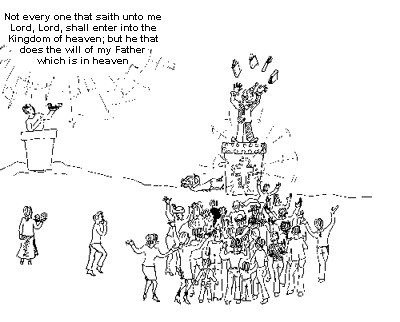
Jesus himself says: "Not every one that saith unto me, Lord, Lord, shall enter unto the kingdom of heaven; but he that doeth the will of my Father which is in heaven. Many will say to me in that day, Lord, Lord, have we not prophesied in thy name? and in thy name have cast out devils? and in thy name done many wonderful works? And then will I profess unto them, I never knew you: depart from me, ye that work iniquity."4

Today many are claiming that their message and wonders are from God. But please do not believe every spirit, but test the spirits to see if they are from God. Jesus tells us that we are to know them by their fruits.5 Do their lives reveal the Biblical pattern of life?

As we have read, the Bible declares that many will heal in the name of Jesus, prophesy in the name of Jesus, cast out demons in the name of Jesus, perform miracles, signs and wonders in the name of Jesus, but Jesus will say to them on that great day: "I never knew you."

WHO RECEIVES THE SPIRIT OF GOD?

Miracles in themselves do not reveal their source. In order to distinguish the false from the genuine, what is from Satan and what is from God, Jesus urges us to seek the kingdom of God first.6 First we have to learn to know the will of God through the study of His Word, and then see if these men are doing the will of God. Are they, in the daily life, walking in the footsteps of Jesus? Are their lives and preaching reflecting the life and preaching of Jesus? This is the test!

But what kind of message do these teachers preach? Does it lead you to fear and love God? Are you filled with a longing to reveal your love for Jesus Christ by faithfully living according to His commandments? The apostle John writes: "He that saith, I know him, and keepeth not his commandments, is a liar, and the truth is not in him."30 People who do not realize the great importance of the moral law, that look down on and deliberately break and violate the commandments of God, even if it is only one of them, and teach other people to do the same, are looked upon as unrighteous in the eyes of God.31 Then we know that their teaching is not from God. They carry on the same work as the prince of darkness started, he who is the enemy of God.

There are those who believe they are right when they are in the wrong. While they proclaim that Jesus is their Lord and declare that they are doing great things in His name, they are really doing what is evil. "And they come unto thee as the people cometh, and they sit before thee as my people, and they hear thy words, but they will not do them: for with their mouth they shew much love, but their heart goeth after their covetousness." 32

It is no use pretending to be a Christian. You rarely hear it being preached about the faith in Jesus that saves and changes a man. Just believe, they say, then you do not need to keep the law. But a faith that does not lead to obedience, is a dead faith.33

Therefore the spirit of God is not given to everybody. It is God who decides who will receive His Spirit. It is He who decides who He will work through. It is He who decides who will be His ambassador. Therefore the Bible says quite simply and clearly that those who are doing His will and are obedient to Him, will receive the Holy Spirit.7

Besides, a godly man or woman will not accept money or gifts for miraculous healings that come from God. They will declare that God alone is the One to receive honor and glory.8 This will, also today, characterize those who truly heal in the name of Jesus. But today we see many healers and their coworkers readily accept a "quiet collection."

We are aware that several charismatics use NLP (Neuro Linguistic Programming), a hypnotic technique that sales representatives, politicians, charismatics and others use in order to sell their products or win adherents or followers.29
The charismatic movement emphasizes experiences of the spirit. But it is not screaming, faintings, repeated shouts of "hallelujah" and so on, that prove whether they have the Spirit of God or not. God wants conscious human beings, not unconscious, half-fainted and knocked out individuals that lie on the floor kicking their legs and writhing in ecstatic laughter. The devil is an expert on debauched experiences, while the Bible says: "Let all things be done decently and in order."9 It is Jesus Christ and Biblical truth that are going to set us free, and give a true revival - not emotional and sentimental mass meetings.10

TRANSFORMATION - TRUE REVIVAL

There are many kinds of revivals. A true revival appears when we say Yes to Jesus. Then we will receive the Holy Spirit as a source of power in our life, and this will bring about a change in us. There will take place a reform, a change or a transformation in our minds and lives. It will involve not letting Self control or rule us. Then we will say no to the lust of the flesh and worldly pleasures and temptations, and yes to the Spirit. The sinful nature of the flesh will be a part of us as long as we live here on this earth, but we are not to let it control our minds and lives. We must let the Holy Spirit enter our minds, so that we will be partakers of the divine nature. And we will be partakers of the divine nature as long as we stay close to Jesus, and do His will.11

When we let the Spirit control our minds, we will turn away from impurity, cheating, adultery, lust, envy and everything that has to do with sin. We will not love the world and the things that are in it anymore, but rather love Jesus and everything He represented in His life and teachings. We will receive a new mind, new purposes and new motives. People will notice that a change has taken place. The fruit of the Spirit will be shown in our lives, such as love, joy, peace, goodness, patience and so on.12 In other words, a character change takes place in our lives. It is a pleasure to let Jesus be represented in our daily lives, by not taking part in the pleasures and the lust of this world. This we can not do alone, by ourselves, but in our efforts to resist the temptations of the devil and live for Christ, we can unite our weakness with the strength of Jesus.13 It is this kind of revival and transformation that Jesus and the Bible are speaking about, totally different from faintings on command, hypnotic repetitions of words, ecstatic and uncontrolled laughter and so on.

When the born-again Christian learns to know Jesus and the unlimited love He has shown us, in order to save us, then this person will love Jesus dearly. He or she wants to be a disciple of Jesus, and will by the guidance of the Holy Spirit try to help others on the path to heaven.

Dear reader! Remember that even if you feel unworthy to come to God in humility and prayer, even if you have fallen very deeply into sin, Jesus stands there like the father of the prodigal son with arms opened wide, ready to accept us, as long as we are willing to repent and forsake our sins. The Holy Spirit calls on you to make this decision now. If you still doubt whether Jesus accepts you or not, then remember His own words: "him that cometh to me I will in no wise cast out."14 This is Jesus. Such is His love for human beings.

THEY WILL PREACH A CORRECT BIBLICAL MESSAGE

Those who have humbled themselves before God, repented from their sins and accepted the salvation of Jesus by faith, will receive forgiveness for their sins. They will be partakers of baptism, and by the grace of God receive the Holy Spirit as the source of power in their lives. They also will go out and preach a correct Biblical message.

They will preach that Jesus is the only one who can save us, and that it is up to you and me if we will accept this gift of salvation by grace through faith.15
They will preach that if we forget to stay close to Jesus and then sin, God will only look upon us as righteous if we wholeheartedly repent of our sins and accept the gift of salvation.16
They will preach that - just like Jesus, who came to this earth as a degenerated man, had to receive power and strength from God in order to obtain victory in every temptation,17 so we, too, can - by God's help - have victory in every temptation that we meet.18
They will not only preach that God is love, but "this is the love of God, that we keep his commandments: and his commandments ( not the commandments you find in the Catechism, but God's Ten Commandments in Exodus 20: 3-17) are not grievous."19

They will preach that Jesus was one with the Father. He was God. He was the Creator. When Jesus came to save the human race from sin, He clothed His divinity with humanity. For 4000 years the race had been decreasing in physical strength, in mental power and in moral worth; and Christ took upon Himself the infirmities of degenerate humanity. He was tempted in all points as we are, but He did not sin.21 Only in this way could He save us.
They will preach that if we are wholeheartedly surrendered to Jesus Christ, we will "be partakers of the divine nature" - by His Spirit.22
They will preach that we will receive all the power and strength we need (by the Holy Spirit) in order not to sin, and that "Whosoever is born of God doth not commit sin; for his seed remaineth in him: and he cannot sin, because he is born of God."23
They will preach that the change in our lives has to happen now, before the coming of Jesus, so that we may be clean and prepared when Jesus returns in the clouds of heaven. For "there shall in no wise enter into it (in heaven) any thing that defileth, neither whatsoever worketh abomination, or maketh a lie: but they which are written in the Lamb's book of life."24
Do you doubt that Jesus can give you victory in every temptation? As long as we stay close to Him and have a constant relationship with Jesus, like the branch to the vine, we will receive the help we need in order to gain victory over sin.25 When do you hear this being preached?

A MESSAGE OF SALVATION AND A MESSAGE OF WARNING

Dear reader! It is important that we place ourselves on the side of Jesus now, so that we may receive the Spirit of God and be a part of the last movement that the Father, the Son, and the Holy Spirit are behind, before the return of Jesus. The Bible, in Revelation chapter 14, verses 6-12, mentions three special messages God's faithful servants will preach just before the coming of Jesus. We are also strongly urged to LEAVE all false religious systems and revivals, so that we will not have a part in their apostasy and sins.26 Will you accept this challenge? Remember that those who place themselves on the side of Jesus, have the strongest one on their side. Jesus says: "All power is given unto me in heaven and in earth. Go ye therefore, and teach all nations"...27

Let us come to a conclusion: We must be aware of the fact that the charismatic movement is a global movement, a movement that is seeking to unite the world under false manifestations, a movement that unfortunately is one of the means that Satan is using in order to gather "Christianity" and different religions into one. Protestants that have thrown off the shield of faith, will - together with Catholics and worldly people indiscriminately - unite in the last times. Satan will strengthen his cause by seducing them all into the camp of spiritualism. Many will regard this alliance as a great movement that will unite and convert the world and finally proclaim the much longed for Millenium. This will be a fulfillment of the prophecy of the Bible that tells us how the world will unite through spiritualism. And we see the prelude to this fulfillment now. 28

I pray that we all will take our stand completely and totally on the side of Jesus, so that we may receive the Holy Spirit. Only then can we be able to discern the false from the genuine. Only then can we be ready when Jesus soon returns to gather His people and take them home to heaven. May you and I be among them!

In the blessed hope,

Bente and Abel Struksnes


--------------------------------------------------------------------------------

References:

1. Matt. 8. 5-13; Acts 3. 3-19
2. 2. Thes. 2. 9
3. Rev. 16. 13,14
4. Matt. 7. 21-23
5. Matt. 7. 15-20
6. Matt. 6. 33
7. Acts 5. 32
8. 2. Kings 5
9. 1. Cor. 14. 20
10. John 8. 32-34
11. 2. Pet. 1. 3,4; 1. John 3. 9; 1. John 2. 1,2
12. Gal. 5. 22
13. Phil. 2. 12,13
14. Luke 15. 11-32; John 6. 37
15. John 14. 6; John 3. 16
16. 1. John 2. 1,2; Heb. 8. 1+2
17. John 5. 30
18. 1. Cor. 10.13; Matt. 28.18
19. 1. John 5.3
20. Rom. 8.3; John. 1. 1-3+14; Jes. 9.6; 2.Pet. 1.4
21. Heb. 2.16-18; Heb. 4.15-17
22. 2. Pet. 1. 3,4
23. 1 John 3.9; 2. Pet. 1.10
24. Rom. 12. 1,2; James 1.4; Rev. 21.27; 1. Thess. 4. 13-18
25. 1. Cor. 10.13; John 15. 4+5
26. Rev. 18. 1-4
27. Matt. 28.18; Rev. 17. 13,14; Rev. 5. 12-14
28. Rev. 16. 12-14; Rev. 17. 12-14; "The Great Controversy" by E. G. White p. 588
29. "Freedom's Ring" by Bob Trefz, March 1991, p. 9-18.
30. 1. John 2.4
31. Matt. 5.17-19
32. Eze. 33.31
33. James 2. 14-26; 1. John 5.3; John 14. 23,24 

Thursday, August 20, 2015

Billy Graham - Rome's American Idol

Image result for billy graham and pope
 “I’ve found that my beliefs are essentially the

same as those of orthodox Roman Catholics.”
– Billy Graham 1

To understand Billy Graham, his involvement in the Ecumenical Movement, and why he would accept something like the Templeton Award, we must understand his relationship with Rome.  While the principles of ecumenism can be traced back for centuries (through the Gnostics, Rosicrucians, Freemasons, and of course the Parliament of World Religions) it was Rome’s Vatican II that “officially” launched the modern ecumenical movement.   Vatican II opened the doors of Roman Catholicism (which the world largely views as the oldest form of Christianity) to all other religions of the world.  This is why Vatican II is often referred to as “the ecumenical council.”  As such, as the relationship of Billy Graham developed with the Vatican and the popes, his views became increasingly ecumenical.  This has confused many people because they don’t make the Rome-connection.  Graham, like many other Protestant Evangelicals, seems to be working to fulfill – not the Great Commission – but the mandate of Vatican II.  Once this is understood, the rest of what Billy Graham has done begins to make sense. 

The subject of Graham and Rome has been handled by many Christian writers, not the least of which is Ewin Wilson in his book, The Assimilation of Evangelist Billy Graham into the Roman Catholic Church.  Wilson writes:

"For some unexplainable or even mysterious

reason, Billy Graham is unable to discern the

theological, moral, and spiritual soul of Roman

Catholicism. Likewise, he has failed to grasp,

or worse still, has chosen to ignore the historical

character of the entire Vatican system. Instead,

he has chosen to become attracted, impressed,

and finally to honor and follow the Holy See.

The result has been a tragic failure on his part

to understand the difference between the truth

of God's Word and the utter blackness of

Roman Catholicism …” 5


A Catholic Agenda

Among the chief agents of the papacy are the Knights of Malta.  It was two very powerful Knights of Malta, William Randolph Hearst and Henry Luce that made “Billy Graham” a household name.  Hearst was the founder and president of a newspaper empire, and was openly known as a liar and manipulator of information.  Perhaps the most notorious example of his dishonesty comes from the story of a reporter who was sent to cover a war story.  “When the reporter cabled back that there was no war in progress and that he was ready to come home, Hearst reportedly wired back, ‘Please remain. You supply the pictures, and I'll supply the war.’”1 The term “yellow journalism” was originally coined to describe his journalistic practices.  This same Hearst ordered his editors to “Puff Graham,” something that Graham himself acknowledged.  In a later on-camera interview, the famous evangelist appeared bewildered when describing how certain reporters had told him, “You’ve just been kissed by William Randolph Hearst.”  Meanwhile, Henry Luce was the founder of TIME, LIFE, and Fortune magazines, not to mention Sports Illustrated, who in 1961 was called “the giant of twentieth-century American journalism …” by Current Biography.  He was also a Yale graduate, and member of the Skull & Bones Society.  Henry Luce had articles specifically written about Billy Graham, and put him on the cover of TIME magazine in 1954.  The rest, as we know, is history.

It was Luce, along with Hearst who are said to be most influential in making Graham the chief spokesman of Protestant Christianity.  This is odd when one considers that both Hearst and Luce were members of a devout Catholic order that openly declares its purpose is “service to … the Holy Father (i.e. the pope).”2 Was it their intent to create a kind of “Protestant Pope” to guide the beliefs of non-Catholics?  Whether they intended this or not, that is exactly what Billy Graham would become. 


The Gospel according to Antichrist

“There was a pause in the conversation; suddenly the Pope's arm shot out and he grabbed the lapels of my coat, he pulled me forward within inches of his own face. He fixed his eyes on me and said, 'Listen Graham, we are brothers'" – Billy Graham, on his meeting with Pope John Paul II, (6/8/89, Today).8


"Shouldest thou help the wicked, and

love them who hate the Lord?"

(2 Chronicles 19:2)

In John’s second epistle, he specifically warned against endorsing those who reject or compromise the gospel.  Such deceivers are called “antichrist” and not coincidentally, they teach doctrines that will ultimately usher in the reign of Antichrist.  John wrote:

“For many deceivers are entered into the
world, who confess not that Jesus Christ is

come in the flesh.  This is a deceiver and

an antichrist …. He that abideth in the
doctrine of Christ, he hath both the Father
and the Son.  If there come any unto you,

and bring not this doctrine, receive him not

into your house, neither bid him God speed:

For he that biddeth him God speed is

partaker of his evil deeds.”
(2 John 7, 9-11)

The “doctrine of Christ” that John refers to includes the entire gospel message.  It means the “all things whatsoever I have commanded” from the Great Commission (Matt. 28:20).  Receiving someone in the biblical sense refers to accepting them as a fellow believer in Christ.  Obviously, John was not suggesting that non-Christians should be thrust out of the church simply because they had not yet come to salvation.  But his reference is to those who reject the gospel, and preach a deceptive doctrine.  Despite this warning, Billy Graham has gone out of his way to endorse nearly every major antichrist teacher of the 20th century.  He has, if you will, bid “God speed” to many deceivers and deniers of Christ. 

We earlier documented Graham’s acceptance of the Templeton Award.  Dave Hunt had this to say about evangelicals who accept the award:

“Obviously, it would be dishonest for anyone to accept the Templeton Prize for Progress in Religion who was not in complete sympathy with its purpose and the beliefs behind it.  The very acceptance of the prize constitutes an endorsement of all that the prize represents.  Nor can any evangelical recipient claim ignorance, for Templeton’s neopagan views have been widely published for years.” (Hunt, Occult Invasion p. 534)

The same can be said for the views of those Billy Graham has supported throughout his career.  These are teachers and leaders that impact people all over the world, and their beliefs are almost always well known.

Dr. Cathy Burns dedicated some 800 pages (200 of which are footnotes) to exposing Graham’s antichrist endorsements in her book, Billy Graham and His Friends.  The “friends” that the title refers to are an assortment of new age and occult practitioners that have routinely led millions of people into spiritual darkness.  One such friend was Dag Hammarskjold, the second Secretary-General of the United Nations.  Hammarskjold was once invited to speak at the World Council of Churches (another one-world group openly supported by Graham), and personally designed one of the most occult epicenters anywhere in the world: the United Nations Meditation Room. 


The following quotes come from the official U.N. website.  They tell us about Hammarskjold’s original concept for the room, and where the financing for it came from:
In the original plan for the new Headquarters, a
tinyroom had been provided as a place dedicated
to silence, where people could withdraw into
themselves, regardless of their faith, creed or religion,
but Dag Hammarskjöld wanted something more dignified.
In his efforts he was supported by a group, composed
of Christians, Jews, and Moslems, the ‘Friends of the
UN Meditation Room’
, who combined their efforts and
provided the money for a room worthy of a world organization.” 
(UN.org article, “A Room of Quiet, The Meditation Room,
United Nations Headquarters”)

Next, the U.N. goes on to make certain we understand that Hammarskjold “personally planned and supervised in every detail the creation of the ‘Meditation Room,’” and his desire was that this room should be “the center of the United Nations.”  In the middle of the room, Hammarskjold place a gift from the King of Sweden, “a six and half-ton block of iron ore, polished on the top and illuminated from above by a single spotlight.”  Hammarskjold refers to this block of iron as “a stone” in his written text “to be distributed to the visitors of the room.”  Among many other new age sounding declarations, he says the following:

“… the stone in the middle of the room has more
to tell us. We may see it as an altar, empty not because
there is no God, not because it is an altar to an unknown god,
but because it is dedicated to the God whom man worships

under many names and in many forms.” 

It takes little imagination to realize from this quote, (and many others) that Hammarskjold viewed the United Nations as a vehicle for bringing forth the one world religion of Antichrist.  The full description of Hammarskjold’s designing process reads like some obsessed witchdoctor planning an incantation; detailing the paint, the benches, etc.  Nevertheless, here is what Billy Graham had to say about this new age occultist in his autobiography, Just As I Am:

“In the 1950’s, when I was in New York City,

I would occasionally slip by to visit Dag Hammarskjold,

secretary-general of the United Nations, and

have prayer with him.  He was … trying to make

a difference for world peace, in large part

because of his Christian convictions.” 15


Graham deceives millions into thinking that men like Dag Hammarskjold represent “Christianity,” and in doing so, changes the world’s definition of what the Christian faith is truly about. 


Graham & Schuller

Another of Graham’s chief endorsements is Robert Schuller, perhaps the greatest anti-Christ wolf-in-sheep’s-clothing of them all.   Schuller, who has repeatedly denied the Gospel and pushed new age self-empowerment principles for years, has “the largest TV audience of all the televangelists …” 16 His theology of “self esteem” has reached blasphemous levels as he suggests re-directing the Lord’s Prayer.  In his book, Self-Esteem: The New Reformation, he writes:

“And we can pray, ‘Our Father in heaven,
honorable is our name.’” 17

This same principle of exalting self in place of God is the declaration of Lucifer in Isaiah 14:14, and is directly preached by new age adherents.  In a document called “A Course in Miracles,” the opening lines state: “God’s Name is holy, but no holier than yours.  To call upon His Name is but to call upon your own.” (A Course in Miracles, Workbook Lesson 183, I call upon God’s Name and on my own).  Schuller also redefines “sin.”  The Bible defines sin as any disobedience to God; but Schuller, again, re-directs the focus to self:

“Sin is any act or thought that robs myself or
another human being of his or her self-esteem.”
(Burns, p. 114)

Schuller’s delusions are colossal and repetitive.  It’s truly amazing that any professing Christian would have anything to do with him.  He writes:

“Christianity with its doctrine of salvation is a
faith by God for the glory of the human being
for the greater glory of God.  Because of this we
can pray, ‘O God, I am great.’” 19

Meanwhile, the Scriptures warn us that “… in the last days perilous times shall come.  For men shall be lovers of their own selves …” (2 Tim. 3:1-2) Jesus clearly said that if any man would follow Him, he must “deny himself” (Matt. 16:24), not spend his life worrying about his own self-esteem. 

Robert Schuller has pushed the Ecumenical movement as much, if not more, than any leader in the world.  Some even report that Schuller “no longer wants to be called a ‘Christian’ because it cuts him off from Hindus and Muslims …” 18 Dr. Cathy Burns exposes Schuller’s agenda to embrace the teachings of Islam – a religion that openly denies that Jesus Christ is the Son of God.  The Bible tells us:

“He is antichrist, that denieth the Father
and the Son.  Whosoever denieth the Son,
the same hath not the Father …”
(1 John 2:22-23)

Written upon the Islamic Dome of the Rock (the Al Aqsa Mosque) in Jerusalem is the declaration of the Koran that, “God has no son.”  Muslims today have little hesitation about informing people that Jesus is not really God’s Son, and that Christians are engaged in “idolatry” to worship Him.  Yet Robert Schuller, who should know better, openly embraces Islam and its anti-Christ doctrine, deceiving millions.  Dr. Burns writes:

“Schuller’s Crystal Cathedral actually houses the
offices for a group called ‘Christians and Muslims
for Peace’ (CAMP).  Schuller told Imam Alfred
Mohammed of the Muslim American Society he
wouldn’t be bothered if he came back in 100 years
and found that his descendants were Muslims.  In
fact, Schuller has recommended and written a
forward to the book More in Common Than You
Think, which ‘declares that Christians and
Muslims are all one in our true worship of God.’
He even had the author speak on his August
28, 1999 program.” (Burns, p. 116)

Meanwhile, Billy Graham has been an ardent supporter of Robert Schuller for many years.  Graham has said: “There is no one in all the world I love in Christ more than I do Bob Schuller … He has done some of the greatest things for the kingdom of God of any man in our generation.” 20 Years later, Graham would say, “Robert Schuller is a great man of God, whose shoes I am not worthy to stoop and loose.” 22 Notice how Graham is associating his admiration for this man in the same way John the Baptist spoke about Jesus Christ.  This is a pathetic endorsement, given Schuller’s antichristian views. But like Schuller, Graham refuses to speak the truth about Islam:

“On May 30, 1997, on the David Frost program,
Graham said: ‘… I think Islam is misunderstood,
too, because Mohamed has a great respect for
Jesus, and he called Jesus the greatest of the
prophets except for himself.  And I think that we’re

closer to Islam than we really think we are.” 21

It seems only appropriate that Graham would choose to openly deny the Gospel of Christ in a television interview on Schuller’s Hour of Power. Robert Schuller asked him, “What do you think is the future of Christianity?”  To which, Graham replied:

“Well, Christianity and being a true believer -- you know,
I think there's the Body of Christ. This comes from all
the Christian groups around the world, outside the
Christian groups. I think everybody that loves Christ,
or knows Christ, whether they're conscious of it or not,
they're members of the Body of Christ ... I think James
answered that, the Apostle James in the first council
in Jerusalem, when he said that God's purpose for this
age is to call out a people for His name. And that's what
God is doing today, He's calling people out of the world
for His name, whether they come from the Muslim world,
or the Buddhist world, or the Christian world, or the
non-believing world, they are members of the Body of
Christ, because they've been called by God. They may
not even know the name of Jesus, but they know in their
hearts that they need something that they don't have,
and they turn to the only light that they have, and I think
they are saved, and that they're going to be with us in heaven."
(See our documentary, “Megiddo II: The New Age” to
watch the video clip of this interview)

Despite such testimony, people continue to think of Billy Graham as “the most Christ-like” person they’ve ever seen!  When Jesus preached they tried to throw Him off a cliff, stone Him, and ultimately whipped Him, beat Him, and nailed Him to a cross.  When Billy Graham preaches, he gets a standing ovation.

The apostle Paul warned about false teachers, and how believers ought to deal with them:

“Now I beseech you, brethren, mark them
which cause divisions and offences contrary
to the doctrine which ye have learned; and
avoid them.  For they that are such serve not
our Lord Jesus Christ, but their own belly;
and by good words and fair speeches deceive

the hearts of the simple.”
                                        (Romans 16:17-18)        
The Rome Connection

While there are many other examples of antichrist teachers and teachings supported by Graham, they are all like so many roads that lead to Rome.  Each endorsement really furthers the Vatican’s purpose of establishing a world religion.  This is something that both Billy Graham and Robert Schuller have in common.  Both men had numerous “private audiences” with Pope John Paul II during his reign. Schuller specifically flew to Rome and met with the pope to get his “blessing on the building plans for his Crystal Cathedral” (Foundation, March-April, 1990), and has become notorious for saying, “It’s time for Protestants to go to the shepherd [i.e. the pope] and say, ‘what do we have to do to come home?’” (Calvary Contender, Nov. 15, 1987)

Yet the Protestant support of the papacy really begins with Billy Graham, who has supported no less than four popes in succession; John XXIII (who established Vatican II), John Paul I (who died 33 days into his pontificate), John Paul II (probably the most influential pope in a thousand years), and now, Pope Benedict XVI (former Hitler youth member, and ‘Grand Inquisitor’ for the modern Holy Office of the Inquisition).  By far, the most significant of these four is Pope John Paul II. 

In accordance with Vatican II, Pope John Paul II championed ecumenism like no one else in a thousand years.  He kissed the Koran, took the mark of Shiva on his forehead, and allowed the Dalai Lama to remove the cross from a Catholic altar to set up an idol of the Buddha for him and his monks to worship.  These things are all well documented, and widely published.  It was John Paul II who met with religious leaders from all over the world at Assisi, Italy in 1986, with Muslims, Hindus, snake charmers, American Indian shaman, witchdoctors, Voodoo priests, and a whole host of pagans with whom he prayed for “peace.”   At one point, he said to them, “We are all praying to the same god.”

Jesus said that “idolaters … shall have their part in the lake which burneth with fire and brimstone: which is the second death.” (Rev. 21:8) Since Jesus is the Judge of the living and the dead (2Tim. 4:1), His words ought to be cause for concern. Nevertheless, Billy Graham refused to share this warning with either John Paul or anyone else caught up in the pope’s drive to establish a one world religion.  Instead, consider what Graham said in an interview with Larry King, just after John Paul II passed away:

GRAHAM: And tonight, I have a very strange feeling of loss.
I almost feel as though one of my family members has gone.
I loved him very much and had the opportunity of discussing
so many things with him. And we wrote each other several
times during the years.
KING: Did he actually say to you once, "We are brothers'"?
GRAHAM: That's correct. He certainly did. He held my hand
the first time that I met him about 1981 -- he'd just been
Pope for two years when I saw him first. Because when he
was elevated to the papacy, I was preaching in his cathedral
in
Krakow that very day. And we had thousands of people
in the streets. And watching the television today of Krakow
has brought back many memories.
KING: You said that he was an Evangelist.
GRAHAM: He was, indeed. He traveled throughout the world
to bring his Christian message to the world.

The pope’s “message” about embracing all religions had been widely reported by world media.  The fact that John Paul on at least four different occasions (May 13, 1982, October 16, 1983, March 25, 1984, Dec. 8, 1985) consecrated “the world” to the Virgin Mary was well known. 14 It is unconscionable that any Christian leader could endorse this high priest of pagan practices, yet many professing Christian leaders have, including: Paul & Jan Crouch, Benny Hinn, Jack Van Impe, Robert Schuller, James Dobson, Jerry Falwell and Pat Robertson – to name a few.  CBN founder, Pat Robertson had this to say at Pope John Paul’s death:

“I am deeply grieved as a great man passes from this world
to his much deserved eternal reward. John Paul II has been
the most beloved religious leader of our age –
It was my great honor to meet with him at the residence
of my good friend, Cardinal O’Connor, in
New York, and to
sit in the Consistory during the mass he conducted in
Central Park.”
-- Pat Robertson, CBN.com article titled, Pat Robertson comments
on Pope John Paul II’s Passing
Notice how Robertson infers that the pope will end up in heaven (right before referring to his “good friend, Cardinal O’Connor”). This view of the pope’s salvation was likewise expressed by Billy Graham in the rest of his interview with Larry King. Bear in mind, that John Paul declared openly to the whole world that he dedicated his life and work to the Virgin Mary.  The National Catholic Reporter tells us:

“[The pope’s] motto, Totus Tuus, (Totally yours) signified
his devotion to Mary and his belief she was with him as pope
, a conviction he saw confirmed in the assassination attempt
of May 13, 1981 - the Feast of Our Lady of Fatima.”
(National Catholic Reporter Online, The Death of the Pope/
Analysis of Pope John Paul II’s Reign, by John L. Allen, Jr., 2005)

John Paul II literally had the phrase, totus tuus sum Maria (Mary I’m all yours) sewn into the lining of his robes, while a capital letter “M” (for Mary) adorned his coat of arms.  The pope publicly “dedicated himself and his Pontificate to Our Lady,” 12 and not to Jesus Christ.  This is idolatry in no uncertain terms.  Idolatry is repeatedly condemned throughout the Scriptures, which testify that no idolater has any inheritance in the Kingdom of God (1 Corinthians 6:9, Ephesians 5:5), and that both men and angels who “preach any other gospel” are “accursed” (Galatians 1:8).

Yet, Graham unreservedly says that John Paul is “with God” because he supposedly trusted “the cross.” 

KING: There is no question in your mind that he is with God now?
GRAHAM: Oh, no. There may be a question about my own,
but I don't think Cardinal Wojtyla, or the Pope -- I think he's
with the Lord, because he believed. He believed in the Cross
.
That was his focus throughout his ministry, the Cross,
no matter if you were talking to him from personal issue or
an ethical problem, he felt that there was the answer to
all of our problems, the cross and the resurrection.
And he was a strong believer. 13

This report from Graham is false, and repeatedly refuted by the words and deeds of John Paul himself.  Certainly if the pope put faith in the cross of Jesus Christ, according to the scriptures, he would be in heaven today.  But there is no evidence of that from the testimony of his life.  What is equally a concern are Graham’s apparent doubts about his own salvation.  Notice how he said, “There may be a question about my own …” Are these the words of the man who supposedly preached the gospel to more people than any person in history?  Measure them against those of the apostle Paul:

“I have fought a good fight, I have finished

my course, I have kept the faith: henceforth

there is laid up for me a crown of righteousness,

which the Lord, the righteous judge, shall

give me at that day …”

(2 Timothy 4:7-8)

Could Graham have doubts about his own redemption because, in his heart, he knows he has betrayed the Gospel?  Graham likewise endorsed the idolatrous Bishop Fulton J. Sheen, calling him “the greatest communicator of the twentieth century.”10 Sheen had this to say about the role of the Virgin Mary in his eternal salvation:

“When I was ordained, I took a resolution to
offer the Holy Sacrifice of the Eucharist every
Saturday to the Blessed Mother … All this makes
me very certain that when I go before the
Judgment Seat of Christ, He will say to me in
His mercy: ‘I heard My Mother speak of you.’” 11

When such an influential person as Billy Graham gives an endorsement to a religious leader, he compels others to look to that example.  Those who trust Graham will likely trust those he endorses.  And when a man like Bishop Sheen tells millions that he’s trusting Mary for his salvation, this can only encourage Catholics in their idolatrous belief.  Why should they repent? After all, the leaders of both Catholic and Protestant faiths have confirmed both Sheen and the pope!  In the book of Ezekiel, God specifically condemns those who promise salvation to men who will not repent of wicked practices:

“Because with lies ye have … strengthened

the hands of the wicked, that he should not

turn from his wicked way, by promising him

life.”  -- Ezekiel 13:22

This is what men like Billy Graham, Pat Robertson, Bill Bright and Charles Colson have done by supporting the false doctrines of Rome and of the neo-pagan/ecumenical movement.  By relying upon a vague understanding of who goes to heaven and who doesn’t, they keep sinners dead in their sins and confident in their false belief systems so that they will not repent.  By telling them that “good people” of all faiths probably go to heaven, men are compelled to pursue “good behavior” rather than a personal relationship with Jesus Christ.  This is why so-called “Christian conservatives” in America today focus on social morality, rather than a right relationship with Jesus.  This is nothing short of an open denial of the true Gospel.  Jesus said:


“And this is life eternal, that they might

know thee the only true God, and Jesus

Christ, whom thou hast sent.”

– John 17:3


 --CJP

Footnotes

1. McCall’s, January 1978, as quoted by Dave Hunt in A Woman Rides the Beast, p. 388
2. History of Newspapers, Cybercollege.com
3. Constitutional Charter of the Sovereign Military Hospitaller Order of St. John of Jerusalem, of Rhodes and of Malta, p. 6
4. Biblical Discernment Ministries, article: Billy Graham: General Teachings/Activities
5. The Assimilation of Evangelist Billy Graham into the Roman Catholic Church, by Ewin Wilson p. 22 – as quoted by Biblical Discernment Ministries article: Billy Graham: General Teachings/Activities
6. Biblical Discernment Ministries, article: Billy Graham: General Teachings/Activities
7. Ibid, quoting the Catholic Sentinel
8. Ibid, quoting Today magazine
9. Vatican Council II, Constitutions, Decrees, Declarations, Austin Flannery, O.P., General Editor, p. 88
10. A Woman Rides the Beast, by Dave Hunt, p. 440, quoting “numerous advertisements for videos of Fulton J. Sheen’s television shows.”
11. Ibid, p. 440 quoting Fulton J. Sheen, Treasure in Clay, p. 317
12. A Woman Rides the Beast, by Dave Hunt, p. 459 quoting The Fatima Crusader, Winter 1992, front cover and p. 3
13. Larry King interview as documented by CBN.com article, Billy Graham: Pope John Paul II Was “Most Influential Voice in 100 Years,” by Michael Ireland, Chief Correspondent, ASSIST News Service
14. A Woman Rides the Beast, by Dave Hunt, p. 459 citing The Fatima Crusader, November/December 1986, p. 9
15. Billy Graham and His Friends: A Hidden Agenda? by Dr. Cathy Burns, p. 132, quoting Just As I Am, by Billy Graham, pgs. 685-686.
16. Burns, p. 113
17. Ibid, p. 113, quoting Self-Esteem: The New Reformation, by Robert Schuller, p. 69
18. Calvary Contender, August 1999; also recorded by Dr. Cathy Burns, Billy Graham & His Friends: A Hidden Agenda, p. 116
19. Burns, p. 115, quoting Joseph P. Gudel, “A New Reformation?: The Faulty Gospel of Robert Schuller,” Passport Magazine (January-February 1988), p.9
20.  Burns, p. 116, quoting “Schuller and Rome,” Christian News (October 9, 2000, Vol. 38, No. 37), p.8
21. Burns, p. 118
22. Burns p. 121
Adullam Films