Showing posts with label Reformation. Show all posts

Sunday, January 31, 2021

The St. bartholomew massacre

St. Bartholomew's Day massacre - Wikipedia
THE NAME FRANCE IS DERIVED FROM THE FRANKISH WORD FRANK (GER. FREI) WHICH MEANS FREE AS IN: "THEREFORE IF THE SON MAKES YOU FREE, YOU SHALL BE FREE INDEED (ST. JOHN 7:36).

Here is an English language quote based on a true history of France entitled Franco-Gallia by a Massacre survivor named François Hotman:

Gaul returned to a tradition of more freedom with the arrival of the Franks. They were originally a Germanic tribe living on the coasts of northern Europe, between the Rhine and the Elbe. Their very name reflects their love of freedom, as frank means "free" in German. The Franks were originally a fairly small band, but other Germanic peoples entering Gaul adopted their name out of admiration for their leading role in overthrowing the tyranny of the Romans. (Kingdon, Myths About the St. Bartholomew's Day Massacre, p. 143).

The old Frankish language was replaced by the French language which is a Romance language derived from Latin with only a few Frankish words remaining to remind the French of the liberty-loving Franks.

The French Christians were given the derogatory name "Huguenot" by the Jesuits. Unlike the word "Protestant," which came from the corrupt Latin Vulgate Version, the origin of that word is still obscure.

Satan is the same in every country, so Empress Tzu Hsi engineered a Chinese St. Bartholomew's Day Massacre in 1900.

On August 15, 1534, Ignatius Loyola and 6 of his companions founded the Jesuit order on a hilltop outside Paris. The deadly 6 founders were: Ignatius Loyola, Francis Xavier, Alfonso Salmeron, Diego Laínez, Nicolás Bobadilla, Peter Faber, and Simão Rodrigues. Francis Borgia, the grandson of Pope Alexander VI, and the éminence grise behind the new order–was not present at that time. 

On August 15, 1534, the Jesuit order was founded on a hilltop outside Paris called Montmartre. It was originally a Druid shrine where human sacrifices were made to Esus.

A basilica to the Sacred Heart of Jesus now dominates Montmartre.

The original French name of the Jesuits was la Sociéte des Pères du Sacré-Coeur de Jésus.

In 1540, Pope Paul III officially recognized the "new" Militia of Zeus and Minerva....In reality, the Jesuits were just warmed-over or incognito Franciscans....They were the shock troops or special forces of the Counter-Reformation. They were excused from chanting the Psalms; they did not have to wear the round tonsure, they were allowed to wear civilian clothes, and their general was elected for life. 

The planning for the Massacre began immediately after the founding of the Jesuits. The glorious Reformation, begun in Germany on October 31, 1517, had spread to France–and was joyfully received. A great change had come over the people as industry and learning began to flourish, and so rapidly did the Truth spread that over a third of the French population of 20,000,000 embraced the Reformed Christian Faith.

True Christianity was also making progress at the highest echelon of French society. In 1521, Anne Boleyn—the future queen of England—returned from a 5-year-stay at the French Court . . . burning with zeal to rescue her nation from Papal darkness. 

Walsingham "hid" in the British embassy and escaped the Massacre. He was not even FIRED for incompetence . . . but was promoted to become the queen's Secretary of State in 1573....That was an incredible failure of intelligence for the legendary British Secret Service!!

The Massacre happened at a time of great friendship and ecumenical goodwill between the French Christians and the Vatican. The French Christians were derisively called "Huguenots" by the Latin

Alarmingly for the Jesuits, the French Christians ignored the Bull of Borgia granting the entire New World to Spain. In 1562, Jean Ribault led a colonizing expedition to South Carolina . . . which was brutally wiped out by the Spanish. 

Catherine married Henry II of France in 1533. For the first 10 years of their marriage she produced no children. In desperation, she entered into a pact with Lucifer himself, and eventually produced 10 "children." One of her daughters, Elizabeth, married Philip II of Spain. 

Charles was the eldest son of King Francis II (1544–1560), who suffered an untimely death in a jousting tournament. Charles was only 10-years-old at that time, so his mother Catherine became Regent, and de-facto ruler of the country. Unlike England, French Salic law prohibited females from inheriting the throne, otherwise Catherine would have joined Elizabeth of England and Mary Queen of Scots as an independent sovereign.

The lure to get the admiral to Paris was the wedding of King Henry III of Navarre to Marguerite de Valois. Marguerite was the daughter of King Henry II of France and Catherine de' Medici.

Admiral Coligny was without doubt the most famous man in France, and a leader in the French effort to plant the New Israel in the New World. The 1562 colony that was founded by Jean Ribault in South Carolina was wiped out by the Spanish Inquisition. 

On the morning of Friday, August 22, Admiral Coligny was walking back from the Louvre after a meeting with King Charles. The admiral was near home when suddenly he bent down to tie his shoelace. At that moment a shot rang out, wounding . . . but not killing the admiral:

On the morning of Friday, 22 August, the government recess for the marriage celebrations being now over, Admiral Gaspard de Coligny left his lodgings on the rue de Béthizy–today No. 144 rue de Rivoli–for a council meeting that was to start at nine o'clock. He had wished to press for French military intervention in Flanders, but to his frustration he found Anjou presiding over the meeting as the King had risen late. Anjou left the meeting early and when matters had been concluded the Admiral came across the King on his way with Téligny and the Duke of Guise to play a game of tennis. Charles begged Coligny to join him for a game but the Admiral refused. They parted at around eleven o'clock and Coligny left the Louvre for his short walk home, reading a document while he did so. As he approached the window at which Maurevert was hiding a binding on one of his shoes came loose and he bent down to fix it. Just as he did so, a shot rang out. The bullet broke his left arm and almost tore the index finger off his right hand. Had he not bent over at the critical moment he would have been mortally wounded. (Frieda, Catherine de Medici, p. 259).

 Charles de Louviers, seignor de Maurevert, lay in wait for days to kill Admiral Coligny . . . but in the end his attempt ended in failure. 

Catherine didn't care if her son was killed in the "assassination" attempt because she was the real ruler of France. This false flag operation was similar to the Gunpowder Plot in England....Our Great JEHOVAH brought their wicked council to nothing:

JEHOVAH brings the counsel of the nations to nothing. He makes the plans of the peoples of no effect
(Psalm 33:10).

In preparation for the Massacre, friendly diplomatic relations also began between long-time rivals England and France. The Treaty of Blois was signed on April 19, 1572, between Queen Elizabeth and Catherine de' Medici. Based on the terms of the treaty, France and England relinquished their historic rivalry and established an alliance against Spain:

In June, the Queen Mother sent to London, as ambassador extraordinary, the Duke of Montmorency, with powers to ratify the Treaty of Blois and formally offer Alencon as a husband for the Queen. Elizabeth was a gracious hostess, entertaining the embassy lavishly and investing the Duke with the Order of the Garter, but she was noncommittal about the marriage proposal, citing her reservations about Alencon's age and appearance. When Montmorency left, she promised that she would consider the matter and give King Charles her answer within a month. She then told Burghley to instruct Walshingham to submit a full report. (Weir, The Life of Queen Elizabeth I, p. 285).

Sir "Francis" Walshingham was the queen's "spymaster" and eyes and ears throughout Europe.

To distinguish between the murderers and the French Christians, a white cross was sown on their hats.

It is true that England and France were always bitter enemies . . . but that was Papal England and Papal France!!           

 References
Algrant, Christine Pevitt. Madame de Pompadour, Mistress of France. Grove Press, New York. 2002.
Bernier, Olivier. Louis the Beloved. The Life of Louis XV. Doubleday & Co., Garden City, New York, 1984.
Crowdy, Terry. The Enemy Within: A History of Spies, Spymasters and Espionage. Osprey Publishing, Oxford, UK, 2006.
Erickson, Carolly, The First Elizabeth. St. Martin's Press, New York, 1983.
Frieda, Leonie. Catherine de Medici: Renaissance Queen of France. HarperCollins Publishers, New York, 2003.
Hotman, François. Franco-Gallia: or, an Account of the Ancient Free State of France. Tim. Goodwin, London, 1711.
Haynes, Alan. Walshingham: Elizabethan Spymaster and Statesman. Sutton Publishing, Gloustershire, UK, 2007.
Kingdon, Robert M. Myth's About the St. Bartholomew's Day Massacre, Harvard University Press, Cambridge, MASS, 1988.
Lever, Evelyne. Madame de Pompadour. A Life. Farrar, Straus and Giroux, New York, 2000.
Nicolini, G.B. History of the Jesuits. George Bell & Sons, London & New York, 1893.
Noguerès, Henry. The Massacre of Saint Bartholomew. The Macmillan Company, New York, 1959.
Smith, H.C. The Bonapartes. The History of a Dynasty. Hambledon & London, London & New York, 2000.
Somerset, Anne, Elizabeth I. St. Martin's Griffin, New York, 1991.
Weir, Alison. The Life of Queen Elizabeth I. Ballantine Books, New York, 1998.

         Reformation

Saturday, April 25, 2020

John Wycliffe the "Morning Start of Reformation"

John Wycliffe - Wikipedia
John de Wycliffe, born about 1324, styled the “Morning Star of Reformation,” was an English divine, whose piety and talents procured for him one of the highest ecclesiastical positions of honor.  Having openly preached against the corruptions of the Roman Church, he was displaced, the pope issuing several bulls against him for heresy.  Accordingly, he was examined by an assembly, but made so able a defense that it ended without determination.  Continuing to denounce the papal corruptions, and power, he was again summoned before a synod, but was released by order of the king’s mother.  It is remarkable that although he continued his vehement attacks upon vital of Romish doctrine, he escaped the fate of others similarly accused; but over forty years after his death, which occurred in 1384, his bones were exhumed, burned, and cast into the River Swift, which bore them through the Severn to the sea, his very dust thus becoming emblematic of his doctrine, now diffused the world over.  His most important work was the first English version of the Bible.   BRT

Sunday, April 12, 2020

The masters of deception

3D Printed Fast and Strong Soft Robots - ASME
Throughout Christendom, Protestantism was menaced by formidable foes. The first triumphs of the Reformation past, Rome summoned new forces, hoping to accomplish its destruction. At this time the order of the Jesuits was created, the most cruel, unscrupulous, and powerful of all the champions of popery. Cut off from earthly ties and human interests, dead to the claims of natural affection, reason and conscience wholly silenced, they knew no rule, no tie, but that of their order, and no duty but to extend its power. (See Appendix.) The gospel of Christ had enabled its adherents to meet danger and endure suffering, undismayed by cold, hunger, toil, and poverty, to uphold the banner of truth in face of the rack, the dungeon, and the stake. To combat these forces, Jesuitism inspired its followers with a fanaticism that enabled them to endure like dangers, and to oppose to the power of truth all the weapons of deception. There was no crime too great for them to commit, no deception too base for them to practice, no disguise too difficult for them to assume. Vowed to perpetual poverty and humility, it was their studied aim to secure wealth and power, to be devoted to the overthrow of Protestantism, and the re-establishment of the papal supremacy.  

When appearing as members of their order, they wore a garb of sanctity, visiting prisons and hospitals, ministering to the sick and the poor, professing to have renounced the world, and bearing the sacred name of Jesus, who went about doing good. But under this blameless exterior the most criminal and deadly purposes were often concealed. It was a fundamental principle of the order that the end justifies the means. By this code, lying, theft, perjury, assassination, were not only pardonable but commendable, when they served the interests of the church. Under various disguises the Jesuits worked their way into offices of state, climbing up to be the counselors of kings, and shaping the policy of nations. They became servants to act as spies upon their masters. They established colleges for the sons of princes and nobles, and schools for the common people; and the children of Protestant parents were drawn into an observance of popish rites. All the outward pomp and display of the Romish worship was brought to bear to confuse the mind and dazzle and captivate the imagination, and thus the liberty for which the fathers had toiled and bled was betrayed by the sons. The Jesuits rapidly spread themselves over Europe, and wherever they went, there followed a revival of popery.        Great Controversy pp. 234

Tuesday, October 31, 2017

500 years ago today: The birth of Protestantism


Martin Luther

WND   October 31, 2017
On Oct. 31, 1517, an Augustinian monk named Martin Luther posted 95 debate questions on the door of Wittenberg Church, which began the movement known as “the Reformation.”
In 1521, 34-year-old Martin Luther was summoned to stand trial before the most powerful man in the world, 21-year-old Holy Roman Emperor Charles V. Charles V of Spain’s empire spanned nearly two million square miles across Europe, the Netherlands, the Far East, North and South America and the Caribbean.
The Philippine Islands were named after his son, King Philip II of Spain. The sun never set on the Spanish Empire.
At the Diet of Worms, Charles V initially dismissed Luther’s theses as “an argument between monks” and simply declared Martin Luther an outlaw. Martin Luther was hid by Frederick of Saxony in the Wartburg Castle, where he translated the New Testament into German. Charles V’s unruly troops sacked Rome and imprisoned Pope Clement VII for six months.
​This was the same Pope that refused to annul the marriage of Henry VIII and Charles’s aunt Catherine of Aragon, leading Henry break away from Rome and start the Church of England. (Catherine had been married for six months to Henry’s older brother Arthur before he died in 1502.)
Charles V oversaw the Spanish colonization of the Americas, and began the Counter-Reformation. He eventually responded to the pleadings of the priest Bartolomé de Las Casas and outlawed the enslavement of native Americans.
Gold from the New World was used by Spain to push back the Muslim Ottoman Empire’s invasion of Europe. Sultan Suleiman the Magnificent’s Ottoman fleet dominated the Mediterranean Sea, the Red Sea and the Persian Gulf. Suleiman conquered into Christian Hungary, Christian Serbia and Christian Austria, in addition to controlling the Middle East and North Africa. In 1529, 35-year-old Suleiman the Magnificent sent 100,000 Muslim Turks to surround Vienna, Austria.
Martin Luther wrote: “The Turk is the rod of the wrath of the Lord our God. … If the Turk’s god, the devil, is not beaten first, there is reason to fear that the Turk will not be so easy to beat. … Christian weapons and power must do it. …”
Martin Luther continued: “(The fight against the Turks) must begin with repentance, and we must reform our lives, or we shall fight in vain. (The Church should) drive men to repentance by showing our great and numberless sins and our ingratitude, by which we have earned God’s wrath and disfavor, so that He justly gives us into the hands of the devil and the Turk.”
In an attempt to unite the Holy Roman Empire against the Ottoman Muslims, Charles V agreed to a truce recognizing the Protestants, as Eric W. Gritisch wrote in “Martin – God’s Court Jester: Luther in Retrospect” (Philadelphia: Fortress, 1983, p. 69-70): “Afraid of losing the much-needed support of the German princes for the struggle against the Turkish threat from the south, Emperor Charles V agreed to a truce between Protestant and Catholic territories in Nuremberg in 1532. … Thus the Lutheran movement was, for the first time, officially tolerated and could enjoy a place in the political sun of the Holy Roman Empire.”
As the Islamic threat intensified, reformer John Calvin wrote to Philip Melanthon in 154 (“Selected Works of John Calvin: Tracts & Letters,” I: 373): “I hear of the sad condition of your Germany! … The Turk again prepares to wage war with a larger force. Who will stand up to oppose his marching throughout the length and breadth of the land, at his mere will and pleasure?”
Followers of the reformers who “protested” certain doctrines, were generally referred to as “Protestants.” Some Protestants refused to help Charles V who was defending Europe from the Muslim invasion. Finally, Charles V made a treaty with the German Lutheran Princes by signing the Peace of Augsburg, September 25, 1555, ceasing the religious struggle between Lutherans and Catholics.
A line in the treaty, “cuius regio, eius religio,” allowed each king to decide what was to be believed in his kingdom.
A month later, Oct. 25, 1555, suffering from severe gout, Charles V abdicated his throne and lived the rest of his life secluded in the monastery of Yuste, leaving his son Philip II to rule.
As different kings in Europe chose different denominations for their kingdoms, millions migrated from one country to another simply for conscience sake. Many of these Christian religious refugees fled Europe to settle colonies in America.
New York University Professor Emeritus Patricia Bonomi, in her article “The Middle Colonies as the Birthplace of American Religious Pluralism” wrote: “The colonists were about 98 percent Protestant.”
Of the 56 signers of the Declaration, most were Protestant, with the notable exception of Catholic Charles Carroll of Maryland.
British Statesman Edmund Burke addressed Parliament, 1775: “All Protestantism … is a sort of dissent. But the religion most prevalent in our Northern Colonies is a refinement on the principle of resistance; it is the dissidence of dissent, and the protestantism of the Protestant religion.”
Samuel Adams stated when he signed the Declaration of Independence: “This day, I trust, the reign of political protestantism will commence.”
Martin Luther, who died in 1546, wrote: “I am much afraid that schools will prove to be the great gates of hell unless they diligently labor in explaining the Holy Scriptures, engraving them in the hearts of youth.”

Catholic and Protestant leaders will stress their mutual bonds 500 years after the start of the Reformation


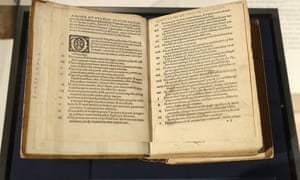
An edition of Martin Luther’s The 95 Theses printed in Basel in 1517, an academic disputation on indulgences.

The Guardian  Tuesday 31 October 2017
Catholic and Protestant leaders will stress their mutual bonds 500 years after the start of the Reformation, a movement which tore apart western Christianity and sparked a string of bloody religious wars in Europe lasting more than a century.
A service in Westminster Abbey on Tuesday will mark the anniversary of the date in 1517 on which the German theologian Martin Luther submitted The 95 Theses to the archbishop of Mainz as well as nailing a copy to the door of a church in Wittenburg, lighting the fuse of the Reformation.
The archbishop of Canterbury, Justin Welby, will present a text by the Anglican communion affirming a joint declaration by the Roman Catholic church and global Protestant bodies described as “a sign of healing after 500 years of division”.
Last week, Pope Francis said Catholics and Protestants were now enjoying a relationship of “true fraternity” based on mutual understanding, trust and cooperation.
He told Derek Browning, moderator of the Church of Scotland, who was visiting the Vatican as part of the Reformation commemorations, that the two traditions were “no longer … adversaries, after long centuries of estrangement and conflict”
The pontiff added: “For so long we regarded one another from afar, all too humanly, harbouring suspicion, dwelling on differences and errors, and with hearts intent on recrimination for past wrongs.”
The 95 Theses, written in Latin, was a backlash against increasing corruption in the Catholic church and, in particular, the highly profitable sale of “indulgences”. These promised a fast-track to heaven and were sold to fund the building of St Peter’s Basilica in Rome.
Luther argued that salvation could not be bought or brokered by the church, but was a matter between an individual and God.
His challenge to the authority and elitism of the Catholic church was translated into German and other European languages. Thanks to revolutionary new printing presses, his message spread rapidly and was taken up by others, including the French theologian John Calvin.
Rome condemned Luther as a heretic and launched the Counter-Reformation, but by the end of the 16th century most of northern Europe was Protestant.
In England, Henry VIII, desperate to dissolve his marriage to Catherine of Aragon in pursuit of a male heir, launched his own, less clear-cut, separation from the Catholic church which involved the destruction of much of the country’s religious heritage.
In 1999, the Catholic and Lutheran churches agreed a “joint declaration on the doctrine of justification” that resolved many of the theological issues at the heart of the schism. This document has now been welcomed and affirmed by the Anglican communion.
A spokesperson for the Catholic church in England and Wales said: “The desire for reconciliation is such that mistakes can be recognised, injuries can be forgiven and wounds healed.
“We give thanks to the joy of the gospel we share as Christians, express repentance for the sadness of our divisions and renew our commitment to common witness and service to the world.”
But despite the warm words of reconciliation issued by leaders, there are issues blocking the prospect of a reunification of the two traditions, not least that of female priests.
Meanwhile, pockets of sectarianism remain in parts of northern Europe, including Northern Ireland and Scotland.
Last year, a document released by an evangelical Protestant group, Reformanda Initiative, drew a distinction between individual Catholics and the “unchecked dogmatic claims and complex political and diplomatic structure … [of the] the institutional Catholic church”.
It concluded: “The issues that gave birth to the Reformation 500 years ago are still very much alive in the 21st century for the whole church.”

Friday, August 4, 2017

Jesus, thy blood and righteousness

Jesus, Thy blood and righteousness my beauty are, my glorious dress; ’midst flaming worlds, in these arrayed, with joy shall I lift up my head. Bold shall I stand in Thy great day; for who aught to my charge shall lay? Fully absolved through these I am from sin and fear, from guilt and shame. The holy, meek, unspotted Lamb, who from the Father’s bosom came, who died for me, e’en me to atone, Now for my Lord and God I own. Lord, I believe Thy precious blood, which, at the mercy seat of God, forever doth for sinners plead, for me, e’en for my soul, was shed. Lord, I believe were sinners more than sands upon the ocean shore, thou hast for all a ransom paid, for all a full atonement made.
When from the dust of death I rise to claim my mansion in the skies, ev’n then this shall be all my plea, Jesus hath lived, hath died, for me. This spotless robe the same appears, when ruined nature sinks in years; no age can change its glorious hue, the robe of Christ is ever new. Jesus, the endless praise to Thee, whose boundless mercy hath for me— for me a full atonement made, an everlasting ransom paid. O let the dead now hear Thy voice; now bid Thy banished ones rejoice; their beauty this, their glorious dress, Jesus, Thy blood and righteousness.  

Words: Nikolaus L. von Zin­zen­dorf, 1739 (Christi Blut und Ge­rech­tig­keit); first pub­lished in the eighth ap­pen­dix to his Das Ge­sang-Buch der Ge­meine in Herrn-Huth.; trans­lat­ed from Ger­man to Eng­lish by John Wes­ley, Hymns and Sac­red Po­ems, 1740, alt.

John Wycliffe, the medieval reformer


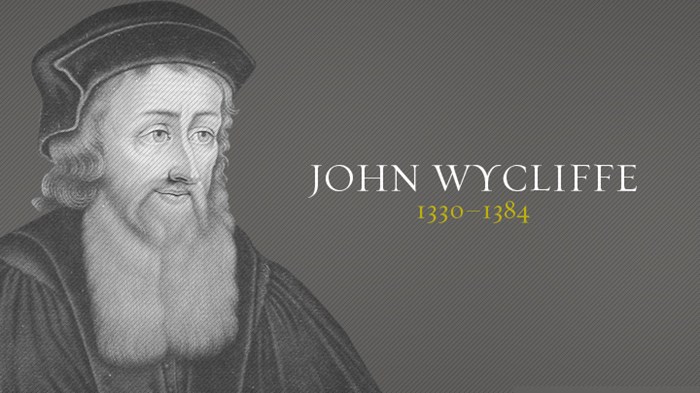
John Wycliffe

 "Trust wholly in Christ; rely altogether on his sufferings; beware of seeking to be justified in any other way than by his righteousness."
John Wycliffe left quite an impression on the church: 43 years after his death, officials dug up his body, burned his remains, and threw the ashes into the river Swift. Still, they couldn't get rid of him. Wycliffe's teachings, though suppressed, continued to spread. As a later chronicler observed, "Thus the brook hath conveyed his ashes into Avon; Avon into Severn; Severn into the narrow seas; and they into the main ocean. And thus the ashes of Wycliffe are the emblem of his doctrine which now is dispersed the world over."

Timeline

1302
Unam Sanctam proclaims papal supremacy
1309
Papacy begins "Babylonian" exile in Avignon
1321
Dante completes Divine Comedy
1330
John Wycliffe born
1384
John Wycliffe dies
1415
Jan Hus burned at stake

"Master of errors"

Wycliffe had been born in the hinterlands, on a sheep farm 200 miles from London. He left for Oxford University in 1346, but because of periodic eruptions of the Black Death, he was not able to earn his doctorate until 1372. Nonetheless, by then he was already considered Oxford's leading philosopher and theologian.
In 1374 he became rector of the parish in Lutterworth, but a year later he was disappointed to learn he was not granted a position at Lincoln nor the bishopric of Worcester—setbacks that some have seized upon as motives for his subsequent attacks on the papacy.
In the meantime, Rome had demanded financial support from England, a nation struggling to raise money to resist a possible French attack. Wycliffe advised his local lord, John of Gaunt, to tell Parliament not to comply. He argued that the church was already too wealthy and that Christ called his disciples to poverty, not wealth. If anyone should keep such taxes, it should be local English authorities.
Such opinions got Wycliffe into trouble, and he was brought to London to answer charges of heresy. The hearing had hardly gotten underway when recriminations on both sides filled the air. Soon they erupted into an open brawl, ending the meeting. Three months later, Pope Gregory XI issued five bulls (church edicts) against Wycliffe, in which Wycliffe was accused on 18 counts and was called "the master of errors."
At a subsequent hearing before the archbishop at Lambeth Palace, Wycliffe replied, "I am ready to defend my convictions even unto death…. I have followed the Sacred Scriptures and the holy doctors." He went on to say that the pope and the church were second in authority to Scripture.
This didn't sit well with Rome, but because of Wycliffe's popularity in England and a subsequent split in the papacy (the Great Schism of 1378, when rival popes were elected), Wycliffe was put under "house arrest" and left to pastor his Lutterworth parish.

Disputing the church

He deepened his study of Scripture and wrote more about his conflicts with official church teaching. He wrote against the doctrine of transubstantiation: "The bread while becoming by virtue of Christ's words the body of Christ does not cease to be bread."
He challenged indulgences: "It is plain to me that our prelates in granting indulgences do commonly blaspheme the wisdom of God."
He repudiated the confessional: "Private confession … was not ordered by Christ and was not used by the apostles."
He reiterated the biblical teaching on faith: "Trust wholly in Christ; rely altogether on his sufferings; beware of seeking to be justified in any other way than by his righteousness."
Believing that every Christian should have access to Scripture (only Latin translations were available at the time), he began translating the Bible into English, with the help of his good friend John Purvey.
The church bitterly opposed it: "By this translation, the Scriptures have become vulgar, and they are more available to lay, and even to women who can read, than they were to learned scholars, who have a high intelligence. So the pearl of the gospel is scattered and trodden underfoot by swine."
Wycliffe replied, "Englishmen learn Christ's law best in English. Moses heard God's law in his own tongue; so did Christ's apostles."
Wycliffe died before the translation was complete (and before authorities could convict him of heresy); his friend Purvey is considered responsible for the version of the "Wycliffe" Bible we have today. Though Wycliffe's followers (who came to be called "Lollards"—referring to the region of their original strength) were driven underground, they remained a persistent irritant to English Catholic authorities until the English Reformation made their views the norm.        Christianity Today

Tuesday, July 11, 2017

John Knox and the Scottish Reformation

There are different events that take place in small pockets of the earth that shape the course of human history and revolutionise the planet. John Knox was nicknamed the "thundering Scot", he is little known today, but what legacy did he leave on this earth?

Monday, October 31, 2016

Pope Francis Marks 500th Anniversary Of Protestant Reformation

Pope Francis (left) hugs Lutheran Archbishop Antje Jackelen, primate of the Church of Sweden on Monday.
Andrew Medichini/AP
Pope Francis arrived in Sweden on Monday for services marking the 500th anniversary of the Protestant Reformation that split Lutherans and Catholics.
He arrived in the southern city of Malmo, and is scheduled to attend an event with leaders of the Lutheran World Federation on Monday afternoon. He will also lead a service at a Lutheran Cathedral in the city of Lund, and a Mass at the arena in Malmo on Tuesday.
Sweden is a secular, majority-Lutheran country. Some 72 million people belong to the Lutheran church worldwide, according to the Lutheran World Federation. The Vatican estimates about 1.2 billion people have been baptized in the Catholic church.
According to Vatican Radio, Pope Francis told the magazine La Civilta Cattolica that he hopes the trip will encourage Lutherans and Catholics to support each other, especially in places where Christians of different denominations are persecuted together.
NPR's Sylvia Poggioli reports that the trip is "in keeping with his efforts to reach out to other branches of Christianity — like the Russian Orthodox Church — and other faiths, including Islam and Judaism."
While the pontiff's visit to Sweden is only for two days, it kicks off a yearlong commemoration of the Protestant Reformation.
And if you don't know the story of the Reformation, Sylvia has you covered for the basics:
"It was the year 1517 when the German monk Martin Luther pinned his 95 Theses to the door of his Catholic church, denouncing the Catholic sale of indulgences — pardons for sins — and questioning papal authority. That led to his excommunication and the start of the Protestant Reformation.
"The Catholic Church reacted with the Counter Reformation, and mutual enmity led to decades of religious wars that devastated central Europe.
...
"The animosity and resentments left by the Reformation only began to heal after the Second Vatican Council in the 1960s, with the start of an ecumenical dialogue aimed at promoting Christian unity.
"There are still some doctrinal disputes. But Pope Francis says that while theologians iron out their differences, the two churches can work together on social issues like caring for the poor, migrants and refugees, and combating persecution of Christians."
Sylvia also notes that, in the spirit of reconciliation, Pope Francis went so far as to praise Martin Luther as a great reformer. Luther was long deemed a heretic by the Catholic church.
Still, differences in theology and ritual remain between the two churches. The Lutheran church allows women to serve as pastors, while the Catholic church does not permit women as priests, and the two churches have historically different relationships to the papacy itself.                                NPR

Reformation Day


Happy Reformation Day - It isn't just Halloween!


Monday, October 24, 2016

Matthew Henry Biography

MatthewHenry.jpg

Matthew Henry (18 October 1662 – 22 June 1714) was a Nonconformist minister and author, born in Wales but spending much of his life in England.

Henry was born at Broad Oak, Iscoyd, a farmhouse on the borders of Flintshire and Shropshire, Wales, United Kingdom. His father, Philip Henry, was a Church of England cleric and had just been ejected under the Act of Uniformity 1662. Unlike most of his fellow-sufferers, Philip possessed some private means, and was thus able to give his son a good education. Matthew went first to a school at Islington, at that time a village just outside London, and then to Gray's Inn, in the heart of the capital. He soon gave up his legal studies for theology, and in 1687 became minister of a Presbyterian congregation at Chester.[1] While in Chester, Henry founded the Presbyterian Chapel in Trinity Street.[2] He moved again in 1712 to Mare Street, Hackney. Two years later (22 June 1714), he died suddenly of apoplexy at the Queen's Aid House (41 High Street) in Nantwich, while on a journey from Chester to London.[1][3]

Matthew Henry's well-known six-volume Exposition of the Old and New Testaments (1708–10) or Complete Commentary, provides an exhaustive verse by verse study of the Bible.[4] covering the whole of the Old Testament, and the Gospels and Acts in the New Testament. After the author's death, the work was finished (Romans through Revelation) by thirteen other nonconformist ministers, partly based upon notes taken by Henry's hearers, and edited by George Burder and John Hughes in 1811.[5]
Henry's commentaries are primarily exegetical, dealing with the scripture text as presented, with his prime intention being explanation, for practical and devotional purposes. While not being a work of textual research, for which Henry recommended Matthew Poole's Synopsis Criticorum, Henry's Exposition gives the result of a critical account of the original as of his time, with practical application.[5][6] It was considered sensible and stylish, a commentary for devotional purposes.
Famous evangelical Protestant preachers such as George Whitefield and Charles Spurgeon used and heartily commended the work, with Whitefield reading it through four times – the last time on his knees.[7] Spurgeon stated, "Every minister ought to read it entirely and carefully through once at least." [8] John Wesley wrote of Henry:
He is allowed by all competent judges, to have been a person of strong understanding, of various learning, of solid piety, and much experience in the ways of God. And his exposition is generally clear and intelligible, the thoughts being expressed in plain words: It is also found, agreeable to the tenor of scripture, and to the analogy of faith. It is frequently full, giving a sufficient explication of the passages which require explaining. It is in many parts deep, penetrating farther into the inspired writings than most other comments do. It does not entertain us with vain speculations, but is practical throughout: and usually spiritual too teaching us how to worship God, not in form only, but in spirit and in truth.[9]
Henry's Miscellaneous Writings, including a Life of Mr. Philip Henry, The Communicant's Companion, Directions for Daily Communion with God, A Method for Prayer, A Scriptural Catechism, and numerous sermons, the life of his father, tracts, and biography of eminent Christians, together with the sermon on the author's death by William Tong were edited in 1809; and in 1830 a new edition included sermons not previously included and Philip Henry's "What Christ is made to believers". The collection was issued several times by different publishers.[10]
Several abbreviated editions of the Commentary were published in the twentieth century; more recently the Christian linguist and author of reference books, Martin H. Manser, edited a version in modern English: The New Matthew Henry Commentary: The Classic Work with Updated Language (Zondervan 2010).

In agreement with many other reformed Christian theologians, the Commentary identifies the 'man of sin', the focus of latter day apostasy, and the Antichrist as the papacy in his interpretation of 2 Thessalonians 2:3. The author lists three 'blasphemous titles' that he states have been attached to the 'bishops of Rome'.[11]
This stridently anti-papist commentary was not directly authored by Matthew Henry, but occurs in the sixth volume, on Romans to Revelation, edited by Burden and Hughes, as noted above. It has been influential nonetheless.
Worthy of note is that this Son of Perdition sets himself forth as God. The present participle (“sets forth continually”) reveals that this presumptive posture is characteristic of the Man of Sin.
This person represents himself as God, either:
  • by making claims that belong only to deity;
  • by receiving adoration reserved exclusively for God; or,
  • by usurping prerogatives which only God can accomplish.
Clearly, the Man of Sin is an ecclesiastical character. Recall the description of John’s lamb-like beast in Revelation 13:11 https://www.christiancourier.com/articles/677-who-is-pauls-man-of-sin        Wikipedia

Saturday, September 17, 2016

The wearing out of the saints of the Most High by the papal system

In Daniel we read that one of the characteristics of the Antichrist is that it would wear out the saints of the Most High:

And he shall speak great words against the most High, and shall wear out the saints of the most High, and think to change times and laws (Daniel 7:25).
The Papacy has a long history of "wearing out" the saints of the Most High. Below is a timeline of the generally aggressive history of the Roman Catholic Church, but the most tragic one that concerns the Word of God is the persecution during the Middle Ages of anyone daring to oppose the Church. The Bible predicts that the saints of the Most High would be persecuted for 1260 years.

Historian J. A. Wylie said this:

It is idle in Rome to say, "I gave you the Bible, and therefore you must believe in me before you can believe in it." The facts...conclusively dispose of this claim. Rome did not give us the Bible—she did all in her power to keep it form us; she retained it under the seal of a dead language; and when others broke that seal, and threw open its pages to all, she stood over the book, and unsheathing her fiery sword, would permit none to read the message of life, save at the peril of eternal anathema" (emphasis in original).i

During these years of oppression in which the masses were kept in ignorance and the priest held sway over every aspect of life, here and there arose individuals willing to shine a light into the darkness. Dave Hunt tells us that because they rejected transubstantiation, "Christians were burned at the stake by Roman Catholics by the hundreds of thousands."ii

In 1940, French statesman Baron DePonnat stated, “Roman Catholicism was born in blood, has wallowed in blood, and has quenched its thirst in blood, and it is in letters of blood that its true history is written.” Indeed, the history of papal Rome has been one of brutal torture, slaughter, and mass murder. 

A Bloody Past


1096 Roman Catholic crusaders slaughter half the Jews in Worms, Germany.

1098 Roman Catholic crusaders slaughter almost all of the inhabitants of the city of Antioch.

1099 Roman Catholic crusaders massacre 70,000 Muslims and Jews when they capture Jerusalem.

1208 – 1226 The Albigensian Crusades in southern France. Roman Catholic crusaders slaughter approximately 20,000 citizens of Beziers, France, on July 22, 1209. Albigensian Christians and Catholics were slain. By the time the Roman Catholic armies finished their “crusade,” almost the entire population of southern France (mostly Albigensian Christians) has been exterminated. During the six centuries of papal Inquisition that began in the 13th century, up to 50 million people were killed.

1236 Roman Catholic crusaders slaughter Jews in the Anjou and Poitou regions of western France. The Catholic crusaders trample to death under their horses 3000 Jews who refuse baptism.

1243 Roman Catholic mobs burn alive all the Jews in Berlitz, Germany (near Berlin).

1298 Roman Catholic mobs burn alive all Jews in Rottingen, Germany.

April 26, 1349 Roman Catholic mobs burn to death all Jews in Germersheim, Germany.

1348 – 1349 The Jews are blamed for the bubonic plague. Author Dave Hunt tells us, “Accused of causing the ‘Black Death’ Jews were rounded up [by Roman Catholic mobs] and hanged, burned, and drowned by the thousands in revenge.”

1389 Roman Catholic mobs murder 3000 Jews in Prague when they refuse to be baptized.

1481 – 1483 At the direction of the Roman Catholic inquisitors, authorities burn at the stake at least 2000 people during the first two years of the Spanish Inquisition.

1540 – 1570 Roman Catholic armies butcher at least 900,000 Waldensian Christians of all ages during this 30-year period.

1550 – 1560 Roman Catholic troops slaughter at least 250,000 Dutch Protestants via torture, hanging, and burning during this ten-year period.

1553 – 1558 Roman Catholic Queen Mary I of England (aka “bloody Mary”) attempts to bring England back under the yoke of papal tyranny. During her reign, approximately 200 men and woman are burned to death at the sake. Her victims include bishops, scholars, and other Protestant leaders.

1572 St. Bartholomew’s Day Massacre. French Roman Catholic soldiers begin killing Protestants in Paris on the night of August 24, 1572. The soldiers kill at least 10,000 Protestants during the first three days. At least 8000 more Protestants are killed as the slaughter spreads to the countryside.

1618 – 1648 The Thirty Years’ War. This bloody, religious war is planned, instigated, and orchestrated by the Roman Catholic Jesuit order and its agents in an attempt to exterminate all the Protestants in Europe. Many countries in central Europe lose up to half their population.

1641 –  1649 Eight years of Jesuit-instigated Roman Catholic butchery of Irish Protestants claims the lives of at least 100,000 Protestants.

1685  French Roman Catholic soldiers slaughter approximately 500,000 French Protestant Huguenots on the orders of Roman Catholic King Louis 14 of France.

Circa 1938 –  1945 Catholic dictators such as Adolf Hitler and Monsignor Tiso slaughter approximately six million Jews in Europe prior to and during World War 2.

1941 – 1945 The Roman Catholic Ustashi in the fascist state of Croatia butcher up to one million Serbian Orthodox Christians. Roman Catholic killer squads are often led by Franciscan priests, monks, and friars. This genocide is choreographed by two Jesuit prelates: Aloysius Stepinac and Ivan Saric.                  AD              

References:
i. J.A. Wylie, History of Protestantism Volume 1 (Virginia: Heartland Publications, 2002): 58.
ii. Dave Hunt, A Cup of Trembling (Eugene, Oregon: Harvest House Publishers, 1995): 160.