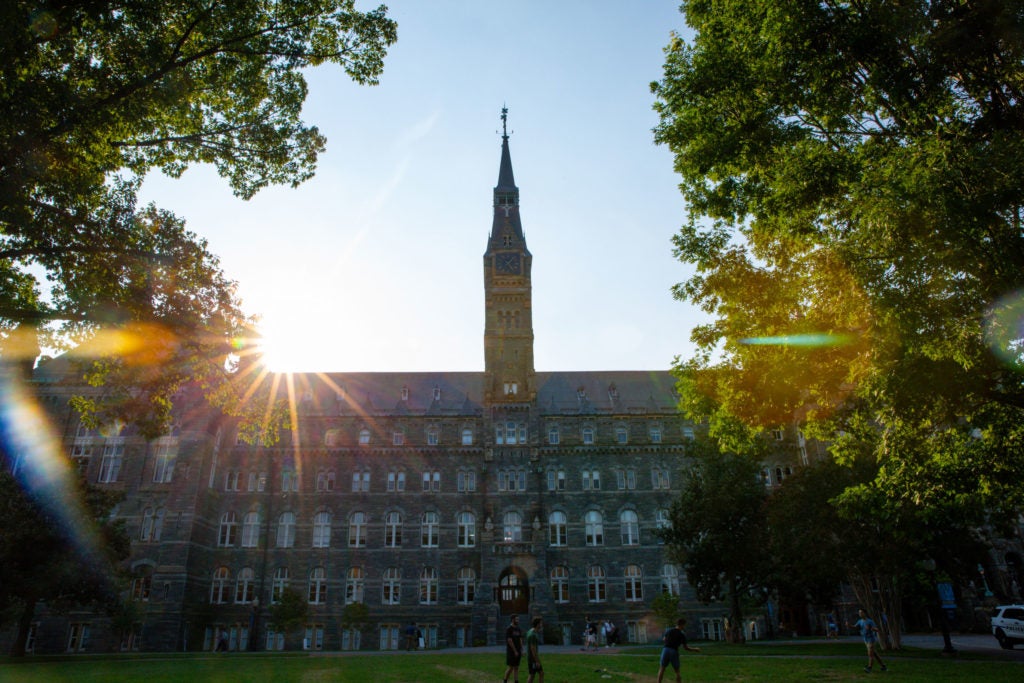
Berkley Center, Georgetown University
Background: Ganoune Diop is a leading
intellectual within interfaith circles and has been part of the G20
Interfaith Forum since its inception in 2014, focusing on issues of
religious freedom. He is currently leading the Association’s working
group on religious dimensions of racism. He and Katherine Marshall spoke
(by zoom) on July 27, to explore various dimensions of his path from
Rufisque, Senegal to the Seventh Day Adventist headquarters in Silver
Spring, Maryland. This has involved a constant focus on freedom and a
remarkable intellectual journey crossing multiple disciplines and
topics.
What did you do after you finished with your master’s degree?
I
was offered an internship to become a pastor, in Paris, where I lived
for many years. During the latter two years I was working as an
associate pastor. I was then called to be the senior pastor in another
city, Lille, a city with a well-known university with students from all
over the world. I engaged many people. I focused then a great deal on philosophy, an area where my interest had never diminished, even as I was doing theology.
From Lille, I was called to head the Department of Biblical Studies for
the Adventist Church in France, which I did for three years.
The
next large shift came when I was asked if I wanted to pursue an
academic career as a teacher. That would entail going to the US, to
Michigan, and doing a PhD in Old Testament. At the time, I was doing a
PhD in New Testament in France at the Catholic University of Paris,
linked to semiotics, the analysis of religious discourse. I was
also studying at La Sorbonne. I found that fascinating. I stayed in the
US for about five years, finishing a PhD in Old Testament. I then
returned to France, this time as a teacher.
I had studied ancient languages, Hebrew especially, while I was in
college, then for my masters. While I was working in Paris, I decided
that I really needed to have a degree in philology, the science of
languages. I did not just want to be a good student in Hebrew or a good
student in Greek. If I was to teach these languages, I wanted to have
the necessary credentials. I went to the Catholic University of Paris
again, while I was teaching in France, pursuing a master's degree in
philology at the School of Ancient Near Eastern Civilizations and
Languages.
The Seventh Day Adventist Church is not part of the World Council of Churches. We have what we call observer status.
I'm invited to events and I work with them personally. I was even part
of the writing committee at the Busan General Assembly few years ago. We
collaborate and we partner, but the Seventh Day Adventist Church has
chosen, for freedom of conscience purposes, not to belong to an
ecumenical entity with a central organization, because belonging to such
a central organization is like surrendering one's constitutional
conscience. This may be why the Catholic Church, for example, while
having very close and cordial relationships, cannot be under the
umbrella of another organization. We position ourselves in a similar
way. We will join any table where people come with an equal footing. For
reasons of freedom of conscience and preservation of our distinct
identity, SDAs are involved in interchurch relations but not fusion of
churches. We belong to the family of Christians who confess the
Trinitarian God, the divinity of Jesus who is lord and savior. However,
just to be clear, in some countries, the Seventh Day Adventist Church is
part of, for example, the Protestant World Federation or similar
organizations. France and Spain are such cases, because the government
deals directly with these entities that include Catholics, Protestants,
Jews, Muslims, etc. But we are not part of the World Council of
Churches, nor of the Council of European Churches (CEC), even though we
work so closely with them I personally teach every year at their
European summer school on human rights, and I'm invited at their general
assembly More