Showing posts with label Europe. Show all posts

Wednesday, March 31, 2021

Ireland’s New Anti-Hate Speech Surveillance Technology


Burkean 02/02/2021

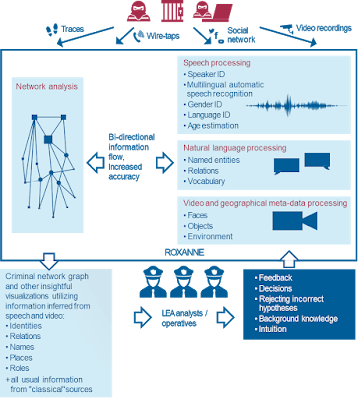
Marketed as a multiplatform analytical tool to evaluate speech and facial patterns in order to create visual mapping for authorities and identity suspects, ROXANNE is a new breed of surveillance technology in the process of development and currently being backed by both An Garda Síochána and the PSNI to bring into use. 

An acronym for Real time netwOrk, teXt, and speaker ANalytics for combating orgaNized crimE, it was announced in November the Republic’s involvement in the project currently being developed in Switzerland.

A biometrics based platform ostensibly to monitor and crack down on organised crime, an additional application of ROXANNE which its creators advertise freely is the ability to monitor those guilty of alleged hate speech and political extremism. 

A product of the EU funded Horizon 2020 to foster new surveillance technology, ROXANNE works across social media sites such as Facebook, YouTube as well as normal telecommunications platforms to identify, categorise, and track faces and voices enabling authorities to paint a more in depth picture of the network being investigated, whether it be in relation to criminal activity or those deemed politically extreme.

Enabling authorities to draw on raw data from a variety of sources and platforms in order to recognise common speech patterns, facial features, and geolocation, the end result is both to identify suspects and paint an intricate picture of the networks being put under the microscope.

Iceland rocked by more than 20,000 earthquakes in 10 days


Southwest Iceland is currently experiencing a "swarm" of seismic activity, with more than 20,000 earthquakes recorded since February 24, according to the the Icelandic Meteorological Office. The office said magma movements are likely the cause of the current surge on the Reykjanes Peninsula, raising fears of a volcanic eruption. 

There have been more than 3,100 earthquakes on the peninsula in the past 48 hours alone, according to the office. At least 63 of them had a magnitude of 3 or higher. A magnitude 3 earthquake can be felt, but rarely causes damage; as the number increases, the earthquakes become more dangerous. 

Similar bursts of seismic activity in the country have previously caused volcanic eruptions, the office said. 

2/3 Since then two earthquakes over M5.0 detected. Occurred on Feb. 27th and March 1st. Over 20000 earthquakes have been detected in the area since activity started. At 19:14 an M4.2 earthquake was detected 2 km N of Grindavík. It was felt in the Grindavík and in the capital area

— Icelandic Meteorological Office - IMO (@Vedurstofan) March 5, 2021

The aviation color code for the Reykjanes Peninsula is at an orange level, meaning there is "heightened unrest" and that there is an "increased likelihood of eruption," according to the office. 

The government of Iceland said on its website Thursday that there was a volcanic tremor pulse near Mt. Keilir, which is located on the peninsula, on Wednesday. 

Earlier today a tremor pulse was detected south of Mt Keilir, in the Reykjanes Peninsula, SW Iceland. No eruption has yet been detected but due to risks related to volcanic activity, all traffic near Keilir and Mt Fagradalsfjall is prohibited, including drone flights.

EU Bishops call for nations to protect work-free Sunday

People enjoy Sunday leisure time near the Pantheon in Rome, Italy

Vatican News  04 March 2021

The Bishops of the European Union and the European Sunday Alliance are urging EU leaders to protect synchronized free-time, which most nations traditionally observe on Sunday.

Synchronised free time should be a priority in the EU social-policy agenda, according to European Bishops and other organizations.

In a joint statement published Wedneday, on the occasion of the International Day for a work-free Sunday, the Commission of the Bishops' Conferences of the EU (COMECE) and the European Sunday Alliance urged political leaders in Europe to protect synchronised free time  - in most European countries traditionally on Sundays.

"This," they say, "is especially relevant in times where the Covid-19 pandemic has accelerated existing challenges of digitalisation by intensifying work and extending working hours, thus putting a healthy work-life balance at risk for more people."

Non-stop work

The statement notes that one of the major impacts of the pandemic lockdowns has been an acceleration of previous trends towards increasing levels of mobile and home working.

“With the rise of digital working, the fragmentation and de-limitation of working time has further proceeded. Working in the evenings and during weekends is increasingly common and indeed expected by many employers.”

The Alliance says this increases stress on workers and "affects their work-life balance” and “compromises the health and wellbeing of workers, making them not only sick in the long run but also causing increasingly more often their absence from work due to psychosocial illness for sustained periods of time.”

Day of rest

According to the network - which includes more than 100 national Sunday alliances, trade unions, employers' organisations, civil society associations, churches and religious communities in the European Union - a full day of rest per week is indispensable to recover.

“Indeed," they say, "a common day of rest truly increases wellbeing and brings a positive effect on health.”

“Only during a common day of rest is it possible to pursue volunteer work, civic engagement, joint social, sports or faith-related activities, family time and, more generally, to spend time together,” the statement explains.

EU Bishops also recall that “humans are social beings, and for many of them their health requires more than individual time off at scattered, random moments of the week to spend alone. A day free of work recognised by tradition or custom is therefore 'essential to disconnect, literally and figuratively'."

Sunday, January 31, 2021

Italy Government on Verge of Collapse as Renzi Party Quits

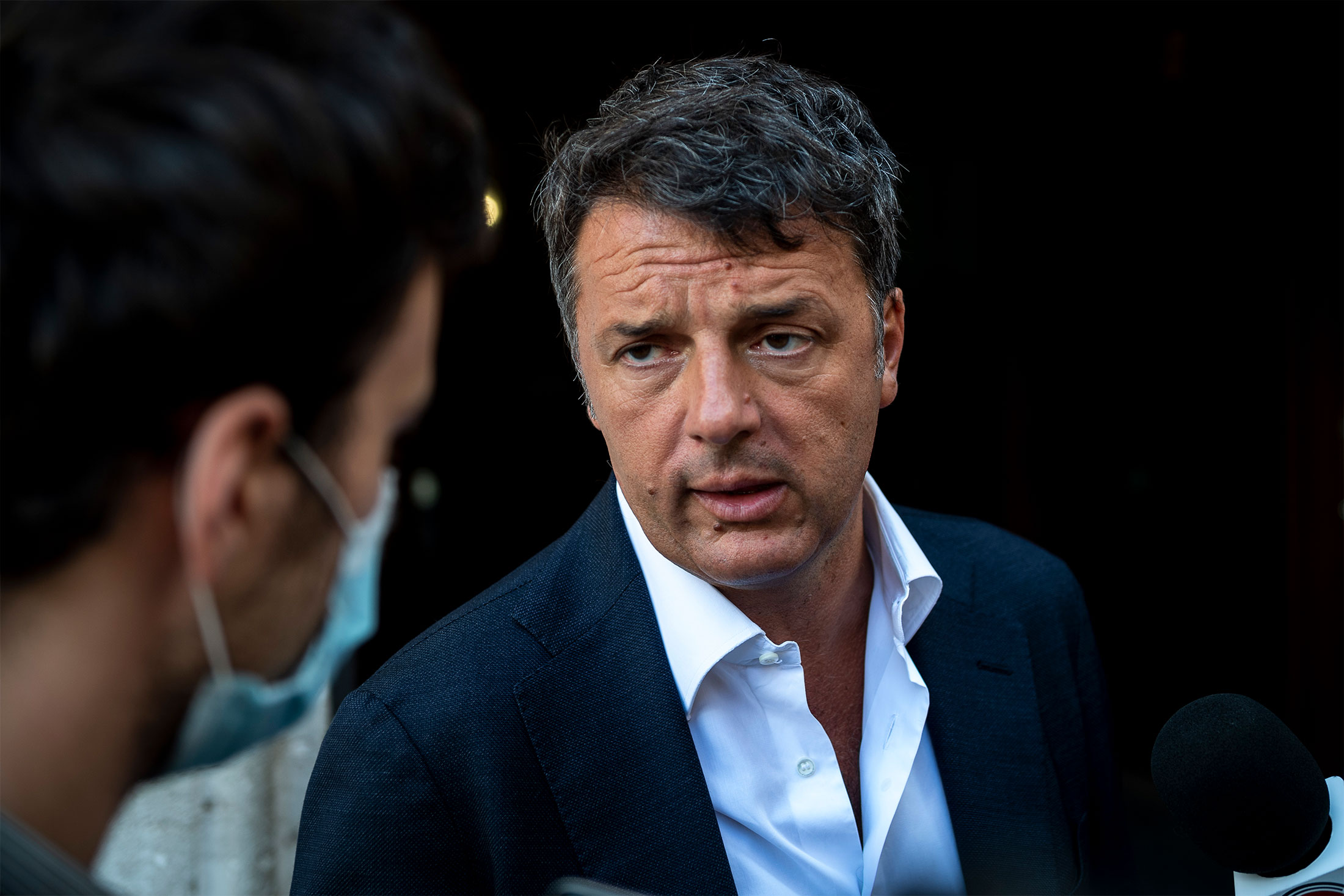
Former Prime Minister Matteo Renzi  

Bloomberg January 13, 2021

 Italy’s government led by Prime Minister Giuseppe Conte risks collapsing in the middle of the Covid-19 pandemic after a junior coalition partner pulled out.

Former Premier Matteo Renzi said his Italy Alive party is quitting the coalition, attacking Conte for failing to do enough to tackle the country’s problems. Though the party is tiny, Conte relies on it to maintain his majority in parliament.

Renzi’s decision sparks a government crisis which could last days or even weeks, and has no clear solution in sight.

After accepting the ministers’ resignation, Conte could step down himself. That would likely trigger a new round of talks among parties and lead to another Conte government, a new premier or a technocratic administration. Snap elections, although a risk, appear unlikely for now.

Monday, November 30, 2020

Bibles and newspapers ‘would be banned under new hate crime law’

The Times  November 08 2020

Books, bibles and newspapers would be seized and destroyed under the SNP’s plan to criminalise “inflammatory” publications, religious and secular organisations have warned.

An unlikely alliance of chapels, kirks, gurdwaras, humanists, secularists, artists, writers and journalists have united in condemnation of the Scottish government’s Hate Crime Bill.

Only Muslim Engagement and Development (MED), an Islamic rights lobby group, and the Scottish Council of Jewish Communities (Scotjec) argued that the bill did not go far enough in the latest round of scrutiny by Holyrood’s justice committee.

Saturday, October 31, 2020

Vatican City State Mint issued a 10 euro silver coin depicting a mother carrying the earth in her womb


Life Site  Oct 15, 2020

ROME, Italy, October 15, 2020 (LifeSiteNews) — The Vatican issued a coin depicting a mother carrying the earth in her womb. The issue of the coin comes almost one year to the day when the idol Pachamama was worshipped in the Vatican gardens in the presence of Pope Francis as part of the opening ceremony of the Amazon synod.

“The Vatican City State Mint will issue a 10 euro silver coin made by Maestro Oldani, depicting a mother carrying the earth in her womb, to whom we owe care and love as if it were a daughter, with long ears of wheat in her hair, in a reference between past and future that becomes timeless, and therefore eternal,” states the official description of the coin.

“The celebration of life on earth is a commitment to take care of the planet, a project to which the Church intends to offer its support, a grandiose and complex work that aims: to promote international action to guarantee everyone a future, the food that is needed, both in quantity and quality, so that economic advancement may be accompanied with social development, without which there is no real progress.”

Friday, October 30, 2020

Croatia is heading towards a work-free Sunday

Croatia Week Sep 21, 2020

Croatia is heading towards a work-free Sunday, in the direction of half of EU countries where Sunday working in shops is restricted, with the exception of newsstands, bakeries, petrol station convenience shops, and shops at bus and railways stations, the Vecernji List daily said on Monday.

Government spokesman Marko Milic confirmed that a law to regulate Sunday working was in preparation, taking into account the balance between work, rest, and spending time with family.

“The final proposal and determining the concrete number of non-working Sundays is still being defined and the government will discuss this with social partners,” Milic was quoted as saying, adding that Labour Minister Josip Aladrovic and Economy Minister Tomislav Coric will meet this week with union representatives to discuss this topic.

“And we will also maintain a dialogue with employers,” Milic said, adding that the political position of the HDZ government had not changed with regards to work-free Sunday and that they still wanted it to be work-free. They have analysed European practice and the best solution will be found.

Regulating and restricting Sunday working is also in line with the Directive of Work-Life Balance, adopted by the European Parliament last year, which has to be incorporated into the national legislation of EU countries by 2022.

Wednesday, September 30, 2020

The European Union is planning to establish an EU-wide digital ID system

Biometric Update Sep 10, 2020

The European Union is planning to establish an EU-wide digital ID system, with a proposal due by the middle of 2021, and leaders will seek to fund it with resources from its economic recovery fund, according to Euractiv.

EU leaders will request the European Commission to develop the service to support continued integration of digital services and economies in the region. EU rules have evolved over the past several years to make national digital identity systems more interoperable through eIDAS regulation.

Leaders are expected to call for “EU-wide secure public electronic identification (e-ID) to provide people with control over their online identity and data as well as to enable access to cross-border digital services,” a draft document seen by Euractiv reads.

EC Vice-President for Digital Margarethe Vestager launched public consultations over the summer to consider revisions to eIDAS. That consultation closes on October 2. The Commission is also expected to publish its Digital Services Act by the end of the year, which will include some details on how the EU will extend its digital identification framework.

Tuesday, March 31, 2020

Ex-PM calls for global government to tackle coronavirus

The Guardian 26 Mar 2020 
Gordon Brown has urged world leaders to create a temporary form of global government to tackle the twin medical and economic crises caused by the Covid-19 pandemic.
The former Labour prime minister, who was at the centre of the international efforts to tackle the impact of the near-meltdown of the banks in 2008, said there was a need for a taskforce involving world leaders, health experts and the heads of the international organisations that would have executive powers to coordinate the response.
A virtual meeting of the G20 group of developed and developing countries, chaired by Saudi Arabia, will be held on Thursday, but Brown said it would have been preferable to have also included the UN security council.

Friday, February 28, 2020

Majority of Germans say shops should be closed on Sundays


Evangelical Focus. 13 FEBRUARY 2020 
A survey published by news agency Idea in Germany concludes that most agree that businesses should remain closed on Sundays. 61% of the respondents said they agree with the view that, as a general rule, shops should remain closed on Sundays. Only 28% were against and 11% did not know or did not respond. According to the survey conducted by INSA-Consulere, the highest percentage support for closed shops on Sunday was found among women (64% vs 57% of men). All age groups seemed to agree on this issue except those between 18 and 29 years old: 54% prefer businesses to work on Sundays. 

CONTRAST BETWEEN CHRISTIANS AND MUSLIMS 
The survey also showed a different approach to the issue depending on the religion of the respondents. Protestants (66%), Catholics (67%) and members of free churches-evangelicals (62%) were in favour of shops closed on Sundays. In contrast, Muslims did disagree, with only 37% saying businesses should remain closed. 

POLAND AND THE UK 
The trend in European countries in the last years has been to allow businesses to extend the trading hours, including Sundays. But social initiatives have also called to “Keep Sunday Special”, as a campaign led by Christians in the UK has been asking for decades. In Poland, the calls to allow time “for family, rest and social relations” led the parliament to restrict the number of working Sundays. From 2020 on, businesses will be able to open only eight Sundays a year.

EU poised to create massive transatlantic facial-recognition database, link with US

RT 22 Feb, 2020
The EU is laying the groundwork for a massive international facial recognition database that may someday hook into the one maintained by the US, according to leaked internal documents.
National police forces of 10 EU member states are calling for a legal framework to create a massive system of interlinked facial recognition databases “as quickly as possible,” a report leaked to the Intercept on Friday reveals. Austria is leading the way on the project, which was still in its early phases as of November, when the report initially circulated among EU officials.
Produced as part of a project to expand Prüm, the EU-wide database-cross-referencing system that already allows for all-at-once scanning of individual DNA, fingerprint, and vehicle registration databases, the report calls for EU legislation that would create and connect country-level facial recognition databases, potentially all the way to the US. Because the US already has a Prüm-like exchange in place with countries that are part of the Visa Waiver Program, including most EU member states, some – including the alarmed EU official who allegedly leaked the report to the Intercept – believe any future facial recognition database network would include the US by default.

Saturday, January 25, 2020

Faith leaders call for unity, 75 years after the liberation of Auschwitz

Church Times. 24 January 2020
THE 75th anniversary of the liberation of Auschwitz should be used “to come before God in worship, conscious of our need for forgiveness, but committed to action that would seek the common flourishing of all”, the Archbishop of Canterbury has said.
In a statement released this week, in advance of Holocaust Memorial Day on Monday, Archbishop Welby said: “The Holocaust, the Shoah, remains a unique stain on the history of Europe, and a chilling reminder to me of how millennia of Christian anti-Jewish hatred could provide a seedbed for such evil.”
The Council of Christians and Jews (CCJ) has released a prayer for this year’s Holocaust Memorial Day. It was launched at an event in the House of the Lords on Monday, where it was read by the Bishop of London, the Rt Revd Sarah Mullally.
The chair of the CCJ, the Bishop of Lichfield, Dr Michael Ipgrave, said: “Through prayer, we will be asking Christians to remember the pains of the past, and to recommit to a better future for all people, and, in particular, of course, to commit themselves to combating anti-Semitism, which is such a scourge in our society and our world.”
The chief executive of the Holocaust Memorial Day Trust (HMDT), Olivia Marks-Woldman, said: “This year, we reflect on the theme ‘Stand Together’. In the run-up to the Holocaust, and in each subsequent genocide, perpetrators took deliberate steps to stop their designated victims living, studying, and working alongside their neighbours. Communities were stopped from being together.
“And, today, we know that prejudice and hostility based on faith or identity is still prevalent in many areas. Indeed, in some cases, it is even on the increase. We need to show solidarity to others.”

Tuesday, December 31, 2019

The church fights in Europe to prohibit working on Sunday

Actualidad.  August 31, 2017
On Wednesday, August 23, 2017, Polish bishops requested a total ban on work on Sunday in a country where the law is very liberal on this particular point. Likewise, throughout Europe, several episcopal conferences are trying again to place the issue of Sunday rest at the center of political debates.
 
The president of the Episcopal Conference of Poland, Archbishop Stanislaw Gadecki, declared on Wednesday, August 23, 2017, on behalf of the bishops of Poland that "both Catholics and non-Catholics and atheists need to rest on Sunday."
 
Although it has the support of the Solidarity Labor Union party , the Church in Poland has not been able to impose its point of view.
 
In this country deeply imbued with Catholicism, civil law allows work on Sunday and holidays. However, there has been progress: the current government is in favor of the ban, and will address the issue next fall.
 
As usually happens, the declaration of the episcopal conference is only limited to defending Sunday rest, but does not mention any religious motive. Proposes ad hominem arguments, such as the need for a "better quality of life". In the same context, the Archbishop of Katowice, Monsignor Wiktor Skworc, declared that "families not only need financial support, but also free time."
 
Sunday rest has its origin in the Decalogue: "Six days you will work, and you will do all your work. But the seventh day is a day of rest, consecrated to Yahweh your God; and you will not do any work in it, neither you, nor your son, neither your daughter, nor your servant, nor your servant, nor your cattle, nor the foreigner who is within your doors "(Exodus 20: 9-10) From the Resurrection of Christ, the rest day is Sunday, the" Lord's Day "- dies Domini. Therefore, Sunday as a day of rest is a matter of positive divine law; all the Church did was explain this command of God and make it more explicit. Later, he also included it in his code of canon law and in his universal catechism.
 
When, after the Edict of Milan, the Church's relations with temporal power were normalized, the latter followed the example of ecclesiastical law in this matter. Thus, in a decree of March 7, 321, Emperor Constantine declared: "On the venerable day of the sun, may the magistrates and the people rest in the cities, and may all the workshops be closed."
  1
This practice was constant in the Church throughout the centuries, until the first attacks against Sunday, the sacred day in which the faithful fulfill their duties to render to God the worship that is due. The first attacks took place during the French Revolution, with the republican calendar imposed between 1793 and 1806; this one suppressed the week of seven days thus eliminating Sundays.
 
Currently, where atheistic and secular ideologies have failed, commercial interests succeed. For many years now, there have been new laws in favor of Sunday work. Modern Popes have tried to control these changes. On May 31, 1998, in his Apostolic Letter Dies Domini , Pope John Paul II recalled that Sunday rest "is the way man has to withdraw from the plaintiff and excessive cycle of earthly tasks to remember that God is the author of everything."
 
Also, in August 2009, the 24 Eucharistic Congress was held in Bari, Italy, on the theme: "Without Sunday, we cannot live." At the closing of the congress, Benedict XVI asked Christians to rediscover the spiritual importance of Sunday, as "an expression of the identity of the Christian community" against "unbridled consumerism" and "religious indifference."
 
Paradoxically, in Europe, a small number of highly secularized countries, such as Austria and Germany, seem to be more respectful towards Sunday rest. In an article published in La Croix , Delphine Allaire cites the German Constitution stipulated in article 139: "Sundays and holidays recognized by the state remain legally protected as days of rest and spiritual edification." In Belgium, it is only allowed to work three Sundays a year, except in the tourist cities.
 
However, in most European countries, including the United Kingdom, Holland, Sweden, Norway, Romania, Czech Republic, Ireland, Italy and Portugal, as well as in Madrid, the capital of Spain, business is open 52 Sundays at year. In highly Catholic countries such as Italy, Portugal and Spain, heated public discussions regularly erupt, La Croix adds. Therefore, in 2014, the Spanish bishop of Santander, Vicente Jiménez, called for a "united front", appealing to the authorities to resist "economic pressures" that seek to liberalize working hours.
 
In France, Sunday rest lost importance after the promulgation of the Macron Law in 2015, which created 21 international tourist areas in a country where it is allowed, through a trade agreement, to work on Sundays.
 
In Italy, Delphine Allaire explains, the Episcopal Conference prefers to stick to the protection of the rights of "workers" to spend time with their families on Sundays, supporting the country's main business association, Confesercenti.
 
It should be noted that on June 9, 1873, at the feast of the Holy Trinity, the Blessed Virgin Mary appeared in Saint-Bauzille-de-la-Sylve in the Hérault, to Auguste Arnaud, a young winemaker of 30 years old , who worked during the week, and who was working in his small vineyard, and said very seriously: "You must not work on Sunday. Blessed are those who believe; woe to those who do not believe." This Marian apparition was recognized by the authorities of the Church, and serves to demonstrate once again the importance of sanctifying the Lord's Day. The Mother of God had already reminded men of the importance of this religious obligation in La Salette.
Monday, November 18, 2019

The Royal Bank of Scotland will open Britain’s first cashless bank

The Royal Bank of Scotland will open what is believed to be Britain’s first cashless bank branch next month in as the move towards online banking continues at pace.

The bank is to open at 49 Bishopsgate, London on November 20, replacing the branch at 62-63 Threadneedle Street, London, which is being closed on December 20.

The “digital bank” will remove the frontline cashier services in the store and will not have an ATM fitted, meaning customers will not be able to pay in and take cash out.

Instead, the branch will be used for other banking needs, including appointments to open Isas and other savings accounts as well as applying for mortgages.

Video banking, where people can book appointments to talk to bankers via video chat will be available, as well as staff to assist with online banking and “presentation space” for anyone to attend sessions on protecting against scammers and managing their finances.

The Federation of Protestant Churches of Switzerland announced that it supports civil marriage between same-sex individuals.

Swiss Protestant church supports gay marriage
The Local   8 November 2019
Church leaders already came out in favour of same-sex marriage in August, but officially endorsed it this week during their national assembly held in Bern.

"The diversity of sexual orientations reflects the fullness of the divine act of creation. God wants us the way we were created. We cannot choose our sexual orientation," the Church Council said.

The Federation stressed that its support does not mean the church intends to actually introduce religious marriage for same-sex couples, as this decision belongs to local parishes.

It did, however, propose to include a provision in the church's regulations giving its pastors the freedom of choice on whether to marry same-sex couples in a religious ceremony.

Peter Schneeberger, president of the Association VFG Free Churches Switzerland, criticized FEPS's decision.

"Marriage between men and women, because of their potential, has a special status in our view and is based on God's order of creation," he told Livenet.ch, a web portal for Switzerland's Christian community. 

Switzerland allows civil unions between same-sex couples, but not full marriages.

However, a proposal called "Marriage For All", introduced by the Liberal Green party, is currently in the parliament. Deputiesare expected to discuss it during the spring 2020 session.

Same-sex marriage is now legal in most Western European nations. Italy, where these unions are still prohibited, started to recognize them in 2016.

Tuesday, October 29, 2019

Switzerland’s supreme court rules parents have no right to homeschool their kids


Featured Image

GENEVA, Switzerland, September 18, 2019 (LifeSiteNews) -- Switzerland’s top court ruled that parents do not have a right to homeschool their children.

On Monday, the Swiss Federal Court ruled against a mother from the city of Basel who in 2017 had applied for permission to school her 8-year-old son at home. School authorities rejected the application and a cantonal court threw out the mother’s appeal.

When she brought her case to the Federal Court, the mother held that the appeal court’s decision was tantamount to a ban on private instruction at home, thus violating a constitutional right to privacy and family life.

The high court, however, rejected the mother’s argument, ruling that the constitutional right to a private life does not also apply to homeschooling. The court noted that no international treaty grants a right to homeschooling. 

In addition, the Federal Court ruled that Switzerland’s cantons may decide whether to authorize homeschooling or to ban it outright. In Basel, homeschooling is allowed if applicants can show that the child’s attendance at school is impossible. The Federal Court had ruled earlier that national law does not explicitly grant a right to private instruction at home. Nevertheless, it ruled that cantons may decide how they comply with federal requirements for basic education.

Monday, July 29, 2019

A Bank With 49 Trillion Dollars In Exposure To Derivatives Is Melting Down Right In Front Of Our Eyes


TECB
Could it be possible that we are on the verge of the next “Lehman Brothers moment”?  Deutsche Bank is the most important bank in all of Europe, it has 49 trillion dollars in exposure to derivatives, and most of the largest “too big to fail banks” in the United States have very deep financial connections to the bank.  In other words, the global financial system simply cannot afford for Deutsche Bank to fail, and right now it is literally melting down right in front of our eyes.  For years I have been warning that this day would come, and even though it has been hit by scandal after scandal, somehow Deutsche Bank was able to survive until now.  But after what we have witnessed in recent days, many now believe that the end is near for Deutsche Bank.  On July 7th, they really shook up investors all over the globe when they laid off 18,000 employees and announced that they would be completely exiting their global equities trading business…
It takes a lot to rattle Wall Street.
But Deutsche Bank managed to. The beleaguered German giant announced on July 7 that it is laying off 18,000 employees—roughly one-fifth of its global workforce—and pursuing a vast restructuring plan that most notably includes shutting down its global equities trading business.
Though Deutsche’s Bloody Sunday seemed to come out of the blue, it’s actually the culmination of a years-long—some would say decades-long—descent into unprofitability and scandal for the bank, which in the early 1990s set out to make itself into a universal banking powerhouse to rival the behemoths of Wall Street.
These moves may delay Deutsche Bank’s inexorable march into oblivion, but not by much.
And as Deutsche Bank collapses, it could take a whole lot of others down with it at the same time.  According to Wall Street On Parade, the bank had 49 trillion dollars in exposure to derivatives as of the end of last year…
During 2018, the serially troubled Deutsche Bank – which still has a vast derivatives footprint in the U.S. as counterparty to some of the largest banks on Wall Street – trimmed its exposure to derivatives from a notional €48.266 trillion to a notional €43.459 trillion (49 trillion U.S. dollars) according to its 2018 annual report. A derivatives book of $49 trillion notional puts Deutsche Bank in the same league as the bank holding companies of U.S. juggernauts JPMorgan Chase, Citigroup and Goldman Sachs, which logged in at $48 trillion, $47 trillion and $42 trillion, respectively, at the end of December 2018 according to the Office of the Comptroller of the Currency (OCC). (See Table 2 in the Appendix at this link.)
Yes, the actual credit risk to Deutsche Bank is much, much lower than the notional value of its derivatives contracts, but we are still talking about an obscene amount of exposure.
And this is especially true when we consider the state of Deutsche Bank’s balance sheet.  According to Nasdaq.com, as of the end of last year the bank had total assets of 1.541 trillion dollars and total liabilities of 1.469 trillion dollars.
In other words, there wasn’t much equity there at the end of December, and things have deteriorated rapidly since that time.  In fact, it is being reported that a billion dollars a day is being pulled out of the bank at this point.
I know that most Americans don’t really care if Deutsche Bank lives or dies, but as the New York Post has pointed out, the failure of Deutsche Bank could quickly become a major crisis for the entire global financial system…

Thursday, November 29, 2018

Merkel: EU leaders should one day consider “a real, true European army”

The Guardian   13 Nov 2018
Angela Merkel has said EU leaders should one day consider “a real, true European army” shortly after Donald Trump ramped up a Twitter attack on Emmanuel Macron over the same idea.

Speaking to the European parliament in Strasbourg, the German chancellor backed the bold step in European defence policy, as part of a speech extolling the need for EU cooperation in migration, climate change and counter-terrorism. “The times when we could rely on others is past,” she said.

To a mix of applause and jeers from Eurosceptic MEPs, she said: “We have to look at the vision of one day creating a real, true European army.” The chancellor said the idea would complement Nato, but gave no details on when the ambitious idea could become reality.

Her words echoed those of the French president, who in an interview said Europe needed to better defend itself.

Trump took umbrage at what he saw as a call by Macron for a European army as protection against the US, conflating earlier comments from the French president on cyber threats. The US president escalated his attack on Tuesday with a number of insulting tweets.

Friday, August 31, 2018

A group of strict Protestants who believe Sunday should be a day of rest are going to court on Friday to have a festival in the centre of Alkmaar banned

Dutch News July 20, 2018
A group of strict Protestants who believe Sunday should be a day of rest are going to court on Friday to have a festival in the centre of Alkmaar banned. 

The Vereniging Zondagsrust is using legislation dating from 1815 to make its case to halt the outdoor dance party, due to be held on Sunday August 26. 

The legislation, which was amended in 1953, states that there must be no noise nuisance close to churches before 13.00 on Sunday or any public entertainment nearby, unless local councils rule otherwise. 

But it also stops local councils in strict Protestant communities from banning sports events on Sundays. 

Councils are allowed to deviate from the rules, but must properly support their arguments, association lawyer Laus Vogelaar told local paper Noordhollands Dagblad. 

And, he says, the town council has failed to mention the legislation when granting the licence for the event. Sunday as a day of rest is being increasingly undermined, he says, adding ‘it is right that the courts take a look at it’. 

The Alkmaar resident who initiated the legal action told local website Alkmaar Centraal he hoped the courts would realise the importance of having a day of rest to city centre residents. 

The previous coalition government had planned to remove the law from the statute books but the new coalition, which includes two Christian parties, decided to leave it unchallenged.
A group of strict Protestants who believe Sunday should be a day of rest are going to court on Friday to have a festival in the centre of Alkmaar banned. The Vereniging Zondagsrust is using legislation dating from 1815 to make its case to halt the outdoor dance party, due to be held on Sunday August 26. The legislation, which was amended in 1953, states that there must be no noise nuisance close to churches before 13.00 on Sunday or any public entertainment nearby, unless local councils rule otherwise. But it also stops local councils in strict Protestant communities from banning sports events on Sundays. Councils are allowed to deviate from the rules, but must properly support their arguments, association lawyer Laus Vogelaar told local paper Noordhollands Dagblad. And, he says, the town council has failed to mention the legislation when granting the licence for the event. Sunday as a day of rest is being increasingly undermined, he says, adding ‘it is right that the courts take a look at it’. The Alkmaar resident who initiated the legal action told local website Alkmaar Centraal he hoped the courts would realise the importance of having a day of rest to city centre residents. The previous coalition government had planned to remove the law from the statute books but the new coalition, which includes two Christian parties, decided to leave it unchallenged.

Read more at DutchNews.nl:
A group of strict Protestants who believe Sunday should be a day of rest are going to court on Friday to have a festival in the centre of Alkmaar banned. The Vereniging Zondagsrust is using legislation dating from 1815 to make its case to halt the outdoor dance party, due to be held on Sunday August 26. The legislation, which was amended in 1953, states that there must be no noise nuisance close to churches before 13.00 on Sunday or any public entertainment nearby, unless local councils rule otherwise. But it also stops local councils in strict Protestant communities from banning sports events on Sundays.

Read more at DutchNews.nl:
A group of strict Protestants who believe Sunday should be a day of rest are going to court on Friday to have a festival in the centre of Alkmaar banned. The Vereniging Zondagsrust is using legislation dating from 1815 to make its case to halt the outdoor dance party, due to be held on Sunday August 26. The legislation, which was amended in 1953, states that there must be no noise nuisance close to churches before 13.00 on Sunday or any public entertainment nearby, unless local councils rule otherwise. But it also stops local councils in strict Protestant communities from banning sports events on Sundays.

Read more at DutchNews.nl:

Saturday, April 28, 2018

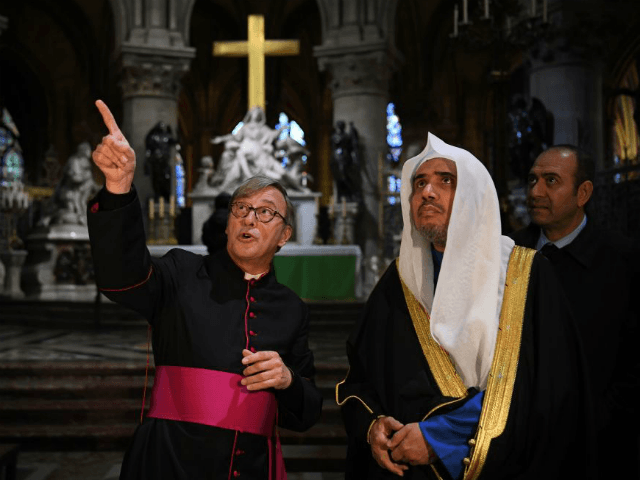
Global Islam Body Demands Europe Ban Religious Hate Speech


 Europe

Breitbart  12 Apr 2018

Europe must increase its efforts to integrate Muslims and eradicate religious hate speech, Muslim World League (MWL) chief Mohammed al-Issa has declared.

“We believe that European countries, where there is much debate now, and other countries around the world … need to enhance national assimilation programmes and criminalise hatred and contempt for adherents of religions because this threatens the safety of the community,” he toldReuters in an interview.

Without giving specific details, the wealthy Saudi figure told the international news agency that the MWL “has programmes and curricula that enhance national assimilation and which can courageously and forcefully confront all forms of extremism, as well as special programmes to thwart efforts to infiltrate the Muslim community”.

Widely regarded a promoter of the Kingdom’s fundamentalist Wahhabi ideology which critics allege is the basis for jihadi violence across the globe, the MWL is very active in nations of Europe which have a large number of Muslim residents, such as Britain and France.

As well as encouraging followers of Islam to be more religiously observant and promoting global solidarity among Muslims, the body also seeks to propagate a conservative brand of the religion and convert nonbelievers, according to the Pew Research Center.