Showing posts with label Increased Knowledge. Show all posts

Saturday, October 31, 2020

A knowledge of God is the foundation of all true education

Like our Saviour, we are in this world to do service for God. We are here to become like God in character, and by a life of service to reveal Him to the world. In order to be co-workers with God, in order to become like Him and to reveal His character, we must know Him aright. We must know Him as He reveals Himself. 

A knowledge of God is the foundation of all true education and of all true service. It is the only real safeguard against temptation. It is this alone that can make us like God in character. 

This is the knowledge needed by all who are working for the uplifting of their fellow men. 

Transformation of character, purity of life, efficiency in service, adherence to correct principles, all depend upon a right knowledge of God. This knowledge is the essential preparation both for this life and for the life to come.  

“The knowledge of the Holy is understanding.” Proverbs 9:10. 

Through a knowledge of Him are given unto us “all things that pertain unto life and godliness.” 2 Peter 1:3. 

 “This is life eternal,” said Jesus, “that they might know Thee the only true God, and Jesus Christ, whom Thou hast sent.” John 17:3.    Ministry of Healing pp. 409,410

Monday, July 31, 2017

Disease, ageing and even death are all human realities that super intelligence seek to end.

By Alexander Thomas, July 31, 2017 
The rapid development of so-called NBIC technologies – nanotechnology, biotechnology, information technology and cognitive science – are giving rise to possibilities that have long been the domain of science fiction. Disease, ageing and even death are all human realities that these technologies seek to end.
They may enable us to enjoy greater “morphological freedom” – we could take on new forms through prosthetics or genetic engineering. Or advance our cognitive capacities. We could use brain-computer interfaces to link us to advanced artificial intelligence (AI).
Nanobots could roam our bloodstream to monitor our health and enhance our emotional propensities for joy, love or other emotions. Advances in one area often raise new possibilities in others, and this “convergence” may bring about radical changes to our world in the near-future.
“Transhumanism” is the idea that humans should transcend their current natural state and limitations through the use of technology – that we should embrace self-directed human evolution. If the history of technological progress can be seen as humankind’s attempt to tame nature to better serve its needs, transhumanism is the logical continuation: the revision of humankind’s nature to better serve its fantasies.                  More

Friday, June 9, 2017

German scientists have found a way to photograph people in 3D through walls using Wi-Fi


amplifi meshpoint covers home in wifi

By Dave Mosher, 22.05.2017
Wi-Fi can pass through walls.
This fact is easy to take for granted, yet it's the reason we can surf the web using a wireless router located in another room.
But not all of that microwave radiation makes it to (or from) our phones, tablets, and laptops. Routers scatter and bounce their signal off objects, illuminating our homes and offices like invisible light bulbs.
Now, German scientists have found a way to exploit this property to take holograms, or 3D photographs, of objects inside a room — from outside it.
"It can basically scan a room with someone's Wi-Fi transmission," Philipp Holl, a 23-year-old undergraduate physics student at the Technical University of Munich, told Business Insider.
Holl initially built the device as part of his bachelor thesis with the help of his academic supervisor, Friedemann Reinhard. The two later submitted a study about their technique to the journal Physical Review Letters, which published their paper in early May.
Holl says the technology is only in its prototype stage and has limited resolution, but he is excited about its promise.
"If there's a cup of coffee on a table, you may see something is there, but you couldn't see the shape," Holl says. "But you could make out the shape of a person, or a dog on a couch. Really any object that's more than 4 centimeters in size."    Read More

Thursday, May 18, 2017

The Military is Using Human Brain Waves to Teach Robots How to Shoot


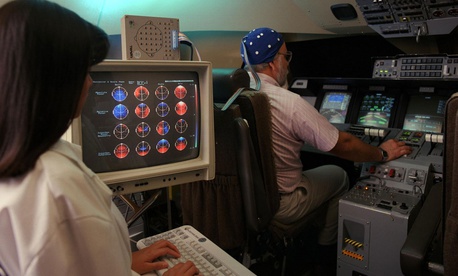
A 2009 photo from the he Human Engineering Methods (HEM) Research Lab.

By Patrick Tucker,  May 5 2017
Modern sensors can see farther than humans. Electronic circuits can shoot faster than nerves and muscles can pull a trigger. Humans still outperform armed robots in knowing what to shoot at — but new research funded in part by the Army may soon narrow that gap.
Researchers from DCS Corp and the Army Research Lab fed datasets of human brain waves into a neural network — a type of artificial intelligence — which learned to recognize when a human is making a targeting decision. They presented their paper on it at the annual Intelligent User Interface conference in Cyprus in March.
Why is this a big deal? Machine learning relies on highly structured data, numbers in rows that software can read. But identifying a target in the chaotic real world is incredibly difficult for computers. The human brain does it easily, structuring data in the form of memories, but not in a language machines can understand. It’s a problem that the military has been grappling with for years.
“We often talk about deep learning. The challenge there for the military is that that involves huge datasets and a well-defined problem,” Thomas Russell, the chief scientist for the Army, said at a recent National Defense Industrial Association event. “Like Google just solved the Go game problem.”
Last year, Google’s DeepMind lab showed that an AI could beat the world’s top player in the game of Go, a game considered exponentially harder than chess. “You can train the system to do deep learning in a [highly structured] environment but if the Go game board changed dynamically over time, the AI would never be able to solve that problem. You have to figure out...in that dynamic environment we have in the military world, how do we retrain this learning process from a systems perspective? Right now, I don’t think there’s any way to do that without having the humans train those systems.”
Their research branched out of a multi-year, multi-pronged program called the Cognition and Neuroergonomics Collaborative Technology Alliance.  

Sunday, April 16, 2017

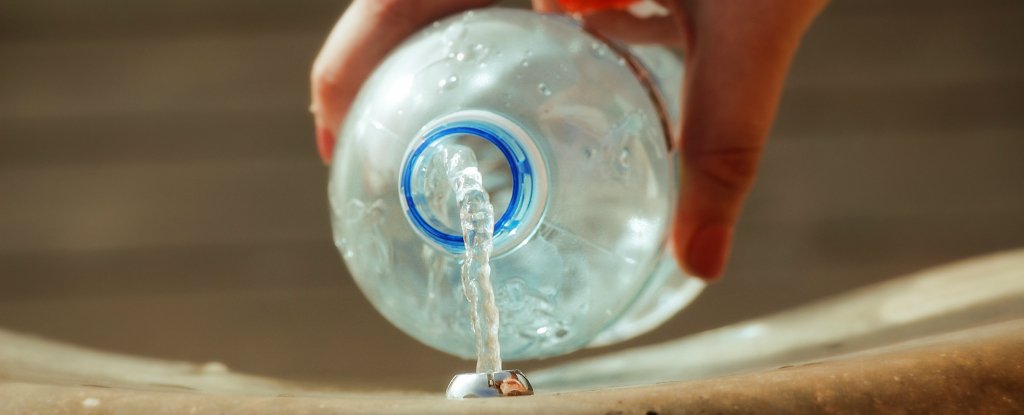
Scientists Have Created a Device That Sucks Water Out of Thin Air

FIONA MACDONALD 13 APR 2017 
When it comes to future challenges, one of the biggest will be water scarcity - on a warming planet we're going to have plenty of seawater, but not enough fresh, clean water in the right places for everybody to drink.
And while a lot of research has focussed on desalination, a team of scientists have now come up with another possible solution - a device that pulls fresh water out of thin air, even in places with humidity as low as 20 percent. All it needs is sunlight.
It might sound too good to be true, but so far the research is solid. Called the 'solar-powered harvester', the device was created by teams from MIT and the University of California, Berkeley, using a special type of material known as a metal-organic framework (MOF).
To be clear, it's only in the prototype phase right now and has been tested in pretty limited situations, but the results so far have just been published in Science.
"This is a major breakthrough in the long-standing challenge of harvesting water from the air at low humidity," said one of the researchers, Omar Yaghi from UC Berkeley.
"There is no other way to do that right now, except by using extra energy. Your electric dehumidifier at home 'produces' very expensive water."
Two-thirds of the world's population is currently experiencing a shortage of clean water, but it's estimated that there's about 13,000 trillion litres of water worldwide present in the air all around us.
So far the prototype device has been tested under conditions of 20 to 30 percent humidity, and was able to pull 2.8 litres (3 quarts) of water from the air over a 12- hour period, using 1 kilogram (2.2 pounds) of MOF.
Successful tests have also been conducted on the rooftop at MIT, showing that it works in real-world conditions.
The team says that the device could easily be scaled up to provide a family with their freshwater needs for the day.        Read More