Showing posts with label Sleep. Show all posts

Wednesday, March 31, 2021

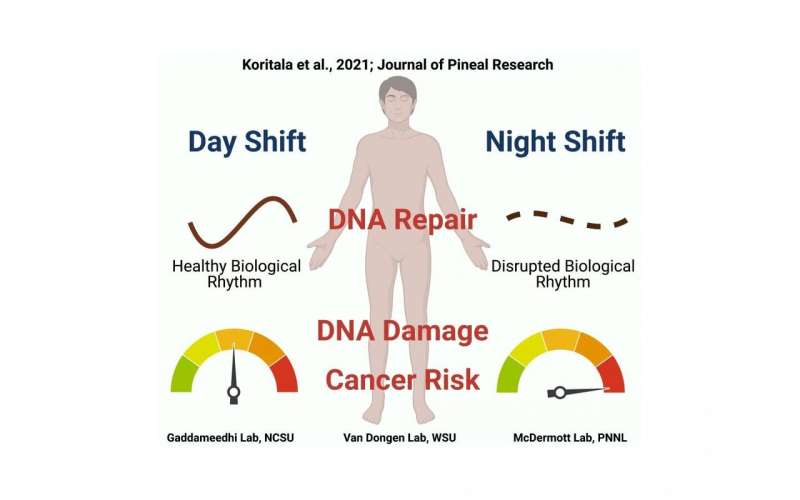
A night shift schedule is associated with increased DNA damage

Research offers insights on how night shift work increases cancer risk

Medical Xpress March 8, 2021

New clues as to why night shift workers are at increased risk of developing certain types of cancer are presented in a new study conducted at Washington State University Health Sciences Spokane.

Published online in the Journal of Pineal Research, the study involved a controlled laboratory experiment that used healthy volunteers who were on simulated night shift or day shift schedules. Findings from the study suggest that night shifts disrupt natural 24-hour rhythms in the activity of certain cancer-related genes, making night shift workers more vulnerable to damage to their DNA while at the same time causing the body's DNA repair mechanisms to be mistimed to deal with that damage.

Though more research still needs to be done, these discoveries could someday be used to help prevent and treat cancer in night shift workers.

"There has been mounting evidence that cancer is more prevalent in , which led the World Health Organization's International Agency for Research on Cancer to classify night shift work as a probable carcinogenic," said co-corresponding author Shobhan Gaddameedhi, an associate professor formerly with the WSU College of Pharmacy and Pharmaceutical Sciences and now with North Carolina State University's Biological Sciences Department and Center for Human Health and the Environment. "However, it has been unclear why night shift work elevates cancer risk, which our study sought to address."

Monday, August 28, 2017

Sleeping less that 6 hours severely damages your brain


Regularly getting less than six hours sleep a night could cause the same long-term damage as alcohol abuse, according to a worrying new study. 
For the body, sleep deprivation results in increased risk of obesity, depression, heart attacks and strokes - causing experts to dub it the 'modern ill'.
However, the most worrying consequences are rooted in the brain and new research suggests the effects are far more destructive than previously thought.
Research suggests that being awake for 18 hours results in the same cognitive impairment people get from being drunk.  
This is so severe that driving while sleep deprived could be as dangerous as driving when drunk, researchers found.
Researchers from Quebec-based digital health company Medisys found people who regularly got less than six hours of sleep a night could suffer terrible cumulative health effects they may be oblivious to.
Although the odd night sleeping just six hours or less will not have a significant effect, frequently not sleeping enough is very dangerous, researchers found. 

Sleep affects hunger hormones
'Sleep plays an important role in regulating the hormones that influence hunger (ghrelin, cortisol, and leptin) that's why sleep deprivation increases appetite and leads to overeating and weight gain', neuroscientist Dr Adrian Owen at Western University, who also works with Medisys, told Digital Journal.
Researchers found your brain becomes less stable for the longer you remain wake - which reduces your attention, ability to focus and use your brain on specific tasks. 
Recent reports have suggested 1 in 3 Canadians are chronically sleep-deprived.

The brain 'eats' itself 
The news comes on the heels of research that showed having too little sleep causes the brain to eat itself if it hasn't had enough sleep.
In May researchers studied lab mice, and found that 'clean-up' cells were more active in their brains when they were sleep-deprived.
'We show for the first time that portions of synapses are literally eaten by astrocytes because of sleep loss,' lead author Michele Bellesi told New Scientist.
According to the research team at Italy's Marche Polytechnic University, the seemingly alarming process is actually a positive thing.

Researchers found your brain becomes less stable for the longer you remain wake - which reduces your attention, ability to focus and use your brain on specific tasks (stock image)
'They [our synpases] are like old pieces of furniture,' Bellesi said. 'And so [they] probably need more attention and cleaning.'
But he added that sleep-deprived brains showed ominous signs of activity that leads to Alzheimer's.
In sleep-deprived mice, brain cells called microglials were more active.
'We already know that sustained microglial activation has been observed in Alzheimer's and other forms of neurodegeneration,' Michele said.         Dailymail
Saturday, May 20, 2017

10 signs you need more sleep


sleep deprived test
By Dr. Mercola    May 18, 2017
1. You Always Feel Hungry
Lack of sleep influences hormone levels, including increasing the "hunger hormone" ghrelin and decreasing leptin, which is involved in satiety. By activating your endocannabinoid system, which is involved in modulating appetite and food intake, sleep deprivation can even give you the munchies, similar to marijuana use.
2. You've Gained Weight
One of the consequences of eating more when you're sleep deprived is weight gain, although lack of sleep also promotes metabolic dysfunction that further fuels weight gain. Losing as little as 30 minutes of sleep each night can disrupt your metabolism enough to cause weight gain. In fact, each half-hour of sleep debt incurred during weeknights raised one study's participants' risk for obesity and insulin resistance by 17 percent and 39 percent respectively after one year.4
What this means is that if you need eight hours of sleep but consistently only get seven, you may theoretically raise your risk of obesity by about 34 percent and simultaneously jack up your chances of insulin resistance — which is a hallmark of most chronic diseases, including type 2 diabetes — by 78 percent.
3. Your Memory Fails You
The process of brain growth, or neuroplasticity, is believed to underlie your brain's capacity to control behavior, including learning and memory. However, sleep and sleep loss modify the expression of several genes and gene products that may be important for synaptic plasticity.
Furthermore, certain forms of long-term potentiation, a neural process associated with the laying down of learning and memory can be elicited in sleep, suggesting synaptic connections are strengthened while you slumber.
4. It's Difficult to Make Decisions
Sleep deprivation leads to accidents both big and small, some of which prove to be fatal, in part because it leads to blunted reaction times and difficulty making decisions. Participants in one study underwent two nights of total sleep deprivation followed by two nights of recovery sleep, then performed a decision-making test.5
A well-rested control group (who had slept normally) performed better on the tests than the sleep-deprived group, but, worse yet, when the test rules were reversed none of the sleep-deprived volunteers got the right answer, even after 40 tries, leading the study's lead author to state their ability to take in new information was "completely devastated."6
5. Your Reaction Time Slows
In the aforementioned study, the researchers concluded that sleep deprivation is particularly problematic for decision-making involving uncertainty and unexpected change. This leads to blunted reaction times that can have tragic consequences while you're driving or on the job.
6. You're Overly Emotional
Lack of sleep kicks your emotions into high gear, which means you're likely to overreact when expressing emotions like fear and anger. Your brain's frontal cortex, for instance, plays a key role in the regulation of emotions, and sleep is vital for its function. Not to mention that research shows even one night of too little sleep may lead to unwanted behavior at work the next day, such as acting rude toward co-workers, theft or going home early without notifying the boss.7
7. You're Always Getting Sick
Sleep deprivation has the same effect on your immune system as physical stress or illness,8 which may help explain why lack of sleep is tied to an increased risk of numerous chronic diseases and acute illnesses like colds and flu. In fact, research shows adults who sleep less than six hours a night have a four times higher risk of catching a cold when directly exposed to the virus than those who get at least seven hours.9
Sleeping less than five hours per night resulted in a 4.5 times higher risk. The study found that sleep was more important than any other factor when it came to protecting against the cold virus, including stress levels, age and smoking. In short, if you want your immune system to be at its best, adequate sleep is essential. The researchers, writing in the journal Sleep, explained:10
"Growing evidence demonstrates that short sleep duration (< 6 or 7 h/night) and poor sleep continuity are associated with the onset and development of a number of chronic illnesses, susceptibility to acute infectious illness, and premature mortality. Experimental evidence in animals and humans suggests that the immune system serves as a key biological pathway.
For instance, total and partial sleep deprivation in humans results in modulation of immune parameters critical to host resistance, including diminished T cell proliferation, shifts in T helper cell cytokine responses, decreases in natural killer (NK) cell cytotoxicity, and increased activation of proinflammatory pathways."
8. Your Vision Seems Unfocused
Even your vision is affected by lack of sleep. According to Health, when you're tired your ciliary muscle, which helps your eyes focus, will not work up to par and "the extraocular muscles, which move the eye from side to side and up and down, may start to track improperly, resulting in double vision."11 So, if you seem to be having trouble seeing after a night of little sleep, it's probably not in your imagination.
9. Your Physical Appearance Suffers
Lack of sleep affects your physical appearance significantly, in part because it alters your hormonal balance, which can lead to acne, and decreases collagen production, which may increase the appearance of wrinkles.
Further, one study took photos of 23 people with the same hairstyles, facial expressions and bare (no makeup) skin. The only difference between them was the amount of sleep they'd had—one group had a full night's sleep while the other group had been awake for 31 hours straight and then slept for just five hours.
Not surprisingly, when the photos were shown to a separate group of people, they rated the sleep-deprived group as less healthy, less attractive and more tired, suggesting that the idea of "beauty sleep" is not just a fairy tale.12
10. You Nod Off During the Day
You might be able to fool your body into believing you can function normally on little sleep, but as reported in the journal Sleep, as soon as you let your guard down, overwhelming sleepiness ensues.13 Your body will likely cave in to these episodes of "microsleeps" or nodding off, which can be tragic depending on your line of work or if you fall asleep while behind the wheel.
In a report released by the AAA Foundation for Traffic Safety, researchers compared driving drowsy to driving with a blood alcohol concentration considered legally drunk.14 Lack of sleep, even by one or two hours, nearly doubled study participants' risk of a car accident the following day. If sleep deprivation increased, with participants sleeping just four or five hours a night, their risk of a car crash quadrupled.15 According to the AAA Foundation for Traffic Safety:16

References: