Showing posts with label Carson. Show all posts

Wednesday, December 7, 2016

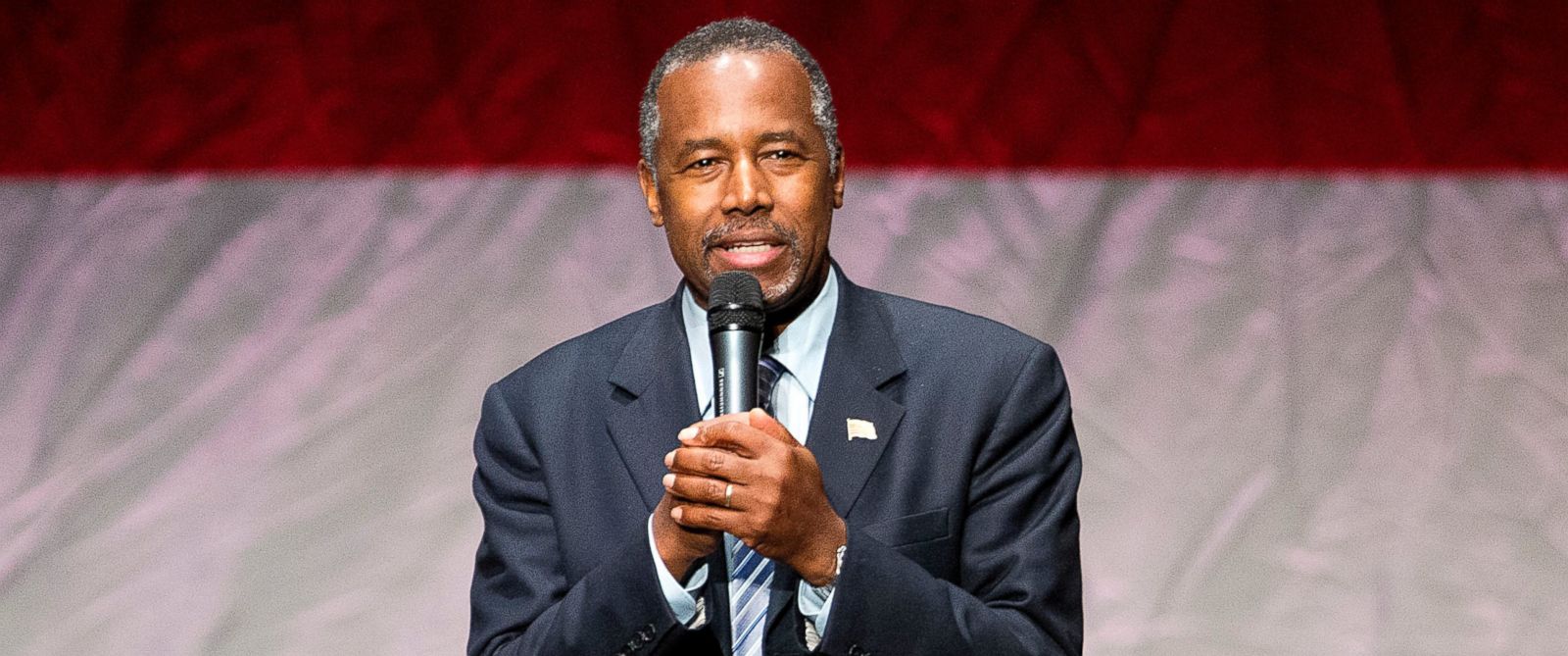
Donald Trump has chosen Dr. Ben Carson to lead the Department of Housing and Urban Development

President-elect Donald Trump has chosen Dr. Ben Carson to lead the Department of Housing and Urban Development in his incoming administration.
"Ben Carson has a brilliant mind and is passionate about strengthening communities and families within those communities," Trump said in a statement released Monday. "We have talked at length about my urban renewal agenda and our message of economic revival, very much including our inner cities."
The famed retired neurosurgeon is an unorthodox pick to lead the agency which oversees affordable housing programs and enforces fair housing legislation.
In fact, a top Carson aide, Armstrong Williams, told The Hill last month that the former GOP presidential hopeful wasn't interested in a Cabinet position because, "Dr. Carson feels he has no government experience, he's never run a federal agency. The last thing he would want to do was take a position that could cripple the presidency."
At the time, Carson's name was being floated to lead the Department of Health and Human Services. And Trump himself confirmed he was considering Carson to lead HUD.

Carson teased later that he was going to accept the appointment, writing on Facebook that he could "make a significant contribution particularly to making our inner cities great for everyone" and that an announcement was "forthcoming."
Carson said he was honored to accept the opportunity to serve in Trump's administration. "I feel that I can make a significant contribution particularly by strengthening communities that are most in need," he said.
Carson was one of Trump's many rivals for the Republican nomination for president, which was the retired African-American doctor's first foray into politics. Carson surged briefly in the polls last fall, which prodded Trump to question Carson's religion (he's a Seventh-day Adventist).
Trump also brought up Carson's childhood temperament and anger, issues Carson had written about in his autobiography. Trump said Carson's temperament was an incurable sickness that he compared to "child molesting."
Nonetheless, Carson endorsed Trump less than a week after he ended his own White House bid just after Super Tuesday and said the two had "buried the hatchet."
Carson grew up in Detroit, Mich., in a home headed by a single mother. Carson told Fox News's Neil Cavuto last month his upbringing made him well-suited for this particular role.
"I grew up in the inner city and have spent a lot of time there, and have dealt with a lot of patients from that area and recognize that we cannot have a strong nation if we have weak inner cities," Carson said.          NPR

Monday, February 1, 2016

A Compromising Interview w/ Ben Carson

Jan 26, 2016

Does Dr. Ben Carson consider himself an evangelical? How would "President Carson" share the gospel? |
Faith of the Candidates: An Interview w/ Ben Carson (Part 1)

On Christian Identity

Ed Stetzer: Do you describe yourself as an Evangelical and if so, or if not, why?
Dr. Ben Carson: I would describe myself first of all as a Christian—Evangelical in the sense that I believe we have a responsibility to proclaim the gospel and show other people why we live the way that we do and hopefully that will affect their lives. I think that’s a very important component of what we do.
ES: How would a President Carson proclaim the gospel in the White House?
Dr. Carson: By not being a politician.
Politicians do what is politically expedient. I don’t believe in that.
I believe you have to do what’s right. And I believe there is such a thing as right and wrong.
We’ve moved away from that model. We’ve moved toward the model of everything is relative and nobody gets to define right and wrong. I, obviously, don’t believe that.
I believe in the Bible, biblical principles. I believe in the Judeo-Christian foundation of this nation and would live accordingly. But the fact is, everybody lives according to their faith. Even an atheist lives according to their faith.
ES: Could you see yourself sharing the gospel in the Oval Office?

On Sharing the Gospel in the Oval Office

Dr. Carson: I will never use my position to force my beliefs upon someone else. But I will always lead a life that I believe is consistent with the will of God.
ES: You’re the first Seventh Day Adventist who is as known on a national scale and people have had questions about Seventh Day Adventism. So a couple of questions related to that.
One of the big emphases in Seventh Day Adventism is the Second Coming. What does it mean that you live in light of that? There is a strong sense of imminence in Seventh Day Adventism. How is that focused in your life?

On the Second Coming of Jesus

Dr. Carson: I obviously do look forward to the return of Christ, you know, as described in 1 Thessalonians 4. I believe that you should lead your life in such a way that every day could be your last day. So you shouldn’t be like planning oh, a year from now, five years, I’ll do this or ten years I’ll do this. You need to lead the right kind of life as if you were going to die today.
ES: Most Christians believe in a return of Jesus. But, in modern political conversation, when a Christian articulates that people ask, “Does that mean you won’t care about certain things because Jesus is coming back soon? “ For example, the environment…
Dr. Carson: Well the thing you have to remember, the Bible says—in the Book of Psalms—to God, one day is like a thousand years or a thousand years is like a day. You know, so imminent return could mean three thousand years or 30 thousand years—or it could be tomorrow.
For us to pre-define what that means in our minds and then live according to that predefinition I think would be foolish.
ES: Do you think Jesus is coming back in our lifetime?
Dr. Carson: No idea.
But I do recognize what is happening in the world, you know, with the radical Islamic Jihadists. I do recognize that it will not be possible to keep nuclear weapons out of their hands forever. And I do realize that they have a mindset that would not preclude them from using them. So, you know, all of that obviously is something of concern.

On Radical Islam

ES: Do you think that the rise of Islamic radicalism is sort of a portent of prophecy?
Dr. Carson: It does seem to fit in with a lot of things that are predicted in the Bible. No question.

On Ellen White and Prophecy

ES: Most people have a general notion—and Christianity Today readers would have a stronger notion—of what Evangelicals are. But, sometimes Evangelicals and Seventh Day Adventists are not sure of one another’s beliefs.
Ellen White, of course, is key figure in Seventh Day Adventism. In Seventh Day Adventism, she’s talked about as a prophet, specifically mentioning “the spirit of prophecy.” How do you perceive Ellen White and her writings?
Dr. Carson: Well I think she added a lot of light, particularly in the health area and was many years ahead of medical science—no question about that. Where could she have gotten that information because it wasn’t known yet?
I think there clearly was some inspiration there. I think some of the things that she wrote were her own opinion. So I’m not one of those people who equate her writings with the Bible by any stretch of the imagination. She said that you shouldn’t do that. But her writing, along with the writings of many religious people over the course of the decades, has been enlightening.
ES: So was she a unique prophet for our day or was she one of many who wrote good, helpful things under the inspiration of God?
Dr. Carson: I would seriously doubt that she would be the only person who would be inspired by God.
But you know, as she said herself—and it’s what I believe—anything that is written by anyone, you must compare it to the Word of God and if there’s any inconsistency, you must reject it.
ES: Did she have a unique prophetic role or one of many who might have a similar prophetic role?
Dr. Carson: I can’t believe that there would only be one prophet.
ES: Is there anyone you look to today who you might say there’s a similar “spirit of prophecy” on that person?
Dr. Carson: Let me put it this way, I think there are a lot of people out there today in the spiritual world that I respect tremendously who have provided extraordinarily wise counsel. Whether they’re inspired or not is very hard to say. But I certainly have a great deal of respect for what they have to say.             CT

Wednesday, December 16, 2015

Ben Carson Calls for Declaration of War Against ISIS

GOP presidential candidate Ben Carson this morning issued a seven-point plan to defeat ISIS -- which he calls "Seven Steps to a Safer America" -- calling for Congress to issue a formal declaration of war on the Islamic State.
“Our country faces grave national security threats,” the retired neurosurgeon said in a statement released this morning. “We must act boldly and decisively to protect American citizens from terrorists at home and abroad.
"We can no longer dawdle while ISIS continues to persecute Christians, enslave young girls, oppress civil societies and perpetrate terrorist attacks against the free world. We must destroy their caliphate and prevent their terrorists from infiltrating our homeland.”
The plan calls for the following actions to be taken:
1. "Congress should immediately issue a formal declaration of war on the Islamic State, which is also known as ISIL or ISIS."
2. "The United States should lead the immediate formation of – and provide substantial advisory, financial and military support to – a military coalition in the Middle East to wage war against ISIS. Such a regional coalition would consist of countries such as Egypt, Saudi Arabia and Jordan."
3. "The United States should urge its allies and partners in the Middle East to engage in massive recruitment and training of Sunni Syrian men based in Saudi Arabia and the Gulf and of Sunni Syrian male refugees in Jordan – to establish a military force to destroy ISIS and to establish a protection zone for the victims of the terrorist state."
4. "The United States should deploy its military resources and work with moderate Arab nations – as well as extend strategic support to Kurdish, Christian and Sunni tribes in the free al-Hasakah Province in northeast Syria – to establish a refugee safe zone in the Province. All refugees should be directed to that free area and to other liberated areas later, and be put under international protection."
5. "Congress should immediately establish a war-time emergency visa and immigration policy; establish an emergency inter-agency task force to review all visa and immigration policies; and limit visitor visas to three months with mandatory check-ins for extensions no longer than three months."
6. "President Barack Obama and Congress should immediately deploy the National Guard and military troops to patrol the U.S. southern border as well as designated spots along the northern border."
7. "The Department of State should designate the Muslim Brotherhood and other organizations that propagate or support Islamic terrorism as terrorist organizations, and fully investigate the Council on American-Islamic Relations (CAIR) as an offshoot of the Muslim Brotherhood and a supporter of terrorism."
"Ben Carson is a failing candidate grasping at straws and seeking payback for CAIR's previous criticism of his anti-Muslim bigotry and his lack of commitment to uphold the Constitution," CAIR communications director Ibrahim Hooper told ABC News today. "He found that Islamophobia gave him a boost in the past, so he is trying it again."
The plan comes as Carson has experienced a drop in the polls, pointing to his lack of foreign policy experience.
“Well, basically ,people feel that I don’t have foreign policy experience and I understand why that would be the case because they listen to the narrative that only politicians can fix this,” Carson said recently on “Good Morning America.”
“But the fact of the matter is, if you look at all the people who are running, how many of them have had foreign policy experience?"
Recent polling both nationally and in Iowa has shown Carson slipping, most recently down to 9 percent in Monday’s Monmouth University poll – the first time he has been in the single digits since mid-August. His drop comes in light of a new focus on national security in the Republican presidential field, bolstering the campaigns of Donald Trump and Ted Cruz.    ABC News

Thursday, December 3, 2015

Carson and the apocalypse

The Washington Post's Sally Quinn recently spoke with Ben Carson on the campaign trail about his faith — and how that faith has shaped his worldview, his campaign, and his life.
Ben Carson believes that we live in an evil world.
“So bad things will happen to some people,” he says. “Our job is to do everything we can to ameliorate the situation for them if we can.”
Of course, some situations can't be improved — one in particular: Carson believes in the apocalypse. “We believe that Christ is going to return to the earth again,” he said.
When the apocalypse comes, there's supposed to be a lot of tribulation. Could what's going on in the world qualify as tribulation? “It could. Of course it could, yeah,” he says. “I think [the return of Christ] could come any time.”
Since we don’t know the exact moment when Jesus is coming back, he said, “you live your life as if he’s coming back today. As if he’s coming back tomorrow.”
There are things Carson, a Seventh-day Adventist, does not believe. He dismisses the “Rapture” — the idea, embraced by many evangelicals, that at some point before the last days described in the book of Revelation, many Christians will literally be, as predicted in the New Testament, “caught up together … in the clouds to meet the Lord in the air.”
Carson doesn't share that view. “I don’t see any evidence for that in the Bible,” he says.
He also does not believe in hell: “I don't believe there is a physical place where people go and are tormented. No. I don't believe that,” he says.
But Carson does believe in God — though he can't quite describe the divine. “There’s no man who can explain God, or he would be God. ... He’s a force that doesn’t believe in dictating and gives you a choice: whether you want to be associated with Him or not. It can provide enormous strength and power if you do. And He has been an integral part of my life. There are many things I would have never taken on in the medical had I not felt that He was behind me.”
And he believes in the idea of heaven a physical place. “The Bible says when you die, you know, there is no soul that kind of floats away. But essentially, when you die, the next thing you know is the coming of Christ because you don’t know anything when you’re dead. If you’re dead for a second or a thousand years, it’s the same. But when he comes, according to the book of First Corinthians, that the sound of the archangel will rise and that’s when things happen.”
So if you’re good, you go to heaven, and if you’re bad, you just get annihilated?
“Pretty much,” he says.
Some evangelical Christians and Baptists have a problem with this view.
“Well, you know,” Carson says, “there’s going to be different interpretations. You know, I see God as a very loving individual. And why would he torment somebody forever who only had a life of 60 or 70 or 80 years? Even if they were evil. Even if they were only evil for 80 years?”
Carson says he certainly hopes he’s going to heaven. “I try to lead a life that would be consistent with the principles that God has set before us,” he says.
Even if it’s foreordained by God, Carson says, he would try to stop any tribulation even if Jesus doesn’t come until after they end. And since we don’t know when Jesus is coming, “I can’t live my life sort of thinking ... 'This is the apocalypse.' I think that’s the wrong way to think about it.”
And that, he says, means his views on the apocalypse wouldn't influence his presidency. “I don’t see how it would,” he says.

Friday, November 27, 2015

Carson and his interpretation of end time prophesy


Traces of the anti-Catholic prejudice White expressed in her writings can still be found in Adventism. Carson rejects that bias.

'I love Catholics. My best friend is Catholic. I have several honorary degrees from Catholic universities,' he said.

Carson also addressed White's end-of-the world prophecy about Jesus' return. She predicted that the government, with the help of Christians who celebrate the Sabbath on Sunday, will persecute Seventh-day Adventists for their Saturday worship.
'I think there's a wide variety of interpretations of that. There's a lot of persecution of Christians going on already in other parts of world. 

'And some people assume that's going to happen every place. I'm not sure that's an appropriate assumption,' he said. 

'If you look at what's going on today with persecution of Christians, particularly in the Middle East, I believe that's really more what's being talked about.'

Monday, November 9, 2015

The Scrutiny of the Press against Ben Carson

Saturday, November 7, 2015

The Concern of Former Seventh Day Adventist for Ben Carson as a President

Friday 6 November 2015 07.30 EST
I have little doubt that Ben Carson’s fundamentalist views are ingrained in him and won’t change. This is deeply troubling in a presidential candidate
I do not think it is in our country or the world’s best interest for Ben Carson to be US president.’ Photograph: Bloomberg via Getty Images

With Ben Carson’s surge in the Republican race for the White House, the world is suddenly fascinated by Seventh-day Adventists.


A small, American-born sect of Christianity that arose in New England in the early 1800s, my former church teaches that the United States will play a key role in the earth’s final events, with its government destined to conspire with the Catholic church and other apostates to bring about the demise of the planet and the return of Jesus to set up God’s eternal kingdom here.

I am deeply concerned that allowing these religious views to lead the nation would amplify rather than ameliorate the crisis faced by our socially and economically unjust country and our ecologically fragile world.


By Carson’s own admission, he believes in much of the church’s dogma – the Genesis account of creation, for example, rather than the scientific account of human evolution. He has said that Darwin developed the theory of evolution under the influence of Satan. He doesn’t believe the scientific consensus on climate change and he apparently thinks the Egyptian pyramids were built to store grain as part of the biblical story of Joseph saving Egypt from a 14-year famine. And like much of his party, Carson apparently sees this rejection of the scientific consensus as central to his platform.

All of this is troubling. Of course, Ben Carson’s religion is his own private business. We should not require a test of faith or non-faith for elected officials. He can believe whatever he wants – in private.

Because of their minority position as observers of the Jewish Sabbath, the Adventist church has, from its beginnings, staunchly defended the wall of separation between religion and state. Though this wall has at times shown cracks, such as in 2008 when the church’s west coast religious liberty organization endorsed Proposition 8, the principle of religious freedom is central to Carson’s religious tradition. The church also has a history of pacifism and conscientious objection to war.

But as with any religious group, the Adventist church has changed drastically in the past 150 years. Its theology has grown with the times and changed to meet new challenges. There is also no monolithic Seventh-day Adventism. There are strong fundamentalists who think that no one beside Adventists are safe from the judgment. There are moderates who appear as evangelicals, concerned more for conservative values, church growth and institutional survival than hewing to 19th-century social codes and fringe end-of-the-world predictions. There is also a small group of progressives, many of whom believe in a scientific account of human evolution, inclusion of LGBT individuals in the church and inter-religious dialogue.

But nothing is more important in order to fulfill their calling as God’s remnant (read: chosen) people than warning the world of impending judgment and the soon return of Jesus. Would Carson be guided by his church’s historic support for freedom of and from religion, or would he follow the evangelistic side of the church and see his role as fulfillment of Bible prophecy? I have little doubt that the apocalyptic vision he inherited from his indoctrination as an Adventist and his view that the Bible is a higher source of truth than science and human reason are deeply ingrained in him and will not change.

Though his rise from childhood poverty and urban violence to his place in medical history is the stuff of legend – through a combination of hard work, a loving mother who refused to give up and, according to Carson, God’s providence, he overcame his past – I do not think it is in our country or the world’s best interest for Ben Carson to be president. It is difficult to separate Carson’s religion from his politics because the two are so intertwined, as they are with all fundamentalists.

And this is precisely the problem. His metaphysical views prevent him from dealing seriously with the world at it is – the only world we elect a president to serve.

Ryan Bell is a former Seventh-day Adventist and the founder, director and senior consultant at Life After God. In March 2013 he resigned his 19-year pastoral ministry and in January 2014 began a yearlong journey exploring the limits of theism and the atheist landscape in the United States called Year Without God.

The Guardian 

A Change will Come That Will Bring the Commandment Keeping People Into Prominence


Image result for being noticed
Our people have been regarded as too insignificant to be worthy of notice, but a change will come; the movements are now being made. The Christian world is now making movements which will necessarily bring the commandment-keeping people to notice. There is a daily suppression of God's truth for the theories and false doctrines of human origin. There are plans and movements being set on foot to enslave the consciences of those who would be loyal to God. The law-making powers will be against God's people. Every soul will be tested. O that we would as a people be wise for ourselves and by precept and example impart that wisdom to our children! Every position of our faith will be searched into, and if we are not thorough Bible students, established, strengthened, settled, the wisdom of the world's great men will be too much for us.--Selected Messages Volume 2 p. 286

Wednesday, November 4, 2015

Carson: Women Should Be Ordained


Republican presidential candidate Dr. Ben Carson’s faith has been a point of discussion in recent weeks, as outlets have delved deeply into the core beliefs of his Seventh-day Adventist denomination.
Amid the ongoing discussion, Carson has revealed that there’s at least one key issue on which he disagrees with church officials: the ordination of women.
“I don’t see any reason why women can’t be ordained,” Carson told the Associated Press in a recent interview.
This is notable, considering that the the denomination voted 1,381 to 977 to preclude regional bodies from ordaining female pastors this past July at its 60th General Conference Session, as Religion News Service reported at the time.
Republican presidential candidate Ben Carson speaks at a luncheon at the National Press Club in Washington, Friday, Oct. 9, 2015. (AP Photo/Andrew Harnik)

Tuesday, October 27, 2015

All Your Questions About Seventh-Day Adventism And Ben Carson Answered

Republican presidential candidate Ben Carson speaks at a North Texas Presidential Forum hosted by Faith & Freedom Coalition and Prestonwood Baptist Church last weekend.

Republican presidential candidate Ben Carson speaks at a North Texas Presidential Forum hosted by Faith & Freedom Coalition and Prestonwood Baptist Church last weekend.
Brandon Wade/AP
Ben Carson has surged into a lead in Iowa and is climbing nationally thanks to his appeal to evangelicals. But could his own beliefs as a Seventh-day Adventist make him anathema to many of those same voters?
Donald Trump seemed to question the Republican neurosurgeon's faith over the weekend.
"I'm Presbyterian," Trump said at a Saturday rally in Florida. "Boy, that's down the middle of the road, folks, in all fairness. I mean, Seventh-day Adventist, I don't know about. I just don't know about."
Trump later denied he was trying to send up a "dog whistle" questioning Carson's faith, but he seemed to be trying to exploit the fact that the faith largely remains a mystery to many Americans.
Just look at the top Google trends for Seventh-day Adventists. Questions people are Googling: Are they a cult? Are they Mormon? Are they anti-Catholic? Are they Protestant? Are they vegetarian?
Here are some background and some answers to those questions and others. First, the background:
When did the Seventh-day Adventist Church begin?
The Adventist movement can trace its influences back to William Miller, a farmer turned Bible teacher who predicted that Jesus would return to Earth sometime between March 1843 and March 1844, based on his interpretation of Old Testament passages and other Scriptures. His followers began selling their possessions, anticipating the rapture. When that didn't happen, Miller said it would happen on a new date: Oct. 22, 1844. That prediction didn't come true either, of course.
The church still considers his original prophecy (though wrong on its dates) one of the central tenets of its faith — that Jesus will soon return. "He was wrong in his prediction, because he predicted the date of when Christ would come," says G. Alexander Bryant, the executive secretary for Seventh-day Adventists of North America "What we learned from William Miller is that no man knows the date or the hour when Jesus will return."
What happened next?
After Miller's prophecy didn't come true, there was a period the church refers to as the "great disappointment" that led to much soul-searching — but the ensuing reflection eventually led to the church's official founding. Its name, the Adventists, reflects that its adherents are awaiting the Second Advent of Christ.
"Many were quite disappointed and disenchanted with the beliefs," Bryant says. "Others began to think more diligently, 'Where did we go wrong?' and continued studying and searching."
One of those people was Ellen G. White, who along with others officially founded the Seventh-day Adventist Church in 1863. A prolific writer on faith and health, she is seen by the church as a prophetess who was instrumental in cementing many of the church's early beliefs. Overall, she wrote more than 40 books and over 50,000 articles.
While the influence of White's writings has drawn scrutiny, Bryant emphasizes that her writings are not seen as divine or meant to supersede the Bible.
"She was a complement to the Bible and a prophetic writer in her own right," he says. "She is viewed as a co-founder of a mission."
How many Seventh-day Adventists are there?
The Adventist Church boasts 1.2 million members in North America; with more than 18.7 million members worldwide it is among the fastest-growing denominations. The Pew Research Center found it to be the most racially diverse religious group in the U.S. earlier this year.
What makes Adventists unique?
Unlike most other Christian denominations, Seventh-day Adventists attend church on Saturdays, which they believe to be the Sabbath instead of Sunday, according to their interpretation of the Bible.
"It's not just that we worship on the Sabbath; we honor that day as a day of rest," Bryant says. "We don't engage in secular activities, we don't work during that time, and we look at that time to be rejuvenated."
There is also an emphasis placed on health and wholeness, partly drawn from White's writings. That includes abstention from alcohol, tobacco, illicit drugs and even meat. The church has an approach it abbreviates as "NEWSTART" — nutrition, exercise, water, sunlight, temperance, air, rest and trust in divine power.
So, are all Seventh-day Adventists forbidden to do anything on Saturdays and to eat any meat?
Not really. Bryant emphasizes that the church takes very seriously setting aside and respecting the Sabbath, but that it also recognizes that some work must take place, such as in the medical field. (The church also has a vast network of hospitals.)
Carson has said he tries to respect the Sabbath, but he has campaigned and made stops on his book tour on Saturdays. "Sabbath is still a precious day for us. We go to church as often as we can. Even if we're on the road we treat it as a different day than all the others," he told an Adventist news network in 2013.
"We do not believe that the only way you can be saved is to keep the Sabbath," says Bryant, noting that the Bible is their only source for their doctrine and that Adventists don't believe other churches to be heretical if they worship on Sundays instead of Saturdays.
As for some of the dietary guidelines, they're just that — guidelines. Not eating meat also isn't a requirement to be a Seventh-day Adventist, though it is encouraged.
"We don't beat people up if they don't choose it, because we still believe it is a personal choice," Bryant says. "But we believe [vegetarianism or veganism] is the healthier choice."
Do their beliefs differ from traditional evangelicals?
Not much. Aside from different days of worship and an outsize emphasis on health and nutrition, doctrinally the two are about the same. Evangelicals and Adventists believe in salvation through faith in Jesus Christ alone, and many of their original members came from other related denominations, like Methodism, or even some from Roman Catholic traditions. The current Seventh-day Adventist Church considers itself to be Protestant.
"If you know our faith, you can't say we don't have the same beliefs as other Protestants," Bryant says.
Randall Balmer, a professor of religion at Dartmouth College, concurred that there weren't many differences in beliefs or theology. But some of the notable stylistic differences may be why Adventists can be viewed very skeptically by some evangelicals.
"I think there's kind of a cultural difference and a residual suspicion because they worship on Saturday rather than Sunday," Balmer said. "My observation is that Seventh-day Adventists are looked askance [at] to some degree. It's not because of anything heretical in what they believe, but it's just kind of a cultural difference."
Do some evangelicals believe Adventists are a cult or are not Christian?
Some may, and there is still some residual skepticism. Earlier this year, Carson was disinvited from speaking at the Southern Baptist Convention's Pastors' Conference because of theological concerns.
On the website of the SBC's North American Mission Board, the church classifies Adventists as a "sect" of Christianity, not a cult, "because it has a number of distinctive doctrines not in accord with the mainstream of historic Christian faith."
Could Carson's faith impact his standing in the GOP primary?
Probably not. Evangelical voters are far more skeptical of Mormonism, which deviates more from their brand of Christianity than do Seventh-day Adventist beliefs. So if Republicans could nominate Mitt Romney, a devout Mormon, Carson's own religion shouldn't be a stumbling block either.
And if Trump is trying to throw doubt on Carson's own faith, there remain plenty of questions about his own — including the fact that the church he says he attends says he isn't an active member.
Carson has drawn scrutiny for some of his comments on abortion and other social issues. Where does the church stand on those?
The church says it does not condone abortion except in cases to save the life of the mother, and abortions are not performed in any of its hospitals.
It also recognizes marriage as solely between a man and a woman. But Bryant says that Adventists "also have a compassionate heart in terms of fellowship and acceptance for all those who come in fellowship and worship in our churches [and] do not condone singling out any group for scorn or derision, let alone abuse."
But while a same-sex couple would be welcome to fellowship with their church, they would not be allowed to join as members or be baptized.
Are Seventh-day Adventists endorsing Carson?
Definitely not. When he announced in May, the church released a statement reiterating its neutrality and reaffirming its belief in separation of church and state.
"We have a very strict and very strong focus on religious liberty," Bryant says. "We advocate and we believe deeply that church and state should be separated."
These beliefs would seem counter to Carson's assertion last month that a Muslim shouldn't be allowed to be president.
Are there other notable Seventh-day Adventists in politics?
Senate Chaplain Barry Black, who gained notoriety for his pointed prayers during the government shutdown two years ago, is the first Seventh-day Adventist chaplain in Congress. Two House members also hail from the church: Sheila Jackson-Lee, D-Texas; and Raul Ruiz, D-Calif., who like Carson is a doctor. Former Rep. Roscoe Bartlett, R-Md., was also a Seventh-day Adventist.
NPR 

Sunday, October 25, 2015

Donald Trump: No apology for questioning Ben Carson’s Seventh-day Adventist faith

Republican presidential candidate Donald Trump said Sunday that he saw no reason to apologize for raising the issue of rival Ben Carson's Seventh-day Adventist faith during a recent campaign rally.
"I would certainly give an apology if I said something bad about it. But I didn't. All I said was I don't know about it," Trump said during an interview on ABC's "This Week," one of three Sunday talk shows on which the billionaire businessman talked about recent polls that showed Carson pulling a
Trump dismissed a suggestion by host George Stephanopoulos that by mentioning Carson's religious affiliation he was trying to "send a dog whistle" to "some conservatives [who] claim the Seventh-day Adventists are not Christian."
"No, not at all," Trump said.
Trump had brought up Carson's religion on Saturday, during a rally in Florida.
"I'm Presbyterian, he said. "Boy, that's down the middle of the road, folks, in all fairness. I mean, Seventh-day Adventist, I don't know about. I just don't know about."
Carson, in an interview on Fox News, declined to strike back but noted that Trump "went ballistic" several weeks ago when Carson questioned Trump's faith, saying the difference between him and Trump was that “I’ve realized where my success has come from, and I don’t in any way deny my faith in God.”
"So it seems a little interesting that he would now be doing that," Carson noted. Carson, who has also said he would not support a Muslim for president, later apologized for the comments about Trump's faith.
Carson also passed when Fox News anchor Chris Wallace reminded him of Trump's criticisms about his rival's energy level and his stand on immigration.
"I really refuse to really get into the mud pit," Carson said, adding that Trump "is who he is. I don't think that's going to change. And I am who I am. That's not going to change, either."
He continued: "And the way I kind of look at it, if people resonate what I'm talking about ... And if they like that, and it works with them, and they feel I'm the good representative for them, that's great. I would love to have their vote. And if they don't want me, that's fine, too. Because I would never lie just to get an office. I wouldn't be happy, and the people wouldn't be happy."
The Seventh-day Adventist Church has struggled historically to be accepted by mainstream Protestants. It traces its roots to lay theologian William Miller, who predicted the return of Jesus Christ in 1844, the movement was abandoned by some of its early followers and dismissed as a cult after Miller's prediction didn't pan out.
Over the decades, leaders of the church have touted their belief in Christian doctrine, though some Christians still look at them with skepticism, as they do with Mormons and Jehovah's Witnesses. Mitt Romney, the GOP's 2012 nominee, is a Mormon, and while his faith was mentioned, it was never a major issue in that race.
Carson, who has said that he was twice baptized as a Seventh-day Adventist, talks frequently about his belief in God and the need to defend religious freedom, but not as much about his specific faith. In a 1999 interview with the Religion News Service, he said: "I spend just as much time in non-Seventh-day Adventist churches because I’m not convinced that the denomination is the most important thing. I think it’s the relationship with God that’s most important.”
In their dueling Sunday show appearances, Trump kept up his aggressive rhetoric about his political prowess and Carson continued his confident but low-key approach to the campaign.
Trump suggested in interviews on Sunday that he was a bit taken aback by polls that show Carson, whom he has criticized as lacking energy, pulling ahead of him in Iowa. A Bloomberg Politics/Des Moines Register released Friday showed Carson with 29 percent support to Trump's 19 percent. The day before a Quinnipiac University poll had Carson ahead of Trump 28-20.
"I was really surprised to see it, because three nights ago, I was in Iowa. We had a packed house. We had 4,000 people, and it was a lovefest," Trump said in an interview on CNN's "State of the Union." "And I have done really well with the evangelicals and with the tea party and everything. And I just don't understand the number. But you know what? I accept the number. It means I have to work a little bit harder in Iowa."
Carson, in an interview on Fox News, attributed his surge in Iowa to "the power of social media and of word of mouth because as you know ... a lot of the media has it in for me. But, you know, if people listen to them, you know, I would be polling at less than zero."
Carson, who has gotten high marks for likability from grassroots Republican Party activists, continues to struggle to explain his policy positions. Wallace spent several minutes trying to get him to clearly articulate his plan for personal health-care accounts, which Carson has suggested could replace Medicare for some older Americans.
Wallace kept saying that Carson was not being clear about whether and how much the government would contribute to the accounts and whether such accounts are simply a new form of Medicare.
"If we take those same dollars and divert them into a system that gives you control over your home health care, you and your health-care provider cut out the middle man, the bureaucracy. Those dollars go much further. We won't have to use many of them. The dollars are already there, Chris," Carson said.
Wallace seemed unconvinced and ended by interview by saying: "Well, this is interesting, obviously, to be continued.... With more prominence in the polls, more discussion of your proposal."
Trump, in his "This Week" interview, said he agreed with Carson's proposal.
"I'm okay with the savings accounts. I think it's a good idea; it's a very down-the-middle idea. It works. It's something that's proven," he said.
head of him in Iowa.
Washington Post