Showing posts with label Bees. Show all posts

Sunday, January 31, 2021

Quarter of known bee species have not been recorded since 1990

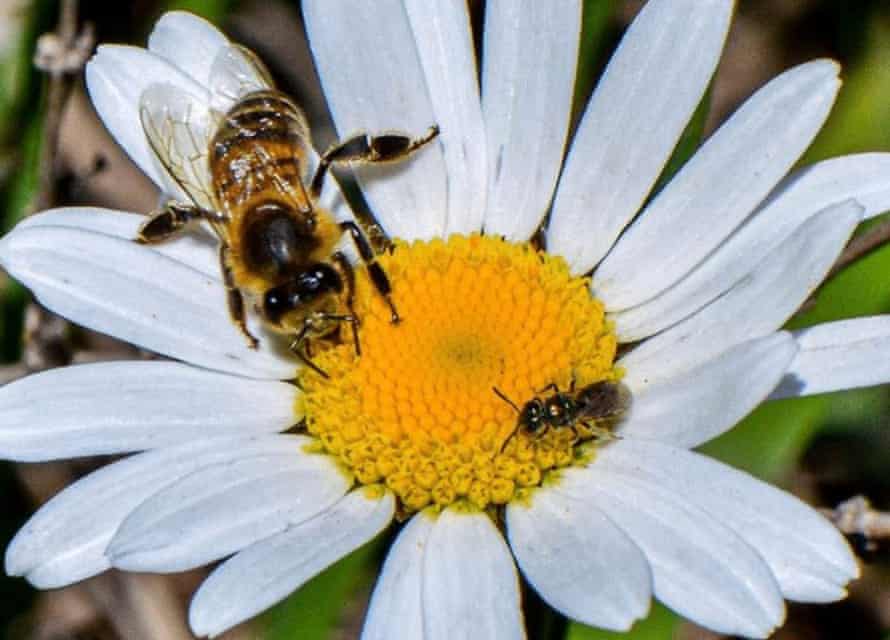
An introduced honey bee and a smaller native sweat bee share a flower in a Patagonian forest.

The Guardian 22 Jan 2021

The number of wild bee species recorded by an international database of life on Earth has declined by a quarter since 1990, according to a global analysis of bee declines.

Researchers analysed bee records from museums, universities and citizen scientists collated by the Global Biodiversity Information Facility, (GBIF) a global, government-funded network providing open-access data on biodiversity.

They found a steep decline in bee species being recorded since 1990, with approximately 25% fewer species reported between 2006 and 2015 than before the 1990s.

Although this does not mean these species are extinct, it may indicate that some have become so scarce that they are no longer regularly observed in the wild.

“With citizen science and the ability to share data, records are going up exponentially, but the number of species reported in these records is going down,” said Eduardo Zattara, the lead author and a biologist from the Universidad Nacional del Comahue and Argentina’s National Scientific and Technical Research Council (Conicet). “It’s not a bee cataclysm yet, but what we can say is that wild bees are not exactly thriving.”

Monday, July 29, 2019

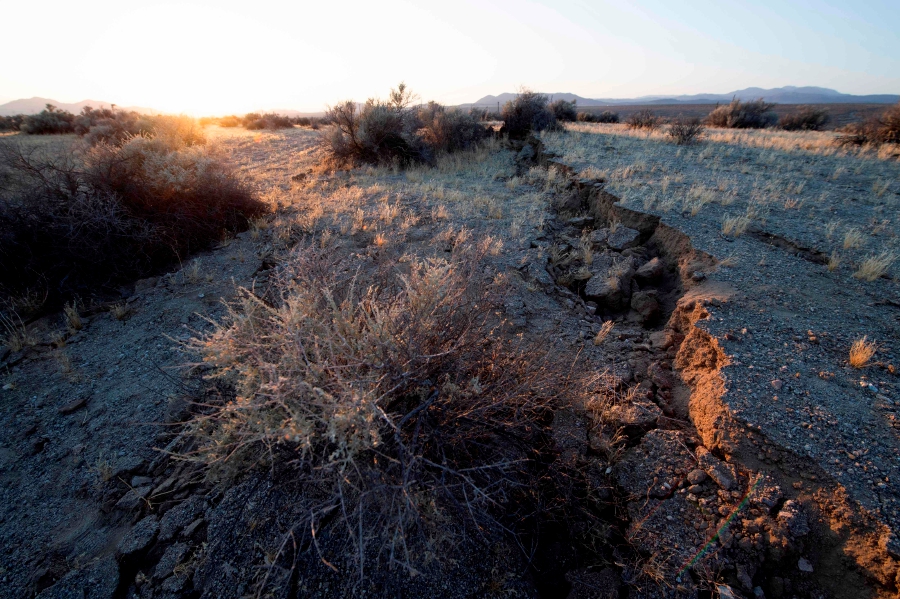
Thousands of bees have been shown dead on the ground after a 7.1 magnitude earthquake struck California

Thousands of bees have been shown dead on the ground after a 7.1 magnitude earthquake struck California on Saturday.

The shocking footage shows social media influencer Khalil Underwood outside his house, amid a mass of the dead insects on July 6.

He zooms close to the ground to reveal the plight of the bees and the masses of carcasses that cover much of the ground in front of him.

“This is crazy. I've never witnessed anything like this,' Underwood exclaims. 'Look how many f***ing bees are on the f***ing floor from the earthquake.”

He pointed to some that were still alive, appearing to shake and buzz on the ground as well as the struggle he had while moving his car.

Underwood claims the bees “vibrated, buzzed and died” as a result of the earthquakes.

Scientists have previously noted that animals and insects act strangely in the lead up to an earthquake, but do not know why, according to the US Geological Survey.

While scientists know creatures are able to recognise earthquakes before humans, the mechanisms explaining how and why they happen “still elude us” they wrote...

The unusual event occurred after a 7.1 magnitude earthquake struck southern California, the worst the state has experienced in two decades.

The second consecutive day of earthquakes caused fires to break-out in Ridgecrest.

The earthquake struck 11 miles off the north-northeast of Ridgecrest at 8.19pm PST on Friday, close to where a 6.4 earthquake had hit the morning before.

More than 250 smaller magnitude aftershocks had also hit during the 36 hours between earthquakes according to the US Geological Survey.

Friday, May 31, 2019

The lack of pollinating insects in some areas of fruit production in China has forced producers to pollinate their fruit trees by hand.

Fresh Plaza   5/24/2019
The lack of pollinating insects in some areas of fruit production in China has forced producers to pollinate their fruit trees by hand.

In these areas, the excessive use of pesticides and the lack of a natural habitat put an end to all the pollinators that inhabited the ecosystem.

There is increasing awareness of insects and other pollinating animals for agriculture worldwide; In fact, in the long term, they are basically the only ones responsible when it comes to growing food and without them agriculture could collapse.

There are simple solutions to avoid their collapse. Studies in Europe and North America have found that it is possible to increase the population of pollinating insects by planting strips of wild flowers near crops and leaving patches of natural vegetation, such as trees and forests. These practices can also increase the population of natural predators, decreasing the need to use pesticides.
With a little effort, it is perfectly possible to grow food and at the same time take care of the environment.

In an attempt to control and transform nature to our advantage, Mao Tse Tung had the incredible idea that certain animals  (sparrows, mosquitoes, flies and mice) were harmful to the performance of agriculture, so he decided to declare war on them, beginning what was called the campaign against the four plagues, with which he intended to exterminate these four species.
The sparrow owed its persecution to the eating of stored grain, causing problems for agriculture. As a result, it was placed in the list of dangerous animals. In the words of Mao Tse Tung, "Sparrows are one of the worst plagues in China." In 1960, alerted by the increase of insects, which were the basis of the diet of the sparrows, that plan was abandoned.

Thursday, May 18, 2017

Where have all the insects gone?

Entomologists call it the windshield phenomenon. "If you talk to people, they have a gut feeling. They remember how insects used to smash on your windscreen," says Wolfgang Wägele, director of the Leibniz Institute for Animal Biodiversity in Bonn, Germany. Today, drivers spend less time scraping and scrubbing. "I'm a very data-driven person," says Scott Black, executive director of the Xerces Society for Invertebrate Conservation in Portland, Oregon. "But it is a visceral reaction when you realize you don't see that mess anymore."
Some people argue that cars today are more aerodynamic and therefore less deadly to insects. But Black says his pride and joy as a teenager in Nebraska was his 1969 Ford Mustang Mach 1—with some pretty sleek lines. "I used to have to wash my car all the time. It was always covered with insects." Lately, Martin Sorg, an entomologist here, has seen the opposite: "I drive a Land Rover, with the aerodynamics of a refrigerator, and these days it stays clean."
Though observations about splattered bugs aren't scientific, few reliable data exist on the fate of important insect species. Scientists have tracked alarming declines in domesticated honey bees, monarch butterflies, and lightning bugs. But few have paid attention to the moths, hover flies, beetles, and countless other insects that buzz and flitter through the warm months. "We have a pretty good track record of ignoring most noncharismatic species," which most insects are, says Joe Nocera, an ecologist at the University of New Brunswick in Canada.
Of the scant records that do exist, many come from amateur naturalists, whether butterfly collectors or bird watchers. Now, a new set of long-term data is coming to light, this time from a dedicated group of mostly amateur entomologists who have tracked insect abundance at more than 100 nature reserves in western Europe since the 1980s.
Over that time the group, the Krefeld Entomological Society, has seen the yearly insect catches fluctuate, as expected. But in 2013 they spotted something alarming. When they returned to one of their earliest trapping sites from 1989, the total mass of their catch had fallen by nearly 80%. Perhaps it was a particularly bad year, they thought, so they set up the traps again in 2014. The numbers were just as low. Through more direct comparisons, the group—which had preserved thousands of samples over 3 decades—found dramatic declines across more than a dozen other sites.     More
Wednesday, February 8, 2017

Thousands of dead and dying bees are washing up on a popular beach in Southern Florida.

Thousands of dead and dying bees are washing up on a popular beach in Southern Florida.
Naples beach goers had to watch where they stepped Tuesday after some people say they have been stung just along the shoreline, according to NBC affiliate WBBH-TV.
Martha Duff lives in Naples and recently had a painful encounter with the bees.
"I've been stung a couple of times and at first, I didn't know what it was and then I realized and then I had an allergic reaction," Duff said.     NBC