Showing posts with label Exercise. Show all posts

Saturday, January 26, 2019

Scottish Doctors Are Now Issuing Prescriptions to Go Hiking


Adventure Journal
Scotland’s Shetland Islands are windswept and rugged, full of wide-open vistas, thousands of squawking migratory birds, awesome rock formations, and winding trails. An epic place for long, lingering walks and time spent decompressing in the joys of raw nature.

It just so happens that doctors are increasingly starting to realize time spent outdoors can be an excellent treatment for chronic health issues. So doctors in the Shetlands are now issuing “nature prescriptions” as part of an initiative to address health issues without drugs if you can imagine that.

For everything from high blood pressure to diabetes, anxiety, and depression, the medical community is learning (though lots of us have always known) that many ailments and diseases can be treated with activities like birdwatching, maybe a little kayaking, perhaps combing a beach for shells, even skipping pebbles across a slow-moving stream. Even just sitting silently in a forest, meditating (see: Japan, forest bathing).

Tuesday, April 10, 2018

Walking is a simple way to improve your physical health and encourage creativity

Alternet  March 18, 2018
When we walk, we engage both sides of the body, simultaneously activating both the left and right sides of the brain. Hartmann explains that both hemispheres of the brain join forces through the bilateral therapy of walking, in order to break up the patterning of a traumatic experience that has become "stuck" in the brain.
Walking for creativity and problem solving
"The legs are the wheels of creativity." —Albert Einstein
Creativity and problem solving are psychologically similar processes. Both combine a linear approach—how do I get from here to there?—with the need to randomly access memories and ideas that may, in a linear world, seem completely unrelated.

One of the unique hallmarks of bilateral activity is that it gives access to the whole brain, making walking and other forms of bilateral work/play useful for enhancing creativity and problem solving. Resources and strengths, helpful learnings and experiences that date all the way back from childhood are available when walking, and can be brought to bear on current problems or creative endeavors.

Walking is a grounding experience, a step-by-step, moment-by-moment contact with the earth. Whether by some mystical force or some as yet unexplained psychological phenomenon, perhaps deeply rooted in our genes and stretching back over millions of years of evolutionary ancestry, feeling connected with the earth produces a liberating experience for most people.

Walking also provides us with a break from the state of normal everyday existence. Looking at the same walls, the same furniture, the same place and people often anchors us to a particular state of mind. When we go out for a walk, that state is broken, and new states of mind and emotion provoked by new sounds, sights, smells, and sensations offer access to new ways of knowing and understanding ourselves and our problems or opportunities.

Thursday, March 29, 2018

Exercise is the best treatment for depression


Related image

Psyblog  June 6, 2017
A brisk walk three times a week can actually beat antidepressant medication in treating major depression, research finds.
The results come from a study on three groups of elderly people with major depressive disorder.
One group were given the exercise, another given antidepressant medication and the third both.
The results showed that all three groups improved the same amount.
Professor James Blumenthal, the study’s first author, said:
“One of the conclusions we can draw from this is that exercise may be just as effective as medication and may be a better alternative for certain patients.”
The results showed that after exercise almost two-thirds of participants were no longer depressed after 16 weeks.
One of the problems with exercise is that it may take a little longer to take effect.
Professor Blumenthal said:
“While we don’t know why exercise confers such a benefit, this study shows that exercise should be considered as a credible form of treatment for these patients.
Almost one-third of depressed patients in general do not respond to medications, and for others, the medications can cause unwanted side effects.
Exercise should be considered a viable option.”
Exercise could be particularly beneficial because people are taking an active role, rather than passively taking a pill, Professor Blumenthal said:
“Simply taking a pill is very passive.
Patients who exercised may have felt a greater sense of mastery over their condition and gained a greater sense of accomplishment.
They felt more self-confident and had better self-esteem because they were able to do it themselves, and attributed their improvement to their ability to exercise.
These findings could change the way some depressed patients are treated, especially those who are not interested in taking anti-depressants.
While these medications have been proven to be effective, many people want to avoid the side effects or are looking for a more ‘natural’ way of feeling better.”
The antidepressant tested in the study was sertraline, which is marketed as Zoloft.

Saturday, May 20, 2017

Exercise has the potential to be an effective approach to both treating and preventing depressive symptoms

A new study published in The British Medical Journal compares the effects of varying amounts of exercise on preventing depressive symptoms in older adults. There has been limited research to date on the long-term mental health effects of exercise within older adult populations. Utilizing a prospective approach, the authors compared four types (duration/frequency) of moderate exercise and found evidence that persistent low amounts of exercise can have physical and psychological benefits for older adults.

Persistent low-volume practice (less than 15 minutes of moderate intensity exercise per day) was shown to have preventive effects on depressive symptoms, similar to the effects of 30 minutes of exercise, the authors explain.

Exercise has the potential to be an effective approach to both treating and preventing depressive symptoms. As the authors point out, there is evidence of hippocampal neurogenesis and as a result of exercise, which can have anti-depressive effects. Exercise has also been linked with increases in B-endorphins, vascular endothelial growth factor, brain-derived neurotrophic factor, and serotonin.    More

It is never too late to benefit from exercise.

The toll that aging takes on a body extends all the way down to the cellular level. But the damage accrued by cells in older muscles is especially severe, because they do not regenerate easily and they become weaker as their mitochondria, which produce energy, diminish in vigor and number.

A study published this month in Cell Metabolism, however, suggests that certain sorts of workouts may undo some of what the years can do to our mitochondria.

Exercise is good for people, as everyone knows. But scientists have surprisingly little understanding of its cellular impacts and how those might vary by activity and the age of the exerciser.

So researchers at the Mayo Clinic in Rochester, Minn., recently conducted an experiment on the cells of 72 healthy but sedentary men and women who were 30 or younger or older than 64. After baseline measures were established for their aerobic fitness, their blood-sugar levels and the gene activity and mitochondrial health in their muscle cells, the volunteers were randomly assigned to a particular exercise regimen.

Some of them did vigorous weight training several times a week; some did brief interval training three times a week on stationary bicycles (pedaling hard for four minutes, resting for three and then repeating that sequence three more times); some rode stationary bikes at a moderate pace for 30 minutes a few times a week and lifted weights lightly on other days. A fourth group, the control, did not exercise.

After 12 weeks, the lab tests were repeated. In general, everyone experienced improvements in fitness and an ability to regulate blood sugar.
There were some unsurprising differences: The gains in muscle mass and strength were greater for those who exercised only with weights, while interval training had the strongest influence on endurance.

But more unexpected results were found in the biopsied muscle cells. Among the younger subjects who went through interval training, the activity levels had changed in 274 genes, compared with 170 genes for those who exercised more moderately and 74 for the weight lifters. Among the older cohort, almost 400 genes were working differently now, compared with 33 for the weight lifters and only 19 for the moderate exercisers.

Many of these affected genes, especially in the cells of the interval trainers, are believed to influence the ability of mitochondria to produce energy for muscle cells; the subjects who did the interval workouts showed increases in the number and health of their mitochondria — an impact that was particularly pronounced among the older cyclists.

It seems as if the decline in the cellular health of muscles associated with aging was “corrected” with exercise, especially if it was intense, says Dr. Sreekumaran Nair, a professor of medicine and an endocrinologist at the Mayo Clinic and the study’s senior author. In fact, older people’s cells responded in some ways more robustly to intense exercise than the cells of the young did — suggesting, he says, that it is never too late to benefit from exercise.          NY Times

Monday, May 1, 2017

Walking for 10 minutes is more energizing than 50 mg of caffeine


Goran Bogicevic/Shutterstock


Christopher Bergland Apr 21, 2017
We all know the feeling of craving an afternoon pick-me-up. Regardless of how much sleep you’ve gotten the night before—afternoon is a time of day when our hormonal and circadian rhythms seem hardwired to take a siesta or power nap. Obviously, for anyone who is chronically sleep deprived, the need for a midday jolt of energy to stay alert and keep chugging along at work or school is going to be more pronounced. Unfortunately, consuming caffeine in the afternoon can create a vicious cycle of making it less likely you'll sleep well that night, which will cause you to crave caffeine the following afternoon...and so on, and so on.
But there is good news: The latest empirical evidence suggests that 10 minutes of walking or climbing a few flights of stairs is actually a more effective way to boost your energy and vigor than consuming 50 milligrams of caffeine. 
This first-of-its-kind study on the energizing benefits of small doses of physical activity compared to caffeine was conducted by Patrick O’Connor and Derek Randolph from the Department of Kinesiology (Exercise Science Programs) at the University of Georgia and published in the Journal of Physiology & Behavior. 
Randolph and O’Connor were curious to see if a brief bout of exercise or consuming a 50 mg caffeine tablet—which is roughly the equivalent of a can of soda, cup of tea, or shot of espresso—provided more of an energy boost for chronically sleep deprived adults (18-23 years of age) who frequently used caffeine to improve their afternoon alertness.
The researchers state, “The acute energizing effect of exercise and caffeine has never been examined in a single study of adults with chronic sleep deprivation but evidence from a study of this type could help individuals choose between these two common alertness-enhancing options.” More specifically, the researchers found that the energizing effect of 10 minutes of low-to-moderate intensity exercise was greater than 50 mg caffeine for study participants who were sleeping less than 45 hours per week (under 6½ hours per night).
While designing the parameters of this study, O'Connor wanted to simulate typical physical activity hurdles encountered by people who work in an office. The researchers chose stair climbing as a form of physical activity because most office workers have access to a stairwell in which someone can casually slip away from his or her desk and squeeze in a quick workout without needing to change into athletic gear or shower before returning to work. Additionally, in terms of creating a daily habit, taking a quick break from staring at your computer screen to walk some stairs can become an afternoon routine that isn’t dependent on weather conditions. 
Although this study doesn’t address sleep hygiene directly, experts agree that consuming caffeine in the afternoon can disrupt evening sleep patterns and exacerbate insomnia. The American Sleep Association (ASA) tip sheet states, “The effects of caffeine may last for several hours after ingestion. Caffeine can fragment sleep, and cause difficulty initiating sleep. If you drink caffeine, use it only before noon. Remember that soda and tea contain caffeine as well.” (Sleep hygiene is defined as, “habits and practices that are conducive to sleeping well on a regular basis and having full daytime alertness.”)
The win-win of taking an afternoon walk or climbing some stairs to boost energy instead of reaching for a caffeinated beverage is that low-to-moderate intensity exercise will improve your physical and psychological well-being in the short and long term, as well as help you sleep better at night.
If you are experiencing an afternoon energy lull as you read this, remember: Substituting a 10-minute dose of low-to-moderate intensity exercise instead of an afternoon shot of caffeine is the perfect midday energizer. Brief bouts of exercise can help break the vicious cycle of caffeine-induced sleep deprivation while countering the overall detriments of sedentarism and sitting too much during the day.
References
Derek D. Randolph, Patrick J. O'Connor. Stair walking is more energizing than low dose caffeine in sleep deprived young women, Physiology & Behavior (2017). DOI: 10.1016/j.physbeh.2017.03.013   

Wednesday, July 27, 2016

Just one hour of physical activity a day may undo the increased risk of early death

Image result for Exercise walking
By Steven Reinberg
HealthDay Reporter
WEDNESDAY, July 27, 2016 (HealthDay News) -- Just one hour of physical activity a day -- something as simple as a brisk walk or a bicycle ride -- may undo the increased risk of early death that comes with sitting eight hours or more on a daily basis, a new study suggests.
"These results provide further evidence on the benefits of physical activity, particularly in societies where increasing numbers of people have to sit for long hours for work or commuting," said lead researcher Ulf Ekelund. He is a professor in physical activity and health at the Norwegian School of Sport Sciences in Oslo, Norway.
"Unfortunately, only 25 percent of our sample exercised an hour a day or more," he said.
The study also found that watching TV for three hours or more a day was linked with an increased risk of early death, regardless of physical activity -- except among those who were the most physically active.
However, even among those who exercised the most, the risk of premature death was significantly increased if they watched five hours of TV a day or more, the researchers added.
It's not TV, per se, that is associated with an increased risk of dying early; rather, TV is a marker for sitting and not being active, Ekelund said.
In their review of 16 previously published studies that included more than one million people, the researchers divided the participants into four groups: those who got about 5 minutes of moderate-intensity exercise a day; 25 to 35 minutes a day; 50 to 65 minutes day; and 60 to 75 minutes a day.
The increased risk of early death ranged from 12 percent to 59 percent, depending on how much exercise the participants got, the findings showed.
"Indeed, those belonging to the most active group, and who are active about 60 to 75 minutes per day, seem to have no increased risk of mortality, even if they sit for more than eight hours a day," Ekelund said.
"Sit less, move more, and the more you move the better," he suggested.
The report, which did not prove that inactivity caused early death, was published online July 27 in The Lancet.
According to Dr. David Katz, president of the American College of Lifestyle Medicine, "This important analysis fortifies the increasingly clear verdict from a large and growing body of evidence addressing physical activity and health: all movement is good movement."
Evidence is clear that moderately vigorous exercise has an array of health benefits, Katz said.
"If you don't exercise but can stand often, do. If you can't stand often but can exercise, do," he added. "Better still, do both. It's clear: all movement is good movement."
Not only does physical inactivity increase the risk of early death, it's expensive, according to another study published in the same journal issue.
In that study, researchers estimated the cost of being physically inactive based on the increased risk for type 2 diabetes, heart disease, stroke, and breast and colon cancer. In 2013 dollars, the study authors estimated that inactivity costs the United States about $28 billion annually.
"The current economic cost of physical inactivity is borne mainly by high-income countries. However, as low- and middle-income countries develop, and if the current trajectory of inactivity continues, so too will the economic burden in low- and middle-income countries who are currently poorly equipped to deal with chronic diseases linked to physical inactivity," study author Dr. Melody Ding, of the University of Sydney in Australia, said in a statement.       US News

Saturday, March 19, 2016

More doctors prescribing exercise instead of medication

BOSTON (AP) — When Dr. Michelle Johnson scribbles out prescriptions, the next stop for many of her patients is the gym, not the pharmacy.
Doctors treating chronic health problems increasingly are prescribing exercise for their patients — and encouraging them to think of physical activity as their new medication.
In one such program run by a health center in Boston’s Roxbury neighborhood, primary care physicians, internists and psychologists prescribe access to a gym for $10 a month, including free child care, classes and kids programs. Providing affordable gym access for patients ensures compliance, said Gibbs Saunders of Healthworks Community Fitness, a nonprofit gym in Dorchester that has partnered with several health care providers to help low-income residents fill their exercise prescriptions.

Life expectancy in Roxbury is 59 years — well below the national average of 78.8 years.
“Exercise is not a new medicine. It’s really an old medicine,” said Johnson, who prescribes exercise to patients at the Roxbury-based health center. “But you know, I think we’re now coming to the point of understanding how important it is.”
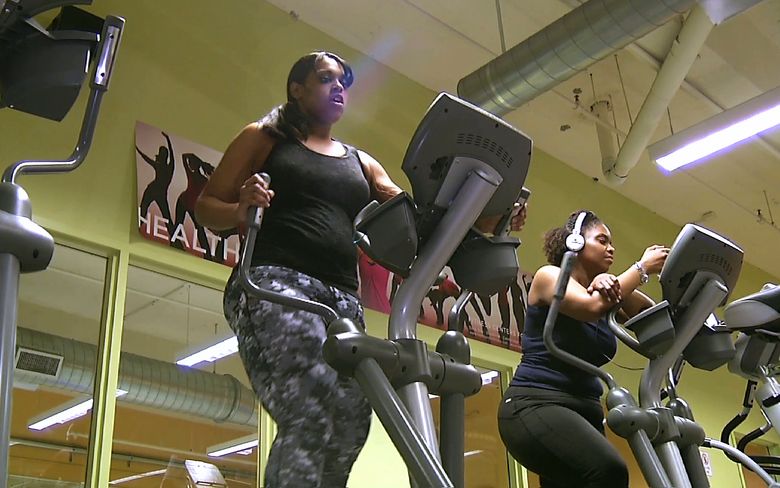
Monisha Long, who is morbidly obese and suffers from hypertension, got a doctor’s prescription for exercise and says she’s gotten visible and dramatic results after more than two years of regular workouts.
“I lost well over 150 pounds, and I’ve been keeping it off for the past couple of years,” she said after working out on an elliptical machine at Healthworks.
And Long cites other, less-visible benefits.
“I’m more energized,” she said. “As far as my energy, I feel like I’m stronger. I feel like I’m less tired. I feel like I can do almost anything now.”
People who are physically active tend to live longer and are at lower risk of heart disease, stroke, Type 2 diabetes, depression and some cancers, according to the U.S. Centers for Disease and Control and Prevention. Yet fewer than one in four American adults exercises enough to reap those benefits, the agency says.
Dr. Edward Phillips, a Boston physician, is so sold on exercise he pedals on a stationary bike that’s integrated into his office desk. Phillips said exercise is “like taking a little bit of Prozac — an antidepressant — and a little bit of Ritalin, which is a stimulant.”
“Our bodies are meant to move,” he said. “Integrating movement into our day allows the system to work optimally. Part of the system that needs to work is our brain, and includes sleep, mood, cognition, ability to concentrate.”
A prescription for exercise is a bargain, said Stephanie Dennis, who works out on a treadmill to stay fit.
“$10 a month is what? $2 a week, $2-$2.50 a week,” she said. “A lot of people pay that every day for coffee. It’s not a big sacrifice for something that you get big rewards from.”            Seattle Times