Showing posts with label Rome. Show all posts

Monday, April 26, 2021

The doctrine contrary to reason and common sense


Roswell F. Cottrell - Wikipedia

“That one person is three persons, and that three persons are only one person, is the doctrine which we claim is contrary to reason and common sense. The being and attributes of God are above, beyond, out of reach of my sense and reason, yet I believe them: But the doctrine I object to is contrary, yes, that is the word, to the very sense and reason that God has himself implanted in us. Such a doctrine he does not ask us to believe. A miracle is beyond our comprehension, but we all believe in miracles who believe our own senses. What we see and hear convinces us that there is a power that effected the most wonderful miracle of creation. But our Creator has made it an absurdity to us that one person should be three persons, and three persons but one person; and in his revealed word he has never asked us to believe it. This our friend thinks objectionable.…

“But to hold the doctrine of the Trinity is not so much an evidence of evil intention as of intoxication from that wine of which all the nations have drunk. The fact that this was one of the leading doctrines, if not the very chief, upon which the bishop of Rome was exalted to popedom, does not say much in its favor. This should cause men to investigate it for themselves; as when the spirits of devils working miracles undertake the advocacy of the immortality of the soul. Had I never doubted it before, I would now probe it to the bottom, by that word which modern Spiritualism sets at nought.…

“Revelation goes beyond us; but in no instance does it go contrary to right reason and common sense. God has not claimed, as the popes have, that he could “make justice of injustice,” nor has he, after teaching us to count, told us that there is no difference between the singular and plural numbers. Let us believe all he has revealed, and add nothing to it.” —R. F. Cottrell, July 6, 1869, Review & Herald

Wednesday, March 31, 2021

EU Bishops call for nations to protect work-free Sunday

People enjoy Sunday leisure time near the Pantheon in Rome, Italy

Vatican News  04 March 2021

The Bishops of the European Union and the European Sunday Alliance are urging EU leaders to protect synchronized free-time, which most nations traditionally observe on Sunday.

Synchronised free time should be a priority in the EU social-policy agenda, according to European Bishops and other organizations.

In a joint statement published Wedneday, on the occasion of the International Day for a work-free Sunday, the Commission of the Bishops' Conferences of the EU (COMECE) and the European Sunday Alliance urged political leaders in Europe to protect synchronised free time  - in most European countries traditionally on Sundays.

"This," they say, "is especially relevant in times where the Covid-19 pandemic has accelerated existing challenges of digitalisation by intensifying work and extending working hours, thus putting a healthy work-life balance at risk for more people."

Non-stop work

The statement notes that one of the major impacts of the pandemic lockdowns has been an acceleration of previous trends towards increasing levels of mobile and home working.

“With the rise of digital working, the fragmentation and de-limitation of working time has further proceeded. Working in the evenings and during weekends is increasingly common and indeed expected by many employers.”

The Alliance says this increases stress on workers and "affects their work-life balance” and “compromises the health and wellbeing of workers, making them not only sick in the long run but also causing increasingly more often their absence from work due to psychosocial illness for sustained periods of time.”

Day of rest

According to the network - which includes more than 100 national Sunday alliances, trade unions, employers' organisations, civil society associations, churches and religious communities in the European Union - a full day of rest per week is indispensable to recover.

“Indeed," they say, "a common day of rest truly increases wellbeing and brings a positive effect on health.”

“Only during a common day of rest is it possible to pursue volunteer work, civic engagement, joint social, sports or faith-related activities, family time and, more generally, to spend time together,” the statement explains.

EU Bishops also recall that “humans are social beings, and for many of them their health requires more than individual time off at scattered, random moments of the week to spend alone. A day free of work recognised by tradition or custom is therefore 'essential to disconnect, literally and figuratively'."

Wednesday, August 30, 2017

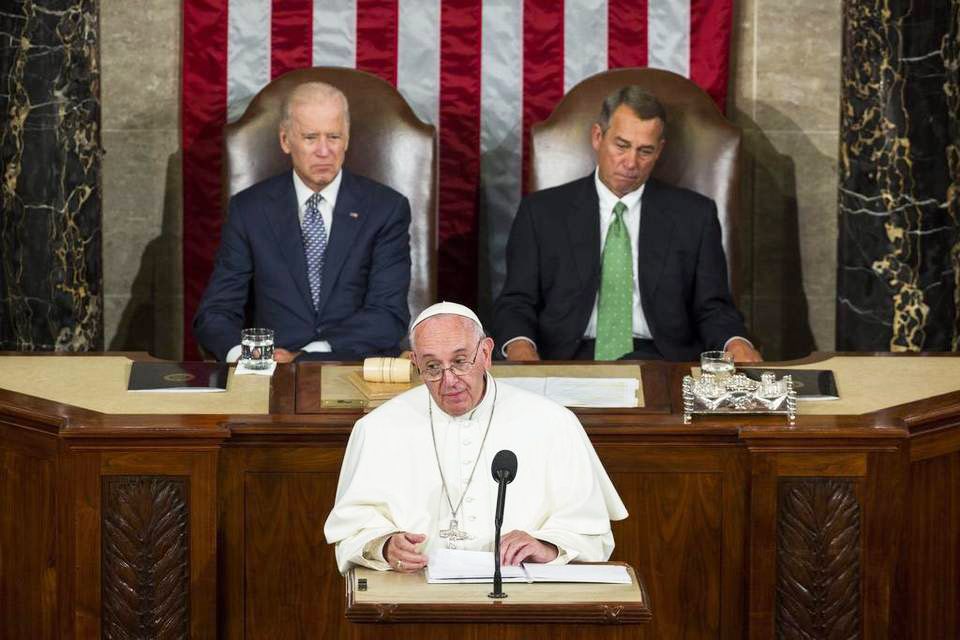
Pope to Catholic lawmakers from around the world: let church teaching influence your work


Pope to Catholic politicians: Let Church teaching influence your work

Inés San Martín, August 29, 2017

ROME - Speaking to a group of Catholic lawmakers from around the world on Monday, Pope Francis urged them to bring a commitment to Church teaching to their public lives in order to build a better society.

The pontiff also urged Catholic politicians to transcend partisan divides, calling on them to “build bridges of dialogue between diverse political perspectives.

“While the contribution of the Church to the great questions of the society of our time can often be called into question, it is vital that your commitment is continually permeated by her moral and social teachings in order to build a more humane and just society,” Francis said, according to the Spanish edition of Vatican Radio.

The pope also asked the group to promulgate and apply laws that build bridges of dialogue between diverse political perspectives, particularly when their purpose is to promote greater care for the defenseless and the marginalized, “especially towards the many who are forced to leave their homeland.”

He also encouraged the legislators to draw on the fruits of their reflections in Rome about “how the Catholic faith conducts towards a just understanding of the person” when they go back to their countries.

The pope’s remarks came on Sunday, as he was addressing members of the International Catholic Legislators Network (ICLN), created in 2010 to discuss the promotion of Christian principles in the political arena.

With the patronage of Cardinal Christoph Schönborn of Vienna, Austria, and British parliamentarian Lord David Alton of Liverpool, it was founded by Dr. Christiaan Alting von Geusau of the Netherlands.

Speaking with Vatican Radio, Schönborn said that popes have always encouraged the group. He also said that Catholic politicians “find great encouragement from the Church’s approval to their commitment, because many times they feel quite alone in their parliaments as they have to face difficult situations.”

The scope of their annual meetings, he said, is to reinforce their faith which is the reason why the group has daily Mass, prays the Rosary together, and shares moments of Eucharistic adoration, in addition to having access to the sacrament of Reconciliation.

According to the network’s website, the ICLN meets near Rome each year at the end of August, bringing together some 120 people, including top-level politicians, to discuss urgent policy issues. The four-day event is held under the Chatham House Rule, with no journalists, press releases, or published speeches.

The Chatham House Rule, named after the headquarters of the UK Royal Institute of International Affairs, is invoked at meetings with the aim of providing anonymity to speakers and to encourage openness and the sharing of information.

In the case of the ICLN meetings, this applies also to the pope’s remarks, which is why Francis’s yearly addresses to the group haven’t been disclosed, nor those given by Benedict XVI on previous opportunities.

The list of topics discussed by the groups include abortion; euthanasia and assisted suicide; free market economy; communicating Catholic thought in secular politics, immigration and secularization and the persecution of Christians.

Among the participants of this year’s gathering was U.S. Congressman Alex Mooney (R-WV). Speaking with Vatican Radio, he said that it’s very “inspiring” to see “how people are fighting for family values.”

He defined the gathering as “an opportunity to meet here with other Catholic legislators and elected officials from other parts of the world, and to discuss common concerns - problems, opportunities - for our faith, and how to work together and support each other.”

At the end of the audience, when participants greeted the pope, there was a final twist definitely not on the official program: One participant took advantage of the moment to propose to his girlfriend in front of Francis.       Cruxnow

Tuesday, July 11, 2017

Vatican police have raided a cardinal's apartment where a drug-fuelled homosexual orgy was taking place.

5 Jul, 2017 1:35pm 
Vatican police have raided a cardinal's apartment where a drug-fuelled homosexual orgy was taking place.
Police entered an apartment at the former palace of the Congregation for the Doctrine of the Faith (or Holy Office) last month, not far from the Vatican City.
The occupant of the apartment is alleged to be a priest who serves as a secretary to cardinal Francesco Coccopalmerio, the head of the Pontifical Council for Legislative Texts and a personal adviser to the Pope.
The allegations of the orgy were first published by newspaper Il Fatto Quotidiano.
According to the paper, neighbours became suspicious before complaining about irregular behaviour of those coming and going at the apartment.
When police showed up at the apartment, they reportedly found drugs and a group of men engaged in sexual activity.
The priest was then arrested and taken for questioning.
Il Fatto Quotidiano suggested that Pope Francis was infuriated by the news and may force Coccopalmerio into retirement.
The alleged orgy is symptomatic of a difficult period for the Pope. Four years into his papacy the Catholic Church appears racked by conflict and scandal.
Critics blame the Pope's choice of personnel: cardinal George Pell, appointed to clean up the Vatican's murky finances, has taken a leave of absence to defend himself against sex abuse charges in Australia.      nzherald

Tuesday, May 2, 2017

The Knights of Malta elected a new leader in Rome

The Knights of Malta elected a new leader in Rome on Saturday in a bid to end a bitter internal feud that led to Pope Francis’ personal intervention in the ancient Catholic chivalric order.
Giacomo Dalla Torre del Tempio di Sanguinetto was named lieutenant of the Grand Master, which means he will serve a one-year term instead of the customary life-long term of a full Grand Master. 
The 72-year-old Italian was chosen from 12 candidates by the order’s council in a secret ballot held at its grand 14th century Magistral Villa with panoramic views overlooking the Tiber River.
Dressed in traditional black robes with a white Maltese cross, 56 electors celebrated Mass in at the Church of St Mary of the Priory inside the villa’s sprawling gardens early on Saturday before marching solemnly to the villa to cast their ballot.      Telegraph

Saturday, October 29, 2016

Ancient Roman Battlefield Uncovered in Jerusalem

Ancient Roman Battlefield Uncovered in Jerusalem

By |

Archaeologists say they've found evidence of a battlefield from the Roman emperor Titus' siege of Jerusalem in A.D. 70.
Recent excavations revealed a section of the so-called "Third Wall" of Jerusalem that Titus' army breached on its way to conquering the city, according to the Israel Antiquities Authority (IAA).
Outside the wall, the archaeologists found that the ground was littered with large ballista stones (stones used as projectiles with a type of crossbow) and sling stones, suggesting that this area had been under heavy fire from Roman siege engines. [See Photos of the Ancient Roman Battlefield]
These archaeological remains were unearthed last winter at the site where the campus of the Bezalel Academy of Arts and Design is to be built, in an area of the city that is known today as the Russian Compound, IAA officials said.
"This is a fascinating testimony of the intensive bombardment by the Roman army, led by Titus, on their way to conquering the city and destroying the Second Temple," the excavation directors, Rina Avner and Kfir Arbib, said in a statement from the IAA. "The bombardment was intended to attack the sentries guarding the wall and provide cover for the Roman forces so they could approach the wall with battering rams and thereby breach the city's defenses."
An eyewitness to the war, historian Flavius Josephus, wrote the seminal account of the Roman siege of Jerusalem, which included key details about the Third Wall.
Josephus said the wall was built to protect a neighborhood called Beit Zeita, which was built outside the city's boundaries at the time. The construction was started by Agrippa I, King of Judea, and was finished two decades later to help fortify the city as Jewish rebels prepared to revolt against Rome in A.D. 66.
Ultimately, the uprising against Rome was unsuccessful, and in A.D. 70, the Romans took back Jerusalem and destroyed much of the city, including the Second Temple.
The newly uncovered section of the wall is 6.2 feet (1.9 meters) wide. Pottery discovered at the site suggests that this battlefield dates back to Roman times, the archaeologists said. They also discovered the remains of a watchtower along the wall.
The new findings could help settle some debate about the exact location of the Third Wall, which has been going on ever since archaeologist Edward Robinson claimed to have found a portion of the wall in 1838. The discoveries will be presented next week at the New Studies in the Archaeology of Jerusalem and its Region conference.

Wednesday, March 9, 2016

Ancient Rome

Tuesday, February 16, 2016

The Dark, Bloody and Muddled Origins Of Valentine's Day

Valentine's Day is a time to celebrate romance and love and kissy-face fealty. But the origins of this festival of candy and cupids are actually dark, bloody — and a bit muddled.
A drawing depicts the death of St. Valentine — one of them, anyway. The Romans executed two men by that name on Feb. 14 of different years in the 3rd century A.D. i
A drawing depicts the death of St. Valentine — one of them, anyway. The Romans executed two men by that name on Feb. 14 of different years in the 3rd century A.D.
Hulton Archive/Getty Images
Though no one has pinpointed the exact origin of the holiday, one good place to start is ancient Rome, where men hit on women by, well, hitting them.
Those Wild And Crazy Romans
From Feb. 13 to 15, the Romans celebrated the feast of Lupercalia. The men sacrificed a goat and a dog, then whipped women with the hides of the animals they had just slain.
The Roman romantics "were drunk. They were naked," says Noel Lenski, a historian at the University of Colorado at Boulder. Young women would actually line up for the men to hit them, Lenski says. They believed this would make them fertile.
The brutal fete included a matchmaking lottery, in which young men drew the names of women from a jar. The couple would then be, um, coupled up for the duration of the festival — or longer, if the match was right.
The ancient Romans may also be responsible for the name of our modern day of love. Emperor Claudius II executed two men — both named Valentine — on Feb. 14 of different years in the 3rd century A.D. Their martyrdom was honored by the Catholic Church with the celebration of St. Valentine's Day.
Later, Pope Gelasius I muddled things in the 5th century by combining St. Valentine's Day with Lupercalia to expel the pagan rituals. But the festival was more of a theatrical interpretation of what it had once been. Lenski adds, "It was a little more of a drunken revel, but the Christians put clothes back on it. That didn't stop it from being a day of fertility and love."
Around the same time, the Normans celebrated Galatin's Day. Galatin meant "lover of women." That was likely confused with St. Valentine's Day at some point, in part because they sound alike.
William Shakespeare helped romanticize Valentine's Day in his work, and it gained popularity throughout Britain and the rest of Europe. i
William Shakespeare helped romanticize Valentine's Day in his work, and it gained popularity throughout Britain and the rest of Europe.
Perry-Castañeda Library, University of Texas
Shakespeare In Love
As the years went on, the holiday grew sweeter. Chaucer and Shakespeare romanticized it in their work, and it gained popularity throughout Britain and the rest of Europe. Handmade paper cards became the tokens-du-jour in the Middle Ages.
Eventually, the tradition made its way to the New World. The industrial revolution ushered in factory-made cards in the 19th century. And in 1913, Hallmark Cards of Kansas City, Mo., began mass producing valentines. February has not been the same since.
Today, the holiday is big business: According to market research firm IBIS World, Valentine's Day sales reached $17.6 billion last year; this year's sales are expected to total $18.6 billion.
But that commercialization has spoiled the day for many. Helen Fisher, a sociologist at Rutgers University, says we have only ourselves to blame.
"This isn't a command performance," she says. "If people didn't want to buy Hallmark cards, they would not be bought, and Hallmark would go out of business."
And so the celebration of Valentine's Day goes on, in varied ways. Many will break the bank buying jewelry and flowers for their beloveds. Others will celebrate in a SAD (that's Single Awareness Day) way, dining alone and binging on self-gifted chocolates. A few may even be spending this day the same way the early Romans did. But let's not go there.                NPR

Thursday, January 28, 2016

Iran and Rome take giant step to boost ties


TEHRAN - President Hassan Rouhani said on Monday that Iran and Italy are determined to broaden cooperation in all fields of “mutual interests”, the presidential website reported. 

The remarks by Rouhani came after Iran and Italy signed multi-billion dollar contracts covering various sectors including health, transportation, agriculture and energy.

The contracts, worth up to 17 billion euros (18.4 billion dollars), were signed in a ceremony attended by Rouhani and his Italian counterpart Sergio Mattarella, according to Press TV.


“As a new chapter of cooperation has started in Tehran-Rome ties, energy, new technologies, industry, mining, agriculture and culture can be the fields in which Iran and Italy can expand their cooperation,” Rouhani said in a joint press conference on Monday evening with Italian Prime Minister Matteo Renzi.

Rouhani expressed Iran’s readiness to invite investments and new technologies and start cooperation for production and export of joint productions, according to the Iranian presidential website.


Describing ties as historical, he added, “As Italy was once Iran’s first trade partner among European Union countries, we are sure that in the new chapter, the two countries’ cooperation can be further developed.”

Referring to the necessity of starting joint investment in a number fields of mutual interests, the president said, “Iran’s special strategic location in the region as the linking point between countries of central Asia, Caucuses and Indian sub-continent implies that it can play the role of a hub for the two countries’ exports.”

Also indicating a more active participation of the two countries’ private sectors for investment, Rouhani stated, “The governments of Iran and Italy will do their utmost to support private sectors in this regard.”

On the regional peace and security, he said, “The achievements of the visit to Italy go beyond bilateral significance and can contribute to world peace, security and stability which are the two countries’ main ideals to be met in the region and over the world for the benefit of all.”

Noting that Iran has always been a “pioneer in combating terrorism”, Rouhani said, “As Iran and Italy once started a joint cooperation for establishing peace and stability in Afghanistan, they can definitely continue the cooperation for peace and stability in the region, as well.”

Iran and Italy are eager to witness security in Syria, Iraq, Afghanistan and Libya as they are ready to help peace in the region and the larger world and this entails “cultural, political and intelligence cooperation”, he remarked.

The visit to Rome by Rouhani and his accompanying delegation took place immediately after the Joint Comprehensive Plan of Action (the JCPOA), commonly called nuclear deal, went into force.

“As the JCPOA well proved that diplomacy is the best solution for issues and establishing a sustainable peace, why should we not believe JCPOA can also be an exemplary model for settling the regional and international issues, especially those issues in the Middle East and North Africa,” Rouhani noted.

For his part, the Italian premier said, “Tehran and Rome enjoy historical relations that have resulted in the friendship of the Iranian and Italian nations.”

Renzi described the JCPOA as a starting point for expansion of the two countries’ mutual ties and an example to be followed for the settlement of regional and international issue as well.

“The JCPOA well proved that as Iran and the world powers could agree on the JCPOA, they can also agree on all other regional issues,” the prime minister noted.

Emphasizing Iran’s important role in regional interactions, the Italian prime minister said, “Iran can also play a vital and effective role in achieving peace and democracy in the region and tackling terrorism in the region and over the world.”

“Italy is serious in strengthening relations with Iran in all areas of mutual interests.”

----- Rouhani says economic growth crucial to defeating extremism

Generating economic growth in the Middle East is crucial to defeating extremism, Rouhani said, putting forward his country as a regional trade hub and pillar of stability, according to Reuters.

Rouhani described establishing, expanding and safeguarding peace in the region and over the world as Iran’s principal policy. “Iran has always been for a peaceful coexistence with all neighboring countries and still believe that the only mechanism to settle regional crisis is not merely a military one, but negotiations.”

He also invited the Italian prime minister to pay a visit to Iran.

Appreciating Rouhani for his invitation, Renzi promised to pay visit to Iran in near future.     Tehran Times

Friday, December 11, 2015

The papacy system will be unmasked


Image result for rome
In every generation God has sent His servants to rebuke sin, both in the world and in the church. But the people desire smooth things spoken to them, and the pure, unvarnished truth is not acceptable. Many reformers, in entering upon their work, determined to exercise great prudence in attacking the sins of the church and the nation. They hoped, by the example of a pure Christian life, to lead the people back to the doctrines of the Bible. But the Spirit of God came upon them as it came upon Elijah, moving him to rebuke the sins of a wicked king and an apostate people; they could not refrain from preaching the plain utterances of the Bible-- doctrines which they had been reluctant to present. They were impelled to zealously declare the truth and the danger which threatened souls. The words which the Lord gave them they uttered, fearless of consequences, and the people were compelled to hear the warning.

Thus the message of the third angel will be proclaimed. As the time comes for it to be given with greatest power, the Lord will work through humble instruments, leading the minds of those who consecrate themselves to His service. The laborers will be qualified rather by the unction of His Spirit than by the training of literary institutions. Men of faith and prayer will be constrained to go forth with holy zeal, declaring the words which God gives them. The sins of Babylon will be laid open. The fearful results of enforcing the observances of the church by civil authority, the inroads of spiritualism, the stealthy but rapid progress of the papal power--all will be unmasked. By these solemn warnings the people will be stirred. Thousands upon thousands will listen who have never heard words like these. In amazement they hear the testimony that Babylon is the church, fallen because of her errors and sins, because of her rejection of the truth sent to her from heaven. As the people go to their former teachers with the eager inquiry, Are these things so? the ministers present fables, prophesy smooth things, to soothe their fears and quiet the awakened conscience. But since many refuse to be satisfied with the mere authority of men and demand a plain "Thus saith the Lord," the popular ministry, like the Pharisees of old, filled with anger as their authority is questioned, will denounce the message as of Satan and stir up the sin-loving multitudes to revile and persecute those who proclaim it.
The Great Controversy, pp. 605-607.

Sunday, November 29, 2015

The ecumenical language of Rome for sin

By Father Paul Keller, C.M.F.| 

Are you living in sin? The answer to that question is “Yes”—we are all living in sin. We are all sinners. We all live in a world that forces us to deal with the consequences of our own sins and the sins of others. However, the phrase “living in sin” has traditionally been applied to couples who live together without being validly married. This phrase has normally been applied to: 1) Couples who are living together but are not married, 2) Catholics who are civilly married, but not married in the Catholic Church, and 3) Catholics who, after being married in the church, have divorced and remarried civilly (although anyone, not just a Catholic, who is divorced and remarried would fall into this same category). Of course, it is not sinful to merely live with someone else. In order for these couples to be “living in sin,” they must be sexually intimate.
 
Last October in Rome, the Extraordinary General Assembly of the Synod of Bishops on the Family took place. During this synod some bishops suggested the church drop the use of language such as “living in sin,” “intrinsically disordered,” and “contraceptive mentality.” The final report from this synod, which also serves as the working document for the Ordinary Synod to take place this October, does call for a critical examination of the language the church uses when addressing the people who would normally have these terms applied to them. Many of those critical of this idea see it as a cowardly concession to political correctness. However, there are good reasons to drop this kind of language. 
 
First of all, this phrase is used inconsistently. As I previously noted, we are all “living in sin.” We are all sinners. To apply a phrase like this to only one kind of human behavior, as if others are not also “living in sin,” is an arbitrary and deceptive misrepresentation of people’s circumstances and the reality of sin. For example, are not those who fail to care for the poor also living in sin? Why should we apply this phrase to only one kind of misbehavior? The church is not fairly representing all the complexities of any relationship when it focuses on only one aspect of that relationship (i.e., sexual intimacy outside of a valid marriage), as important as this aspect might be, and tells the couple they are “living in sin.” 
 
The church loses credibility because most people know couples who are not married in the church. The experience of these couples is that they can be committed, prayerful, generous, loving, and kind to each other, to their children, and to others. It sounds insulting, dismissive, and inaccurate when the church labels these couples as merely “living in sin.” Identifying sinful aspects of any (or all) relationships is very different than claiming that there is only one significant aspect of the relationship, or that the entirety of the relationship can be fairly categorized as only sinful, which is what this phrase seems to imply.
 
Do you know what Catholics used to call Protestants? Heretics. Technically speaking, according to Catholic teaching, Protestants are still heretics. However, when was the last time you heard your priest or bishop use that term to refer to Protestants? There was a big shift during the Second Vatican Council. In the decree from Vatican II on ecumenism, Unitatis Redintegratio (1964), the church began referring to Protestants as “brothers [and sisters] in the Lord” or “separated brothers [and sisters].”  Notice the difference? Without changing doctrine, the church changed its language. The church recognized that the term heretic, with all its associated emotions and images, was not an adequate or appropriate description for our Protestant brothers and sisters. The church recognized that using a word that comes across as an insult is not a fitting way for members of the Body of Christ to speak. As the psalmist pointed out, it is God’s will that truth and kindness must always accompany one another (Ps. 85:10). Truth without kindness can be arrogant and cruel. Kindness without truth can be cowardly and cruel. Both are ineffective when it comes to proclaiming the gospel. It is not enough to only proclaim truth; it is absolutely essential to make sure that our proclamation of the truth is wrapped in the language and reality of loving kindness.
 
Just as the Catholic Church has changed the language it uses concerning our Protestant brothers and sisters in the Lord, the church should also change the language it uses concerning couples whose relationships fail to symbolize the fullness of marriage. It is time to recognize the reality that holiness and sin coexist in the life of every human person and in every human relationship. Language that obscures that truth should be abandoned. It is time for kindness and truth to meet.
 
This column appeared in the August 2015 issue of U.S. Catholic (Vol. 80, No. 8, pages 37–38).
Published: 
Thursday, July 30, 2015
Father Paul Keller, C.M.F. is a Catholic priest and a Claretian Missionary. He received a master of divinity degree from Catholic Theological Union and a master of arts in marriage and family therapy from St. Mary’s University in San Antonio. He is currently a doctoral student in theology and the philosophy of religion at Claremont Graduate University.
USCatholic

Friday, November 27, 2015

Rome's doctrines are exerting their influence in legislative halls, in the churches, and in the hearts of men

 
God's Word has given warning of the impending danger; let this be unheeded, and the Protestant world will learn what the purposes of Rome really are, only when it is too late to escape the snare. She is silently growing into power. Her doctrines are exerting their influence in legislative halls, in the churches, and in the hearts of men. She is piling up her lofty and massive structures, in the secret recesses of which her former persecutions will be repeated. Stealthily and unsuspectedly she is strengthening her forces to further her own ends when the time shall come for her to strike. All that she desires is vantage-ground, and this is already being given her. We shall soon see and shall feel what the purpose of the Roman element is. Whoever shall believe and obey the Word of God will thereby incur reproach and persecution. GC p. 581