"Our opponents sometimes claim that no belief should be held
dogmatically which is not explicitly stated in scripture … But the
Protestant Churches have themselves accepted such dogmas, as the trinity, for which there is no such precise authority in the Gospels." Assumption of Mary, Lifemagazine, Oct 30, 1950, p. 51
Showing posts with label Protestants. Show all posts
Showing posts with label Protestants. Show all posts
Saturday, October 31, 2020
No such precise authority in the Gospels


Saturday, January 25, 2020
The Court Case That Could Finally Take Down Antiquated Anti-Catholic Laws
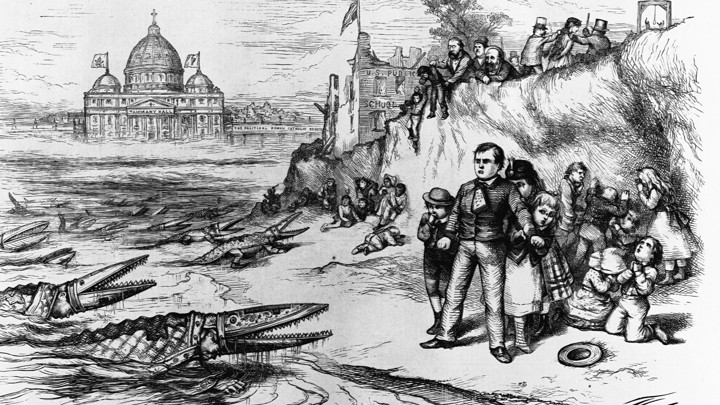
The Atlantic. January 12, 2020
Later this month, the U.S. Supreme Court will hear one of the most significant education cases in decades: Espinoza v. Montana Department of Revenue. Centering around a modest tax-credit scholarship program in Montana, Espinoza could have major ramifications for educational-choice programs across America, which help nearly half a million students attend private schools.
In deciding Espinoza, the Court has the opportunity to do more than just settle the fate of one controversial tax credit; it could also junk Montana’s Blaine Amendment, finding it in violation of the Constitution’s religious-freedom and equal-protection clauses. In doing so, it would set a strong precedent against any law born of bigotry, even if other justifications seem neutral.
The Espinoza case dates back to 2015, when, shortly after state lawmakers enacted the tax-credit scholarship program, the Montana Department of Revenue devised a rule that banned families from using the scholarships to attend religious schools, which account for more than two-thirds of the state’s private schools. The case is brought by three Montana moms whose children are thriving at a private religious school; without the tax-credit scholarships, the families are struggling to pay tuition. (Litigating on behalf of the parents is the Institute for Justice, where I work, though I’m not directly involved with the lawsuit.)
In May 2017, a trial court ruled in their favor and struck down the Department of Revenue’s rule. But in December 2018, the Montana Supreme Court reversed the decision, citing what is commonly known as Montana’s Blaine Amendment.
Enacted during a wave of anti-Catholic bigotry in 1889, the amendment
bans “direct or indirect” public funding for any “sectarian purpose.”
According to the majority opinion, the tax-credit scholarship program
violates the Blaine Amendment, even though it’s funded entirely through
voluntary, charitable, private donations incentivized by the state’s tax
credit. This past summer, the U.S. Supreme Court agreed to hear the
case, and it will be argued on January 22.
Today, 37 states have Blaine Amendments in their state constitution, though the precise wording varies. The amendments are named after Representative James G. Blaine of Maine, who in 1876 proposed a federal constitutional amendment that would have prohibited state funding for schools “under the control of any religious sect.” Blaine’s amendment passed the U.S. House of Representatives but fell just short of the supermajority it needed to pass the U.S. Senate.
Even though Blaine’s amendment was never enacted nationwide, Congress later required many potential states to adopt a version of the amendment in order to be admitted to the union. Starting with the Enabling Act of 1889, Congress granted statehood to Montana, North Dakota, South Dakota, and Washington only after their state constitutions guaranteed that their public schools would be “free from sectarian control.” Senator Henry Blair of New Hampshire, who regularly reintroduced the Blaine Amendment in subsequent sessions, called this provision of the Enabling Act “the very essence” of his proposal, and praised Congress for setting a “great precedent.”
At first glance, Blaine Amendments may seem like a benign way to ensure the government’s neutrality toward religion. In the 1875 speech that inspired Representative Blaine, President Ulysses S. Grant called for a federal ban on government funding for “sectarian schools” in order to “keep the Church and state forever separate.” More recently, nine states with Blaine Amendments collectively filed an amicus brief in the Espinoza case, arguing that no-aid provisions like theirs and Montana’s merely “sought to solidify the Framers’ original design separating church and State.”
But Blaine Amendments weren’t truly devoted to the separation of Church and state. Instead, they were mainly focused on separating the Catholic Church and state. Although public schools are largely secular today, that wasn’t the case in the 19th century. Public or “common” schools typically instilled in their students a nondenominational form of Protestantism, requiring them to sing hymns, pray, and read from the King James Bible—in direct conflict with Catholic dogma.
Refusing to send their children to schools that clashed with their values, many Catholic families (often immigrants) created their own private, religiously affiliated school systems. In turn, those parochial schools quickly became a target for bigoted attacks, most infamously by the Know Nothing party, and later by the American Protective Association. The association was particularly powerful in Montana: At the APA’s peak, up to one-tenth of Montana residents were members. The fact that Blaine Amendments featured so prominently in the platforms of those groups clearly shows that prejudice was a motivating factor behind state Blaine Amendments. More
Sunday, December 29, 2019
Abraham Lincoln knew the real enemies of liberty
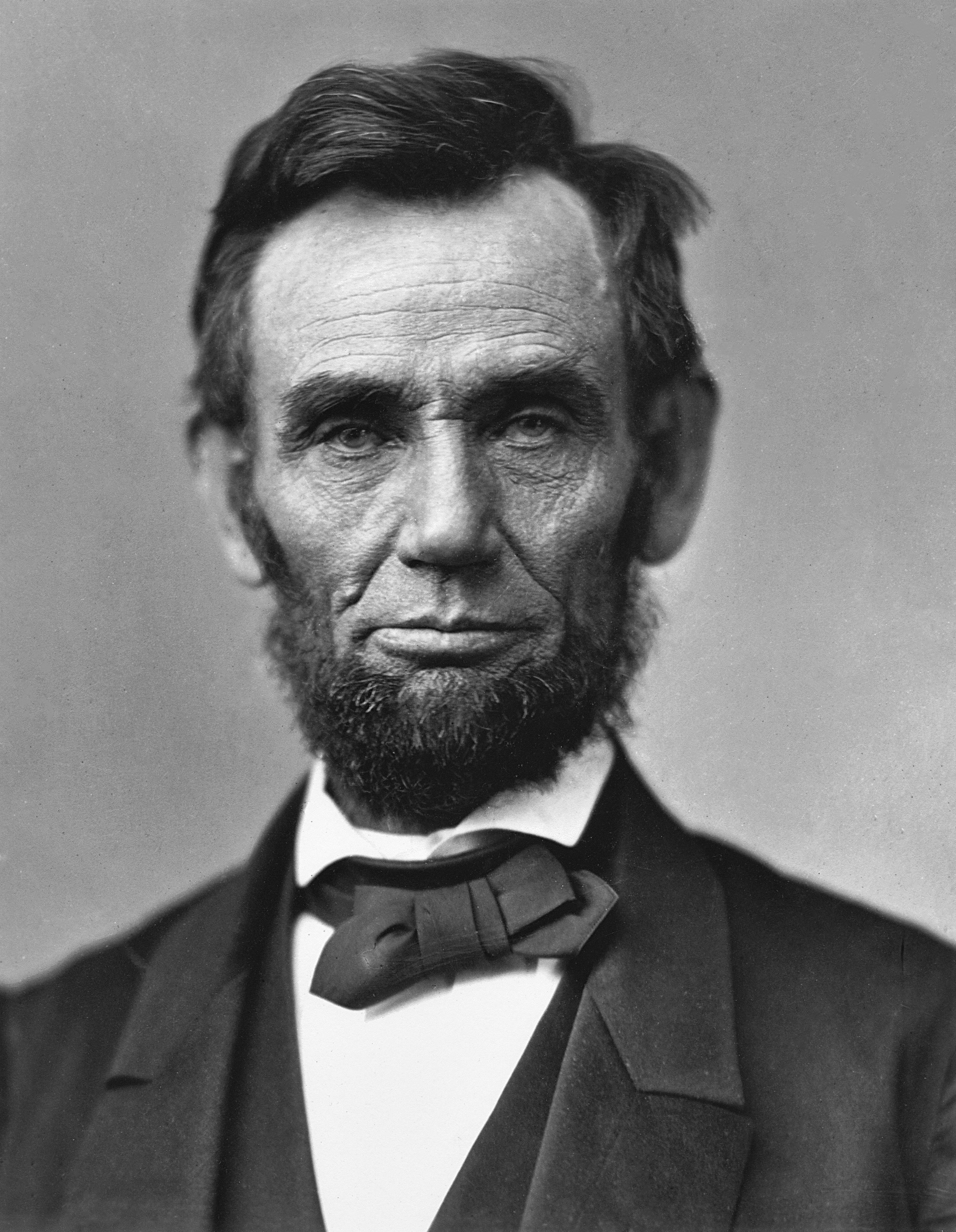
"You see that your friends, the Jesuits, have not yet killed me. But they would have surely done it, when I passed through their most devoted city, Baltimore, had I not defeated their plans, by passing incognito, a few hours before they expected me. We have the proof that the company which had been selected and organized to murder me, was lead by a rabid Roman Catholic, called Byrne; it was almost entirely composed of Roman Catholics; more than that, there were two disguised priests among them, to lead and encourage them. I am sorry to have so little time to see you; but I will not let you go before telling you that, a few days ago, I saw Mr. Morse, the learned inventor of electric telegraphy; he told me that, when he was in Rome, not long ago, he found out the proofs of a most formidable conspiracy against this country and all its institutions. It is evident that it is to the intrigues and emissaries of the pope, that we owe, in great part, the horrible civil war which is threatening to cover the country with blood and ruins."
"
If I were fighting against a Protestant South, as a nation, there would be no danger of assassination. The nations who read the Bible, fight bravely on the battlefields, but they do not assassinate their enemies. The Pope and the Jesuits, with their infernal Inquisition, are the only organized power in the world which have recourse to the dagger of the assassin to murder those whom they cannot convince with their arguments, or conquer with the sword. "Unfortunately, I feel more and more, everyday, that it is not against the Americans of the South, alone, I am fighting, it is more against the Pope of Rome, his perfidious Jesuits and their blind and blood-thirsty slaves, than against the real American Protestants, that we have to defend ourselves. Here is the real danger of our position. So long as they will hope to conquer the North, they will spare me; but the day we will rout their armies (and the day will surely come, with the help of God), take their cities, and force them to submit; then, it is my impression that the Jesuits, who are the principal rulers of the South, will do what they have almost in variably done in the past. The dagger or the pistol of one of their adepts, will do what the strong hands of the warriors could not achieve. This civil war seems to be nothing but a political affair to those who do not see, as I do, the secret springs of that terrible drama. But it is more a religious than a civil war. It is Rome who wants to rule and degrade the North, as she has ruled and degraded the South, from the very day of its discovery. There are only very few of the Southern leaders who are not more or less under the influence of the Jesuits, through their wives, family relations and their friends. Several members of the family of Jeff Davis belong to the Church of Rome. Even the Protestant ministers are under the influence of the Jesuits without suspecting it. To keep her ascendancy in the North, as she does in the South, Rome is doing here what she has done in Mexico, and in all the South American Republics; she is paralyzing, by a civil war, the arms of the soldiers of Liberty. She divides our nation, in order to weaken, subdue and rule it."
"But there is a thing which is very certain; it is, that if the American people could learn what I know of the fierce hatred of the generality of the priests of Rome against our institutions, our schools, our most sacred rights, and our so dearly bought liberties, they would drive them away, tomorrow, from among us, or they would shoot them as traitors. But I keep those sad secrets in my heart; you are the only one to whom I reveal them, for I know that you learned them before me. The history of these last thousand years tells us that wherever the Church of Rome is not a dagger to pierce the bosom of a free nation, she is a stone to her neck, and a ball to her feet, to paralyze her and prevent her advance in the ways of civilization, science, intelligence, happiness and liberty."
"This war would never have been possible without the sinister influence of the Jesuits. We. owe it to Popery that we now see our land reddened with the blood of her noblest sons. Though there were great differences of opinion between the South and the North, on the question of slavery; neither Jeff Davis nor anyone of the leading men of the Confederacy would have dared to attack the North, had they not relied on the promises of the Jesuits, that, under the mask of Democracy, the money and the arms of the Roman Catholics, even the arms of France, were at their disposal, if they would attack us. I pity the priests, the bishops and the monks of Rome in the United States, when the people realize that they are, in great part, responsible for the tears and the bloodshed in this war; the later the more terrible will the retribution be. I conceal what I know, on that subject, from the knowledge of the nation; for if the people knew the whole truth, this war would turn into a religious war, and it would, at once, take a tenfold more savage and bloody character. It would become merciless as all religious wars are. It would become a war of extermination on both sides. The Protestants of both the North and the South would surely unite to exterminate the priests and the Jesuits, if they could hear what Professor Morse has said to me of the plots made in the very city of Rome to destroy this Republic, and if they could learn how the priests, the nuns, and the monks, who daily land on our shores, under the pretext of preaching their religion, instructing the people in their schools, taking care of the sick in the hospitals, are nothing else but the emissaries of the Pope, of Napoleon, and the other despots of Europe, to undermine our institutions, alienate the hearts of our people from our constitution, and our laws, destroy our schools, and prepare a reign of anarchy here as they have done in Ireland, in Mexico, in Spain, and wherever there are any people who want to be free, etc."
"Two cankers are biting the very entrails of the United States, today: the Romish and the Mormon priests. Both are quietly at work to form a people of the most abject, ignorant and fanatical slaves, who will recognize no other authority but their supreme pontiffs. Both are aiming at the destruction of our schools, to raise themselves upon our ruins. Both shelter themselves under our grand and holy principles of liberty of conscience, to destroy that very liberty of conscience, and bind the world before their heavy and ignominious yoke. The Mormon and the Jesuit priests are equally the uncompromising enemies of our constitution and our laws; but the more dangerous of the two is the Jesuit —the Romish priest, for he knows better how to conceal his hatred under the mask of friendship and public good; he is better trained to commit the most cruel and diabolical deeds for the glory of God. " Abraham Lincoln, Fifty Years In The Church Of Rome pp. 691-704
Sunday, March 3, 2019
Protestants and Catholics are so nearly united in sentiment

"Protestants
and Catholics are so nearly united in sentiment, that it is not
difficult to conceive how Protestants may make an image to the Beast.
The mass of Protestants believe with Catholics in the Trinity,
immortality of the soul, consciousness of the dead, rewards and
punishments at death, the endless torture of the wicked, inheritance of
the saints beyond the skies, sprinkling for baptism, and the PAGAN
SUNDAY for the Sabbath; all of which is contrary to the spirit and
letter of the new testament. Surely there is between the mother and
daughters, a striking family resemblance." Merritt E. Cornell, Facts for the Times, p. 76. 1858
Wednesday, November 1, 2017
Tuesday, October 31, 2017
500 years ago today: The birth of Protestantism

WND October 31, 2017
On Oct. 31, 1517, an Augustinian monk named Martin Luther posted 95
debate questions on the door of Wittenberg Church, which began the
movement known as “the Reformation.”
In 1521, 34-year-old Martin Luther was summoned to stand trial before
the most powerful man in the world, 21-year-old Holy Roman Emperor
Charles V. Charles V of Spain’s empire spanned nearly two million square
miles across Europe, the Netherlands, the Far East, North and South
America and the Caribbean.
The Philippine Islands were named after his son, King Philip II of Spain. The sun never set on the Spanish Empire.
At the Diet of Worms, Charles V initially dismissed Luther’s theses
as “an argument between monks” and simply declared Martin Luther an
outlaw. Martin Luther was hid by Frederick of Saxony in the Wartburg
Castle, where he translated the New Testament into German. Charles V’s
unruly troops sacked Rome and imprisoned Pope Clement VII for six
months.
Charles V oversaw the Spanish colonization of the Americas, and began
the Counter-Reformation. He eventually responded to the pleadings of
the priest Bartolomé de Las Casas and outlawed the enslavement of native
Americans.
Gold from the New World was used by Spain to push back the Muslim
Ottoman Empire’s invasion of Europe. Sultan Suleiman the Magnificent’s
Ottoman fleet dominated the Mediterranean Sea, the Red Sea and the
Persian Gulf. Suleiman conquered into Christian Hungary, Christian
Serbia and Christian Austria, in addition to controlling the Middle East
and North Africa. In 1529, 35-year-old Suleiman the Magnificent sent
100,000 Muslim Turks to surround Vienna, Austria.
Martin Luther wrote: “The Turk is the rod of the wrath of the Lord
our God. … If the Turk’s god, the devil, is not beaten first, there is
reason to fear that the Turk will not be so easy to beat. … Christian
weapons and power must do it. …”
Martin Luther continued: “(The fight against the Turks) must begin
with repentance, and we must reform our lives, or we shall fight in
vain. (The Church should) drive men to repentance by showing our great
and numberless sins and our ingratitude, by which we have earned God’s
wrath and disfavor, so that He justly gives us into the hands of the
devil and the Turk.”
In an attempt to unite the Holy Roman Empire against the Ottoman
Muslims, Charles V agreed to a truce recognizing the Protestants, as
Eric W. Gritisch wrote in “Martin – God’s Court Jester: Luther in
Retrospect” (Philadelphia: Fortress, 1983, p. 69-70): “Afraid of losing
the much-needed support of the German princes for the struggle against
the Turkish threat from the south, Emperor Charles V agreed to a truce
between Protestant and Catholic territories in Nuremberg in 1532. … Thus
the Lutheran movement was, for the first time, officially tolerated and
could enjoy a place in the political sun of the Holy Roman Empire.”
As the Islamic threat intensified, reformer John Calvin wrote to
Philip Melanthon in 154 (“Selected Works of John Calvin: Tracts &
Letters,” I: 373): “I hear of the sad condition of your Germany! … The
Turk again prepares to wage war with a larger force. Who will stand up
to oppose his marching throughout the length and breadth of the land, at
his mere will and pleasure?”
Followers of the reformers who “protested” certain doctrines, were
generally referred to as “Protestants.” Some Protestants refused to help
Charles V who was defending Europe from the Muslim invasion. Finally,
Charles V made a treaty with the German Lutheran Princes by signing the
Peace of Augsburg, September 25, 1555, ceasing the religious struggle
between Lutherans and Catholics.
A line in the treaty, “cuius regio, eius religio,” allowed each king to decide what was to be believed in his kingdom.
A month later, Oct. 25, 1555, suffering from severe gout, Charles V
abdicated his throne and lived the rest of his life secluded in the
monastery of Yuste, leaving his son Philip II to rule.
As different kings in Europe chose different denominations for their
kingdoms, millions migrated from one country to another simply for
conscience sake. Many of these Christian religious refugees fled Europe
to settle colonies in America.
New York University Professor Emeritus Patricia Bonomi, in her
article “The Middle Colonies as the Birthplace of American Religious
Pluralism” wrote: “The colonists were about 98 percent Protestant.”
Of the 56 signers of the Declaration, most were Protestant, with the notable exception of Catholic Charles Carroll of Maryland.
British Statesman Edmund Burke addressed Parliament, 1775: “All
Protestantism … is a sort of dissent. But the religion most prevalent in
our Northern Colonies is a refinement on the principle of resistance;
it is the dissidence of dissent, and the protestantism of the Protestant
religion.”
Samuel Adams stated when he signed the Declaration of Independence:
“This day, I trust, the reign of political protestantism will commence.”
Martin Luther, who died in 1546, wrote: “I am much afraid that
schools will prove to be the great gates of hell unless they diligently
labor in explaining the Holy Scriptures, engraving them in the hearts of
youth.”
Wednesday, October 25, 2017

Subscribe to:
Posts (Atom)