Showing posts with label NSA. Show all posts

Tuesday, October 29, 2019

Privacy implications of FBI use of surveillance data

CPOMagazine   10/15/2019
According to a new declassified ruling from the U.S. Foreign Intelligence Surveillance Court (FISC), FBI personnel systematically abused National Security Agency (NSA) mass surveillance data in both 2017 and 2018. The 138-page ruling, which dates back to October 2018, was only unsealed 12 months later in October 2019. It offers a rare look at how the Federal Bureau of Investigation (FBI) has been abusing the constitutional privacy rights of U.S. citizens with alarming regularity. The court ruling is also a stinging rebuke to the FBI’s overreach of its ability to search surveillance intelligence databases.

Sunday, April 16, 2017

U.S. Navy is funding the development of a new super-surveillance system which uses robots to snoop on humans

   11th April 2017
It has handed a $1.7 million (£1.4 million) grant to researchers from Cornell University, who are working to build a system which can “conduct surveillance as a single entity with many eyes”.
The cash was handed over by the U.S. Office of Naval Research, which is dedicated to developing new forms of military and civilian technology.
Last year, we exclusively revealed that the same department discussed plans to fit humans with microchips and track their every move.
Now it wants to develop a system which lets teams of surveillance robots gather and share intelligence “at the speed of light”.
“Once you have robots that cooperate you can do all sorts of things,” said Kilian Weinberger, associate professor of computer science.
The team suggested the new technology “might help when teams of robots relieve humans of dangerous jobs like disposing of landmines, cleaning up after a nuclear meltdown or surveying the damage after a flood or hurricane”
It could also be taught to spot people behaving suspiciously, such as someone who has placed a backpack on the floor and walked away.
The Navy is likely to want to fit the technology into drones.
Of course, one of the main things this sort of system could really do is is spy on people.
The Cornell team’s technology will ultimately allow multiple robots to “identify objects and track objects and people from place to place”.
This will draw on the team’s expertise in “computer vision”, the name for a discipline dedicated to teaching camera-fitted robots to observe the world and understand what’s going on in front of them.
Facebook’s artificial intelligence chief, Yann LeCun,  is one of the world’s leading expert in this field.    The Sun

Monday, December 12, 2016

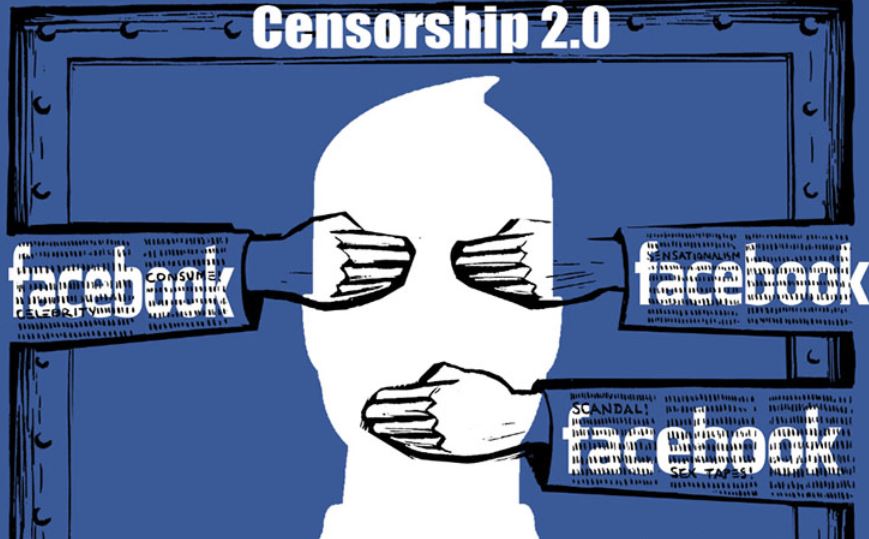
Facebook began testing new tools to carry out its "censorship plan" with the convenient name of "tackling fake news"

Image result for facebook censorship

One of the tools being tested will enable users to inform Facebook if certain news stories are using “misleading language”. Some users posted images of a Facebook survey asking them the following question: “To what extent do you think that this link’s title withholds key details of the story?”.
It is still unclear what kind of actions will be carried out after this additional user data is collected, but it is likely that some sort of a database, containing the list of “misleading” news websites, will be generated.
In a not so distant past, content curators from Facebook confirmed that they received direct orders from the company to decrease the relevance or even hide from the newsfeed stories and content with conservative language. While this happened in the US, similar stories have been reported in Brazil, the United Kingdom around the time of the Brexit, and in other countries.
Recently, there were other reports that Facebook developed a special software for the Chinese market, that would enable “third parties” to authorize the contents before posting it to the users’ timelines. The initiative would aim to lift the current ban of the social network in the country.
The main difference between this new software and the current content restrictions in some countries is that instead of reacting to a government request to hide some specific content, Facebook would be giving the option to some parties to censor and take down content before it is even posted on the network.
It is true that when you create a profile on Facebook or any other social network, you have to accept their terms and conditions in exchange of the “non-paid” use of their platforms. Most of these terms and conditions allow the social networks to analyze the information you are publishing and reading for several proposes, including targeted advertisements and many others, but is it ethical to take advantage of this information in order to define what content you should or should not see?
Since Snowden’s NSA information leak we know that we can be monitored at any given time by government agencies. The realization of this fact, however, didn’t stop us from using the same networks, nor did it prompt the closure of the NSA or other agencies involved in the perpetual recording and storage of our data.
But now we are entering a whole new level in which companies and governments will attempt to define what is right and wrong for us to see, read and talk about. What’s even more bizarre is that the CEO of Facebook could potentially run for office, while retaining control over one of the most popular social networks in the world, with the capability of retrieving and accessing anyone’s data without any sort of legal process or request.
This Orwellian trend is truly scary and we should really start questioning ourselves about the extent to which we are willing to continue handing out personal data and information to these networks.    The Duran

Saturday, October 29, 2016

The Little-Known Company That Enables Worldwide Mass Surveillance

, October 23 2016, 4:19 a.m.

It was a powerful piece of technology created for an important customer. The Medusa system, named after the mythical Greek monster with snakes instead of hair, had one main purpose: to vacuum up vast quantities of internet data at an astonishing speed.
The technology was designed by Endace, a little-known New Zealand company. And the important customer was the British electronic eavesdropping agency, Government Communications Headquarters, or GCHQ.
Dozens of internal documents and emails from Endace, obtained by The Intercept and reported in cooperation with Television New Zealand, reveal the firm’s key role helping governments across the world harvest vast amounts of information on people’s private emails, online chats, social media conversations, and internet browsing histories.
The leaked files, which were provided by a source through SecureDrop, show that Endace listed a Moroccan security agency implicated in torture as one of its customers. They also indicate that the company sold its surveillance gear to more than half a dozen other government agencies, including in the United States, Israel, Denmark, Australia, Canada, Spain, and India.
Some of Endace’s largest sales in recent years, however, were to the United Kingdom’s GCHQ, which purchased a variety of “data acquisition” systems and “probes” that it used to covertly monitor internet traffic.
Documents from the National Security Agency whistleblower Edward Snowden, previously disclosed by The Intercept, have shown how GCHQ dramatically expanded its online surveillance between 2009 and 2012. The newly obtained Endace documents add to those revelations, shining light for the first time on the vital role played by the private sector in enabling the spying.
Stuart Wilson, Endace’s CEO, declined to answer questions for this story. Wilson said in a statement that Endace’s technology “generates significant export revenue for New Zealand and builds important technical capability for our country.” He added: “Our commercial technology is used by customers worldwide … who rely on network recording to protect their critical infrastructure and data from cybercriminals, terrorists, and state-sponsored cybersecurity threats.”                         Read More

Wednesday, October 26, 2016

The Path to Total Dictatorship: America's Shadow Government and Its Silent Coup

By John W. Whitehead, October 24, 2016

“Today the path to total dictatorship in the U.S. can be laid by strictly legal means, unseen and unheard by Congress, the President, or the people. Outwardly we have a Constitutional government. We have operating within our government and political system … a well-organized political-action group in this country, determined to destroy our Constitution and establish a one-party state.... The important point to remember about this group is not its ideology but its organization… It operates secretly, silently, continuously to transform our Government.... This group ... is answerable neither to the President, the Congress, nor the courts. It is practically irremovable.”— Senator William Jenner, 1954 speech
Unaffected by elections. Unaltered by populist movements. Beyond the reach of the law.
Say hello to America’s shadow government.
A corporatized, militarized, entrenched bureaucracy that is fully operational and staffed by unelected officials who are, in essence, running the country, this shadow government represents the hidden face of a government that has no respect for the freedom of its citizenry.
No matter which candidate wins the presidential election, this shadow government is here to stay. Indeed, as recent documents by the FBI reveal, this shadow government—also referred to as “The 7th Floor Group”—may well have played a part in who will win the White House this year.
To be precise, however, the future president will actually inherit not one but two shadow governments.
The first shadow government, referred to as COG or Continuity of Government, is made up of unelected individuals who have been appointed to run the government in the event of a “catastrophe.” COG is a phantom menace waiting for the right circumstances—a terrorist attack, a natural disaster, an economic meltdown—to bring it out of the shadows, where it operates even now. When and if COG takes over, the police state will transition to martial law.
Yet it is the second shadow government—also referred to as the Deep State—that poses the greater threat to freedom right now. Comprised of unelected government bureaucrats, corporations, contractors, paper-pushers, and button-pushers who are actually calling the shots behind the scenes, this government within a government is the real reason “we the people” have no real control over our government.
The Deep State, which “operates according to its own compass heading regardless of who is formally in power,” makes a mockery of elections and the entire concept of a representative government.
So who or what is the Deep State?
It’s the militarized police, which have joined forces with state and federal law enforcement agencies in order to establish themselves as a standing army. It’s the fusion centers and spy agencies that have created a surveillance state and turned all of us into suspects. It’s the courthouses and prisons that have allowed corporate profits to take precedence over due process and justice. It’s the military empire with its private contractors and defense industry that is bankrupting the nation. It’s the private sector with its 854,000 contract personnel with top-secret clearances, “a number greater than that of top-secret-cleared civilian employees of the government.” It’s what former congressional staffer Mike Lofgren refers to as “a hybrid of national security and law enforcement agencies”: the Department of Defense, the State Department, Homeland Security, the CIA, the Justice Department, the Treasury, the Executive Office of the President via the National Security Council, the Foreign Intelligence Surveillance Court, a handful of vital federal trial courts, and members of the defense and intelligence committees.
It’s every facet of a government that is no longer friendly to freedom and is working overtime to trample the Constitution underfoot and render the citizenry powerless in the face of the government’s power grabs, corruption and abusive tactics.
These are the key players that drive the shadow government.
This is the hidden face of the American police state that will continue long past Election Day.
Just consider some of the key programs and policies advanced by the shadow government that will continue no matter who occupies the Oval Office.
Domestic surveillance. No matter who wins the presidential popularity contest, the National Security Agency (NSA), with its $10.8 billion black ops annual budget, will continue to spy on every person in the United States who uses a computer or phone. Thus, on any given day, whether you’re walking through a store, driving your car, checking email, or talking to friends and family on the phone, you can be sure that some government agency, whether the NSA or some other entity, is listening in and tracking your behavior. Local police have been outfitted with a litany of surveillance gear, from license plate readers and cell phone tracking devices to biometric data recorders. Technology now makes it possible for the police to scan passersby in order to detect the contents of their pockets, purses, briefcases, etc. Full-body scanners, which perform virtual strip-searches of Americans traveling by plane, have gone mobile, with roving police vans that peer into vehicles and buildings alike—including homes. Coupled with the nation’s growing network of real-time surveillance cameras and facial recognition software, soon there really will be nowhere to run and nowhere to hide.
Global spying. The NSA’s massive surveillance network, what the Washington Post refers to as a $500 billion “espionage empire,” will continue to span the globe and target every single person on the planet who uses a phone or a computer. The NSA’s Echelon program intercepts and analyzes virtually every phone call, fax and email message sent anywhere in the world. In addition to carrying out domestic surveillance on peaceful political groups such as Amnesty International, Greenpeace and several religious groups, Echelon has also been a keystone in the government’s attempts at political and corporate espionage.
Roving TSA searches. The American taxpayer will continue to get ripped off by government agencies in the dubious name of national security. One of the greatest culprits when it comes to swindling taxpayers has been the Transportation Security Administration (TSA), with its questionable deployment of and complete mismanagement of millions of dollars’ worth of airport full-body X-ray scanners, punitive patdowns by TSA agents and thefts of travelers’ valuables. Considered essential to national security, TSA programs will continue in airports and at transportation hubs around the country.
USA Patriot Act, NDAA. America’s so-called war on terror, which it has relentlessly pursued since 9/11, will continue to chip away at our freedoms, unravel our Constitution and transform our nation into a battlefield, thanks in large part to such subversive legislation as the USA Patriot Act and National Defense Authorization Act. These laws completely circumvent the rule of law and the rights of American citizens. In so doing, they re-orient our legal landscape in such a way as to ensure that martial law, rather than the U.S. Constitution, is the map by which we navigate life in the United States. These laws will continue to be enforced no matter who gets elected.
Militarized police state. Thanks to federal grant programs allowing the Pentagon to transfer surplus military supplies and weapons to local law enforcement agencies without charge, police forces will continue to be transformed from peace officers into heavily armed extensions of the military, complete with jackboots, helmets, shields, batons, pepper-spray, stun guns, assault rifles, body armor, miniature tanks and weaponized drones. Having been given the green light to probe, poke, pinch, taser, search, seize, strip and generally manhandle anyone they see fit in almost any circumstance, all with the general blessing of the courts, America’s law enforcement officials, no longer mere servants of the people entrusted with keeping the peace, will continue to keep the masses corralled, controlled, and treated like suspects and enemies rather than citizens.
SWAT team raids. With more than 80,000 SWAT team raids carried out every year on unsuspecting Americans by local police for relatively routine police matters and federal agencies laying claim to their own law enforcement divisions, the incidence of botched raids and related casualties will continue to rise. Nationwide, SWAT teams will continue to be employed to address an astonishingly trivial array of criminal activity or mere community nuisances including angry dogs, domestic disputes, improper paperwork filed by an orchid farmer, and misdemeanor marijuana possession.
Domestic drones. The domestic use of drones will continue unabated. As mandated by Congress, there will be 30,000 drones crisscrossing the skies of America by 2020, all part of an industry that could be worth as much as $30 billion per year. These machines, which will be equipped with weapons, will be able to record all activities, using video feeds, heat sensors and radar. An Inspector General report revealed that the Dept. of Justice has already spent nearly $4 million on drones domestically, largely for use by the FBI, with grants for another $1.26 million so police departments and nonprofits can acquire their own drones.
School-to-prison pipeline. The paradigm of abject compliance to the state will continue to be taught by example in the schools, through school lockdowns where police and drug-sniffing dogs enter the classroom, and zero tolerance policies that punish all offenses equally and result in young people being expelled for childish behavior. School districts will continue to team up with law enforcement to create a “schoolhouse to jailhouse track” by imposing a “double dose” of punishment: suspension or expulsion from school, accompanied by an arrest by the police and a trip to juvenile court.
Overcriminalization. The government bureaucracy will continue to churn out laws, statutes, codes and regulations that reinforce its powers and value systems and those of the police state and its corporate allies, rendering the rest of us petty criminals. The average American now unknowingly commits three felonies a day, thanks to this overabundance of vague laws that render otherwise innocent activity illegal. Consequently, small farmers who dare to make unpasteurized goat cheese and share it with members of their community will continue to have their farms raided.
Privatized Prisons. States will continue to outsource prisons to private corporations, resulting in a cash cow whereby mega-corporations imprison Americans in private prisons in order to make a profit. In exchange for corporations buying and managing public prisons across the country at a supposed savings to the states, the states have to agree to maintain a 90% occupancy rate in the privately run prisons for at least 20 years.
Endless wars. America’s expanding military empire will continue to bleed the country dry at a rate of more than $15 billion a month (or $20 million an hour). The Pentagon spends more on war than all 50 states combined spend on health, education, welfare, and safety. Yet what most Americans fail to recognize is that these ongoing wars have little to do with keeping the country safe and everything to do with enriching the military industrial complex at taxpayer expense.
Are you getting the message yet?
The next president, much like the current president and his predecessors, will be little more than a figurehead, a puppet to entertain and distract the populace from what’s really going on.
As Lofgren reveals, this state within a state, “concealed behind the one that is visible at either end of Pennsylvania Avenue,” is a “hybrid entity of public and private institutions ruling the country according to consistent patterns in season and out, connected to, but only intermittently controlled by, the visible state whose leaders we choose.”
The Deep State not only holds the nation’s capital in thrall, but it also controls Wall Street (“which supplies the cash that keeps the political machine quiescent and operating as a diversionary marionette theater”) and Silicon Valley.
This is fascism in its most covert form, hiding behind public agencies and private companies to carry out its dirty deeds.
It is a marriage between government bureaucrats and corporate fat cats.
As Lofgren concludes:
[T]he Deep State is so heavily entrenched, so well protected by surveillance, firepower, money and its ability to co-opt resistance that it is almost impervious to change… If there is anything the Deep State requires it is silent, uninterrupted cash flow and the confidence that things will go on as they have in the past. It is even willing to tolerate a degree of gridlock: Partisan mud wrestling over cultural issues may be a useful distraction from its agenda.
In other words, as I point out in my book Battlefield America: The War on the American People, as long as government officials—elected and unelected alike—are allowed to operate beyond the reach of the Constitution, the courts and the citizenry, the threat to our freedoms remains undiminished.
So the next time you find yourselves despondent over the 2016 presidential candidates, remember that it’s just a puppet show intended to distract you from the silent coup being carried out by America's shadow government.                 Rutherford

AT&T Is Spying on Americans for Profit and doing NSA-style work for law enforcement—without a warrant


Kenneth Lipp10.25.16 1:13 AM ET

On Nov. 11, 2013, Victorville, California, sheriff’s deputies and a coroner responded to a motorcyclist’s report of human remains outside of town.
They identified the partially bleached skull of a child, and later discovered the remains of the McStay family who had been missing for the past three years. Joseph, 40, his wife Summer, 43, Gianni, 4, and Joseph Jr., 3, had been bludgeoned to death and buried in shallow graves in the desert.
Investigators long suspected Charles Merritt in the family’s disappearance, interviewing him days after they went missing. Merritt was McStay’s business partner and the last person known to see him alive. Merritt had also borrowed $30,000 from McStay to cover a gambling debt, a mutual business partner told police. None of it was enough to make an arrest.
Even after the gravesite was discovered and McStay’s DNA was found inside Merritt’s vehicle, police were far from pinning the quadruple homicide on him.
Until they turned to Project Hemisphere.
Hemisphere is a secretive program run by AT&T that searches trillions of call records and analyzes cellular data to determine where a target is located, with whom he speaks, and potentially why.
“Merritt was in a position to access the cellular telephone tower northeast of the McStay family gravesite on February 6th, 2010, two days after the family disappeared,” an affidavit for his girlfriend’s call records reports Hemisphere finding (PDF). Merritt was arrested almost a year to the date after the McStay family’s remains were discovered, and is awaiting trial for the murders.
In 2013, Hemisphere was revealed by The New York Times and described only within a Powerpoint presentation made by the Drug Enforcement Administration. The Times described it as a “partnership” between AT&T and the U.S. government; the Justice Department said it was an essential, and prudently deployed, counter-narcotics tool.
However, AT&T’s own documentation—reported here by The Daily Beast for the first time—shows Hemisphere was used far beyond the war on drugs to include everything from investigations of homicide to Medicaid fraud.
Hemisphere isn’t a “partnership” but rather a product AT&T developed, marketed, and sold at a cost of millions of dollars per year to taxpayers. No warrant is required to make use of the company’s massive trove of data, according to AT&T documents, only a promise from law enforcement to not disclose Hemisphere if an investigation using it becomes public.
These new revelations come as the company seeks to acquire Time Warner in the face of vocal opposition saying the deal would be bad for consumers. Donald Trump told supporters over the weekend he would kill the acquisition if he’s elected president; Hillary Clinton has urged regulators to scrutinize the deal.
While telecommunications companies are legally obligated to hand over records, AT&T appears to have gone much further to make the enterprise profitable, according to ACLU technology policy analyst Christopher Soghoian.
“Companies have to give this data to law enforcement upon request, if they have it. AT&T doesn’t have to data-mine its database to help police come up with new numbers to investigate,” Soghoian said.
AT&T has a unique power to extract information from its metadata because it retains so much of it. The company owns more than three-quarters of U.S. landline switches, and the second largest share of the nation’s wireless infrastructure and cellphone towers, behind Verizon. AT&T retains its cell tower data going back to July 2008, longer than other providers. Verizon holds records for a year and Sprint for 18 months, according to a 2011 retention schedule obtained by The Daily Beast.         Read More

Sunday, August 28, 2016

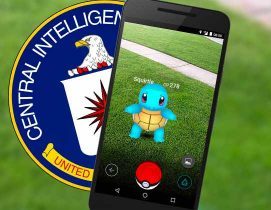
The CIA’s ‘Pokémon Go’ App is Doing What the Patriot Act Can’t

by James Corbett TheInternationalForecaster.com 07/13/2016

Privacy advocates (that’s establishment speak for “normal human beings”) celebrated earlier this week as the House rejected yet another attempt to expand the Patriot Act’s snooping provisions. House Resolution 5606, better known by its Orwellian name, the “Anti-terrorism Information Sharing is Strength Act,” would have allowed Big Brother to access Americans’ financial information based on what the government deems to be “suspicious activity.” Given that the DHS has labeled such things as using binoculars, paying with cash, or even “appearing normal” as “possible terrorist activity” in the past (thus making pretty much every human being a possible terrorist), everyone can breathe a sigh of relief that the bill failed.
But don’t breathe that sigh too deeply, because exactly as that threat to privacy was being extinguished, another one was rising to take its place. It goes by the name of “Pokémon Go” and it is a so-called “augmented reality” game that allows users to capture, train and battle virtual Pokémon by chasing them around through real world environments with your smart phone.
pokemongoFull disclosure: Although I live in the land of anime and video games, I have never played any Pokémon games, watched any of the shows, read any of the comics or bought any of the toys associated with the franchise. I don’t know anything about it except for the name of that ubiquitous yellow Pikachu character. So if you are an out-of-touch fuddy-duddy like me, you may be surprised to learn that the “Pokémon Go” app, launched just one week ago, is the hottest thing on the planet right now.
To put into perspective just how popular this game is, it topped the App Store’s “Top Grossing” category within 24 hours of its release. Now, just one week out, it has been downloaded an estimated 7.5 million times in the US alone and is generating an estimated $1.6 million a day for Nintendo. But here’s the truly mind-boggling part: In just the first two trading days after the game’s release, Nintendo’s market value rose a staggering $7.5 billion. That’s right, folks, this is not merely a game, it is a phenomenon.
For those unfamiliar with “augmented reality” gaming, it’s a type of game where one tracks virtual characters or objects that appear on their smart phones through real world environments. The Pokémon Go game is prompting scores of people out into the streets to go chasing for wild Pokémon to capture.
It is also prompting heists, violence, hoaxes and hysteria.
pokemonilluminatiOn the more innocuous side, some restaurants and businesses are already trying to cash in on their proximity to spots with a lot of in-game activity. On the less innocuous side, robbers are now using “Lures” (which attract Pokémon to a certain spot) to lure gamers in to be mugged. One 19-year-old hunting for water Pokémon in a rural river ended up uncovering a dead body, one IT executive got fired from his job after an online Facebook tirade inspired by frustration at the game, and one YouTuber who was live streaming the game while out Ubering allegedly saw someone get murdered right in front of him…but that turned out to be a hoax.
If you’re wondering what’s going on here, you’re not the only one. It seems the internet is flipping its collective lid over this app as the line between gaming and the real world gets blurrier. But perhaps all of this pales in comparison to the game’s terms and conditions.
Firstly, the app requires an excessive amount of permissions on a user’s device, including the ability to read your contacts, find accounts on your device, and access your camera. The app even requires full access to a user’s Google account, which it can then use to read your emails, send emails from your account, browse your Google Drive documents and photos, etc. But apparently that’s just “a mistake” and will be “corrected soon.”
Secondly, the game’s privacy policy contains such gems as: “We may disclose any information about you (or your authorized child) that is in our possession or control to government or law enforcement officials or private parties.” What could go wrong?
But wait, it gets worse!
pokemonciaThe maker of the app? Niantic Labs. Never heard of them? That’s because until last year they were an internal start-up of none other than Google, the NSA-linked Big Brother company. Even now Google remains one of Niantic’s major backers. Niantic was founded by John Hanke, who also founded Keyhole, Inc., the mapping company which was created with seed money from In-Q-Tel, the CIA’s venture capital arm, and which was eventually rolled into Google Maps.
So yes, the Pokémon game currently taking the internet by storm (and scooping up all their data, including activities, movements and communications) was created by a CIA-linked businessman who gestated his company at Google.
Feeling safe yet?
As it turns out, the big, bad Big Brother Spies of the NSA and the DHS and the CIA don’t really need their Patriot Act powers, after all. All the powers-that-shouldn’t-be need to do is create a fun, shiny trinket for the people to play with and they will literally pay for their own surveillance.
Welcome to the “Matrix Economy,” where people pay to spy on themselves…and have fun doing it!
Huxley would be proud.                       CorbettReport

Monday, January 4, 2016

An Ungodly Transformation Of Our World!

Last Trumpet Newsletter
Volume XXXV      Issue I      January 2016
Last Trumpet Ministries, PO Box 806, Beaver Dam, WI 53916
Phone: 920-887-2626 Internet: http://www.lasttrumpetministries.org

An Ungodly Transformation Of Our World!

"But of the times and the seasons, brethren, ye have no need that I write unto you. For yourselves know perfectly that the day of the Lord so cometh as a thief in the night. For when they shall say, Peace and safety; then sudden destruction cometh upon them, as travail upon a woman with child; and they shall not escape. But ye, brethren, are not in darkness, that that day should overtake you as a thief."
I Thessalonians 5:1-4
"And in the days of these kings shall the God of heaven set up a kingdom, which shall never be destroyed: and the kingdom shall not be left to other people, but it shall break in pieces and consume all these kingdoms, and it shall stand for ever."
Daniel 2:44
"And I saw the beast, and the kings of the earth, and their armies, gathered together to make war against him that sat on the horse, and against his army. And the beast was taken, and with him the false prophet that wrought miracles before him, with which he deceived them that had received the mark of the beast, and them that worshipped his image. These both were cast alive into a lake of fire burning with brimstone."
Revelation 19:19-20
In this issue of the Last Trumpet Newsletter, we will consider the nature and the means by which an ungodly transformation of our world is now in progress. At this present time, there are forces at work which are seeking to unite the entire world under a global government. At the forefront of such ambitions is an organization which is known as the United Nations. In August 2015 it was announced that the 193 member states of the United Nations, or UN, had reached a new agreement by which they hope to transform the entire world by the year 2030. (1) Since that time the details of the United Nations' agenda has been released in a report titled "Transforming our World: the 2030 Agenda for Sustainable Development." Although most people are likely unaware of this document, the implications of it affect every country in the world as well as every man, woman, and child. The preamble of the document states, "This Agenda is a plan of action for people, planet and prosperity. It also seeks to strengthen universal peace in larger freedom. We recognize that eradicating poverty in all its forms and dimensions, including extreme poverty, is the greatest global challenge and an indispensable requirement for sustainable development. All countries and all stakeholders, acting in collaborative partnership, will implement this plan." (2)
The lengthy document then tells us exactly what the United Nations plans to do, and while some of their goals sound innocuous or even good, a careful study of their words reveals this plan is about the universal control of the world's population. In the agenda's introduction, we are informed, "This is an Agenda of unprecedented scope and significance. It is accepted by all countries and is applicable to all, taking into account different national realities, capacities, and levels of development and respecting national policies and priorities. These are universal goals and targets which involve the entire world, developed and developing countries alike. They are integrated and indivisible and balance the three dimensions of sustainable development." (3)
In the United Nations' vision for the future, all people from every country must be a part of their universal education system. "We commit to providing inclusive and equitable quality education at all levels - early childhood, primary, secondary, tertiary, technical and vocational training. All people, irrespective of sex, age, race, ethnicity, and persons with disabilities, migrants, indigenous peoples, children and youth, especially those in vulnerable situations, should have access to life-long learning opportunities that help them acquire the knowledge and skills needed to exploit opportunities and to participate fully in society," the agenda declares. (4) While it may sound like a noble goal to provide every man, woman, and child with an education, we must remember that the curriculum would likely be formulated by the UN, and the main goal of such an educational system is to indoctrinate the people to conform to their specifications of a global citizen.
The agenda also calls for an overhaul of the world's economic system, which would put an end to capitalism and implement socialism on a global scale. "We will seek to build strong economic foundations for all our countries. Sustained, inclusive and sustainable economic growth is essential for prosperity. This will only be possible if wealth is shared and income inequality is addressed," states the agenda. (5) Apparently, the United Nations intends to take what you have and give it to other people whether you like it or not.
In addition to everything else, the United Nations also intends to implement a universal healthcare system. By universal, they mean a system that encompasses the entire world. "To promote physical and mental health and well-being, and to extend life expectancy for all, we much achieve universal health coverage and access to quality health care. No one must be left behind," the UN document declares. The document also discloses the United Nations' commitment to universal access to abortion and goes on to say, "We are committed to ensuring universal access to sexual and reproductive health care services, including for family planning, information and education." (6)
Predictably, the United Nations has also declared itself to be the authority on the world's climate change policies. "We acknowledge that the UNFCCC (United Nations Framework Convention on Climate Change) is the primary international, intergovernmental forum for negotiating the global response to climate change. We are determined to address decisively the threat posed by climate change and environmental degradation. The global nature of climate change calls for the widest possible international cooperation aimed at accelerating the reduction of global greenhouse gas emissions and addressing adaption to the adverse impacts of climate change," the document asserts. (7) As I have said in the past, I believe the call we are now seeing for action against climate change is the mechanism by which the powers that be intend to corral the people and force them into submission. They will enact rules and regulations that are far-reaching and oppressive, but we will be told that if we do not capitulate, the planet we now occupy will die.
It is important to note that the United Nations believes that reducing the world's population is a crucial step to fighting climate change. This is evident in a video found on the video sharing website known as YouTube. In this video, Greg Dalton, who is the founder of an organization known as Climate One, is seen to be interviewing Executive Secretary of the UNFCCC Christiana Figueres. After being asked by Dalton about "stopping the rise of the population," Figueres was recorded as saying, "Obviously less people would exert less pressure on the natural resources." She then noted that estimates indicate the world's population will rise to nine billion people by the year 2050. She further went on to say, "Really, we should make every effort to change those numbers because we are already, today, already exceeding the planet's planetary carrying capacity." The video was recorded in 2013. (8)
For those who doubt that the United Nations really intends to use a climate change agenda as a means to unite the entire world, we need look no further than the recent United Nations Climate Change Conference which took place between November 30, 2015, and December 12, 2015 in Paris France. Following an announcement that an agreement had been reached by world leaders, American President Barack Obama was quoted as saying, "This agreement represents the best chance we have to save the one planet we've got. I believe this agreement can be a turning point for the world." He later went on to say, "Together we've shown what's possible when the world stands as one." (9)
Yes, even as we enter the new year of 2016, powerful figures are working to establish a one world government and a new world order. It is a system they hope to have in place in less than fifteen years. In reality, that is a very short amount of time. Yet, I do not believe they will ever be fully successful in establishing a one world government. We are assured in Scriptures that God has established His kingdom and it will stand forever. Speaking of the time when Jesus came to earth, Daniel 2:44 tells us, "And in the days of these kings shall the God of heaven set up a kingdom, which shall never be destroyed: and the kingdom shall not be left to other people, but it shall break in pieces and consume all these kingdoms, and it shall stand for ever." It is interesting to note, however, that the United Nations seeks to unite every country in the world, and the 19th chapter of the book of Revelation warns that the kings of the earth and their armies are joined together to make war with Jesus Christ. In Revelation 19:19 we read, "And I saw the beast, and the kings of the earth, and their armies, gathered together to make war against him that sat on the horse, and against his army." The fact that the United Nations believes they will establish their global empire in less than fifteen years is a good indicator of where we are in time.

A Push To Unite The World's Religions!

Even as the United Nations attempts to unite the world under global governance, efforts are also being made to unite the world's religions. The driving force behind this movement is none other than Pope Francis. In recent months, Pope Francis has endeavored to forge a bond between those who identify as Christians and those who embrace the Islamic faith. This is evident in a speech given by Pope Francis at St. Patrick's Cathedral in Manhattan, New York, in September 2015. In the opening remarks of his speech, the Pope said, "I would like to express two sentiments for my Muslim brothers and sisters: Firstly, my greetings as they celebrate the feast of sacrifice. I would have wished my greeting to be warmer. My sentiments of closeness, my sentiments of closeness in the face of tragedy. The tragedy that they suffered in Mecca. In this moment, I give assurances of my prayers. I unite myself with you all. A prayer to almighty god, all merciful." (10) When we consider this quote, we must ask ourselves which god Pope Francis is talking about. It should be noted that Muslims often refer to their god Allah as being "all merciful." To further emphasize the point, during a visit to the Central African Republic in November 2015, Pope Francis told a crowd while speaking at a mosque, "Christians and Muslims are brothers and sisters." (11) The Pope then joined the mosque's imam in a moment of silence while they both aligned themselves to the so-called Islamic holy city of Mecca. (12)
In the meantime, more stories have surfaced of public schools in the United States promoting Islam. This includes the town of Blaine, Minnesota, which recently held a holiday concert in December 2015. Parents were distressed to learn that one of the songs their children would be singing was an Arabic song about the Islamic holiday known as Ramadan. The song includes the phrase "Allahu Akbar," which is translated as "God is great." (13) In another incident, students at Riverheads High School in Staunton, Virginia, were given an assignment which they were told was a lesson in Arabic calligraphy. In reality, the assignment forced the students to write out the Islamic statement of faith of which the English translation is "There is no god but Allah. Muhammad is the messenger of Allah." The students were also given an opportunity to try on an Islamic head scarf known as a hijab. (14)
Many people in the United States find the proliferation of Islam around the world to be quite distressing. Yet, it is important for us to remember that our God is sovereign and He can even reach Muslims. In fact, a report surfaced in June 2015 which tells the story of an Islamic State fighter who expressed a desire to follow Jesus Christ after having a series of dreams. His story was recounted by Gina Fadely, director of Youth with a Mission Frontier Missions, or YWAM. "He told this YWAM leader that he had begun having dreams of this man in white who came to him and said 'You are killing my people.' And he started to feel really sick and uneasy about what he was doing. The fighter said just before he killed one Christian, the man said 'I know you will kill me, but I give to you my Bible.' The Christian was killed and this ISIS fighter actually took the Bible and began to read it. In another dream, Jesus asked him to follow him and he was now asking to become a follower of Christ and to be discipled," Fadely said. (15) This is certainly a remarkable story. It bears a strong similarity to the story we find in Acts, chapter 9. Interestingly enough, the story about Paul took place around the city of Damascus, which is located in Syria. The Islamic State operates in that same region of the world.

A Cashless Revolution!

As we move into the new year of 2016, we are witnessing a cashless revolution. It is a transition that has been a long time in the making, but numerous reports indicate that certain countries around the world are on the cusp of becoming a fully cashless society. This is true in the nation of Sweden where a general disdain for cash is prevalent. In fact, physical currency now represents just 2 percent of Sweden's economy, and only 20 percent of all payments in the country were made in cash in 2015. (16) Speaking of this trend, former rock musician Bjorn Ulvaeus, who now operates a museum, was quoted as saying, "We don't want to be behind the times by taking cash while cash is dying out." Mr. Ulvaeus became a proponent of a cashless society after his son's apartment was burglarized. Recalling the burglary, Mr. Ulvaeus said, "It made me think: What would happen if this was a cashless society, and the robbers couldn't sell what they stole?" (17) Even some churches in Sweden have adopted cashless payment systems. This includes the Filadelphia church in the city of Stockholm where about 1,000 members attend. The church has installed a special "kollektomat" card machine, which can accept electronic payments. "People give more money to the church now because it's electronic and easy," said executive pastor Soren Eskilsson. (18)
The nation of Denmark is also moving towards a cashless society. According to a December 2015 report, only 25 percent of Danish citizens still use cash. "We're interested in getting rid of cash. The handling, security, and everything else is expensive; so, definitely we want to push digital payments, and that's of course why we introduced mobile payments to help this process," said IT Director Thomas Grane of the Danish company known as Matas. (19) While the Danish government has pledged to continue providing cash to those who want it, support has been expressed for cashless payments. "We're obliged to supply the amount of cash the population and businesses demand. But on the other hand, we think it's important to have an efficient and secure payment infrastructure, the whole digitalization process is very important in a country like Denmark," said central bank leader Hugo Frey Jensen. (20)
Citizens in Australia have also shown a strong preference for cashless payments. This trend prompted Australian journalist Rex Jory to write in a December 2015 editorial, "For many people the cashless society is virtually here. For others, perhaps less savvy and more suspicious of technology, the transition will take longer. But watch how quickly the cashless society gains traction during 2016." Amazingly enough, the Australian bank known as Westpac predicts that Australia will be an entirely cashless society by the year 2022. (21)
Canada, too, is moving towards a cashless society. In a recent survey conducted by the payment-processing firm known as Moneris, 77 percent of Canadians who responded indicated a preference for debit or credit cards over cash, while 65 percent said they rarely use any cash at all. "I think we're at a point where you don't need cash for most of what you need to do today. I do think people will continue to use cash because it's been around so long… But this growth in contactless (payments using credit cards or mobile apps) I think is going to lead towards the end of cash," stated Rob Cameron, the chief product and marketing officer at Moneris. (22)
Generally speaking, consumers enjoy cashless payment methods, such as credit cards, debit cards, and smartphone programs, because they facilitate convenient and fast payments. Governments also like cashless payment methods because it always leaves a paper trail and makes it more difficult for people to evade taxes. Naturally, a one world government beast system would also love a cashless system, for such a system makes it easier to track, monitor, and control the people. Sadly, this is the direction our world is heading. A recent report published by the New York Times quoted a twenty-three year-old student in Sweden who said, "No one uses cash. I think our generation can live without it." (23)

A Future Without Privacy!

In this connected generation of today, many people, especially young people have become accustomed to sharing every detail of their lives online. This is something they do willingly out of habit without giving it much thought. It seems as though future generations, however many there may be, will not know what it was like to live a life with any semblance of privacy whatsoever. After all, Big Brother is always watching.
In December 2015 the United States Congress passed new budget legislation known as the Omnibus Appropriations Bill. (24) Although this bill was simply supposed to be a required measure to keep the United States government in operation, House Speaker Paul Ryan, who is a Republican from Wisconsin, seized the opportunity and inserted what has come to be known as the Cybersecurity Information Sharing Act, or CISA, into the bill. In short, the provisions of this act give American companies immunity from prosecution and lawsuits when they share private data with the National Security Agency, or NSA. After the data of the American people becomes the property of the NSA, it can then be shared with other government agencies, such as the FBI, and used as a method of surveillance. Some lawmakers did protest against the bill, including Democratic Senator Ron Wyden of Oregon. Regarding the bill, Wyden was quoted as saying, "These unacceptable surveillance provisions are a black mark on a worthy package that contains the biggest tax cut for working families in decades, an accomplishment I fought for in weeks of negotiations. Unfortunately, this misguided cyber legislation does little to protect Americans' security and a great deal more to threaten our privacy than the flawed Senate version. Americans demand real solutions that will protect them from foreign hackers, not knee-jerk responses that allow companies to fork over huge amounts of their customer's private data with only cursory review." (25)
Ironically, the communist nation of China recently enacted a counter-terrorism law, which functions similarly to the new provisions found in CISA. Yet, Western leaders, including Barack Obama, have been highly critical of China's new rules. China's new law requires technology companies to hand over data encryption keys and other information to the government if they are told to do so. "This rule accords with the actual work need of fighting terrorism and is basically the same as what other major countries in the world do," stated Li Shouwei, who is deputy head of the parliament's criminal law division. (26) Regarding the new law, foreign ministry spokesman Hong Lei confessed that they drew upon United States' law for inspiration. "While formulating our counter terrorism law, we learned from the legislatures of other countries, including the U.S.," Lei said. (27)
Meanwhile, the government in Great Britain has also proposed a plan that would give their government more power to conduct online surveillance. The plan calls for technology companies to install backdoors in their products which would give the British government access to sensitive information, while also allowing communications data to be intercepted. This development caused the technology company known as Apple, Inc. to speak out against the proposal. "We believe it is wrong to weaken security for hundreds of millions of law-abiding customers so that it will also be weaker for the very few who pose a threat," Apple said. The company also likened the plan to leaving a key under the doormat. "A key left under the doormat would not just be there for the good guys. The bad guys would find it too." (28)
In closing, our world is indeed undergoing a transformation. As a result of this transformation, the young people of today are embracing a secular world with a different set of values. According to a recent poll from the Pew Research Center, only 63 percent of American respondents to their study claimed to be "absolutely certain" that God exists. This percentage is a stark drop from the year 2007, which was not so long ago, when 71 percent said they were certain that God exists. (29) Amongst those who still claim to be Christian, many are now accepting homosexuality. In fact, another Pew Research study published in December 2015 found that 54 percent of professing Christians who answered their poll said that homosexuality should be accepted and encouraged by society. (30) The people of today are being groomed and conditioned to accept a globalist society, and a one world government. As we continue to move through time, the Christian people will face mounting and intensifying pressure to assimilate with the world. With that thought in mind, let us lay to heart the words we find in II Thessalonians 2:15-17, "Therefore, brethren, stand fast, and hold the traditions which ye have been taught, whether by word, or our epistle. Now our Lord Jesus Christ himself, and God, even our Father, which hath loved us, and hath given us everlasting consolation and good hope through grace, Comfort your hearts, and stablish you in every good word and work." Yes, our hope is in the Lord Jesus Christ. If you have not yet given your heart to God and dedicated your life to Him, I urge you to do so now.
As always, we are here and ready to pray for you and your needs. If you have any prayer requests, please do not hesitate to send them our way. We take prayer seriously and every request is always given individual attention. Thank you all for your support of this ministry. We appreciate your kindness. Grace and peace be unto you in the name of the Lord Jesus Christ.
Samuel David Meyer

Acknowledgements
01. The United Nations, August 2, 2015, By the United Nations, http://un.org.
02. Transforming Our World: the 2030 Agenda for Sustainable Development, By the United Nations, http://sustainabledevelopment.un.org.
03. Ibid.
04. Ibid.
05. Ibid.
06. Ibid.
07. Ibid.
08. YouTube, April 17, 2013, By Climate One, https://www.youtube.com/watch?v=xFGksEgSwk8.
09. NBC News, December 12, 2015, By Elizabeth Chuck and Associated Press, http://nbcnews.com.
10. Reuters News Service/ABC News, September 24, 2015, By Emily Shapiro, http://abcnews.go.com.
11. BBC News, November 30, 2015, By BBC News, http://bbc.com.
12. The Chronicle, December 3, 2015, By News 24, Bangui, Central African Republic, http://chronicle.co.zw.
13. CBS Local News, December 17, 2015, By John Lauritsen, Blaine, MN.
14. MSN News, December 18, 2015, By Emma Brown, http://msn.com.
15. The Christian Post, June 3, 2015, By Nicola Menzie, http://christianpost.com.
16. The New York Times, December 26, 2015, By Liz Alderman, Stockholm, Sweden.
17. Ibid.
18. Ibid.
19. Payment Week, December 23, 2015, By Michael Cheng, http://paymentweek.com.
20. Ibid.
21. The Advertiser, December 27, 2015, By Rex Jory, http://adelaidenow.com.au.
22. Toronto Star, December 25, 2015, By Lauren La Rose, Toronto, Canada.
23. The New York Times, December 26, 2015, By Liz Alderman, Stockholm, Sweden.
24. ARS Technica, December 18, 2015, By David Kravets, http://arstechnica.com.
25. Ibid.
26. Reuters News Service, December 28, 2015, By Ben Blanchard, Beijing, China.
27. AFP, December 23, 2015, By AFP, Beijing, China.
28. Reuters News Service, December 22, 2015, By Paul Sandle, London, England.
29. National Public Radio, November 5, 2015, By Tom Gjelten, http://npr.org.
30. Pew Research Center, December 18, 2015, By Carlyle Murphy, http://pewresearch.org.                       Last Trumpet

Wednesday, December 23, 2015

The controversial 'surveillance' act Obama just signed


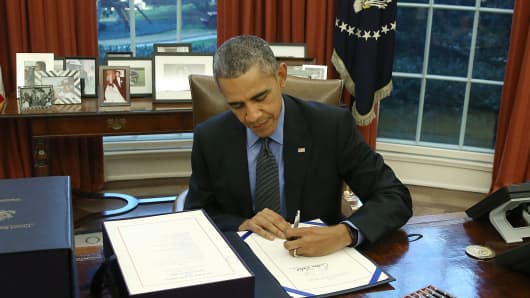
President Barack Obama signs the budget bill in the Oval Office of the White House December 18, 2015 in Washington, DC.
President Barack Obama signed into law a $1.1 trillion spending bill last Friday, staving off a potential government shutdown — and in the process, quietly inaugurated what some have called a second Patriot Act.

As part of the more-than-2,000-page document, the 14th rider to be exact, the appropriations omnibus includes the Cybersecurity Act of 2015. Buried within that section is the text of the Cybersecurity Information Sharing Act (CISA), a bill that seeks to permit private companies to handover information to federal agencies.

In essence, the law allows companies to directly share information with the Department of Defense (including the National Security Agency) without fear of being sued. This info can be used for cybersecurity purposes, but critics have keyed into the law's allowance for using the data to address or investigate a "specific threat" of death, serious bodily harm, serious economic harm, terrorism, harm to a minor and more.

As Wired noted, an earlier bill only allowed information sharing in the case of "imminent threats," but the new "specific" verbiage disregards any timeliness.
The House Committee on Rules described the information sharing measure as "a voluntary cybersecurity information sharing process that will encourage public and private sector entities to share cyberthreat information, without legal barriers and the threat of unfounded litigation — while protecting private information."

As benign as that description may sound, several legislators released comments decrying the implications of the CISA measures.

"I was unable to vote for the omnibus spending bill today because it included an extraneous provision purported to facilitate cybersecurity information sharing that — in effect — will function as a surveillance tool," California Rep. Zoe Lofgren said in a statement.

Oregon Sen. Ron Wyden was even more critical, saying the "unacceptable surveillance provisions" are a "black mark" on the rest of the appropriations bill. He even implied that the information sharing provisions are worse than in previous incarnations.

"Ultimately, I cannot vote for this badly flawed CISA bill. The latest version of CISA is the worst one yet — it contains substantially fewer oversight and reporting provisions than the Senate version did," he said in a statement. "That means that violations of Americans' privacy will be more likely to go unnoticed."

To Wyden's point, 55 civil society groups, security experts and academics, wrote earlier this year that CISA would "seriously threaten privacy and civil liberties, and could undermine cybersecurity, rather than enhance it."

These complaints may be blowing the scope of the bill out of proportion, according to Randy Sabett, vice chair of the privacy and data protection group at the law firm Cooley.

"I try to maintain a relatively open mind toward the arguments that people raise when they start talking about privacy and civil liberties, but I guess where I have difficulty is with some of these sweeping statements that it's a pure surveillance bill," he said.
 
Sabett pointed to CISA's voluntary nature — it doesn't compel any company to share data with the government, only prevents them from being sued for it. On the other hand, the law unequivocally requires both federal authorities and companies to scrub personal information from shared data.

Additionally, the law compels the government to issue regular privacy update reports to monitor any abuses, Sabett said.

And there are many who support the information sharing law, including Obama administration officials and industry groups.

"Cybersecurity is a top priority for DHS and the Obama administration, and this bipartisan effort is a significant step forward in strengthening our nation's cybersecurity," Homeland Security Secretary Jeh Johnson said in a statement after the omnibus spending bill was passed. "I look forward to working with Congress on further strengthening DHS' cybersecurity mission."

The U.S. Chamber of Commerce also put its support behind the new law. Recognizing that cybercrime targets both government and businesses, the Chamber's president and CEO, Thomas Donohue, said in a statement that CISA will allow businesses to voluntarily work with authorities "to better prevent, detect and mitigate threats."

"This legislation, long championed by the Chamber, is our best chance yet to help address this economic and national security priority in a meaningful way and help prevent further attacks," Donohue said.

Financial sector groups, such as the Securities Industry and Financial Markets Association and the American Bankers Association, have applauded CISA. Members of the Cyber Threat Alliance — which is made up of four companies: Palo Alto Networks, Fortinet, Symantec and Intel Security Group — were largely positive on the CISA measures in October.

"I have seen companies benefit from information sharing: To be in a situation where that information is like pulling teeth, and then to see the benefits that come out of it is an eye-opening experience," Sabett told CNBC. "Getting something on the books is going to have a lot more positive effects than the negative effects that the critics are pointing to."   CNBC
 
Everett Rosenfeld Staff Writer

Monday, November 30, 2015

Life in the Electronic Concentration Camp: The Surveillance State Is Alive and Well


By John W. Whitehead
November 30, 2015

“Big Brother in the form of an increasingly powerful government and in an increasingly powerful private sector will pile the records high with reasons why privacy should give way to national security, to law and order [...] and the like.” ― William O. Douglas, Supreme Court Justice
Bottle up the champagne, pack away the noisemakers, and toss out the party hats.
There is no cause for celebration.
We have secured no major victories against tyranny.
We have achieved no great feat in pushing back against government overreach.
For all intents and purposes, the National Security Agency has supposedly ceased its bulk collection of metadata from Americans’ phone calls, but read the fine print: nothing is going to change.
The USA Freedom Act, which claimed to put an end to the National Security Agency’s controversial collection of metadata from Americans’ phone calls, was just a placebo pill intended to make us feel better and let the politicians take credit for reforming mass surveillance.
In other words, it was a sham, a sleight-of-hand political gag pulled on a gullible public desperate to believe that we still live in a constitutional republic rather than a down-and-out, out-of-control, corporate-controlled, economically impoverished, corrupt, warring, militarized banana republic.
You cannot restrain the NSA. The beast has outgrown its chains.
You cannot reform the NSA. A government that lies, cheats, steals, sidesteps the law, and then absolves itself of wrongdoing does not voluntarily alter its behavior.
You cannot put an end to the NSA’s “technotyranny.” Presidents, politicians, and court rulings have come and gone over the course of the NSA’s 60-year history, but none of them have managed to shut down the government’s secret surveillance of Americans’ phone calls, emails, text messages, transactions, communications and activities.
Indeed, the government has become an expert in finding ways to sidestep niggling, inconvenient laws aimed at ensuring accountability, bringing about government transparency and protecting citizen privacy.
It has mastered the art of stealth maneuvers and end-runs around the Constitution.
It knows all too well how to hide its nefarious, covert, clandestine activities behind the classified language of national security and terrorism. And when that doesn’t suffice, it obfuscates, complicates, stymies or just plain bamboozles the public into remaining in the dark.
Case in point: the so-called end of the NSA’s metadata collection of Americans’ phone calls.
This, of course, is no end at all.
On any given day, the average American going about his daily business will still be monitored, surveilled, spied on and tracked in more than 20 different ways, by both government and corporate eyes and ears.
More than a year before politicians attempted to patch up our mortally wounded privacy rights with the legislative bandaid fix that is the USA Freedom Act, researchers at Harvard and Boston University documented secret loopholes that allow the government to bypass Fourth Amendment protections to conduct massive domestic surveillance on U.S. citizens.
It’s extraordinary rendition all over again, only this time it’s surveillance instead of torture being outsourced.
In much the same way that the government moved its torture programs overseas in order to bypass legal prohibitions against doing so on American soil, it is doing the same thing for its surveillance programs. By shifting its data storage, collection and surveillance activities outside of the country, the government is able to bypass constitutional protections against unwarranted searches of Americans’ emails, documents, social networking data, and other cloud-stored data.
Heck, the government doesn’t even need to move all of its programs overseas. It just has to push the data over the border in order to “[circumvent] constitutional and statutory safeguards seeking to protect the privacy of Americans.”
Credit for this particular brainchild goes to the Obama administration, which issued Executive Order 12333 authorizing the collection of Americans’ data from surveillance conducted on foreign soil.
Using this rationale, the government was able to justify hacking into and collecting an estimated 180 million user records from Google and Yahoo data centers every month because the data travels over international fiber-optic cables. The NSA program, dubbed MUSCULAR, is carried out in concert with British intelligence.
No wonder the NSA appeared so unfazed about being forced to shut down its much-publicized metadata program. It had already figured out a way to accomplish the same results (illegally spying on Americans’ communications) without being shackled by the legislative or judicial branches of the government.
Mind you, this metadata collection now being carried out overseas is just a small piece of the surveillance pie. The government and its corporate partners have a veritable arsenal of surveillance programs that will continue to operate largely in secret, carrying out warrantless mass surveillance on hundreds of millions of Americans’ phone calls, emails, text messages and the like, beyond the scrutiny of most of Congress and the taxpayers who are forced to fund its multi-billion dollar secret black ops budget.
The surveillance state is alive and well and kicking privacy to shreds in America.
Whether you’re walking through a store, driving your car, checking email, or talking to friends and family on the phone, you can be sure that some government agency, whether the NSA or some other entity, will still be listening in and tracking your behavior. This doesn’t even begin to touch on the corporate trackers that monitor your purchases, web browsing, Facebook posts and other activities taking place in the cyber sphere.
We are now in a state of transition with the police state shifting into high-gear under the auspices of the surveillance state.
Having already transformed local police into extensions of the military, the Department of Homeland Security, the Justice Department and the FBI are preparing to turn the nation’s police officers into techno-warriors, complete with iris scanners, body scanners, thermal imaging Doppler radar devices, facial recognition programs, license plate readers, cell phone Stingray devices and so much more.
Add in the fusion centers, city-wide surveillance networks, data clouds conveniently hosted overseas by Amazon and Microsoft, drones equipped with thermal imaging cameras, and biometric databases, and you’ve got the makings of a world in which “privacy” is reserved exclusively for government agencies.
Thus, telephone surveillance by the NSA is the least of our worries.
Even with restrictions on its ability to collect mass quantities of telephone metadata, the government and its various spy agencies, from the NSA to the FBI, can still employ an endless number of methods for carrying out warrantless surveillance on Americans, all of which are far more invasive than the bulk collection program.
As I point out in my new book Battlefield America: The War on the American People, just about every branch of the government—from the Postal Service to the Treasury Department and every agency in between—now has its own surveillance sector, authorized to spy on the American people.
Then there are the fusion and counterterrorism centers that gather all of the data from the smaller government spies—the police, public health officials, transportation, etc.—and make it accessible for all those in power.
And of course that doesn’t even begin to touch on the complicity of the corporate sector, which buys and sells us from cradle to grave, until we have no more data left to mine. Indeed, Facebook, Amazon and Google are among the government’s closest competitors when it comes to carrying out surveillance on Americans, monitoring the content of your emails, tracking your purchases and exploiting your social media posts.
“Few consumers understand what data are being shared, with whom, or how the information is being used,” reports the Los Angeles Times. “Most Americans emit a stream of personal digital exhaust — what they search for, what they buy, who they communicate with, where they are — that is captured and exploited in a largely unregulated fashion.”
It’s not just what we say, where we go and what we buy that is being tracked.
We’re being surveilled right down to our genes, thanks to a potent combination of hardware, software and data collection that scans our biometrics—our faces, irises, voices, genetics, even our gait—runs them through computer programs that can break the data down into unique “identifiers,” and then offers them up to the government and its corporate allies for their respective uses.
All of those internet-connected gadgets we just have to have (Forbes refers to them as “(data) pipelines to our intimate bodily processes”)—the smart watches that can monitor our blood pressure and the smart phones that let us pay for purchases with our fingerprints and iris scans—are setting us up for a brave new world where there is nowhere to run and nowhere to hide.
For instance, imagine what the NSA could do (and is likely already doing) with voiceprint technology, which has been likened to a fingerprint. Described as “the next frontline in the battle against overweening public surveillance,” the collection of voiceprints is a booming industry for governments and businesses alike. As The Guardian reports, “voice biometrics could be used to pinpoint the location of individuals. There is already discussion about placing voice sensors in public spaces, and [Lee Tien, senior staff attorney with the Electronic Frontier Foundation] said that multiple sensors could be triangulated to identify individuals and specify their location within very small areas.”
Suddenly the NSA’s telephone metadata program seems like child’s play compared to what’s coming down the pike.
That, of course, is the point.
The NSA is merely one small part of a shadowy permanent government comprised of unelected bureaucrats who march in lockstep with profit-driven corporations that actually runs Washington, DC, and works to keep us under surveillance and, thus, under control. For example, Google openly works with the NSA, Amazon has built a massive $600 million intelligence database for CIA, and the telecommunications industry is making a fat profit by spying on us for the government.
In other words, Corporate America is making a hefty profit by aiding and abetting the government in its domestic surveillance efforts.
At every turn, we have been handicapped in our quest for transparency, accountability and a representative democracy by an establishment culture of secrecy: secret agencies, secret experiments, secret military bases, secret surveillance, secret budgets, and secret court rulings, all of which exist beyond our reach, operate outside our knowledge, and do not answer to “we the people.”
Now there are still those who insist that they have nothing to hide from the surveillance state and nothing to fear from the police state because they have done nothing wrong.
To those sanctimonious few, secure in their delusions, let this be a warning: the danger posed by the American police state applies equally to all of us—lawbreaker and law abider alike, black and white, rich and poor, liberal and conservative, blue collar and white collar, and any other distinction you’d care to trot out.
In an age of too many laws, too many prisons, too many government spies, and too many corporations eager to make a fast buck at the expense of the American taxpayer, there is no safe place and no watertight alibi. We are all guilty of some transgression or other, and eventually, we will all be made to suffer the same consequences in the electronic concentration camp that surrounds us. Source