Showing posts with label Food Crisis. Show all posts

Friday, July 31, 2020

The world stands on the brink of a food crisis

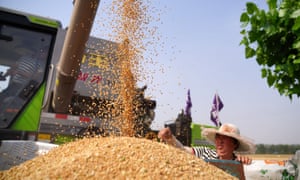
A farmer harvests wheat in Hebei province, China

The Guardian June 2020

The world stands on the brink of a food crisis worse than any seen for at least 50 years, the UN has warned as it urged governments to act swiftly to avoid disaster.

Better social protections for poor people are urgently needed as the looming recession following the coronavirus pandemic may put basic nutrition beyond their reach, the UN secretary general, António Guterres, said on Tuesday.

“Unless immediate action is taken, it is increasingly clear that there is an impending global food emergency that could have long-term impacts on hundreds of millions of children and adults,” he said. “We need to act now to avoid the worst impacts of our efforts to control the pandemic.”

Although harvests of staple crops are holding up, and the export bans and protectionism that experts feared have so far been largely avoided, the worst of the impacts of the pandemic and ensuing recession are yet to be felt. Guterres warned: “Even in countries with abundant food, we see risks of disruption in the food supply chain.”

About 50 million people risk falling into extreme poverty this year owing to the pandemic, but the long-term effects will be even worse, as poor nutrition in childhood causes lifelong suffering. Already, one in five children around the world are stunted in their growth by the age of five, and millions more are likely to suffer the same fate if poverty rates soar.

Friday, February 28, 2020

Australia’s hottest and driest year on record has slashed crop production, with summer output expected to fall to the lowest levels on record

TECB. February 19, 2020
Global food production is being hit from seemingly every side.  Thanks to absolutely crazy weather patterns, giant locust armies in Africa and the Middle East, and an unprecedented outbreak of African Swine Fever in China, a lot less food is being produced around the world than originally anticipated.  Even during the best of years we really struggle to feed everyone on the planet, and so a lot of people are wondering what is going to happen as global food supplies become tighter and tighter.  The mainstream media in the United States is so obsessed with politics right now that they haven’t been paying much attention to this emerging crisis, but the truth is that this growing nightmare is only going to intensify in the months ahead.
In Australia, conditions have been extremely hot and extremely dry, and that helped to fuel the horrific wildfires that we recently witnessed.
And everyone knew that agricultural production in Australia was going to be disappointing this year, but it turns out that it is actually going to be the worst ever recorded…
Australia’s hottest and driest year on record has slashed crop production, with summer output expected to fall to the lowest levels on record, according to official projections released Tuesday.
The country’s agriculture department said it expects production of crops like sorghum, cotton and rice to fall 66 percent — the lowest levels since records began in 1980-81.
The continent of Australia is considered to be one of the breadbaskets of the world.  According to the U.S. Department of Agriculture, in 2018/19 Australia exported over 9 million tons of wheat to the rest of the world.
But thanks to relentless crop failures, Australia has started to import wheat, and that is likely to continue for the foreseeable future.
So instead of helping to feed the rest of the world, Australia is now relying on the rest of us to help feed them.
And what is happening this year didn’t just barely break the old records.  In fact, one senior economist says that this will be the worst summer crop production the country has ever seen “by a large margin”…
“It is the lowest summer crop production in this period by a large margin,” Peter Collins, a senior economist with the department’s statistical body ABARES told AFP.
Of course if the rest of the world was doing great we could certainly survive a downturn in Australia.
Unfortunately, that is definitely not the case.
Right now, billions upon billions of locusts are voraciously devouring farms in eastern Africa and the Middle East.  As I detailed the other day, giant armies of locusts the size of large cities are traveling up to 100 miles per day as they search for food.  When they descend on a farm, all the crops can be consumed literally within 30 seconds.  It is a nightmare of epic proportions, and UN officials are telling us that this crisis is only going to get worse over the next couple of months.

Plague of locusts threatens East African economies as UN sounds emergency alarm


The worst desert locust infestation in 70 years is ravaging East Africa, potentially endangering economies in a region heavily dependent on agriculture for food security.
NTEB February 21, 2020
I honestly thought that the current locust swarming would have stopped by now, or at the very least lessened, but just the opposite is taking place. It is increasing in intensity, with the locusts eating the food of 35,000 people in a single day. Interestingly, the locust swarms seem to be affecting nations that reject the God of the bible who commands the locusts at His will.

“If I shut up heaven that there be no rain, or if I command the locusts to devour the land, or if I send pestilence among my people;” 2 Chronicles 7:13 (KJB)
“Hast thou entered into the treasures of the snow? or hast thou seen the treasures of the hail, Which I have reserved against the time of trouble, against the day of battle and war?” Job 38:22,23 (KJB)

The book of Job tells us that God uses the weather as a weapon, and it is more powerful than anything the militaries of the world can command. Read the book of Revelation sometime and see how God is going to use weather to judge this world. Hydrogen bombs are nothing more than mere firecrackers compared to what God will rain down upon this earth in the coming time of the great Tribulation. I am starting to think that this relentless locust plague is more than a seasonal outbreak, as it is rapidly approaching biblical territory. Birth pangs, perhaps? Time will tell.

Plague of locusts threatens East African economies as UN sounds emergency alarm

FROM CNBC: In recent days, locust swarms have begun to impact South Sudan, Uganda and Tanzania, having already decimated crops throughout Ethiopia, Kenya and Somalia, Eritrea and Djibouti. The Food and Agriculture Organization (FAO) of the United Nations earlier this week called the situation “extremely alarming.”
The UN warned of an unprecedented threat to food security in a part of the world where millions face hunger, and the FAO estimated that 70,000 hectares of crops in Kenya and around 30,000 hectares in Ethiopia had been infested. It added that locusts had attacked coffee and tea crops that account for approximately 30% of Ethiopia’s exports.
The FAO also estimated that around 8.5 million Ethiopians and 3.1 million Kenyans already face food insecurity. The locusts have now begun breeding along both sides of the Red Sea in Egypt, Sudan, Eritrea and Saudi Arabia.
Desert locusts can travel up to 150km (95 miles) a day, and a one-square-kilometer swarm can devour as much food as 35,000 people in a single day, according to the UN.

Tuesday, December 3, 2019

China’s African Swine Fever Now Global Threat

ASF32452
Neo  30.11.2019
The worst outbreak of fatal African Swine Fever disease ever has devastated the world’s largest pig population, that of China, over the past months. Now it is spreading to neighboring states and even threatens the United States pig herds. The political and human impact could be far worse than imagined as a de facto pandemic disease situation spreads. Globalization of agribusiness is not helping matters.

On August 3, 2018 a case of African Swine Fever (ASF) was confirmed in China’s Liaoning Province. Since then despite various measures to contain the deadly disease it has spread across China where as of November, 2019 in little more than a year, nearly half of China’s huge pig population has either died or been eliminated in a desperate effort to contain the disease. ASF is not deadly to humans but is 100% fatal to any pig that is infected. There is no known treatment to cure it. It can be spread by direct contact with an infected pig, body fluids, contact with equipment or clothing and via certain tick species.

The China Agriculture Ministry issued a report in August that the size of China’s live pig herd had declined by a very precise 38.7% from August 2018. Industry sources suspect underreporting and put the actual number at more like 50%. In any event it is huge, and has impacted the politically sensitive measure of China food price inflation over the past year. Pork is a mainstay of the Chinese diet for meat protein and considered a national security issue. Most pigs in China are raised by small-scale farmers who face ruin now. According to reports inside China this has led many desperate small farmers to try to hide the presence of ASF in their herds, to slaughter and sell, to avoid financial ruin.

The disease is especially dangerous. According to experts it’s hard to kill. One report notes, “It lives in feces for 11 days and blood for 15 weeks. It lives in salted meat for 182 days, dried meat for almost a year, and frozen meat for three years. The Chinese love to take meat snacks with them when they travel. Rules can be bent in Asia.”

Saturday, November 30, 2019

Why Asia is facing a food problem?


GP: TOPSHOT-CHINA-AGRICULTURE-RICE 191122

NBC   Nov 27 2019
Asia is “unable to feed itself” — and needs to invest another $800 billion in the next 10 years to produce more food and meet the region’s needs, according to a report.

The population in Asia is growing, and consumers are demanding safer, healthier, and more sustainable food.

 Food spending will more than double — from $4 trillion in 2019 to over $8 trillion by 2030, said the Asia Food Challenge Report which was released last week.

“If this investment does not materialise, we believe the industry will struggle to keep up with demand, resulting in poorer food outcomes for Asia’s population,” according to the authors of the report which was compiled by PwC, Rabobank, and Singapore investment firm Temasek.

Why Asia is facing a food problem

“Asia is unable to feed itself, relying on imports flowing through long supply chains from the Americas, Europe and Africa,” according to the report that was released Nov. 20.

That’s consistent with research from a 2018 United Nations Conference on Trade and Development report. “In general, countries in Latin America, East Africa and South Asia are net food exporters, while most of the rest of Asia and Africa remain net food importers,” the Key Statistics and Trends in International Trade report said.

Friday, May 31, 2019

The worst agricultural downturn since the 1980s is taking its toll on the emotional well-being of American farmers.

Bloomberg  March 20, 2019
The worst agricultural downturn since the 1980s is taking its toll on the emotional well-being of American farmers.
In Kentucky, Montana and Florida, operators at Farm Aid’s hotline have seen a doubling of contacts for everything from financial counseling to crisis assistance. In Wisconsin, Dale Meyer has started holding monthly forums in the basement of his Loganville church following the suicide of a fellow parishioner, a farmer who’d fallen on hard times. In Minnesota, rural counselor Ted Matthews says he’s getting more and more calls.
“Can you imagine doing your job and having your boss say ‘well you know things are bad this year, so not only are we not going to pay you, but you owe us’,” Matthews said by telephone. “That’s what’s happened with farmers.’’
Glutted grain markets have sparked a years-long price slump made worse by a trade war with top buyer China. As their revenues decline, farmers have piled on record debt -- to the tune of $427 billion. The industry’s debt-to-income ratio is the highest since the mid 1980s, when Willie Nelson, Neil Young and John Mellencamp organized the first Farm Aid concert.

Saturday, November 17, 2018

A new study finds that bacteria develop antibiotic resistance when exposed to Roundup


glyphosate
Phys October 12, 2018
A new study finds that bacteria develop antibiotic resistance up to 100,000 times faster when exposed to the world's most widely used herbicides, Roundup (glyphosate) and Kamba (dicamba) and antibiotics compared to without the herbicide. 

This study adds to a growing body of evidence that herbicides used on a mass industrial scale, but not intended to be antibiotics, can have profound effects on bacteria, with potentially negative implications for medicine's ability to treat infectious diseases caused by bacteria, says University of Canterbury scientist Professor Jack Heinemann, one of the study's authors. 

 "The combination of chemicals to which bacteria are exposed in the modern environment should be addressed alongside antibiotic use if we are to preserve antibiotics in the long-term," he says. 

An important finding of the new study was that even in cases where the herbicides increase the toxicity of antibiotics they also significantly increased the rate of antibiotic resistance, which the study's authors say could be contributing to the greater use of antibiotics in both agriculture and medicine.

The Monsanto Papers


Thursday, September 27, 2018

Americans consuming more fake meat & dairy than ever

RT  16 Sep, 2018
A new study by the Good Food Institute (GFI), which represents the plant-based foods industry, found that sales of substitutes for animal products have exceeded $3.7 billion.
While total US retail food sales grew just two percent over the last 12 months, retail sales of plant-based foods grew 17 percent during the same time period.
“The plant-based foods industry has gone from being a relatively niche market to fully mainstream,” said Michele Simon, Executive Director of the Plant Based Foods Association (PBFA).

Sunday, April 29, 2018

US stock markets are currently passing through the same peaks they faced 11 years ago

RT 13 Apr, 2018
US stock markets are currently passing through the same peaks they faced 11 years ago, right before the massive sell-off that triggered the 2008 financial crisis, according to Phil Town, who sold his stocks before the crash.
“I think we are right on the brink. The logic is pretty straightforward from a fundamental point of view, we are at a relationship between the Wilshire GDP ratio which is almost unprecedented historically, where we have a relationship that is historically the Wilshire's 70 to a 100 percent value of GDP,” the investor told The Street.

Tuesday, February 13, 2018

Venezuela’s neighbours are tightening their borders as crisis spurs exodus

Venezuela’s neighbours are tightening their borders, alarmed by the exodus of hundreds of thousands of desperate refugees fleeing hunger, hyperinflation and a spiralling political crisis.
Brazil and Colombia are sending extra troops to patrol frontier regions where Venezuelans have arrived in record numbers over recent months.
Colombia, which officially took in more than half a million Venezuelans over the last six months of 2017, also plans to make it harder to cross the frontier or stay illegally in Colombia. Brazil said it will shift refugees from regions near the border where social services are badly strained.
The economic crisis and food shortages which have driven so many from their homes show no signs of easing.
The International Monetary Fund forecasts hyperinflation in Venezuela will hit 13,000% this year, so most salaries are now worth the equivalent of just a few British pounds a month.

Saturday, September 30, 2017

Thousands of Venezuelans are searching for a new life in Colombia as crisis deepens

28 September 2017
Many have queued overnight, waiting patiently for the Simón Bolívar International bridge to open. Some 25,000 people cross the bridge into Colombia every day.
It is a short walk between the two countries but with the political and economic crisis in Venezuela deepening, the two neighbours now seem worlds apart.
Venezuela is suffering from acute shortages of medicines, hospitals struggle to treat patients and staple goods have become scarce and unaffordable to many.
Mothers cradle their babies, bringing them to the hospital in the town of Cúcuta, on the Colombian side of the border, to get them vaccinated.
Families push poorly relatives in wheelchairs. Others cross into Colombia with empty suitcases, filling them up with food and supplies they cannot get in Venezuela.
Two women with a baby in a pushchair walk past the border guard, muttering: "What a humiliation." They are clearly embarrassed they have to do this.

Crossing the border for food

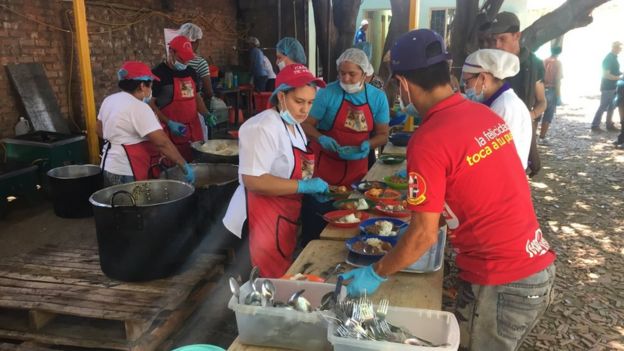
The local church in Cúcuta is feeding between 600 and 2,000 people a day in an open-air courtyard filled with plastic tables and chairs.
Verónica Mendoza, 24, is five months pregnant. She is tucking in to a meal of rice, beans, potatoes and mince with her mother, Mariluz.
The two women travel two hours every day from Venezuela to sell fruit at a market in Colombia.
They cannot find work back home. They come here for their only proper meal of the day.
"Look at the weight I've lost," says Mariluz, grabbing her once fleshy arms and showing the loose skin. "I used to be healthy and strong. But we have to walk such a long way and work so hard."
Mariluz's case is not rare. Recent research [in Spanish] suggests that three-quarters of Venezuelans lost weight in the past year, an average of 9kg (20lb).

Living on the streets

The Colombian government recently introduced "border mobility cards" to allow Venezuelans to go back and forth across the border without the need for a passport.
More than 700,000 people have applied for the scheme so far.
But some like Carlos Alberto Ledesma, a professional jazz musician from Caracas, want to stay in Colombia for good.
Mr Ledesma arrived in Cúcuta eight days ago. "I spent a year living on the streets," he says.
"I stopped working in Venezuela because the bars aren't open, half of the musicians have gone."
Official figures put the number of Venezuelans who have left their homeland for Colombia because of the crisis at 300,000. But the actual number is thought to be much higher.
The influx is putting strain on communities in Colombia, which have lived through more than five decades of armed conflict between left-wing guerrilla groups, the armed forces and right-wing paramilitaries.
Luis Fernando Niño López is the secretary for victims, peace and post-conflict for the province of Norte de Santander, where Cúcuta is located.
"At the moment, there's a pretty big flow but not everybody stays," he says of the Venezuelans arriving in the region.
"But what's going to happen when they can't go back because [Venezuelan President Nicolás] Maduro closes the border or because armed groups that control the border won't let people go back?"

Sheltering Venezuelans

At a shelter run by the Scalabrini International Migration Network in the centre of Cúcuta, the growing scale of the problem is evident.
Between January and June, 650 people came through its doors. In August alone, there were 850 people.
Mr Franklin Díaz, who runs the shelter, says those who come to the shelter are in urgent need of attention and more should be done to help them.
"The action of the authorities is fundamental, they are the ones who manage the resources."
Many of those crossing into Colombia from Venezuela originally fled the armed conflict in Colombia.
Nereidis Ascanio is one of them. Her father was killed by paramilitaries so her family left for Venezuela when she was a child.
A single mother, her two little boys have Venezuelan nationality.
She recently returned to Colombia and now lives in a little shack made out of wooden beams and a corrugated iron roof on the outskirts of Cúcuta. The tarpaulin walls do not even cover the entire shack. 
Ms Ascanio is desperate. "I need to find food for my kids," she says while she wipes away tears.
"And I need to find a job that will allow me to look after my boys."

Getting stuck in Cúcuta

Other Colombians left for Venezuela when the oil industry started booming there in the 1980s.
With oil prices now low and the economic crisis in Venezuela worsening, they too are returning in large numbers.
Many arrive in Colombia with great expectations of a new life.
But Venezuela's triple-digit inflation means their savings in Venezuelan bolivares are worthless once converted into Colombian pesos, so many get stuck.
In the middle of the town is a roundabout with a large sculpture which reads "I love Cúcuta". Some people are curled up sleeping in the letters "c".
Jeferson José Gutierres is one of those sleeping rough along with his wife and their three children. 
He came here a month ago and cannot find work.
But he says life in Cúcuta is still better than in Venezuela and he is not planning on going back while President Maduro is in power.
"I'll return when Maduro goes," he says.
"He's a president who spends money while his people die of hunger."         BBC
Monday, August 28, 2017

Who controls what we eat in the food industry?

Image result for food industry companies that control
Most of us have little to no idea how behind-the-scenes forces control the food we buy, and the depth of the corruption involved. Philip Howard, Ph.D., author of "Concentration and Power in the Food System: Who Controls What We Eat?," studies food system changes, with an emphasis on visualizing these trends.1
"My motivation [for writing the book] was to uncover what's going on, to help people understand who owns what and all the strategies these dominant firms use to further increase their power," he says.
His work has been featured by many prominent media outlets, including The New York Times, The Washington Post and Chicago Tribune. He's an associate professor in the department of community sustainability at Michigan State University and holds a Ph.D. in rural sociology.

Endgame: Global Monopolization

One fact that many don't realize is just how few firms control the global food system, from seeds to supermarkets. As noted by Howard:
"The trend in most industries is for fewer and fewer firms to increase their power. One really dramatic example is the beer industry. Four firms headquartered in Europe brew about half the world's beer. That's going to go down to three very soon, because Anheuser-Busch InBev is acquiring SABMiller.
Even if you're a very dominant firm, you're caught up in this system where you have to get bigger or become acquired by your big competitors. But it's resulting in less and less people making decisions about the food we eat. There's even speculation that InBev is not increasing its sales enough, even with this acquisition, so they're going to have to acquire a big soft drink firm, perhaps even Coke or Pepsi."
With its $103 billion acquisition of SABMiller, InBev is now one of the three largest food firms in the world. InBev also owns Anheuser-Busch, which produces Budweiser, one of the most well-known beer brands in the world. In some parts of the world, such as in Africa and Latin America, InBev has already established a monopoly.
Antitrust rules and regulations enacted by the federal government are meant to prevent these types of monopolies. In fact, when large corporations want to buy other large corporations, a rigorous evaluation process is required before they're authorized to merge. So how is it that this kind of monopoly-building is still happening? Howard explains:
"In the early 1900s, there were a number of laws passed to prevent these trusts, these combinations that resulted in monopolies in these markets. That changed dramatically beginning in the 1980s. Reagan was elected. He directed the heads of federal agencies to take a very different view towardtowards mergers and acquisitions.
At the same time, federal judges were being indoctrinated into the Chicago School of Economics. They got paid to go on these junkets to Arizona, Florida, places like that. They played golf. Then they attended these seminars where they were taught mergers and acquisitions that, unless they immediately raised prices for consumers, were good for everyone.
As a result of just one of those programs, by the early '90s, two-thirds of federal judges had participated. It's essentially impossible to win an antitrust case in the federal courts now."

The truth is, monopolies really only benefit the corporations in question, not the population at large. It merely reinforces the company's power, including their political clout. Many multinational corporate executives even serve on federal advisory committees and global trade agreement working groups.
Some of these international trade deals are kept secret even from the U.S. Congress, yet executives from large multinational firms are present during the negotiations. When large companies are able to influence the very regulatory agencies that are chartered to regulate them, they're able to circumvent the regulatory process, forming what is essentially a cartel.
"A good example is the seed industry. It was taken over by big chemical companies beginning in the 1980s. We got down to just six firms. Previously, there were over 30 firms. These big six chemical companies, which are also seed companies, have cross-licensing agreements for genetically engineered (GE) technologies.
The commodity farmers that want these GE traits, like herbicide resistance — the independent seed companies cannot access those technologies. They either become acquired by these firms or end up going out of business. Right now, it's possible that those big six will be reduced to just three.
BASF … has gotten out of the seed sales. Bayer's trying to acquire Monsanto, Dow and DuPont are planning to merge … [and] ChemChina, a Chinese-owned chemical company, is acquiring Syngenta."

Seed Monopolies Created by Chemical Companies

Monsanto is the classic example of the revolving door between government and industry. "There are people who just go back and forth between Monsanto and the agencies that are supposed to be regulating that firm," Howard notes. Without a doubt, this influence is part of Monsanto's success.
The patenting of seeds and the subsequent restrictions on seed have led to what is essentially a takeover of the farming industry by chemical companies. The patenting of seeds benefits these companies in multiple ways. Not only do farmers have to purchase new seed each year, since the patents do not allow for saving or sharing of seeds, these GE crops also demand certain chemicals to be used with them, which of course these companies also make and sell.
"Monsanto is using very strong intellectual property protections on seeds in the U.S. and trying to extend that model all over the world. With the trade agreements, they're forcing other countries to change their laws to protect companies like Monsanto, rather than allowing farmers to save and replant seeds. In the U.S., some farmers have even gone to prison for saving seeds, not to mention the millions of dollars in fines," Howard says.
There are many reasons to suspect GE seeds were developed to increase chemical sales, as most of the stated benefits of GE seeds have actually turned out to be false. As just one example, Monsanto insisted it was biologically impossible for weeds to develop resistance against glyphosate, yet resistant superweeds have now taken over more than 60 million acres of U.S. croplands.2
The chemical biotechnology industry's answer is to develop crops resistant to more toxic herbicides, but anyone with half a brain should realize that this "solution" will only aggravate the problem, creating weeds resistant to these more potent toxins as well. Sooner or later, we have to get off the chemical treadmill or foods will be too toxic to eat even in the short term.

Despite Grave Concerns, Beneficial Changes Are Also Afoot

In his book, Howard explores the entire supply chain, from seed to farm, to processing and distribution to the retail market, looking at how things have changed over the years. For example, in 1937, there were nearly 6.8 million farmers in the U.S., which at that time had a population of about 100 million. Today, we have fewer than 2 million farmers, with a population of more than 325 million.3
What's worse, an estimated two-thirds of the farm commodities sold in the U.S. come from just 100,000 farms, and these middle-to-large-scale farms just keep getting bigger. The reasons for this trend are manifold, but government subsidies play a significant role. About 85 percent of federal subsidies go to the top 10 percent of farms, which reinforces their advantages, allowing them to expand and buy out neighboring farms.
There are some very clear and real concerns about our food distribution system. But while the situation can seem depressing, beneficial changes are also occurring. As noted by Howard:
"There are a lot of efforts to resist these trends … [B]ig firms are getting bigger … because they have no other way to grow. Beer sales in the U.S., for example, are really leveled off, except for the craft brew segment. We've had this dramatic increase in the number of breweries in the U.S., thousands and thousands now.
Their percentage in sales is well over 10 percent. If you just look at the beer aisle in your supermarket, there's a lot more choice than there was 10 or definitely 20 years ago. One response the big brewers have tried, just in the last few years, is buying up some of those craft breweries.
But the genie is out of the bottle. People have moved away from those macrobrews. They're not increasing their sales at all — that's why they're having to look at other parts of the world for growth.
There are many [other] examples like [that] in other parts of the food system. Heritage breed turkeys, for example. The numbers have gone way up even though in the 2000s, there were less than 2,000 turkeys in the entire U.S. that weren't broad-breasted white. People are creating more and more of these alternatives. It's just hard to find them and support them."
Needless to say, one alternative is to grow some of your own food. We cannot all grow all kinds of food or raise all of our own livestock, but most people can grow something. At present, I grow about half of all the food I eat in any given week. As noted by Howard:
"Even if you have no space, you can grow some sprouts, for example. You just become a little bit self-sufficient in that way. If you don't have any space at all to even have a container garden, then you can make connections with local farmers.
There are more and more community-supported agriculture farms and cooperatives where farmers come together at a drop-off point once a month, and buy-ing clubs. It's really encouraging to see that people are really fed up with the industrial food system and are finding all these alternatives and we're creating more spaces for them to thrive."

How Corporate Takeovers and Mergers Impact Food Quality

Howard discusses many interesting case samples in his book, including that of Silk Soy milk, which is a powerful illustration of how food quality is impacted when a small, integrity-based brand is acquired by a large conventional entity. Personally, I do not recommend drinking soy milk. It's unhealthy for a number of very good reasons, its lectin content being a major detriment.
Nevertheless, Steve Demos, who started the Silk brand sincerely believed soy milk was a healthy product. One of the limitations he faced was breaking into conventional supermarkets, because they charge slotting fees to the tune of billions of dollars per year. To get a single product into a regional supermarket chain can cost tens of thousands of dollars. The way Demos was able to implement his vision was by approaching big firms like Coca-Cola.
One of the companies he secured funding from was Dean Foods. They paid the slotting fees to get Silk soy milk into the supermarkets. The brand grew exponentially, and at one point, Silk had over three-quarters of all soy milk sales, which is more or less a monopoly. The price Demos paid was losing control of his company to his investors. Dean Foods eventually acquired 100 percent of the company, and Demos was unable to block the takeover.
"Not surprisingly, Dean Foods reduced its commitment to organic ingredients. They reduced the commitment to sourcing North American soybeans. They started sourcing soybeans from China and Brazil. They went from a 100 percent organic firm to maybe 6 percent organic today," Howard says.
Stonyfield is another example of a company whose founder was an idealistic and altruistic person dedicated to providing the best product possible, but who eventually lost control of the company in his effort to grow. In the process, the quality of the product was lowered as well.
"Stonyfield was an interesting case because Gary Hirshberg, the founder, had to pay off all his investors, his friends and family that helped him create this firm. He also wanted to make those products available to more consumers.
He spent a long time negotiating a buyout with Danone, the French yogurt company. But its contention was on increasing sales, so they had to water down some of their ideals, like their commitment to organic, to increase sales. Now, they're very vulnerable. They could end up becoming a part of a foreign firm."

Examples of Companies That Refused to Sell Out

On a more positive note, some firms have resisted tremendous buyout offers, refusing to sacrifice their ideals. One example is Clif Bar. At the last minute, Gary Erickson walked away from a $60 million offer by Quaker Oats, a division of Pepsi, because he saw that many of the promises made early on in the negotiations were being reneged. He didn't feel confident they would maintain the commitment to his ideals. So, Clif Bar is still independent, and the company is giving money to a number of environmental causes.
Another intriguing example is Eden Foods, which has held very high organic standards right from the start — so high, in fact, they refused to put the USDA organic label on their food, even though it was organic, because they thought the organic label had been compromised. According to Howard:
"They're a firm that's had a commitment to sourcing from local suppliers and not [using] a lot of synthetic processing aids. They were opposed to the watering down of organic processing standards to allow synthetics. They still don't put the USDA organic label on their products. They were pretty fortunate.
They've been around so long — since the '70s — that their integrity is well-known to a certain number of consumers. They were able to get into a distribution system. It's very likely if they were trying to start out today, they would never make it. It's unfortunate more people don't know which companies are independent, companies like Nature's Path and Bob's Red Mill.
Bob actually hired someone specifically to fend off buyout offers. They would just tell people who inquired 'no.' They never even told Bob the amounts he was being offered. Bob's Red Mill and Clif Bar have both gone into an employee stock ownership program rather than to just sell out to the highest bidder."

Distribution Monopolies

The manufacturing and distribution parts of the supply chain are somewhat mysterious behind-the-scenes components of the food system that few people fully understand. First, the base ingredients have to be made, and then someone has to combine them and put them in a box. Oftentimes, different companies are hired to do certain steps of the process.
When you delegate these responsibilities to other companies, you can easily run into problems, even if they're well-intentioned, as everyone is looking for ways to cut costs. Some ethically challenged companies may sell you subpar ingredients, for example. But even when the ingredients are high quality, the food is still processed, which affects the food's nutritional value. Part of the solution is preparing your foods from scratch. Then you can bypass these hidden pitfalls.
Next, the food has to be distributed from the manufacturing facility to storage facilities and, ultimately, to stores. Howard explains some of the complexities involved, and the problem with monopolization in this area:
"You're getting things from point A to point B, sometimes with refrigeration. We had a cooperative distribution system in the 1980s. We had dozens of cooperatively owned distributors across the U.S. that distributed organic and natural foods. But as the industry grew, they couldn't keep up. They didn't have the capital to buy more trucks and warehouses and so on.
A company called United Natural Foods swooped in and acquired the two largest remaining cooperative distributors back in 2002. They're now publicly traded. Their main customer is Whole Foods. For the broader national distribution of foods, there's Sysco. At just about any restaurant you go to, you will see a Sysco truck.
They have one major competitor — U.S. Foods. At the time I wrote the book, Sysco was planning to acquire U.S. Foods. Meaning, all of these people who pitted them against each other to get better deals weren't going to have that option.
This is one of those things I wasn't expecting, but it was so clear that there were only two firms at that scale that the U.S. government actually undid that acquisition. So, there are still two, although they both continue to acquire a number of other smaller distributors."

Helpful Resources

Even though the facts are quite disheartening, there is something you, your family and friends can do to change this sad state of affairs. Remember, you have a very powerful resource — you can vote with your pocketbook, which is the ultimate arbiter of corporate behavior. Howard ends his book with resources you can use to help you make more educated choices, including the following:
  • GoodGuide.com, which is also available as an app, has a database covering 75,000 products. You can take a picture of a barcode or type in the product name and get a score for the company's environmental, social and health impact, compared to other products in that category. It'll also provide ownership information, so you can see which parent company you're actually supporting with your purchase
  • Buycott.com has both a website and an app that allow you to vote with your wallet by learning a product's history and ownership, and avoid companies that are being boycotted for various reasons, such as those using chocolate produced by child slaves, or those using genetically modified ingredient              Dr Mercola