Showing posts with label Surveillance. Show all posts

Wednesday, March 31, 2021

Russia could become first country to make entire currency DIGITAL as cryptocurrency booms

The Sun 

The head of the Central Bank of Russia, Elvira Nabiullina, said the regulator had received detailed feedback from the banking community about the prospect in a report back in October.

According to an RT report, most lenders expressed their support over a two-level model of the digital ruble.

The model would allow banks to open wallets for their clients on the central bank’s platform and conduct operations with the currency.

Nabiullina said: “We will develop a more detailed concept and start discussing it with the public, market participants, and banks at the beginning of summer.”

Ireland’s New Anti-Hate Speech Surveillance Technology


Burkean 02/02/2021

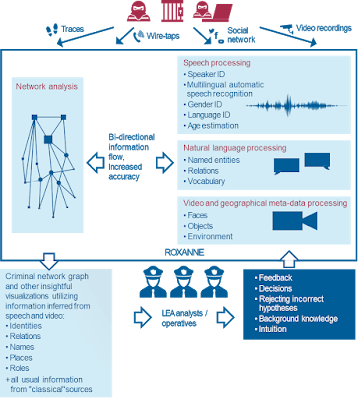
Marketed as a multiplatform analytical tool to evaluate speech and facial patterns in order to create visual mapping for authorities and identity suspects, ROXANNE is a new breed of surveillance technology in the process of development and currently being backed by both An Garda Síochána and the PSNI to bring into use. 

An acronym for Real time netwOrk, teXt, and speaker ANalytics for combating orgaNized crimE, it was announced in November the Republic’s involvement in the project currently being developed in Switzerland.

A biometrics based platform ostensibly to monitor and crack down on organised crime, an additional application of ROXANNE which its creators advertise freely is the ability to monitor those guilty of alleged hate speech and political extremism. 

A product of the EU funded Horizon 2020 to foster new surveillance technology, ROXANNE works across social media sites such as Facebook, YouTube as well as normal telecommunications platforms to identify, categorise, and track faces and voices enabling authorities to paint a more in depth picture of the network being investigated, whether it be in relation to criminal activity or those deemed politically extreme.

Enabling authorities to draw on raw data from a variety of sources and platforms in order to recognise common speech patterns, facial features, and geolocation, the end result is both to identify suspects and paint an intricate picture of the networks being put under the microscope.

China’s ‘Sharp Eyes’ Program Aims to Surveil 100% of Public Space


Medium  March 2, 2021

One of China’s largest and most pervasive surveillance networks got its start in a small county about seven hours north of Shanghai.

Technology and media entities join forces to create standards group aimed at building trust in online content

Microsoft February 22, 2021

SAN JOSE, Calif., and REDMOND, Wash. — Feb. 22, 2021 — A group of influential technology and media companies has partnered to form the Coalition for Content Provenance and Authenticity (C2PA), a Joint Development Foundation project established to address the prevalence of disinformation, misinformation and online content fraud through developing technical standards for certifying the source and history or provenance of media content.  Founding members Adobe, Arm, BBC, Intel, Microsoft and Truepic seek to establish a standardized provenance solution with the goal of combating misleading content.

C2PA member organizations will work together to develop content provenance specifications for common asset types and formats to enable publishers, creators and consumers to trace the origin and evolution of a piece of media, including images, videos, audio and documents. These technical specifications will include defining what information is associated with each type of asset, how that information is presented and stored, and how evidence of tampering can be identified.

The C2PA’s open standard will give platforms a method to preserve and read provenance-based digital content. Because an open standard can be adopted by any online platform, it is critical to scaling trust across the internet. In addition to the inclusion of varied media types at scale, C2PA is driving an end-to-end provenance experience from the capturing device to the information consumer. Collaboration with chipmakers, news organizations, and software and platform companies is critical to facilitate a comprehensive provenance standard and drive broad adoption across the content ecosystem.

Sunday, January 31, 2021

The Domestic Terrorism Prevention Act of 2021

 Organic Prepper Jan 27, 2021

After 9/11, the entire country collectively lost its mind in the throes of fear. During that time, all civil and Constitutional rights were shredded and replaced with the pages of The USA PATRIOT Act.

Almost 20 years later, the U.S. has again lost its collective mind, this time in fear of a “virus” and it’s “super mutations” and a “riot” at the capitol. A lot of people called this and to the surprise of very few, much like after 9/11, Americans are watching what remains of their civil liberties be replaced with a new bill.

The Domestic Terrorism Prevention Act of 2021

The DTPA is essentially the criminalization of speech, expression, and thought. It takes cancel culture a step further and all but outlaws unpopular opinions. This act will empower intelligence, law enforcement, and even military wings of the American ruling class to crack down on individuals adhering to certain belief systems and ideologies.

Your face could be set to replace your bank card

Sara Stewart

BBC 24 January

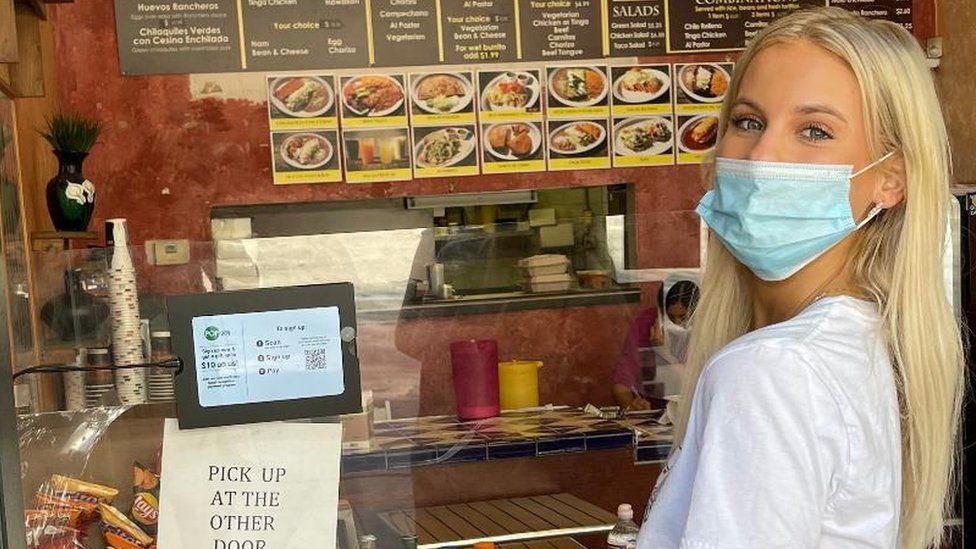
To pay she simply looks at her reflection in a small LCD screen attached to the cashier's counter. Then to add her preferred amount of tip she flashes a quick peace sign at the monitor.

The entire process takes less than five seconds, and is entirely contactless. Moreover, Ms Stewart doesn't need to carry her mobile phone or bank card with her, or show any form of identification, or even enter a pin number.

Welcome to the futuristic world of facial recognition payment. It might sound like something from a science fiction movie, but this kind of transaction is already happening millions of times a day across China's major cities.

With the technology now being introduced in the US, and other countries such as Denmark and Nigeria, are we all going to be using it within a few years' time? And, are there data security and privacy issues that we should worry about?

Ms Stewart, an 18-year-old university student, says she has no such concerns. "I feel like technology is moving so fast that people don't even think twice about using something like this.

Monday, November 30, 2020

Capella Space launched a satellite capable of taking clear radar images of anywhere in the world

X-ray vision. | Landmarks, Louvre, World

FuturismDecember 16th 2020

A few months ago, a company called Capella Space launched a satellite capable of taking clear radar images of anywhere in the world, with incredible resolution. It can even see inside some buildings, including spotting airplanes inside hangars — though only in the case of lightweight structures, the company clarified, and not dense ones like high rises or residential homes.

And unlike most of the huge array of surveillance and observational satellites orbiting the Earth, its satellite Capella 2 can snap a clear picture during night or day, rain or shine.

“It turns out that half of the world is in nighttime, and half of the world, on average, is cloudy,” CEO Payam Banazadeh, a former system engineer at the NASA Jet Propulsion Laboratory, told Futurism. “When you combine those two together, about 75 percent of Earth, at any given time, is going to be cloudy, nighttime, or it’s going to be both. It’s invisible to you, and that portion is moving around.”

On Wednesday, Capella launched a platform allowing governmental or private customers to request images of anything in the world — a capability that will only get more powerful with the deployment of six additional satellites next year. Is that creepy from a privacy point of view? Sure. But Banazadeh says that it also plugs numerous holes in the ways scientists and government agencies are currently able to monitor the planet.


Laws coming to prosecute 'hate speech' at home

A dinner party

The Guardian 4 Nov 2020 1

Proposals to prosecute individuals for hate crimes based on what they discuss in their own homes need to be more widely debated, free speech organisations have said.

The suggestion to remove the “dwelling” privacy exemption from criminal legislation is buried in a few paragraphs of the Law Commission’s 544-page consultation on hate crime published in September.

The commission said on Wednesday that it was “not intending for private conversations at the dinner table to be prosecuted as hate speech”, although that appears to be one possible consequence of the proposed change.

Until 1986, the offence of using words or behaviour intended or likely to incite racial hatred could only be committed in a public place. The scope was later expanded, but an exception remains “where words or behaviour are used or written material displayed within a dwelling, provided that they cannot be seen or heard outside.”

The proposal was spotted by the organisation Fair Cop, which campaigns against what it says is misuse of legislation to curb free speech. Sarah Phillimore, a barrister and member of the organisation, said it would encourage “state surveillance or people to inform on their friends. How else would they get the evidence? It will be like the East German Stasi security service.”

Wednesday, September 30, 2020

The European Union is planning to establish an EU-wide digital ID system

Biometric Update Sep 10, 2020

The European Union is planning to establish an EU-wide digital ID system, with a proposal due by the middle of 2021, and leaders will seek to fund it with resources from its economic recovery fund, according to Euractiv.

EU leaders will request the European Commission to develop the service to support continued integration of digital services and economies in the region. EU rules have evolved over the past several years to make national digital identity systems more interoperable through eIDAS regulation.

Leaders are expected to call for “EU-wide secure public electronic identification (e-ID) to provide people with control over their online identity and data as well as to enable access to cross-border digital services,” a draft document seen by Euractiv reads.

EC Vice-President for Digital Margarethe Vestager launched public consultations over the summer to consider revisions to eIDAS. That consultation closes on October 2. The Commission is also expected to publish its Digital Services Act by the end of the year, which will include some details on how the EU will extend its digital identification framework.

Monday, August 31, 2020

Google working on smart tattoos that turn skin into living touchpad


Telangana. 27th Jul 2020 

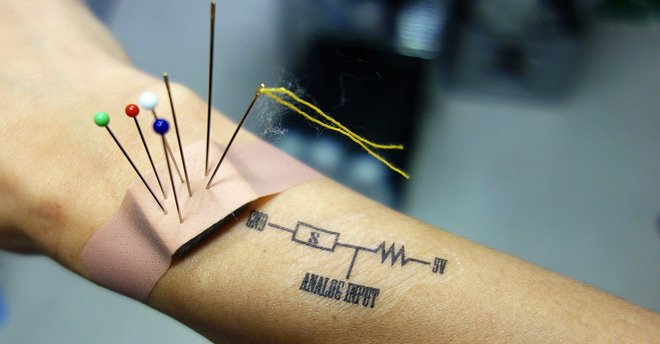
“Through a vastly reduced tattoo thickness and increased stretchability, a ‘SkinMark’ is sufficiently thin and flexible to conform to irregular geometry, like flexure lines and protruding bones.”
 
New Delhi: Google is working on smart tattoos that, when applied to skin, will transform the human body into a living touchpad via embedded sensors.
Part of Google Research, the wearable project is called “SkinMarks” that uses rub-on tattoos.
The project is an effort to create the next generation of wearable technology devices, the CNET reported citing white papers and demo videos.
Here’s how the technology works.
The sensor-driven tattoos are applied to a part of the body.
The sensors can then be triggered by traditional touch or swipe gestures, like we perform on smartphones.
There are a few gestures that are more specific to working on the skin’s surface.
“You could squeeze the area around the tattoo or bend your fingers or limbs to activate the sensors”.
The researchers at Saarland University in Germany wrote in a white paper that the benefit of using skin as an interface “is tapping into the fine motor skills that human beings naturally have”.
The project is partly funded through Google Faculty Research Awards.

Covid spikes cashless payments

Contactless card

Fresh Business 20th August 2020

Safety measures imposed by Covid-19 guidelines have resulted in a spike in cashless and digital payments in recent months, according to a new report.

Payments company Square’s findings showed that fewer than one in four payments have been made by cash during the lockdown period, around half of pre-Covid levels.

The report also identified that in parallel with this trend of businesses moving away from accepting cash, consumers and businesses are increasingly using e-commerce and mobile payments. The percentage of remote payments taken by businesses surged from 2% in January to 33% in April at the height of the pandemic. As businesses reopen, they continue to process and increased portion of payments over the phone or online without the need for physical contact, albeit not at the same levels seen at the peak of lockdown.

Square found that 31% of businesses made the move to being cashless by mid-July, up from just 8% at the start of 2020. This equates to an increase of 288%, a trend which shows little sign of abating.

The food and drink sector has led the way in going cashless – 33% of businesses in this sector were cashless, a massive increase from the start of the year when only 8% were. Similar trends have been seen in other sectors, including professional services (from 7% to 29%), retail (from 8% to 24%) and healthcare and fitness (from 15% to 29%).

Felipe Chacon, economist at Square, said: “Covid has changed the way we pay. Existing trends towards digital and cashless payments…have been greatly accelerated as a result of the pandemic.

“Business owners have had to move fast, quickly adapting to new ways of getting paid. They’ve had to balance keeping themselves and customers safe and feel safe, alongside making every sale they can.”


Sunday, May 31, 2020

Biometric payment cards are expected to play a major role in the aftermath of COVID19

Biometric payment cards to ride contactless wave, market producing extra 110M units in 2020

Biometric Update 

Biometric payment cards are expected to play a major role in a trend towards the use of multi-factor contactless transactions in the aftermath of COVID-19, ABI Research forecasts based on new research.

Contactless payment card issuances are expected to increase by 110 million more than previously expected to more than 2 billion in 2020, driven by demand for touchless interactions due to the pandemic. The new numbers mean that issuance estimates are up 6 to 8 percent from estimates made prior to the pandemic, for total year-over-year growth of 14 percent. Nearly two out of three new cards this year are expected to be contactless.

“Although the overarching trend toward contactless was well in place prior, COVID-19 will further increase the speed of contactless adoption, particularly within countries and economies where cash remains king, and usage not only being encouraged by payment ecosystem players and suppliers but also by governments and health organizations including the WHO,” explains Phil Sealy, Research Director at ABI Research.

“The way people pay for things is rapidly evolving and changing. COVID-19 has driven a significant shift in consumer spending habits spurred by economic uncertainly and a push toward the purchase of mainly essential items. There is also a surge in e-commerce whereby consumers are becoming even more heavily reliant on online retail channels to avoid crowded places to limit social interactions,” Sealy points out in the press release.

Wednesday, April 8, 2020

Kushner’s team seeks national coronavirus surveillance system


Jared Kushner
Politico 04/08/2020
White House senior adviser Jared Kushner’s task force has reached out to a range of health technology companies about creating a national coronavirus surveillance system to give the government a near real-time view of where patients are seeking treatment and for what, and whether hospitals can accommodate them, according to four people with knowledge of the discussions.

The proposed national network could help determine which areas of the country can safely relax social-distancing rules and which should remain vigilant. But it would also represent a significant expansion of government use of individual patient data, forcing a new reckoning over privacy limits amid a national crisis.

Health privacy laws already grant broad exceptions for national security purposes. But the prospect of compiling a national database of potentially sensitive health information has prompted concerns about its impact on civil liberties well after the coronavirus threat recedes, with some critics comparing it to the Patriot Act enacted after the 9/11 attacks.


Already, the Trump administration has sought to ease data-sharing rules and assure health data companies they won’t be penalized for sharing information with state and federal officials — a move driven in part by Kushner’s push to assemble the national network, according to an individual with knowledge of the decision.

“This is a genuine crisis — we have to work through it and do our best to protect people’s health,” said Jessica Rich, a former director of the Federal Trade Commission’s consumer protection bureau. “But doing that doesn’t mean we have to destroy privacy.”

Friday, February 28, 2020

EU poised to create massive transatlantic facial-recognition database, link with US

RT 22 Feb, 2020
The EU is laying the groundwork for a massive international facial recognition database that may someday hook into the one maintained by the US, according to leaked internal documents.
National police forces of 10 EU member states are calling for a legal framework to create a massive system of interlinked facial recognition databases “as quickly as possible,” a report leaked to the Intercept on Friday reveals. Austria is leading the way on the project, which was still in its early phases as of November, when the report initially circulated among EU officials.
Produced as part of a project to expand Prüm, the EU-wide database-cross-referencing system that already allows for all-at-once scanning of individual DNA, fingerprint, and vehicle registration databases, the report calls for EU legislation that would create and connect country-level facial recognition databases, potentially all the way to the US. Because the US already has a Prüm-like exchange in place with countries that are part of the Visa Waiver Program, including most EU member states, some – including the alarmed EU official who allegedly leaked the report to the Intercept – believe any future facial recognition database network would include the US by default.

Tuesday, January 21, 2020

The Hidden Uses of 5G Technology

The Hidden Military Uses of 5G Technology
Walking Times December 23, 2019
At the London Summit, the 29 member countries of NATO agreed to “guarantee the security of our communications, including 5G”. Why is this fifth generation of mobile data transmission so important for NATO?
While the earlier technologies were perfected to create ever more advanced smartphones, 5G is designed not only to improve their performance, but mainly to link digital systems which need enormous quantities of data in order to work automatically. The most important 5G applications will not be intended for civil use, but for the military domain.

The possibilities offered by this new technology are explained by the Defense Applications of 5G Network Technology, published by the Defense Science Board, a federal committee which provides scientific advice for the Pentagon –
The emergence of 5G technology, now commercially available, offers the Department of Defense the opportunity to take advantage, at minimal cost, of the benefits of this system for its own operational requirements.
In other words, the 5G commercial network, built and activated by private companies, will be used by the US armed forces at a much lower expenditure than that necessary if the network were to be set up with an exclusively military goal. Military experts foresee that the 5G system will play an essential role for the use of hypersonic weapons – missiles, including those bearing nuclear warheads, which travel at a speed superior to Mach 5 (five times the speed of sound). In order to guide them on variable trajectories, changing direction in a fraction of a second to avoid interceptor missiles, it is necessary to gather, elaborate and transmit enormous quantities of data in a very short time. The same thing is necessary to activate defences in case of an attack with this type of weapon – since there is not enough time to take such decisions, the only possibility is to rely on 5G automatic systems.
This new technology will also play a key role in the battle network. With the capability of simultaneously linking millions of transceivers within a defined area, it will enable military personnel – departments and individuals – to transmit to one another, almost in real-time, maps, photos and other information about the operation under way.
5G will also be extremely important for the secret services and special forces. It will enable control and espionage systems which are far more efficient than those we use today. It will improve the lethality of killer drones and war robots by giving them the capacity of identifying, following and targeting people on the basis of facial recognition and other characteristics. The 5G network, as a weapon of high-tech capacity, will also become the target for cyber-attacks and war actions carried out with new generation weapons.
As well as the United States, this technology is under development by China and other countries. The international disagreement concerning 5G is therefore not only commercial. The military implications of 5G are almost entirely ignored, because the critics of this technology, including many scientists, are concentrating their attention on its toxic affects for health and the environment, due to exposure to very low-frequency electromagnetic fields. This engagement is of course of the greatest importance, but must be linked to research on the military use of this  technology, financed indirectly by ordinary users. One of its greatest attractions, which favours the dissemination of 5G smartphones, will be the possibility of participating, by subscription, in war games of impressive realism in direct contact with players from all over the world. In this way, without realising it, the players will be financing the preparation for war – but this time it will be a real war.

Tuesday, December 31, 2019

Internet founder launches contract to end online abuse

SCMP   Nov, 2019
Tim Berners-Lee pictured at a data privacy conference at the European Parliament last year. Photo: AP
World Wide Web inventor Tim Berners-Lee on Monday unveiled a “Contract for the Web” to halt “misuse” by governments, companies and individuals, bringing several capital cities and tech titans like Google aboard.
“If we don’t act now – and act together – to prevent the web being misused by those who want to exploit, divide and undermine, we are at risk of squandering” its potential for good, Berners-Lee said in a statement from his World Wide Web Foundation.
Credited with laying the groundwork for the web – the universe of multimedia web pages accessible via the internet – in 1989, the computer scientist has been developing the so-called Contract for the Web since last year.
His unveiling of the final document on Monday comes as government, business and civil society leaders gather in Berlin for the four-day UN Internet Governance Forum.

Friday, December 6, 2019

While Congress subjects the nation to its carefully orchestrated impeachment drama, our civil liberties continue to die a slow, painful death


Image result for liberties at stake"
Rutherford    December 02, 2019
“It is the responsibility of the patriot to protect his country from its government.”—Thomas Paine
While Congress subjects the nation to its impeachment-flavored brand of bread-and-circus politics, our civil liberties continue to die a slow, painful death by a thousand cuts.

Case in point: while Americans have been fixated on the carefully orchestrated impeachment drama that continues to monopolize headlines, Congress passed and President Trump signed into law legislation extending three key provisions of the USA Patriot Act, which had been set to expire on December 15, 2019.

Once again, to no one’s surprise, the bureaucrats on both sides of the aisle—Democrats and Republicans alike—prioritized political grandstanding over principle and their oath of office to protect and defend the Constitution...

The legislation passed the Senate with a bipartisan 74-to-20 vote. It squeaked through the House of Representatives with a 231-192 margin. And it was signed by President Trump—who earlier this year floated the idea of making the government’s surveillance powers permanent—with nary a protest from anyone about its impact on the rights of the American people.

Spending bill or not, it didn’t have to shake down this way, even with the threat of yet another government shutdown looming.

Congress could have voted to separate the Patriot Act extension from the funding bill, as suggested by Rep. Justin Amash, but that didn’t fly. Instead as journalist Norman Solomon writes for Salon, “The cave-in was another bow to normalizing the U.S. government’s mass surveillance powers.”
That, right there, is the key to all of this: normalizing the U.S. government’s mass surveillance powers.

In the 18 years since the USA Patriot Act—a massive 342-page wish list of expanded powers for the FBI and CIA—was rammed through Congress in the wake of the so-called 9/11 terror attacks, it has snowballed into the eradication of every vital safeguard against government overreach, corruption and abuse.

The Patriot Act drove a stake through the heart of the Bill of Rights, violating at least six of the ten original amendments—the First, Fourth, Fifth, Sixth, Seventh and Eighth Amendments—and possibly the Thirteenth and Fourteenth Amendments, as well.

The Patriot Act also redefined terrorism so broadly that many non-terrorist political activities such as protest marches, demonstrations and civil disobedience are now considered potential terrorist acts, thereby rendering anyone desiring to engage in protected First Amendment expressive activities as suspects of the surveillance state.

The Patriot Act justified broader domestic surveillance, the logic being that if government agents knew more about each American, they could distinguish the terrorists from law-abiding citizens—no doubt a reflexive impulse shared by small-town police and federal agents alike.

This, according to Washington Post reporter Robert O’Harrow, Jr., was a fantasy that “had been brewing in the law enforcement world for a long time.” And 9/11 provided the government with the perfect excuse for conducting far-reaching surveillance and collecting mountains of information on even the most law-abiding citizen.

Federal agents and police officers are now authorized to conduct covert black bag “sneak-and-peak” searches of homes and offices while you are away and confiscate your personal property without first notifying you of their intent or their presence.

The law also granted the FBI the right to come to your place of employment, demand your personal records and question your supervisors and fellow employees, all without notifying you; allowed the government access to your medical records, school records and practically every personal record about you; and allowed the government to secretly demand to see records of books or magazines you’ve checked out in any public library and Internet sites you’ve visited (at least 545 libraries received such demands in the first year following passage of the Patriot Act).

In the name of fighting terrorism, government officials are now permitted to monitor religious and political institutions with no suspicion of criminal wrongdoing; prosecute librarians or keepers of any other records if they tell anyone that the government has subpoenaed information related to a terror investigation; monitor conversations between attorneys and clients; search and seize Americans’ papers and effects without showing probable cause; and jail Americans indefinitely without a trial, among other things.

The federal government also made liberal use of its new powers, especially through the use (and abuse) of the nefarious national security letters, which allow the FBI to demand personal customer records from Internet Service Providers, financial institutions and credit companies at the mere say-so of the government agent in charge of a local FBI office and without prior court approval.

In fact, since 9/11, we’ve been spied on by surveillance cameras, eavesdropped on by government agents, had our belongings searched, our phones tapped, our mail opened, our email monitored, our opinions questioned, our purchases scrutinized (under the USA Patriot Act, banks are required to analyze your transactions for any patterns that raise suspicion and to see if you are connected to any objectionable people), and our activities watched.

We’re also being subjected to invasive patdowns and whole-body scans of our persons and seizures of our electronic devices in the nation’s airports. We can’t even purchase certain cold medicines at the pharmacy anymore without it being reported to the government and our names being placed on a watch list.
It’s only getting worse, folks.

Wednesday, October 30, 2019

Google’s announcement that it has achieved “quantum supremacy”

Summit  October 2019
Google’s announcement that it has achieved “quantum supremacy” with a 53-qubit quantum computer greases the skids for all cryptocurrency and military secrets protected by cryptography to be breakable in a stunning new development that will change the world.
The Big Tech corporation’s new quantum processor took a mere 200 seconds to complete a computing task that would normally require 10,000 years on a supercomputer.
The 53-qubit quantum computer can break any 53-bit cryptography in seconds, meaning Bitcoin’s 256-bit encryption is vulnerable once Google scales its quantum computing to 256 qubits, something their own scientists say will be possible by 2022.
Modern military cryptography will also eventually be rendered obsolete given that the number of qubits in Google’s quantum computers will double at least every year, according to the report, growing at “double exponential rate,” which is even faster than Moore’s Law.
At this rate, Google will be able to break all military encryption by 2024, a frightening prospect given the company’s close ties to China.
The prospects of Google controlling such vast supercomputer power when it applies to the field of surveillance is also chilling.
“Google will rapidly come to dominate the world, controlling most of the money, all speech, all politics, most science and technology, most of the news media and all public officials,” writes Mike Adams.
“Google will become the dominant controlling authoritarian force on planet Earth, and all humans will be subservient to its demands. Democracy, truth and freedom will be annihilated.”
Read Adams’ full article for a comprehensive breakdown of what this means for the future – a beast system controlled by Google that makes Skynet look amateur in comparison, controls all secrets, communications and financial transactions.
Google has come a long way from “don’t be evil” to establishing a monopoly over technology that will literally allow them to become the most dominant force on the planet.

Tuesday, October 29, 2019

Privacy implications of FBI use of surveillance data

CPOMagazine   10/15/2019
According to a new declassified ruling from the U.S. Foreign Intelligence Surveillance Court (FISC), FBI personnel systematically abused National Security Agency (NSA) mass surveillance data in both 2017 and 2018. The 138-page ruling, which dates back to October 2018, was only unsealed 12 months later in October 2019. It offers a rare look at how the Federal Bureau of Investigation (FBI) has been abusing the constitutional privacy rights of U.S. citizens with alarming regularity. The court ruling is also a stinging rebuke to the FBI’s overreach of its ability to search surveillance intelligence databases.

Saturday, August 31, 2019

The White House will host a meeting with tech firms about “violent extremism online”

US-POLITICS-PROTEST
Aug 8, 2019   Forbes
Topline: The White House will host a meeting with tech firms on Friday about “violent extremism online” in the wake of last weekend’s mass shootings, which raised questions over the role of Web services companies in moderating hate speech on the internet.
  • White House spokesperson Judd Deere said on Wednesday that the meeting will include “senior administration officials” and representatives from a “range of companies.”
  • The announcement followed a visit by President Donald Trump to El Paso, Texas, and Dayton, Ohio, on Wednesday, where he met with survivors and first responders. His visit was met with protests, while El Paso Congresswoman Veronica Escobar condemned Trump’s “racist and hateful words & actions.”
  • The suspected El Paso gunman, who killed 22 people on Saturday when he attacked Walmart shoppers, posted a hate-filled manifesto targeting the Hispanic community on extremist message board 8chan, minutes before the attack.  
What we don’t know: Which firms will attend or whether Trump will be present.
Key background: The meeting follows a pledge by Trump to order the Department of Justice to work with state and federal agencies, as well as social media companies, to “develop tools that can detect mass shooters before they strike.”