Showing posts with label Wellness. Show all posts

Wednesday, September 30, 2020

How The 'Lost Art' Of Breathing Can Impact Sleep And Resilience

NPR May 27, 2020
Humans typically take about 25,000 breaths per day — often without a second thought. But the COVID-19 pandemic has put a new spotlight on respiratory illnesses and the breaths we so often take for granted.
 
Journalist James Nestor became interested in the respiratory system years ago after his doctor recommended he take a breathing class to help his recurring pneumonia and bronchitis.
 
While researching the science and culture of breathing for his new book, Breath: The New Science of a Lost Art, Nestor participated in a study in which his nose was completely plugged for 10 days, forcing him to breathe solely through his mouth. It was not a pleasant experience.
Nestor says the researchers he's talked to recommend taking time to "consciously listen to yourself and [to] feel how breath is affecting you." He notes taking "slow and low"breaths through the nose can help relieve stress and reduce blood pressure.
 
"This is the way your body wants to take in air," Nestor says. "It lowers the burden of the heart if we breathe properly and if we really engage the diaphragm."

Saturday, January 26, 2019

Scottish Doctors Are Now Issuing Prescriptions to Go Hiking


Adventure Journal
Scotland’s Shetland Islands are windswept and rugged, full of wide-open vistas, thousands of squawking migratory birds, awesome rock formations, and winding trails. An epic place for long, lingering walks and time spent decompressing in the joys of raw nature.

It just so happens that doctors are increasingly starting to realize time spent outdoors can be an excellent treatment for chronic health issues. So doctors in the Shetlands are now issuing “nature prescriptions” as part of an initiative to address health issues without drugs if you can imagine that.

For everything from high blood pressure to diabetes, anxiety, and depression, the medical community is learning (though lots of us have always known) that many ailments and diseases can be treated with activities like birdwatching, maybe a little kayaking, perhaps combing a beach for shells, even skipping pebbles across a slow-moving stream. Even just sitting silently in a forest, meditating (see: Japan, forest bathing).

Tuesday, April 10, 2018

Ginger May Be Stronger than Chemo for Fighting Cancer

ginger-stronger-chemo-fighting-cancer-study
Natural Blaze
We all know that ginger is a healthy addition to any meal, and that it can reduce nausea and inflammation in the human body. It’s a food with curative powers that have been highly regarded for centuries, though science is still unlocking its secrets. Coincidentally, three researchers from the Rajiv Gandhi Centre for Biotechnology in India may have just stumbled upon one of those secrets, and it will likely have far-reaching implications for the cancer treatment field.

They’ve found that there is a chemical in ginger called 6-shogaol, which has an impressive effect against breast cancer cells. It also targets cancer stem cells in particular, which are largely responsible for spreading cancer throughout the body, as well spurring the growth of tumors that have been previously treated with chemo or surgery. And best of all, it is effective at doses that aren’t harmful to noncancerous cells, unlike chemotherapy.

In fact, the researchers decided to see how 6-shogaol would stack up against a traditional chemotherapy drug known as taxol. While taxol is known to inhibit ordinary cancer cells (and cause a host of awful side effects) it still struggles to eliminate cancer stem cells. The researchers tested the taxol at a concentration that was 10,000 times higher than their 6-shogaol samples, and it still wasn’t as effective at destroying cancer stem cells as the ginger chemical.

As for how 6-shogaol works in the human body, the researchers found 6 different ways that it can inhibit cancer growth.
  • It reduces the expression of CD44/CD24 cancer stem cell surface markers in breast cancer spheroids (3-dimensional cultures of cells modeling stem cell like cancer)
  • It significantly affects the cell cycle, resulting in increased cancer cell death
  • It induces programmed cell death primarily through the induction of autophagy, with apoptosis a secondary inducer
  • It inhibits breast cancer spheroid formation by altering Notch signaling pathway through γ-secretase inhibition.
  • It exhibits cytotoxicity (cell killing properties) against monolayer (1-dimensional cancer model) and spheroid cells (3-dimensional cancer model)

Wednesday, July 27, 2016

Just one hour of physical activity a day may undo the increased risk of early death

Image result for Exercise walking
By Steven Reinberg
HealthDay Reporter
WEDNESDAY, July 27, 2016 (HealthDay News) -- Just one hour of physical activity a day -- something as simple as a brisk walk or a bicycle ride -- may undo the increased risk of early death that comes with sitting eight hours or more on a daily basis, a new study suggests.
"These results provide further evidence on the benefits of physical activity, particularly in societies where increasing numbers of people have to sit for long hours for work or commuting," said lead researcher Ulf Ekelund. He is a professor in physical activity and health at the Norwegian School of Sport Sciences in Oslo, Norway.
"Unfortunately, only 25 percent of our sample exercised an hour a day or more," he said.
The study also found that watching TV for three hours or more a day was linked with an increased risk of early death, regardless of physical activity -- except among those who were the most physically active.
However, even among those who exercised the most, the risk of premature death was significantly increased if they watched five hours of TV a day or more, the researchers added.
It's not TV, per se, that is associated with an increased risk of dying early; rather, TV is a marker for sitting and not being active, Ekelund said.
In their review of 16 previously published studies that included more than one million people, the researchers divided the participants into four groups: those who got about 5 minutes of moderate-intensity exercise a day; 25 to 35 minutes a day; 50 to 65 minutes day; and 60 to 75 minutes a day.
The increased risk of early death ranged from 12 percent to 59 percent, depending on how much exercise the participants got, the findings showed.
"Indeed, those belonging to the most active group, and who are active about 60 to 75 minutes per day, seem to have no increased risk of mortality, even if they sit for more than eight hours a day," Ekelund said.
"Sit less, move more, and the more you move the better," he suggested.
The report, which did not prove that inactivity caused early death, was published online July 27 in The Lancet.
According to Dr. David Katz, president of the American College of Lifestyle Medicine, "This important analysis fortifies the increasingly clear verdict from a large and growing body of evidence addressing physical activity and health: all movement is good movement."
Evidence is clear that moderately vigorous exercise has an array of health benefits, Katz said.
"If you don't exercise but can stand often, do. If you can't stand often but can exercise, do," he added. "Better still, do both. It's clear: all movement is good movement."
Not only does physical inactivity increase the risk of early death, it's expensive, according to another study published in the same journal issue.
In that study, researchers estimated the cost of being physically inactive based on the increased risk for type 2 diabetes, heart disease, stroke, and breast and colon cancer. In 2013 dollars, the study authors estimated that inactivity costs the United States about $28 billion annually.
"The current economic cost of physical inactivity is borne mainly by high-income countries. However, as low- and middle-income countries develop, and if the current trajectory of inactivity continues, so too will the economic burden in low- and middle-income countries who are currently poorly equipped to deal with chronic diseases linked to physical inactivity," study author Dr. Melody Ding, of the University of Sydney in Australia, said in a statement.       US News

Saturday, March 19, 2016

More doctors prescribing exercise instead of medication

BOSTON (AP) — When Dr. Michelle Johnson scribbles out prescriptions, the next stop for many of her patients is the gym, not the pharmacy.
Doctors treating chronic health problems increasingly are prescribing exercise for their patients — and encouraging them to think of physical activity as their new medication.
In one such program run by a health center in Boston’s Roxbury neighborhood, primary care physicians, internists and psychologists prescribe access to a gym for $10 a month, including free child care, classes and kids programs. Providing affordable gym access for patients ensures compliance, said Gibbs Saunders of Healthworks Community Fitness, a nonprofit gym in Dorchester that has partnered with several health care providers to help low-income residents fill their exercise prescriptions.

Life expectancy in Roxbury is 59 years — well below the national average of 78.8 years.
“Exercise is not a new medicine. It’s really an old medicine,” said Johnson, who prescribes exercise to patients at the Roxbury-based health center. “But you know, I think we’re now coming to the point of understanding how important it is.”
Monisha Long, who is morbidly obese and suffers from hypertension, got a doctor’s prescription for exercise and says she’s gotten visible and dramatic results after more than two years of regular workouts.
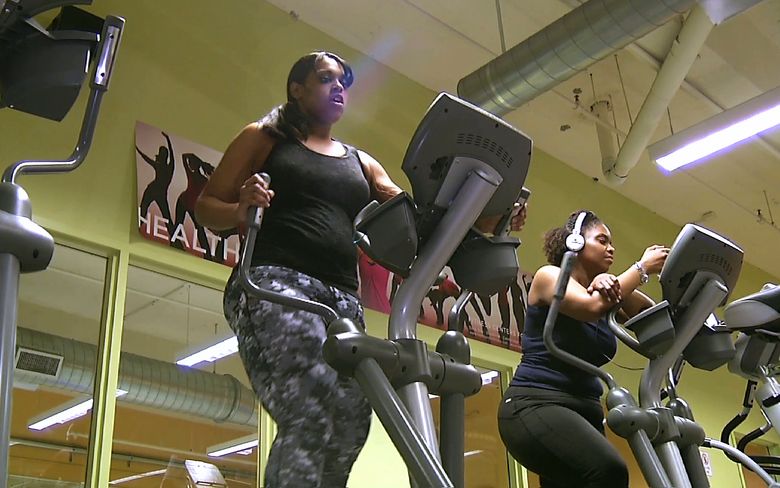
“I lost well over 150 pounds, and I’ve been keeping it off for the past couple of years,” she said after working out on an elliptical machine at Healthworks.
And Long cites other, less-visible benefits.
“I’m more energized,” she said. “As far as my energy, I feel like I’m stronger. I feel like I’m less tired. I feel like I can do almost anything now.”
People who are physically active tend to live longer and are at lower risk of heart disease, stroke, Type 2 diabetes, depression and some cancers, according to the U.S. Centers for Disease and Control and Prevention. Yet fewer than one in four American adults exercises enough to reap those benefits, the agency says.
Dr. Edward Phillips, a Boston physician, is so sold on exercise he pedals on a stationary bike that’s integrated into his office desk. Phillips said exercise is “like taking a little bit of Prozac — an antidepressant — and a little bit of Ritalin, which is a stimulant.”
“Our bodies are meant to move,” he said. “Integrating movement into our day allows the system to work optimally. Part of the system that needs to work is our brain, and includes sleep, mood, cognition, ability to concentrate.”
A prescription for exercise is a bargain, said Stephanie Dennis, who works out on a treadmill to stay fit.
“$10 a month is what? $2 a week, $2-$2.50 a week,” she said. “A lot of people pay that every day for coffee. It’s not a big sacrifice for something that you get big rewards from.”            Seattle Times