Showing posts with label The True God. Show all posts

Monday, April 26, 2021

The doctrine contrary to reason and common sense


Roswell F. Cottrell - Wikipedia

“That one person is three persons, and that three persons are only one person, is the doctrine which we claim is contrary to reason and common sense. The being and attributes of God are above, beyond, out of reach of my sense and reason, yet I believe them: But the doctrine I object to is contrary, yes, that is the word, to the very sense and reason that God has himself implanted in us. Such a doctrine he does not ask us to believe. A miracle is beyond our comprehension, but we all believe in miracles who believe our own senses. What we see and hear convinces us that there is a power that effected the most wonderful miracle of creation. But our Creator has made it an absurdity to us that one person should be three persons, and three persons but one person; and in his revealed word he has never asked us to believe it. This our friend thinks objectionable.…

“But to hold the doctrine of the Trinity is not so much an evidence of evil intention as of intoxication from that wine of which all the nations have drunk. The fact that this was one of the leading doctrines, if not the very chief, upon which the bishop of Rome was exalted to popedom, does not say much in its favor. This should cause men to investigate it for themselves; as when the spirits of devils working miracles undertake the advocacy of the immortality of the soul. Had I never doubted it before, I would now probe it to the bottom, by that word which modern Spiritualism sets at nought.…

“Revelation goes beyond us; but in no instance does it go contrary to right reason and common sense. God has not claimed, as the popes have, that he could “make justice of injustice,” nor has he, after teaching us to count, told us that there is no difference between the singular and plural numbers. Let us believe all he has revealed, and add nothing to it.” —R. F. Cottrell, July 6, 1869, Review & Herald

Monday, November 30, 2020

The Father and the Son are two, yet little short of being identical; two in individuality, yet one in spirit, and heart, and character.

Our Father in Heaven

The love of God was Christ's theme when speaking of his mission and his work. “Therefore doth my Father love me,” he says, “because I lay down my life, that I might take it again.” My Father loves you with a love so unbounded that he loves me the more because I have given my life to redeem you. He loves you, and he loves me more because I love you, and give my life for you. “A new commandment I give unto you, That ye love one another; as I have loved you.” Well did the disciples understand this love as they saw their Saviour enduring shame, reproach, doubt, and betrayal, as they saw his agony in the garden, and his death on Calvary's cross. This is a love the depth of which no sounding can ever fathom. As the disciples comprehended it, as their perception took hold of God's divine compassion, they realized that there is a sense in which the sufferings of the Son were the sufferings of the Father. From eternity there was a complete unity between the Father and the Son. They were two, yet little short of being identical; two in individuality, yet one in spirit, and heart, and character.          Youth Instructor, December 16 1897

Saturday, October 31, 2020

A knowledge of God is the foundation of all true education

Like our Saviour, we are in this world to do service for God. We are here to become like God in character, and by a life of service to reveal Him to the world. In order to be co-workers with God, in order to become like Him and to reveal His character, we must know Him aright. We must know Him as He reveals Himself. 

A knowledge of God is the foundation of all true education and of all true service. It is the only real safeguard against temptation. It is this alone that can make us like God in character. 

This is the knowledge needed by all who are working for the uplifting of their fellow men. 

Transformation of character, purity of life, efficiency in service, adherence to correct principles, all depend upon a right knowledge of God. This knowledge is the essential preparation both for this life and for the life to come.  

“The knowledge of the Holy is understanding.” Proverbs 9:10. 

Through a knowledge of Him are given unto us “all things that pertain unto life and godliness.” 2 Peter 1:3. 

 “This is life eternal,” said Jesus, “that they might know Thee the only true God, and Jesus Christ, whom Thou hast sent.” John 17:3.    Ministry of Healing pp. 409,410

Wednesday, September 30, 2020

Do you worship the mystery of Babylon (trinity) or the true God?

Revelation 17

 1Then one of the seven angels who had the seven bowls came and talked with me, saying [a]to me, “Come, I will show you the judgment of the great harlot who sits on many waters, 2with whom the kings of the earth committed fornication, and the inhabitants of the earth were made drunk with the wine of her fornication.”

3So he carried me away in the Spirit into the wilderness. And I saw a woman sitting on a scarlet beast which was full of names of blasphemy, having seven heads and ten horns.  4The woman was arrayed in purple and scarlet, and adorned with gold and precious stones and pearls, having in her hand a golden cup full of abominations and the filthiness of [b]her fornication.  5And on her forehead a name was written:

MYSTERY, BABYLON THE GREAT,
THE MOTHER OF HARLOTS
AND OF THE ABOMINATIONS
OF THE EARTH
.

6I saw the woman, drunk with the blood of the saints and with the blood of the martyrs of Jesus. And when I saw her, I marveled with great amazement. 


Revelation 14

1Then I looked, and behold, [a]a Lamb standing on Mount Zion, and with Him one hundred and forty-four thousand, [b]having His Father’s name written on their foreheads. 2And I heard a voice from heaven, like the voice of many waters, and like the voice of loud thunder. And I heard the sound of harpists playing their harps. 3They sang as it were a new song before the throne, before the four living creatures, and the elders; and no one could learn that song except the hundred and forty-four thousand who were redeemed from the earth.  4These are the ones who were not defiled with women, for they are virgins. These are the ones who follow the Lamb wherever He goes. These were [c]redeemed from among men, being firstfruits to God and to the Lamb.  5And in their mouth was found no [d]deceit, for they are without fault [e]before the throne of God.

Monday, August 31, 2020

Heavenly trio or heavenly trinity?


Loma Linda, California, August 24, 1905*

I approve of the efforts that have been made to establish our German and Scandinavian publishing work at College View. I hope that plans will be devised for the encouragement and strengthening of this work.

The whole burden of the work must not be left with our foreign brethren. Nor should our brethren throughout the field leave too heavy a load on the conferences near College View. The members of these conferences should lead out and do their best, and all should come to their assistance. The truth is to be proclaimed to all nations and kindreds and tongues and peoples.

Our German and Danish and Swedish brethren have no good reason for not being able to act in harmony in the publishing work. Those who believe the truth should remember that they are God's little children, that they are under His training. Let them be thankful to God for His manifold mercies and be kind to one another. They have one God and one Saviour; and one Spirit--the Spirit of Christ--is to bring unity into their ranks.

After His resurrection, Christ ascended to heaven, and He is today presenting our needs to the Father. "I have graven thee upon the palms of My hands," He says. Isaiah 49:16. It cost something to engrave them there. It cost untold agony. If we would humble ourselves before God, and be kind and courteous and tenderhearted and pitiful, there would be one hundred conversions to the truth where now there is only one. But, though professing to be converted, we carry around with us a bundle of self that we regard as altogether too precious to be given up. It is our privilege to lay this burden at

the feet of Christ and in its place take the character and similitude of Christ. The Saviour is waiting for us to do this.           9T p. 189

*This was written years later following the publishing of the desire of ages.

Friday, January 31, 2020

A mere profession of godliness is worthless

Image result for true vine"A mere profession of godliness is worthless. It is he that abideth in Christ that is a Christian. For “every man that hath this hope in him purifieth himself, even as he is pure.” In every clime, in every nation, our youth should cooperate with God. The only way a person can be pure is to become like-minded with God. How can we know God?—By studying his word. “And this is life eternal, that they might know thee the only true God, and Jesus Christ whom thou hast sent.”     

Of what profit is it to say pleasant things, to deplore the works of Satan, and yet at the same time to enter into the fulfillment of all his devices? This is being double-minded. “Wash ye, make you clean: put away the evil of your doings from before mine eyes, cease to do evil; learn to do well; seek judgment, relieve the oppressed, judge the fatherless, plead for the widow. Come now, and let us reason together, saith the Lord: though your sins be as scarlet, they shall be as white as snow; though they be red like crimson, they shall be as wool. If ye be willing and obedient, ye shall eat the good of the land: but if ye refuse and rebel, ye shall be devoured with the sword: for the mouth of the Lord hath spoken it.”  

There must be a cleansing of the hands, and a purifying of the double mind. “Be afflicted, and weep and mourn: let your laughter be turned into mourning, and your joy into heaviness.” It is right to be cheerful, and even joyful. It is right to cultivate cheerfulness of spirit through sanctification of the truth; but it is not right to indulge in foolish jesting and joking, in lightness and trifling, in words of criticism and condemnation of others. Those who observe such persons who make a profession of religion, know that they are deceived. They know that the hands of such professors need to be cleansed, their hearts need to be purified. They need to experience genuine repentance for sin. What have they to mourn over? They should mourn over their inclination to sin, over the danger they are in from inward corruption and from outward temptation. They should be afraid because they have so feeble a sense of the sinfulness of sin, and so little idea of what constitutes sin.  

When you truly repent of sin, you will not be satisfied to acknowledge simply that you are sinful, and let the matter rest there. Do you intend to remain sinful while life shall last? Do you mean to violate your conscience? Do you mean to do evil always? What does the Lord say to those who have had light, and yet have failed to live in accordance with it? “Therefore to him that knoweth to do good, and doeth it not, to him it is sin.” “Humble yourselves in the sight of the Lord, and he shall lift you up.” There is a repentance of sin that needeth not to be repented of. “And every man that hath this hope in him purifieth himself, even as he is pure.”  

Does this text mean that the human agent can remove one stain of sin from his soul?—No. Then what does it mean to purify himself?—It means to look upon the Lord's great moral standard of righteousness, the holy law of God, and see that he is a sinner in the light of that law. “Whosoever committeth sin transgresseth also the law: for sin is the transgression of the law. And ye know that he was manifested to take away our sin; and in him is no sin.” It is through faith in Jesus Christ that the truth is accepted in the heart and the human agent is purified and cleansed. Jesus was “wounded for our transgressions, he was bruised for our iniquities: the chastisement of our peace was upon him; and with his stripes we are healed.” Is it possible to be healed, while knowingly committing sin?—No; it is genuine faith that says, I know that I have committed sin, but that Jesus has pardoned my sin; and hereafter I will resist temptation in and through his might. “Every man that hath this hope in him [abiding in him] purifieth himself, even as he is pure.” He has an abiding principle in the soul, that enables him to overcome temptation. “Whosoever abideth in him sinneth not.” God has power to keep the soul who is in Christ, when that soul is under temptation. “Whosoever sinneth hath not seen him, neither known him.” That is, every one who is a true believer is sanctified through the truth, in life and character. “Little children, let no man deceive you: he that doeth [not professeth to do] righteousness is righteous, even as he is righteous.” “Whosoever is born of God doth not commit sin; ... because he is born of God. In this the children of God are manifest, and the children of the devil.” Now mark where the distinction is made: “Whosoever doeth not righteousness is not of God, neither is he that loveth not his brother.” “My little children, let us not love in word, neither in tongue, but in deed and in truth.”    The Youth's Instructor, February 15, 1894

The Supremacy of Christ

15Who is the image of the invisible God, the firstborn of every creature: 16For by him were all things created, that are in heaven, and that are in earth, visible and invisible, whether they be thrones, or dominions, or principalities, or powers: all things were created by him, and for him: 17And he is before all things, and by him all things consist. 18And he is the head of the body, the church: who is the beginning, the firstborn from the dead; that in all things he might have the preeminence. 19For it pleased the Father that in him should all fulness dwell; 20And, having made peace through the blood of his cross, by him to reconcile all things unto himself; by him, I say, whether they be things in earth, or things in heaven.      Colosians 1:15-20

Sunday, January 19, 2020

Is God Plural in Greek?

In the Old Testament, the most common Hebrew word for “God” is “elohim”. (Strongs 0430 Myhla ‘elohiym el-o-heem’)
It is (sometimes) used as the plural form of the singular noun (strongs 0433) hwla ‘eloah.
Trinitarians commonly make the mistake of claiming that this plural appearance of the word is “proof” of their Trinitarian doctrine.
However this claim is seriously wrong! It is an abuse of the Hebrew Grammar. We must NOT ignore the fact that although “elohim” looks plural because of its suffix “IM”, it is most often singular in its own right. To distinguish between the singular and plural uses of “elohim” you have to be able to read Hebrew and know a little bit of Hebrew grammar. (or know someone who does!) When it is mean to be understood as singular, it is accompanied by SINGULAR verbs and pronouns. And when it is meant to be understood as plural it is accompanied by PLURAL verbs and pronouns. (Hebrew is a complicated language. There are a very few instances where this rule does not apply. However these relatively rare cases do not affect our main conclusions here)
When ELOHIM is used as a proper name, or when referring to Israel's ONE God, it is treated as a singular noun.

WHEN ELOHIM IS TRANSLATED INTO GREEK
It helps to look at how “elohim” is translated into the Greek language
The Greek language doesn’t have this same “singular/plural appearance” problem.
In the Septuagint version of the Old Testament, and the Greek New Testament, when OT references to “elohim” as the ONE God of Israel are translated into Greek the word "theos" is used. “Theos" is always a SINGULAR noun. You can’t ever mistake it for plural!!
When plural “elohim” meaning (idol) “gods” is translated into Greek the plural form "thea" or "theoi" is easy to distinguish. And when elohim refers to “goddess” or goddesses”, the singular is translated by “thea”. and the plural by “theai”.

LATIN
The same happens in the Latin translations. When “elohim” refers to plural (idol) “gods” (note the lower case)  the term “deus” (singular) or “dei” (plural) is used, When it means “goddesses, “dea” (singular) or “deai” (plural) is used, while for the Christian God the Latin uses simply “Deus” (singular).
From this it ought to be clear that when the OT Hebrew “elohim” refers to the ONE God of Israel, BOTH the Greek and the Latin recognise that it is a singular noun.
There is no possible justification for claiming that it supports the doctrine of the trinity.       Allon Maxwell

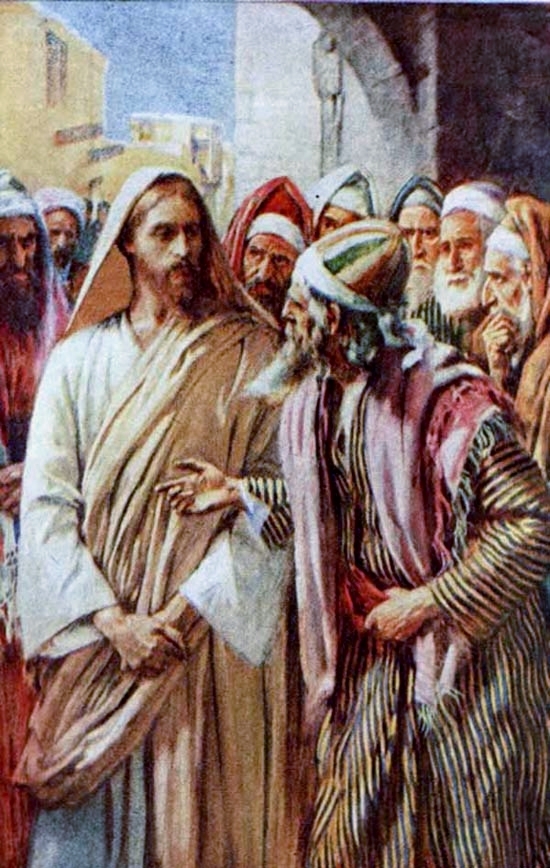
The Greatest Commandment


Image result for jesus and scribe
28And one of the scribes came, and having heard them reasoning together, and perceiving that he had answered them well, asked him, Which is the first commandment of all? 
29And Jesus answered him, The first of all the commandments is, Hear, O Israel; The Lord our God (Theos) is one Lord:  
30And thou shalt love the Lord thy God with all thy heart, and with all thy soul, and with all thy mind, and with all thy strength: this is the first commandment.  
31And the second is like, namely this, Thou shalt love thy neighbour as thyself. There is none other commandment greater than these.  
32And the scribe said unto him, Well, Master, thou hast said the truth: for there is one God; and there is none other but he:
33And to love him with all the heart, and with all the understanding, and with all the soul, and with all the strength, and to love his neighbour as himself, is more than all whole burnt offerings and sacrifices.  
34And when Jesus saw that he answered discreetly, he said unto him, Thou art not far from the kingdom of God. And no man after that durst ask him any question.        Mark 12:28-34
  

Now these are the commandments, the statutes, and the judgments, which the Lord your God commanded to teach you, that ye might do them in the land whither ye go to possess it:
2 That thou mightest fear the Lord thy God, to keep all his statutes and his commandments, which I command thee, thou, and thy son, and thy son's son, all the days of thy life; and that thy days may be prolonged.
3 Hear therefore, O Israel, and observe to do it; that it may be well with thee, and that ye may increase mightily, as the Lord God of thy fathers hath promised thee, in the land that floweth with milk and honey.
4 Hear, O Israel: The Lord our God (Elohim) is one Lord:
5 And thou shalt love the Lord thy God with all thine heart, and with all thy soul, and with all thy might.
6 And these words, which I command thee this day, shall be in thine heart:
7 And thou shalt teach them diligently unto thy children, and shalt talk of them when thou sittest in thine house, and when thou walkest by the way, and when thou liest down, and when thou risest up.     Deuteronomy 6:4


Theos : God, a god
Original Word: θεός, οῦ, ὁ
Part of Speech: Noun, Feminine; Noun, Masculine
Transliteration: theos
Phonetic Spelling: (theh'-os)
Definition: God, a god
Usage: (a) God, (b) a god, generally.

2316 theós (of unknown origin) – properly, God, the Creator and owner of all things (Jn 1:3; Gen 1 - 3).
[Long before the NT was written, 2316 (theós) referred to the supreme being who owns and sustains all things.]


Elohim, singular Eloah, (Hebrew: God), the God of Israel in the Old Testament. A plural of majesty, the term Elohim—though sometimes used for other deities, such as the Moabite god Chemosh, the Sidonian goddess Astarte, and also for other majestic beings such as angels, kings, judges (the Old Testament shofeṭim), and the Messiah—is usually employed in the Old Testament for the one and only God of Israel, whose personal name was revealed to Moses as YHWH, or Yahweh (q.v.). When referring to Yahweh, elohim very often is accompanied by the article ha-, to mean, in combination, “the God,” and sometimes with a further identification Elohim ḥayyim, meaning “the living God.”
Though Elohim is plural in form, it is understood in the singular sense. Thus, in Genesis the words, “In the beginning God (Elohim) created the heavens and the earth,” Elohim is monotheistic in connotation, though its grammatical structure seems polytheistic. The Israelites probably borrowed the Canaanite plural noun Elohim and made it singular in meaning in their cultic practices and theological reflections.   Encyclopaedia Britannica

Friday, January 17, 2020

Understanding the true meaning of the word "Elohim"


Related image
Some claim that because the word most often used for God in the Hebrew Bible is Elohim (plural for El), then God must be a trinity and hence Jesus must be God (Supreme). But this is just another deception or ignorance. The fact is that the word Elohim is used for the true God, false gods, supernatural spirits (angels) and even human leaders such as kings and judges. Thus the word Elohim can and is used to refer to a single person, and when it does, linguists call it a “plural intensive” or “plural of majesty” which denotes greatness. The Hebrew people pluralized nouns when they desired to express greatness or majesty as they did with God. So when Elohim is used of the one true God, it is called a “plural of majesty” which denotes the greatness of God, not number.

This was “only” done by the Hebrew people so in the Greek translation of the Hebrew Bible (the Septuagint, which Jesus and the apostles quoted) where Elohim refers to the true God, the word Theos is used which is not plural but singular. The same applies to the New Testament where Theos is the Greek equivalent to Elohim and once again it is not plural but singular. For example. Jesus quotes Deuteronomy 6:4 in Mark 12:29. The word Theos for God in this verse is singular, not plural. If Elohim was really a plurality of the one true God, then the New Testament writers would have used the plural of Theos also when referring to God. Instead they used the singular form every single time. And yet the plural form is used eight times in the New Testament referring to men or false gods. (John 10:34-35; Acts 7:40, Acts 14:11, Acts 19:26; 1 Corinthians 8:5; Galatians 4:8). I trust that no one will say that God is a Trinity in the Hebrew language while being one God in the Greek language.

Below are some dictionary definitions from scholars concerning the usage of Elohim as a “plural intensive,” or as many prefer, “plural of majesty” (a pluralis excellentice) or “plentitude of might.”

“The Hebrew noun Elohim is plural but the verb is singular, a normal usage in the OT when reference is to the one true God. This use of the plural expresses intensification rather than number and has been called the plural of majesty, or of potentiality.” — New International Version Study Bible, Grand Rapids: Zondervan, 1985, p. 6

“This word [elohim], which is generally viewed as the plural of eloah [Strong's #433], is found far more frequently in Scripture than either el or eloah for the true God. The plural ending is usually described as a plural of majesty and not intended as a true plural when used of God. This is seen in the fact that the noun elohim is consistently used with singular verb forms and with adjectives and pronouns in the singular.” — Theological Wordbook of the Old Testament, Vol. 1, 1980, p. 44

“The plural form of Elohim has given rise to much discussion. The fanciful idea that it referred to the trinity of persons in the Godhead hardly finds now a supporter among scholars. It is either what grammarians call the plural of majesty, or it denotes the fullness of divine strength, the sum of the powers displayed by God. Jehovah denotes specifically the one true God, whose people the Jews were, and who made them the guardians of his truth.” — Smith's Bible Dictionary 1884 pp. 331-332

So why does the fanciful idea that Elohim refers to a trinity hardly find a supporter among scholars now? Because the truth is impossible to avoid and you would only end up looking very foolish and deceived if you use this to try and prove a lie. So when you hear the argument that Elohim means God must be a trinity, then understand that there is either deliberate deception or total ignorance and such a person cannot be trusted.

As for Genesis 1:26, the pronouns are plural in the Hebrew text so it is translated, “God said, let us make man in our image, after our likeness.” Trinitarians claim that since Elohim is plural, and the pronouns are plural, God must be more than one. But Elohim refers to the one true God which only leaves the question of who is “us” in this verse. Scripture does not leave us guessing.

Ephesians 3:9 says, “God, ... created all things by Jesus Christ:” God in this verse is obviously someone other than Jesus Christ, and Hebrews 1:2 and John 1:3 says God created all things by His Son. So who is speaking in Genesis 1:26 and who is He speaking to?

God the Father said to His Son, “let us make man in our image.” Christ is “the express image” of the Father, so anyone created in the Father's image is also created in His Son's image.

“After the earth was created, and the beasts upon it, the Father and Son carried out their purpose, which was designed before the fall of Satan, to make man in their own image. They had wrought together in the creation of the earth and every living thing upon it. And now God says to his Son, “Let us make man in our image.” As Adam came forth from the hand of his Creator, he was of noble height, and of beautiful symmetry. He was more than twice as tall as men now living upon the earth, and was well proportioned. His features were perfect and beautiful. His complexion was neither white, nor sallow, but ruddy, glowing with the rich tint of health. Eve was not quite as tall as Adam. Her head reached a little above his shoulders. She, too, was noble—perfect in symmetry, and very beautiful. ” — 1SP p. 24

Saturday, December 28, 2019

All who are taught of God recognize Christ as His Son

The intrigues of sin surpass infinite conception. Every calamity, every suffering and death is an evidence, not only of the power of evil, but of the truth of the living God. Having known the truth, the Word of the living God, which abideth forever, and which through obedience gives life, man’s weakness in conforming to Satan’s ingenuity is surpassingly strange. All who are taught of God recognize Christ as His Son. All who disbelieve the known declarations of God demonstrate the popularity of sin, and are not working on the side of life and immortality which are brought to light through perfect sanctification of the truth. Unless they make a change in character, in words, and in spirit, souls will be lost.     Manuscript 139, 1903

Who is the Holy Spirit?


Image result for holy spirit
Psalms 139:7    Where can I go from Your Spirit? Or where can I flee from Your presence? 

1 Corinthians 2:11   For what man knows the things of a man except the spirit of the man which is in him? Even so no one knows the things of God except the Spirit of God.

Romans 8:9-10    But you are not in the flesh but in the Spirit, if indeed the Spirit of God dwells in you. Now if anyone does not have the Spirit of Christ, he is not His. And if Christ is in you, the body is dead because of sin, but the Spirit is life because of righteousness. 

John 14:26    But the Comforter, (parakletos) even the Holy Spirit, whom the Father will send in my name, he shall teach you all things, and bring to your remembrance all that I said unto you. 

1 John 2:1   My little children, these things write I unto you, that ye sin not. And if any man sin, we have an advocate (parakletos) with the Father, Jesus Christ the righteous.

John 14:18   I will not leave you comfortless: I will come to you.

John 16:8    And when he has come, he will convict the world of sin, and of righteousness, and of judgement.

John 16:13,14    However, when he, the Spirit of truth, has come, he will guide you into all truth; for he will not speak on His own authority, but whatever he hears he will speak; and he will tell you things to come. He will glorify me, for he will take of what is mine and declare it to you.

Galatians 3:14   That the blessing of Abraham might come upon the Gentiles in Christ Jesus, that we might receive the promise  of the Spirit through faith.


John 14:15-17  If ye love me, keep my commandments. And I will pray the Father, and he shall give you another Comforter, that he may abide with you for ever; Even the Spirit of truth; whom the world cannot receive, because it seeth him not, neither knoweth him: but ye know him; for he dwelleth with you, and shall be in you.
  
Acts 5:32   And we are his witnesses of these things; and so is also the Holy Spirit, whom God hath given to them that obey him. 

Galatians 5:22,23  But the fruit of the Spirit is love, joy, peace, longsuffering, gentleness, goodness, faith, meekness, temperance: against such there is no law.

Galatians 5:16   This I say then, Walk in the Spirit, and ye shall not fulfill the lust of the flesh.


Genesis 6:3   And the LORD said, My Spirit shall not strive with man forever, for he is indeed flesh; yet his days shall be one hundred and twenty years.

Psalm 51:11    Cast me not away from Your presence; and take not Your Holy Spirit from me.

Ephesians 4:30   And do not grieve the Holy Spirit of God, by whom you were sealed for the day of redemption
  
Luke 11:13    If you then, being evil, know how to give good gifts to your children, how much more will your heavenly Father give the Holy Spirit to those who ask Him!.

Acts 2:17,18    And it shall come to pass in the last days, says God, that I will pour out of My Spirit on all flesh; your sons and your daughters shall prophesy, your young men shall see visions, your old men shall dream dreams. And on my menservants and on my maidservants I will pour out My Spirit in those days: and they shall prophesy.

Saturday, November 30, 2019

Israel does not know the Lord


Image result for though your sins be as scarlet, they shall be as white as snow"
The vision of Isaiah the son of Amoz, which he saw concerning Judah and Jerusalem in the days of Uzziah, Jotham, Ahaz, and Hezekiah, kings of Judah.
2 Hear, O heavens, and give ear, O earth: for the Lord hath spoken, I have nourished and brought up children, and they have rebelled against me.
3 The ox knoweth his owner, and the ass his master's crib: but Israel doth not know, my people doth not consider.
4 Ah sinful nation, a people laden with iniquity, a seed of evildoers, children that are corrupters: they have forsaken the Lord, they have provoked the Holy One of Israel unto anger, they are gone away backward.
5 Why should ye be stricken any more? ye will revolt more and more: the whole head is sick, and the whole heart faint.
6 From the sole of the foot even unto the head there is no soundness in it; but wounds, and bruises, and putrifying sores: they have not been closed, neither bound up, neither mollified with ointment.
7 Your country is desolate, your cities are burned with fire: your land, strangers devour it in your presence, and it is desolate, as overthrown by strangers.
8 And the daughter of Zion is left as a cottage in a vineyard, as a lodge in a garden of cucumbers, as a besieged city.
9 Except the Lord of hosts had left unto us a very small remnant, we should have been as Sodom, and we should have been like unto Gomorrah.
10 Hear the word of the Lord, ye rulers of Sodom; give ear unto the law of our God, ye people of Gomorrah.
11 To what purpose is the multitude of your sacrifices unto me? saith the Lord: I am full of the burnt offerings of rams, and the fat of fed beasts; and I delight not in the blood of bullocks, or of lambs, or of he goats.
12 When ye come to appear before me, who hath required this at your hand, to tread my courts?
13 Bring no more vain oblations; incense is an abomination unto me; the new moons and sabbaths, the calling of assemblies, I cannot away with; it is iniquity, even the solemn meeting.
14 Your new moons and your appointed feasts my soul hateth: they are a trouble unto me; I am weary to bear them.
15 And when ye spread forth your hands, I will hide mine eyes from you: yea, when ye make many prayers, I will not hear: your hands are full of blood.
16 Wash you, make you clean; put away the evil of your doings from before mine eyes; cease to do evil;
17 Learn to do well; seek judgment, relieve the oppressed, judge the fatherless, plead for the widow.
18 Come now, and let us reason together, saith the Lord: though your sins be as scarlet, they shall be as white as snow; though they be red like crimson, they shall be as wool.
19 If ye be willing and obedient, ye shall eat the good of the land:
20 But if ye refuse and rebel, ye shall be devoured with the sword: for the mouth of the Lord hath spoken it.                Isaiah 1:1-20